Therapist websites
GDPR Compliant Website for Therapists: A UK Checklist
What actually makes a therapist website GDPR compliant: cookies, your enquiry form, third-party tools and where your data ends up being stored.
On this page9 sections
A therapist website usually gets GDPR attention for the wrong reason: whether the practice is compliant, meaning client notes, retention periods and ICO registration. Our guide to GDPR for therapists covers all of that. But having a genuinely GDPR compliant website is a separate job, because the site itself, before a single client record even exists, is doing its own data processing the moment someone lands on it: cookies fire, a contact form collects an enquiry, a booking widget or chat tool loads from someone else's server. That's where a lot of otherwise careful practices quietly fall short.
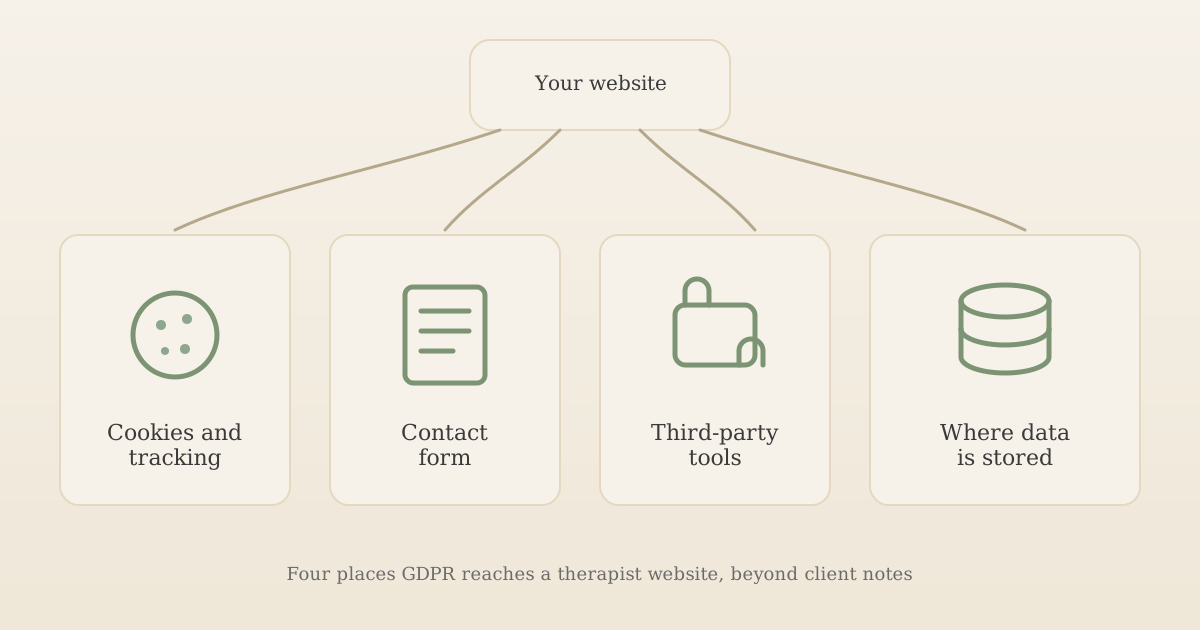
This guide walks through the four places GDPR actually reaches a UK therapist website, in plain terms, so you can check your own site rather than rely on a generic small-business checklist that doesn't account for what makes a therapy enquiry different.
Key takeaways:
- Your website triggers its own GDPR and PECR obligations, separate from how you handle client session notes.
- Cookies and third-party embeds (booking widgets, video, chat, analytics) need consent before they load, not just a mention in a privacy policy.
- A consent checkbox isn't automatically required on a simple enquiry form, but a message field that invites someone to describe their situation needs extra care.
- Where your website's tools actually store data matters. Many mainstream tools are covered for international transfers, but it isn't automatic.
Important: This is a practical overview, not legal, tax, regulatory or professional advice. Data protection law applies to your specific circumstances, and this article can't account for every variation. Check current ICO guidance and get independent advice if you're unsure.
Why your website has its own GDPR obligations
It's easy to think of GDPR as something that starts once a client has actually booked in, but your website is processing personal data from the first visit. A cookie that logs a visitor's device, an enquiry form that captures a name and a private message, an embedded booking calendar that talks to a third party's servers: each of these is a data processing activity you're responsible for, regardless of whether you built the tool yourself or dropped in a plugin.
None of this needs to be complicated. It needs to be deliberate: know what your site actually does, check the handful of things below, and fix what's missing.
Cookies and other tracking on your website
Cookies and similar tracking technologies (pixels, local storage used for tracking) are governed by the Privacy and Electronic Communications Regulations (PECR), not just GDPR itself. The ICO's guidance on storage and access technologies is clear that anything beyond strictly necessary cookies, which covers analytics, embedded video and marketing pixels, needs a visitor's consent before it's set, not retrospective disclosure in a privacy policy.
In practice, that means:
- Nothing non-essential loads before consent. Google Analytics, a Meta pixel, or a third-party chat widget shouldn't fire the moment your page loads, only after a visitor accepts.
- Accepting and declining need to be equally easy. A banner with a prominent "Accept" button next to a buried "Manage preferences" link isn't a genuine choice in the ICO's own terms.
- A cookie policy needs to actually list what you use, not just say "we use cookies to improve your experience."
Most website builders and CMS platforms offer a consent banner plugin; the mistake worth checking for is one that's installed but not actually blocking scripts until consent is given, which is common and defeats the point.
Your contact and enquiry form
This is the part of a therapist website that most generic GDPR advice gets wrong, because it treats every enquiry form the same way.
For an ordinary "get in touch" form, the ICO's own guidance on legitimate interests confirms that most businesses can rely on legitimate interests as their lawful basis, not consent, since you're responding to someone who contacted you first. You don't need a mandatory tick-box just to receive an enquiry. What you do still need, under the right to be informed, is a clear, easy-to-find privacy notice explaining what happens to the information once it's submitted.
Two situations change this:
- If the same form also signs someone up to marketing emails or a newsletter, PECR requires consent for that specific purpose, separately from however you justify holding the enquiry itself.
- If your form's free-text message field could reasonably capture special category data. A general "how can we help?" box invites exactly that: a visitor might describe anxiety, a bereavement, or a diagnosis before you've had a single conversation with them. Health data is special category data, so processing it needs both an ordinary lawful basis and a separate Article 9 condition, almost always explicit consent. A short line near the message field, making clear what will happen to anything they choose to share, does the practical work here.
Third-party tools and embeds
A booking widget, a video call embed, a live chat bubble, a payment processor: each of these is a separate business you've invited onto your site, and each one makes its own data-handling decisions the moment it loads.
For each third-party tool on your site, it's worth confirming:
- What it collects. A chat widget might log a visitor's IP address and browsing history across your site, not just the messages they type.
- Whether it sets cookies before consent. Embedded YouTube video is a common culprit: the standard embed can set cookies on load, whereas most platforms offer a "privacy-enhanced" or consent-gated embed mode that doesn't.
- Where it's named. Your privacy policy should list the actual tools you use, not a generic category like "third-party services."
This overlaps with the wider question of what your website should include in the first place; see our guide to what a therapist website should include if you're still deciding which tools and pages to build in.
Where does your website's data actually go?
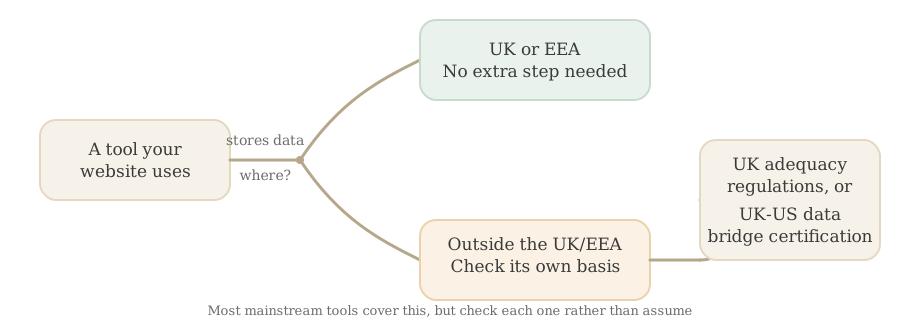
Most UK therapists don't think about where their booking system, email provider or hosting actually stores data, and most of the time it doesn't matter. It starts to matter when a tool stores or processes data outside the UK, which UK GDPR treats as a "restricted transfer" requiring its own legal basis.
The ICO's January 2026 guidance, updated following the Data (Use and Access) Act 2025, sets out how to check this. In short, a transfer outside the UK is generally fine if the receiving country has UK adequacy regulations, or if the specific provider is self-certified under the UK Extension to the EU-US Data Privacy Framework, often called the UK-US data bridge. Many mainstream US-based tools, from email marketing platforms to video conferencing, are certified under this. The mistake is assuming a well-known brand automatically qualifies rather than checking that specific tool's own privacy or trust page.
Your privacy policy: what it needs to actually say
A privacy policy isn't a formality to publish once and forget. For a UK therapist website, it should:
- Name the actual tools you use (booking system, email provider, analytics, hosting), not generic categories.
- State your lawful basis for the enquiry form, and separately for any marketing sign-up.
- Acknowledge that session-related data, once someone becomes a client, is special category health data, and link through to fuller detail if you keep a separate client-facing privacy notice.
- Include the complaints route direct to you, a duty introduced by the Data (Use and Access) Act 2025, alongside the existing right to complain to the ICO.
Our fuller guide to GDPR for therapists covers the practice-wide version of this, including ICO registration and retention periods; this section is specifically about what your website's privacy policy needs to cover, which is narrower but still easy to leave generic.
Is your website GDPR compliant? A quick self-audit
| Check | What "compliant" looks like |
|---|---|
| Cookies | Nothing non-essential loads before consent; accept and decline are equally easy |
| Contact form | A visible privacy notice; consent only where PECR or special category data genuinely requires it |
| Message field | A short line about what happens to anything sensitive a visitor chooses to share |
| Third-party embeds | Each one named in your privacy policy; non-essential ones gated behind cookie consent |
| Data location | You know, tool by tool, where data is actually stored and whether a transfer check applies |
| Privacy policy | Names your actual tools, not generic categories; includes the direct-complaint route |
If your website was built on a platform with reasonable defaults, some of this may already be handled; our comparison of website builders against a custom or done-for-you website is worth reading if you're still choosing a platform, since how much of this is done for you varies a lot between them.
Frequently asked questions
Do I need a consent checkbox on my therapist website's contact form?
Not automatically. For a simple 'get in touch' enquiry, most UK businesses rely on legitimate interests rather than consent as the lawful basis, since you're responding to someone who contacted you first. The exception is PECR: if the same form signs someone up to a newsletter or marketing emails, consent becomes mandatory for that specific purpose regardless. There's also a therapy-specific wrinkle a generic small-business guide won't mention: if your message field could reasonably capture special category data, for example someone describing a mental health condition before you've even spoken, you need an Article 9 condition too, most commonly explicit consent, not just an Article 6 lawful basis.
Does embedding Calendly, Zoom or a booking widget on my website affect GDPR compliance?
Yes. Any third-party tool that loads on your site, whether that's a booking calendar, live chat widget or embedded video, can set cookies or send data to that provider's own servers, and that counts as your processing decision even though you didn't build the tool. Check each tool's own privacy and data processing terms, name it in your privacy policy, and where it sets non-essential cookies, which most embedded video and many chat widgets do, gate it behind the same cookie consent as your analytics rather than letting it load automatically.
Is a free privacy policy generator enough for a therapist website?
It's a reasonable starting point but rarely enough on its own. A generic template usually won't name the specific tools you actually use (your booking system, email provider, analytics, hosting), won't reflect that therapy notes are special category health data, and won't mention the newer duty to let clients complain to you directly, introduced by the Data (Use and Access) Act 2025. Use a generator for the first draft, then edit it so it actually matches your setup rather than publishing it unedited.
Does my website's data need to stay in the UK?
No, but if a tool you use stores or processes data outside the UK, that's a 'restricted transfer' under UK GDPR and needs its own legal basis, most commonly that the receiving country has UK adequacy regulations, or the provider is self-certified under the UK Extension to the EU-US Data Privacy Framework (sometimes called the UK-US data bridge). Many mainstream US-based tools are certified, but it isn't automatic just because a brand is well known. Check the specific tool's own privacy or trust page rather than assuming.
Start with what's actually loading on your site
The fastest way to make progress is to open your own website in a private browser window and watch what loads before you click anything. If analytics or a chat widget fires immediately, that's your first fix. Then work through the contact form, your embedded tools, and finally your privacy policy's wording, in that order, since each one builds on the last.
This is one part of a wider practical setup; if you haven't yet worked through the basics of starting a UK private practice, our guide to setting up a private therapy practice covers the foundations alongside this.
A website that's GDPR compliant from the start
UpTopWeb builds calm, professional websites for counsellors and therapists with consent-gated cookies, a properly scoped contact form and clear third-party disclosures already built in.
Get a free website