Therapist websites
What Should a Therapist Website Include?
The pages, trust signals and practical details a therapist or counsellor website needs, from your homepage and fees to accessibility and GDPR.
On this page13 sections
A therapist website has one job before any other: help a person who is possibly anxious, unsure or in distress work out, in under a minute, whether you're the right therapist for them and how to get in touch. Everything else (design, SEO, blog posts) sits in service of that.
This guide sets out the pages, trust signals and practical details a UK therapist or counsellor website should include, and why each one matters to a prospective client reading it for the first time.
Key takeaways:
- A therapist website needs a small set of essential pages: homepage, about, services, fees and contact, at minimum.
- Trust signals (professional body membership, insurance, and how you handle client data) matter as much as design.
- Accessibility and a clear privacy policy aren't optional extras; they affect who can use your site and what UK law expects of you.
- If you're still setting up your practice more broadly, see our guide to starting a private therapy practice in the UK first.
- This article focuses on what to include; for the bigger picture — design, SEO and AI search, pricing and real examples — see our complete guide to websites for therapists.
Important: This is a practical overview, not legal, tax, regulatory or professional advice. Data protection and professional-body advertising rules can vary by registration and change over time. Check the guidance that applies to your own practice before publishing your site.
1. A homepage that answers the first three questions
A visitor decides whether to keep reading within seconds. Your homepage should make three things obvious without scrolling far:
- Who you help (adults, couples, children, a specific issue or approach)
- Where you work (a town or region, online, or both)
- How to take the next step (an enquiry form, a phone number, a "book a call" link)
Your qualifications and a long biography belong on the about page, not the homepage. Lead with the client's situation, not your CV.
2. An about page that builds trust in you specifically
The about page is where a prospective client checks whether you feel like the right fit as a person, not just a service. Include:
- Your name, professional title and qualifications
- Your therapeutic approach, explained in plain English rather than jargon
- Relevant experience, without needing to list every course you've taken
- A recent, warm, professional photo: clients consistently say a real photo makes a website feel trustworthy
Keep it honest and specific. A vague "I help people become their best selves" tells a reader nothing; a sentence like "I work with adults experiencing anxiety and low mood, using an integrative approach" does.
3. Service pages that answer "can you help with my specific issue?"
Rather than one long list of every issue you've ever worked with, group your services into a small number of clear pages or sections, for example anxiety, relationships, bereavement, or work with a specific client group. Each one should briefly explain what the issue looks like, how you work with it, and what a first session involves.
This also gives search engines something specific to match against a real search, such as "bereavement counsellor in Bristol", rather than a single generic services list.
4. A fees page that removes the awkwardness of asking
Cost is one of the most common reasons a potential client hesitates to make contact. State your session fee (or fee range) clearly, along with:
- Session length
- Whether you offer a free introductory call, and what it involves
- Your cancellation policy
- Whether you offer any reduced-fee spaces, and how those are allocated
If your pricing genuinely varies too much to publish a single number, explain what it depends on rather than leaving the page blank. "Contact me for fees" reads, to many clients, as an invitation not to ask. If you haven't settled on a fee yet, our guide to setting therapy fees that work for your practice covers how to work backwards from the income you need.
5. Trust signals that show you're a safe, legitimate choice
Because therapy involves sensitive personal information and a vulnerable moment for many clients, trust signals matter more on a therapist website than almost any other type of small business site. Three worth including clearly, usually near your credentials or in the site footer:
- Professional body membership: your registration or accreditation, ideally linking to your live entry on the register
- Insurance: a simple statement that you hold professional indemnity (and public liability, if you see clients in person)
- How you handle client data: a link to your privacy policy, and, if relevant, a note on how session notes are stored
Be careful with client testimonials specifically. Professional bodies don't agree on this: UKCP's Code of Ethics and Professional Practice is explicit, clause 13 states members must "not make any claims which you cannot demonstrate to be true or include testimonials from clients in any advertising." BACP's Ethical Framework doesn't set an equivalent outright ban, but does require confidentiality, client autonomy and trust to be protected in anything you publish, and a revised Ethical Framework becomes mandatory for BACP members from 3 November 2026, so it's worth rechecking guidance around that date. Whichever body you're registered with, check its current position before including any testimonial, and prioritise consent over persuasion if you do. The same confidentiality concern applies to a public Google review, not just a testimonial you publish yourself; our local SEO checklist for therapists covers getting genuine reviews without breaching Google's rules or your professional body's.
6. A contact or booking page with almost no friction
However someone reaches your site (Google, a directory, a referral), the contact page is where interest either converts or evaporates. Reduce friction by:
- Offering more than one way to get in touch (form, email, phone) where you're able to manage that
- Being specific about response times ("I usually reply within one working day")
- Explaining what happens after someone gets in touch, so the process feels less uncertain
If you offer a free introductory call, treat it as a genuine first step in the client journey, not an afterthought: say clearly how long it lasts and what it's for.
7. A short, genuinely useful FAQ page
A focused FAQ page answers the practical questions people are too unsure to ask directly: What happens in a first session? Is everything confidential? Do you offer online sessions? What if I need to cancel? This also gives you a natural home for the FAQ structured data search engines can use to show your answers directly in results.
8. Accessibility, so the site actually works for everyone who needs it
A therapist website that's hard to read or navigate excludes exactly the people who may need support most, including people using screen readers, older adults, and anyone reading it during a period of high stress or low concentration. At minimum, aim for:
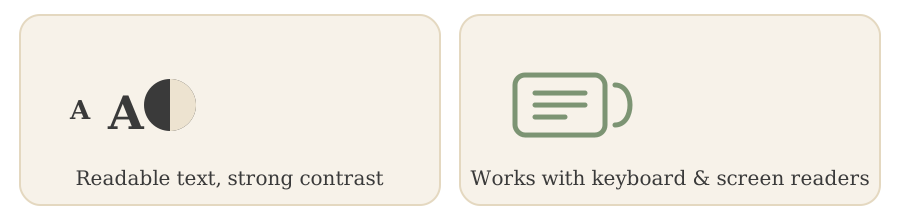
- Body text large enough to read comfortably, with strong colour contrast
- Content that makes sense with images turned off (meaningful alt text where it matters)
- A site that's fully usable by keyboard alone, for anyone who can't use a mouse or trackpad
GOV.UK's introduction to making a service accessible is a clear, non-technical starting point if you're briefing a designer or checking your own site. For the fuller picture, including what UK law actually requires and a checklist you can run yourself, see our guide to website accessibility for therapists.
9. The basics that help clients find you on Google
Your website content itself is part of how search engines decide who to show for a given search. Use natural, specific language that matches how a real client would search, such as "online anxiety counselling for adults", rather than dense keyword lists, and keep a Google Business Profile up to date if you see clients in person or are eligible for one, with the same practice name, address or service area and contact details as your website.

This is a large enough topic to deserve its own treatment; if you want the fuller picture on structuring pages and technical basics for search, see our guide to SEO for therapists.
10. A privacy policy that meets UK GDPR expectations
If your website has a contact form, booking system, analytics or a newsletter sign-up, you are processing personal data, and UK GDPR applies to you as much as to any other organisation. Your privacy policy should plainly explain what you collect, why, how long you keep it, and who a visitor can contact with questions or a complaint. The ICO's guide to how to write a privacy notice and what goes in it sets out exactly what to include, and is the most reliable place to check current requirements, since guidance is updated periodically.
This sits alongside, not instead of, your separate responsibilities for how you store client notes and session records once someone becomes a client, which is a broader practice-management question, not just a website one. See our guide to GDPR for therapists for how that applies to client records, ICO registration and data retention, or our GDPR compliant website checklist if you want the fuller walkthrough of cookies, your contact form and third-party tools specifically.
Therapist website checklist
Before you consider your site finished, check it has:
- A homepage that states who you help, where, and how to get in touch
- An about page with your qualifications, approach and a real photo
- Clear service or specialism pages
- A fees page with session cost, length and cancellation policy
- Visible trust signals: professional body membership, insurance, data handling
- A low-friction contact or booking page
- A short, genuinely useful FAQ page
- Baseline accessibility: readable text, strong contrast, full keyboard support
- An accurate, matching Google Business Profile, if applicable
- A clear, current privacy policy
Frequently asked questions
What pages should a therapist website include?
Most therapist websites need a homepage, an about page, one or more service pages, a fees page, a contact or booking page, and often a short FAQ page. Smaller practices sometimes combine fees and FAQs into one page rather than building six separate pages.
Should a therapist website include client testimonials?
Check your professional body first. UKCP's Code of Ethics and Professional Practice explicitly prohibits including client testimonials in any advertising material. BACP's Ethical Framework doesn't set an equivalent blanket ban but does require confidentiality, client autonomy and trust to be protected in anything you publish. Whichever body you're registered with, never publish a testimonial without explicit, informed consent that doesn't compromise confidentiality.
Does a therapist website need a privacy policy?
Yes. If your site has a contact form, booking system, analytics or newsletter sign-up, you're processing personal data and need a clear privacy policy explaining what you collect, why, and how long you keep it, in line with UK GDPR.
Start with the essentials, then refine
You don't need every page perfect before you launch. Start with the essentials (a clear homepage, an honest about page, your fees, and an easy way to get in touch), then refine your content, accessibility and search visibility as your practice grows.
If you're earlier in the process and haven't set up the rest of your practice yet, our guide to setting up a private therapy practice in the UK covers qualifications, insurance, fees and client records alongside the website itself. And if you're weighing up how to budget for the site itself, see our breakdown of how much a therapist website costs across DIY builders, freelancers and done-for-you services, or our comparison of website builders against a custom or done-for-you website if you're not yet sure which route fits. If you're still deciding whether you need one at all, do therapists need a website? compares a website against a directory listing and social media.
Get a website built around what clients actually need
UpTopWeb builds calm, professional websites for counsellors and therapists, with the essential pages, trust signals and accessibility already built in.
Get a free website