Therapist websites
How to Write Therapist Website Copy (With Before-and-After Examples)
Rewrite your therapist website in plain, warm words that help the right client get in touch, with worked before-and-after examples and the UK claims rules.
On this page8 sections
A thoughtful design makes a first impression, and the words do the rest. Therapist website copy is what answers a visitor's real questions, and it often gets written for the wrong reader: a supervisor, a training panel, or a vague "everyone", rather than the one person who's searching late at night and trying to work out whether you could help them. This guide is for UK counsellors, psychotherapists and other talking therapists writing (or rewriting) their own website. It covers a handful of plain rules, worked before-and-after rewrites for each of the main pages or sections, the claims line UK advertising rules and professional bodies draw, and how to write the page titles and meta descriptions Google shows in search results.
Important: This is a practical overview, not legal, regulatory or professional advice. Advertising rules and professional body guidance change over time and vary by registration body. Check the current guidance from the ASA and your own professional body before publishing claims about what your therapy can do.
Key takeaways:
- Write for one prospective client reading on their phone, not for your peers. Lead with who you help and how, then the practical details.
- Swap training language ("integrative, relational, person-centred") for what a session actually feels like, and keep the modality names for your about page or section.
- Describe what you work with, not what you'll cure. The ASA treats promises of outcomes for mental health conditions as claims that need robust evidence.
- Say the practical things plainly: fee, session length, where, when, and what happens after someone gets in touch.
- Give every main page its own page title and meta description, written for a person, not stuffed with keywords.
Why therapist website copy deserves as much care as the design
A prospective client usually lands on your site with one question: "could this person help me?" They're often anxious, sometimes reading in a spare moment on a phone, and comparing you with two or three other therapists in other tabs. A design that feels distinctive and calm, rather than another template, earns their attention and a sense of trust. The words then need to carry that through: who you help, how you work, what it costs and how to get in touch. If the first thing they read is a paragraph about your training, they have to work to find out whether you're right for them, and some won't.
Our guide to what a therapist website should include covers which pages or sections you need and what belongs in each. This post is the next step: once they exist, what do you actually write in them?
Five plain rules for therapist website copy
These five rules do most of the work. The before-and-after examples below apply each of them.
- Write to one person. Picture a specific kind of client you work well with and write to them directly, as "you". Copy written for everyone ends up speaking to no one.
- Answer first, explain second. Put the direct answer (who you help, what it costs, how to start) in the first sentence of each section, then add the detail underneath. Plenty of visitors skim, so the first line has to carry the answer on its own.
- Use their words, not your training's. Clients search for "help with anxiety" or "someone to talk to after a bereavement", not "integrative relational therapy". Keep modality names, but explain them.
- One idea per paragraph, short sentences. Long, clause-heavy paragraphs are hard to read on a phone and harder still for someone who's distressed. Short paragraphs also help with website accessibility, since plain, well-structured text works better for screen reader users and people with cognitive or reading difficulties.
- Be honest about the practical things. Fee, session length, availability, location, online or in person, and what happens next. Leaving them out makes a visitor do the work of asking, at the point they may find reaching out hardest.
Before and after: rewriting the pages or sections that matter most
Whether your site is several pages or one scrolling page split into sections, the same principles apply. The examples below are invented for illustration, but each "before" is a pattern that turns up on a lot of real therapist websites. Adapt the structure, not the exact words, since the point is for your site to sound like you.
The top of your homepage
The first screen of your homepage is usually a few pieces working together: the main heading, an opening sentence or two underneath, and sometimes short labels above the heading or a line naming where you work. Write them as one unit, not separate bits of copy. There's more than one good way to split the work between them, so here are two.
Before:
Heading: "Welcome to my website"
Opening line: "I am an integrative, relational practitioner drawing on person-centred, psychodynamic and CBT modalities."
After, option 1 (a warm heading):
Label above the heading: "Counselling in Headingley, Leeds, and online"
Heading: "Somewhere steady to talk things through"
Opening line: "I work with adults who feel stuck, anxious or overwhelmed and want to make sense of it, at a pace that feels right for them."
After, option 2 (a descriptive heading):
Heading: "Counselling in Leeds for anxiety, stress and life changes"
Opening line: "A steady, unhurried space for adults who want to make sense of what they're feeling. I see clients in Headingley and online."
"Welcome to my website" uses the most-read line on the page to say nothing, and the "before" opening line is written for other therapists rather than for someone looking for help. Both "after" versions fix that; they just divide the job differently.
In option 1, the heading does the emotional work, the label covers what and where, and the opening line says who you work with in everyday words. It gives the site a distinctive, human voice from the first line. In option 2, the heading says plainly what you offer and where, which is the kind of phrase people type into Google, and the opening line brings the warmth. A descriptive heading gives search engines, and anyone skimming, one more clear signal of what the page is about, so it can suit a practice that's relying heavily on local search.
Neither is the right answer for everyone. A warm heading can still do well in search when the page title, a label and the opening lines say what and where, and a descriptive heading can still feel personal when the line beneath it has warmth. You can also combine them, with a descriptive heading and a warm subheading or the other way round. Whichever you choose, don't repeat the same information across the heading, labels and opening line: each should add something.
Together, those few lines are your positioning sentence, which our guide on how to market yourself as a therapist walks through in more detail. Once you have it, use it on your homepage, directory listing and Google Business Profile in roughly the same words.
Your about page or section
Before: "I hold a Level 4 Diploma in Therapeutic Counselling and am a registered member of the BACP. I draw on person-centred, psychodynamic and CBT approaches, tailoring my integrative practice to each client's needs."
After: "In our sessions, I'll mostly listen, and help you notice patterns in how you think and feel that are hard to see on your own. Sometimes that means looking back at where those patterns came from; sometimes it means trying practical tools for the week ahead. You set the pace. I'm a registered member of the BACP, and I trained for four years before starting private practice."
Both versions are honest, but the "after" leads with what a client will actually experience, then gives the credentials as reassurance rather than as the headline. Keep your full qualifications, your membership number and a link to your professional body's register close by: they matter for trust, they just work best as reassurance alongside the description of how you work.
Your "how I can help" page or section
Before: "I treat anxiety, depression, trauma, OCD, eating disorders, addiction, relationship issues, stress, grief, low self-esteem and more. Counselling can transform your life."
After: "I work with adults experiencing anxiety and stress, grief and loss, and difficulties in relationships. If you're not sure whether what you're going through is something I can help with, get in touch and we can talk it through. If it isn't, I'll try to point you towards someone better placed."
Listing the areas you work with is genuinely useful: it's how many people check whether you're a fit. The problems in the "before" are the open-ended "and more", which makes the list feel like it covers everything rather than what you're experienced in, and "treat" plus "transform your life", which edge into outcome claims that UK advertising rules take seriously (see the claims section below). The "after" names the areas you genuinely work with, uses "work with" rather than "treat", and is honest about the limits. Grouping related issues, or adding a line of context to each, helps a visitor recognise themselves.
Your fees page or section
Before: "Please get in touch to discuss fees."
After: "Sessions are 50 minutes and cost £60. I offer a small number of reduced-fee places for students and people on a low income: just ask. I need 48 hours' notice to cancel or move a session without charge." (Figures invented for illustration.)
A bare "get in touch" adds a step and a small moment of awkwardness for someone who may already find reaching out hard. If you have a set fee, state it with the session length and your cancellation terms. If you work on a sliding scale, that's fine too: say so, explain briefly how it works, and show any fixed fees, such as a first assessment session, so a visitor has a starting point before they enquire. If you haven't settled on a figure yet, our guide to how much counsellors should charge covers how to work one out.
Your contact page or section
Before: "Please use the form below to contact me."
After: "You can email me directly or use the short form. I will respond during my working days and we can arrange a 15-minute introductory conversation."
The "after" gives two ways to get in touch, sets a realistic expectation for when you'll reply, and tells someone what the first step actually is, so reaching out feels less like a leap into the unknown. Keep the form itself short (name, email, how they'd like you to reply and a brief message is plenty), which also keeps unnecessary sensitive information out of your inbox and helps with the GDPR side of your website's contact form. Many therapists also add a short, separate note that their practice isn't an emergency service, with where to go for urgent help.
The claims line: what UK rules expect from your website copy
Your website is advertising, so the UK advertising rules in the CAP Code apply to it, alongside your professional body's ethical framework. Three points cover most of what matters for therapist website copy.
Describe what you work with, not what you'll fix. The ASA's guidance on mental health treatment claims says conditions such as depression and anxiety need particular care in advertising, and that claims to "cure", "heal" or "restore" someone from a condition are unlikely to be acceptable without robust evidence. The same guidance gives wording about clients finding therapy helpful for their mood, rather than treating a named condition, as the kind of claim that's more likely to be acceptable. In practice, "I work with people experiencing anxiety" describes your practice; "I'll cure your anxiety for good" promises an outcome you can't guarantee.
Be accurate about your qualifications and experience. The BACP Ethical Framework (good practice point 45) says that whenever members communicate their qualifications, professional experience and working methods, they will do so accurately and honestly. That rules out the small inflations that creep into website copy: "accredited" when you're registered, "specialist" after a single CPD day, or a qualification you're still training towards written as if it's complete. Note that BACP's updated Ethical Framework becomes mandatory on 3 November 2026 (as checked on 23 September 2026), so recheck the current wording then.
Check your body's rules before adding testimonials. Professional bodies don't agree here. UKCP's Code of Ethics and Professional Practice bans client testimonials in advertising material, while BACP sets no equivalent outright ban but still expects confidentiality and trust to be protected. Good copy doesn't need them: a clear description of how you work usually does more for a hesitant reader than a short, anonymous quote.
Page titles and meta descriptions for a therapy website
Every page has two bits of copy most visitors never see on the page itself: the page title (shown as the clickable headline in Google's results and on the browser tab) and the meta description (a short summary Google may show underneath). They're worth a few minutes per page because they're often the first words of yours a prospective client reads. If your site is one scrolling page, you have one title and one description, so make them cover who you help, where, and how.
Page titles. Make each one unique and lead with what the page is about and where: "Counselling in Headingley, Leeds | Sam Taylor" is more useful than "Home". For a services page: "Anxiety counselling in Leeds and online | Sam Taylor".
Meta descriptions. Google's own guidance on snippets and meta descriptions says snippets are mainly created from the page's content, but Google sometimes uses the meta description if it describes the page more accurately. It recommends a unique description for each page, written to summarise that specific page rather than as a list of keywords, and notes there's no set length limit, though long descriptions get cut off to fit the screen. A good pattern for a therapist is one or two plain sentences: who the page is for, what they'll find, and one practical detail.
Example: "Counselling for adults in Headingley, Leeds, and online across the UK. 50-minute sessions, a free first call, and replies within two working days."
Titles and descriptions are one small part of being found. Our beginner's guide to SEO for therapists covers the rest, and it starts from the same place this post does: clear, specific words that match what people actually search for.
A one-afternoon editing pass
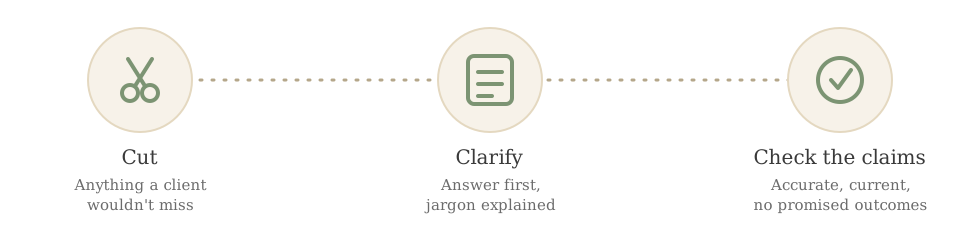
You don't need to rewrite your whole site at once. Set aside an afternoon and go through each main page or section three times, with a different question each time:
- Cut. Remove anything a prospective client wouldn't miss: welcome lines, repeated reassurances, long lists. If a sentence could appear on any therapist's website unchanged, it's a candidate.
- Clarify. Make sure the first sentence of each section answers the question the heading raises. Replace unexplained jargon with what it means for the client. Read it aloud: anywhere you stumble, a reader will too.
- Check the claims. Look for "treat", "cure", "overcome", "specialist" and "accredited", and make sure each one is accurate and supportable. Confirm your fee, availability and response time are current.
Then check it on your phone, since that's where most people will read it. Once your core pages or sections are in good shape, blogging is a natural next step: the same plain, specific writing applied to the questions clients ask you most.
Frequently asked questions
How long should the copy on a therapist's homepage be?
Long enough to answer who you help, how you work, where you are (or that you work online), what it costs and how to get in touch, and no longer. For most solo practices that's a few short sections, each one skimmable in seconds. A homepage doesn't have to hold everything: link to your about, services and fees pages or sections for the detail.
Can I say I treat anxiety or depression on my counselling website?
Be careful with the wording. The ASA's guidance on mental health treatment claims says conditions like depression and anxiety need care in advertising, and claims to cure, heal or restore someone from a condition are unlikely to be acceptable without robust evidence. Describing what you work with ('I work with adults experiencing anxiety') and what sessions involve is a safer pattern than promising an outcome. Check your professional body's current guidance too, since this is advertising, not just website writing.
Should I write my website in the first person or the third person?
For a solo practice, first person ('I work with...') usually reads warmer and more direct, and it matches how a client will actually experience working with you. Third person can suit a group practice or a formal biography section. Whichever you choose, keep it consistent across the site so it doesn't feel like two different people wrote it.
Do I need to write a meta description for every page?
It's worth doing for your main pages. Google says snippets are mainly created from the page content itself, but it sometimes uses the meta description if that describes the page more accurately. A unique, plain-English description for each page (who it's for and what they'll find) costs a few minutes and gives Google a better option to show.
Start with the top of your homepage
If you only change one thing this week, reread the top of your homepage (any labels, the heading and the opening line) as one unit. Between them, they should set the tone and say who you help, what you offer, and where and how you work, without repeating each other. It's the part most visitors read and the part most likely to be doing too little. Everything else on the site gets easier to write once it's clear.
A website with the words done properly
UpTopWeb designs your therapist website from scratch, not from a template, and builds it for free, with professional copywriting for your core pages included.
Get a free website