HCPC registration
The statutory register for practitioner psychologists. Your registration number and a link to your entry let anyone check you in seconds.
Psychologist website design
Years of training don't help if a visitor can't tell what kind of psychologist you are, whether you're registered, or which service they need. We build your site around answering that in the first few seconds.
No design fees. No build costs. Cancel anytime.



5-star reviews across Trustpilot and Google
Not a psychologist? See our guides for counsellors and therapists & psychotherapists.
Psychology is a regulated profession, but most visitors don't know which titles are protected or what separates a clinical psychologist from a counselling one. Your website is where that gets explained — or where the visitor gives up and goes back to the search results.
practitioner psychologists are on the HCPC register — so a visitor comparing psychologists has plenty of names to choose from
HCPC register summary, September 2026
psychologist titles are protected by law, from clinical to educational psychologist — but the word “psychologist” on its own isn’t one of them
HCPC
What a visitor is really deciding
Whether it's a prospective client, a parent, a GP or a solicitor, someone landing on a psychologist's website is working through the same six questions. A good site answers all of them without making anyone dig.
Protected titles
The HCPC regulates practitioner psychologists and protects nine titles, including clinical, counselling and educational psychologist — but not the word “psychologist” by itself. A visitor who knows that will look for your exact title and registration. One who doesn't is relying on your site to make it obvious. Either way, the HCPC register should be one click away.
The statutory register for practitioner psychologists. Your registration number and a link to your entry let anyone check you in seconds.
Clinical, counselling, health, educational, forensic, occupational or sport and exercise psychologist — used exactly as registered.
Chartered membership of the British Psychological Society, shown alongside your HCPC registration — never as a substitute for it.
We build your HCPC number, register link and any BPS status directly into your site. The HCPC's standards of conduct expect your promotional material to be accurate and not misleading, so nothing on your site is overstated.
Structuring your services
Many psychologists offer more than one kind of work, often to completely different audiences. A worried parent, a GP and a solicitor shouldn't have to read the same page to find what they need.
Your approach — CBT, EMDR, compassion-focused or integrative — with session length, fee and format in plain English.
What you assess, each stage of the process, how long it takes and the total cost including the report.
A page written for solicitors, with your instruction process and expertise, kept apart from the client-facing pages.
Written for parents, with consent, confidentiality for young people and any school liaison explained clearly.
For other clinicians looking for a supervisor, without confusing prospective clients about what you offer them.
Training, coaching or consultancy for employers, set out for the people who commission that work.
We only include the services you actually offer and are competent in — no padding your site with specialisms you don't practise.
The essentials
A prospective client or referrer shouldn't have to hunt for reassurance. These are the things every psychology practice website should get right.
Who you are, who you work with and how you work — a human introduction, not a copy of your CV.
Your exact protected title, HCPC number and register link, with BPS status alongside if you have it.
Age groups and presenting concerns you're competent in — and a clear note on when you'd refer someone on.
Therapy models and assessments described in plain language, each with its own clear space.
Where you see people, access information, and where you can work with clients online.
Session fees, assessment and report costs, cancellation terms and any insurers that currently recognise you.
Self-referral, GP or professional referral, insurer or solicitor — each with a path that makes sense.
What confidentiality covers and its limits, and an enquiry form that never asks for clinical history.
Getting found
Directory profiles help people find you, but they put you next to every other psychologist on the page — and there's rarely room to explain an assessment process or a medico-legal service properly. Your own site is where a client, GP or solicitor can see exactly what you do.
Included with every website
Every page loads fast and is properly structured from the day you launch — the unglamorous groundwork search engines actually reward.
Your core pages are written around what people actually search for, such as "clinical psychologist near me" or the assessments you offer.
Structured so tools like ChatGPT and Google AI Overviews can understand your practice, your title and your services, and cite them accurately.
Available to help you go further (paid add-ons)
So someone searching "psychologist near me" finds your profile and your site working together, not competing with each other.
A dedicated page for each assessment or specialism you offer, instead of one page trying to rank for everything at once.
Ongoing optimisation, paid ads and monthly content for practices ready to actively grow their enquiries, not just maintain them.
Design principles
Psychology sites often have the opposite problem to counselling sites: plenty of credentials, and a page that reads like a CV. Visitors need to see the expertise and the person behind it.
Most people search on their phone, often in a stressful moment — a slow site loses them before they read a word.
Fees, services and your contact form should be one or two clicks away, never a hunt through a menu.
Strong contrast, readable type, and a site that still works with a keyboard or screen reader.
Built around your own practice and photography, not a stock layout with your name swapped in.
The building blocks
The same building blocks we use on every UpTopWeb therapy site, adapted for how psychologists are found and referred.
Your own face in a soft, friendly frame is one of the strongest trust signals on the page — and it balances a long list of credentials.
Your full protected title and HCPC registration sit next to your name, not three clicks away on an About page.
A clear "get in touch" for prospective clients, with its own route for GPs, insurers or solicitors who need something different.
A quiet, persistent prompt near the bottom of the page for visitors who read everything before they're ready to act.
Real UpTopWeb examples
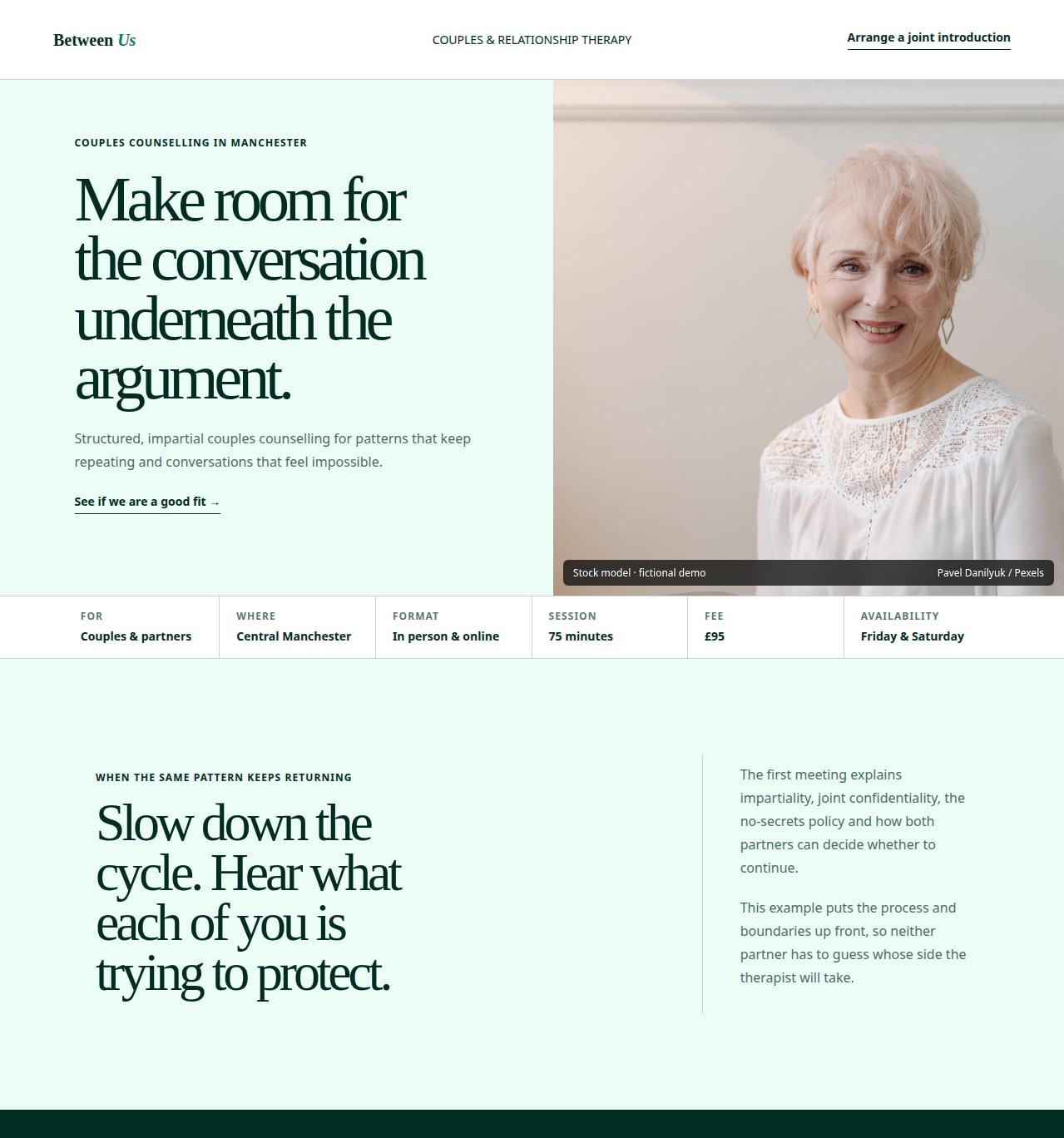
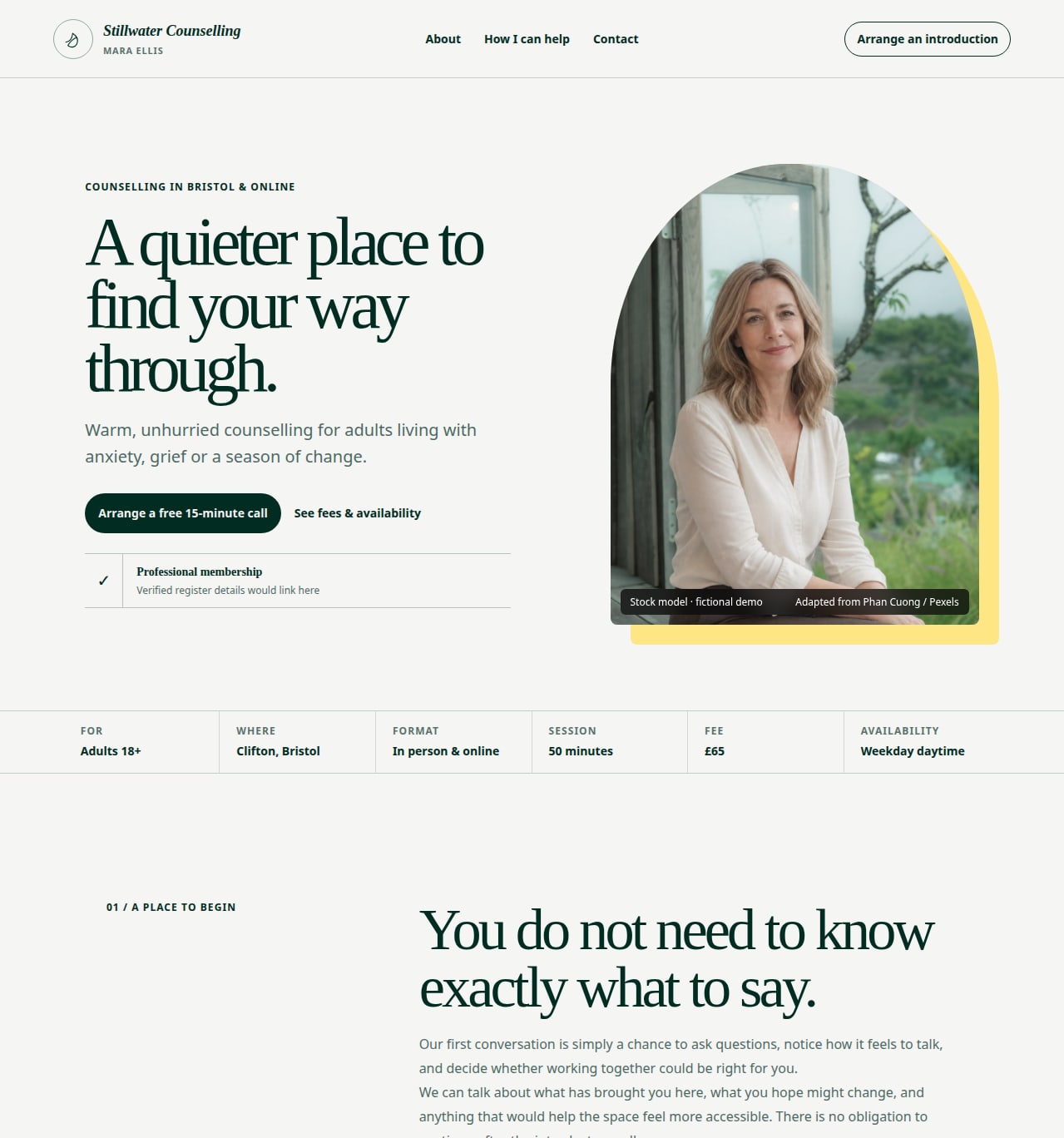
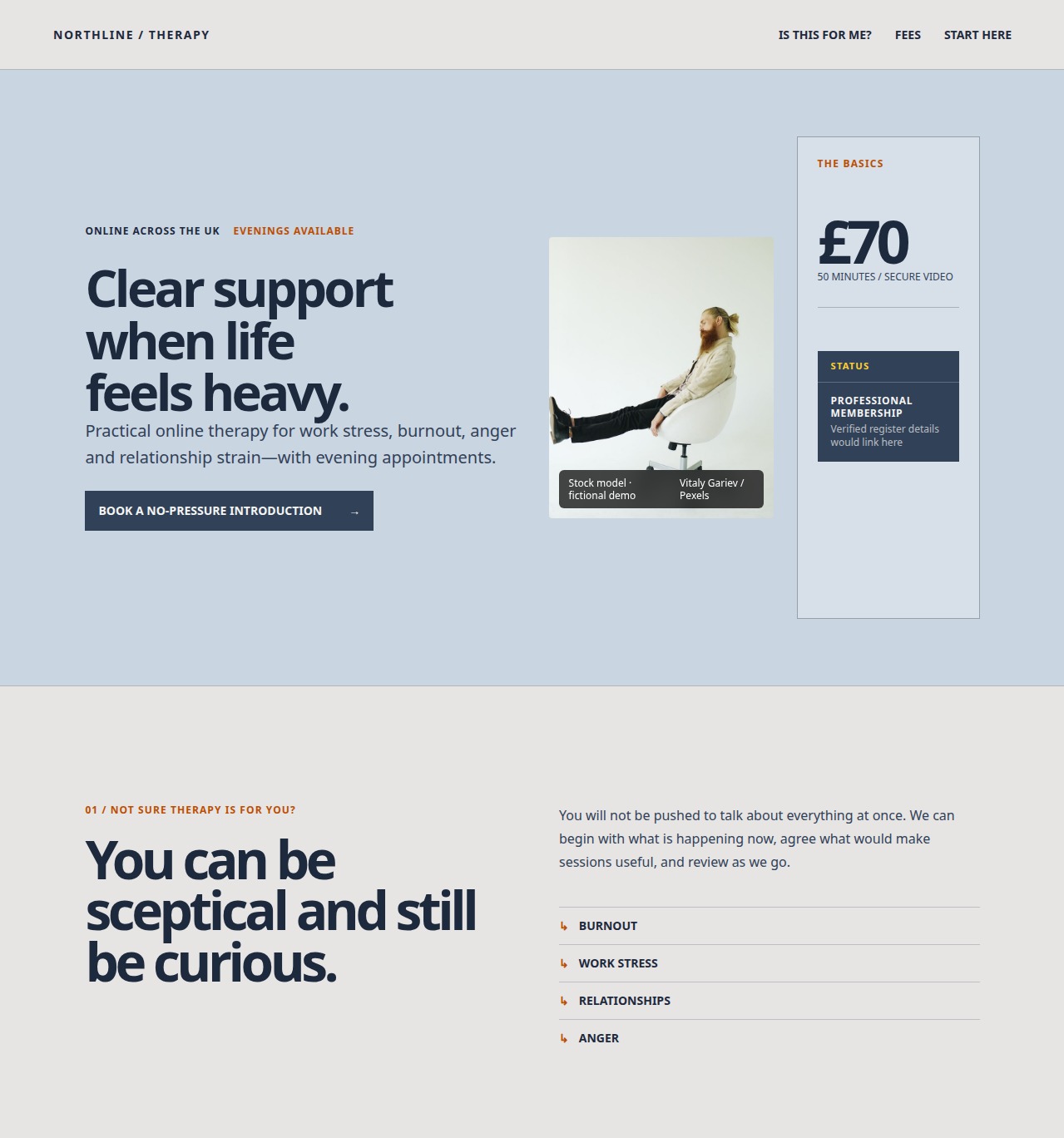
These are fictional demonstrations built around UK private-practice best practice — a trauma-informed art psychotherapy practice and an online therapy service. A psychologist's site uses the same foundations, with your title, registration and services in their place.
Art psychotherapy with room for images, objects, silence and words—always led by your choice.
View the full demoPractical online therapy for work stress, burnout, anger and relationship strain—with evening appointments.
View the full demoPricing
Free design and build, then one simple monthly fee.
10-day free trial — no charge while we design and build your site
Further reading
A good website is one part of running a private practice. These two guides cover more of the groundwork.
FAQ
Yes. We design and build your psychologist website at no upfront cost. The only ongoing charge is £19.99 a month for hosting, support and unlimited edits, with a 10-day trial before billing starts.
It depends on the title. "Psychologist" on its own isn't protected, but "practitioner psychologist", "registered psychologist" and seven specialist titles — including clinical, counselling and educational psychologist — can only be used by people on the HCPC register. We make sure your site uses your exact registered title and links to your register entry.
If you hold it, yes. Chartered membership (CPsychol) is recognised by many visitors and referrers. We show it alongside your HCPC registration rather than in place of it, because the HCPC is the statutory regulator.
If you hold a doctorate, such as a DClinPsy, you can — but make clear you're a psychologist rather than a medical doctor. ASA guidance on health advertising expects a "Dr" title to be clearly qualified when someone doesn't hold a medical qualification, so we always pair it with your full title, for example "Dr Jane Smith, Clinical Psychologist".
Yes. Therapy and assessment usually attract different visitors with different questions, so we give each its own clear space, with its own process, timescale and costs, rather than squeezing them into one paragraph.
Yes. That work is usually best on its own page, written for solicitors rather than clients, so the instruction process is easy to find without appearing in the pages a prospective client reads.
Yes, as long as the recognition is current. We show it as plain text you've confirmed, and only use insurer logos if you have permission to. Insurer lists change, so it's worth checking them whenever your details are updated.
Check your professional body's current guidance first, and consider the power dynamic of asking a client. Advertising rules also apply: a testimonial can't be used to suggest a therapy works for a condition when that isn't backed by evidence. We'll help you get the wording and consent right if you decide to use them.
Yes, this is one of the most common starting points we see. We design and build a full site around your existing profile, so you're not solely dependent on a directory for enquiries.
Yes — your domain and the content that's already working come with you. We design and build the replacement site around them rather than starting from nothing, and can register a .co.uk domain for you if you don't already have one.
Yes. The enquiry form only asks for what's needed to reply — never a clinical history or anything that isn't your business to collect up front — with a short privacy note beside it.
Foundational SEO — structure, page speed, headings and metadata — plus AI search optimisation is built into every site from launch. Local SEO, Google Business Profile management and extra service pages are available as paid add-ons once you're ready to push further.
A first draft is usually ready within 24–48 hours of your brief, then we refine it with you until you're happy. Your 10-day trial gives you time to check everything properly before any billing starts.
No contract, ever. Cancel free during the 10-day trial, or afterwards whenever you like — your site comes down and billing stops the moment you do.
10-day free trial
We design and build your psychologist website at no cost. Maintenance is just £19.99/month, with your first 10 days free.