Marketing
How to Write a Counselling Directory Profile That Stands Out
Most directory profiles are skimmed in two sentences. How UK therapists can write a clearer profile for Counselling Directory, Psychology Today or BACP.
On this page8 sections
Most directory profiles get skimmed for a few seconds, and the first two or three sentences decide whether anyone reads the rest. That's the practical reason to learn how to write a counselling directory profile properly, rather than pasting in your training history and hoping the platform does the work. This guide is for UK counsellors and psychotherapists writing or rewriting a listing. It uses Counselling Directory, the independent directory UK therapists mention most, as the main example, and the same advice works for Psychology Today, BACP's Therapist Directory, UKCP's Find a Therapist and similar sites. It covers how people actually read a profile, what to put in each part, a full worked rewrite, and the professional-body rules that apply to what you say.

Important: This is a practical overview, not legal, regulatory or professional advice. Directory rules, advertising rules and professional body guidance change over time. Check your directory's own listing criteria and your professional body's current guidance before publishing.
Key takeaways:
- A Counselling Directory search for Camden returned 3,996 profiles within five miles. On a results page like that, the line under your name and your first 50 or so words decide whether anyone clicks.
- Write those opening words for someone scrolling: who you help, with what, and where or how you work.
- Describe what you work with, not what you'll fix, and state your registration or accreditation exactly as it appears on your body's register.
- Fill in every practical field that applies (fee, availability, concessions, access, languages, professional body). Counselling Directory has around 15 search filters, and an empty field can keep you out of a filtered search.
- Show your fee, session length and the first step. A missing fee adds a message someone may never send.
- Keep facts identical across every directory and your website, but write each for its own job rather than pasting one long block everywhere.
- Follow your directory's own rules too: BACP's Therapist Directory, for example, sets requirements for photos, website links, testimonials and the title "Dr".
How clients actually read a counselling directory profile
A directory profile is read in three stages, and each one needs something different from you.
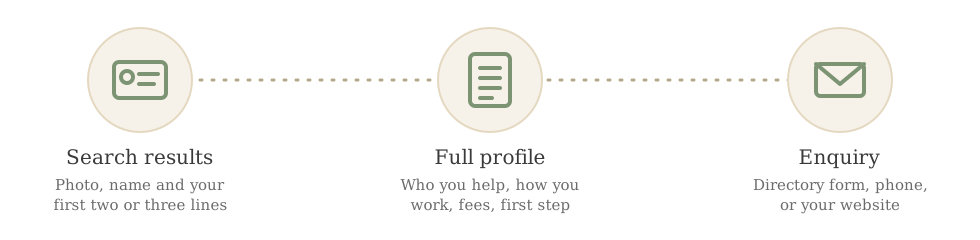
- The search results card. Someone filters by area and issue, then scrolls a list of very similar cards. That short card is often all a visitor reads before choosing which profiles to open (more on exactly what it shows below).
- The full profile. Once they click, they're checking fit: do you work with what they're going through, does the way you describe sessions feel manageable, what does it cost, and can you see them when they're free?
- The enquiry. They contact you through the directory's form, by phone, or by clicking through to your website to find out more first.
What a Counselling Directory search results page shows
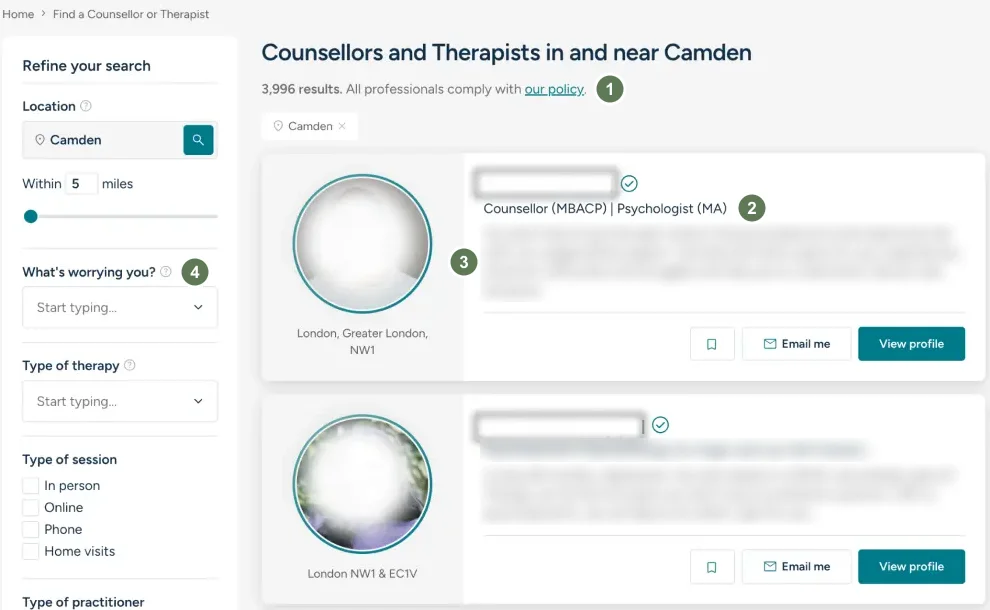
We searched Counselling Directory for Camden on 28 September 2026, with the default five-mile radius. It returned 3,996 counsellors and therapists, 20 to a page, so roughly 200 pages of cards. Each card shows:
- A photo, your name and the site's verified tick.
- One line under your name. Some therapists use it for their title and memberships ("Counsellor (MBACP)", for example); others use it as a short headline about who they help. In our search, a longer headline was cut off with an ellipsis after about 55 characters.
- The opening of your profile text, about three or four lines (roughly 50 words) before it stops.
- Your area, then "Email me" and "View profile" buttons.
Down the side sits a long list of filters, well beyond what fits in the screenshot. As well as location and distance, visitors can narrow the results by:
- What's worrying you? A long list of issues, from anxiety and bereavement to burnout, menopause and neurodiversity.
- Type of therapy, from CBT and EMDR to person-centred, psychodynamic and couples therapy.
- Type of session (in person, online, phone or home visits) and type of practitioner (individuals or organisations).
- Who the therapy is for: children, young people, young adults, adults, older adults, couples, families, groups, organisations or EAP.
- Practicalities: session availability (weekends, weekday daytimes, weekday evenings), price per session, concessions (such as low income, students or trainee counsellors), and accessibility (wheelchair-user access, a hearing induction loop).
- Professional body, health insurance or EAP provider, and language spoken.
- A keyword search across profiles.
Each filter is a question a client can ask before they've read a word you've written. If a field on your profile is left empty, you're likely to drop out of any search that uses that filter, however well the rest is written. So before you polish the wording, fill in every practical field that genuinely applies: availability, fee, concessions, access, languages, your professional body and who you work with. Psychology Today's UK results work in a similar way: a photo, name, title, postcode area and roughly the first two or three sentences of the personal statement (as checked on the same day).
Most profiles are written as if only stage two exists. They open with a qualification, a modality list or "Welcome to my profile", which is exactly the text that shows on the search card. Our guide to whether therapy directories are worth it found that a stale or generic profile is one of the most common reasons a listing goes quiet, so it's worth fixing the opening before judging the platform.
Writing your counselling directory profile, section by section
Every directory lays its fields out a little differently, but most profiles have the same core parts. Work through them in this order, because it's roughly the order a prospective client meets them.
Your photo
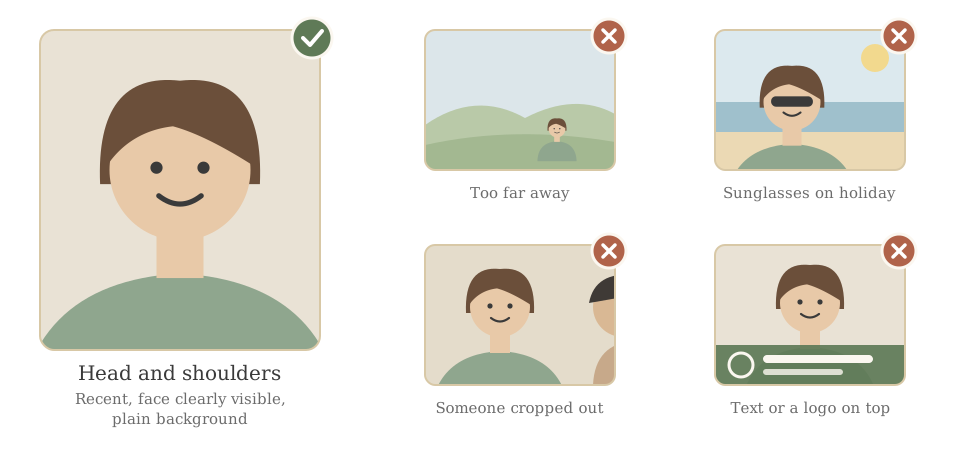
Use a recent, clear head-and-shoulders photo where you look approachable and like yourself on a normal working day. BACP's listing criteria for its Therapist Directory ask for a portrait-style headshot on a plain background, with no other people, pets, logos, contact details or text in the image, which is sensible guidance for any directory. A photo from ten years ago, or a cropped holiday snap, is a small thing that makes the first meeting feel less trustworthy than it should. Avoid a selfie too: holding the camera at arm's length distorts your face, the angle is usually slightly above or below, and it tends to look casual next to everyone else's portrait. Ask someone to take it at eye level, or prop your phone up and use the timer, facing a window for soft, even light.
Your title and credentials line
State your professional title and membership exactly as your professional body's register shows it. "Registered member" and "accredited member" mean different things, and the BACP Ethical Framework expects members to describe their qualifications and experience accurately and honestly. A few specifics from BACP's criteria are worth knowing even if you list elsewhere:
- Protected titles such as "arts therapist" or "practitioner psychologist" can only be used if you're registered with the HCPC.
- If you use "Dr" because of a doctorate, BACP requires a statement making clear it doesn't imply a medical qualification.
- The name on your listing should match the name on the register, so a client checking your registration can find you.
If you're still training towards a qualification, say so in those words rather than listing it as if it's complete.
The line under your name
On Counselling Directory this one line sits directly under your name on every search card, so decide deliberately what it does. There are two sensible choices:
- Your title and memberships, such as "Counsellor (MBACP)". It's clear and checkable, and it suits you if most people search by profession.
- A short headline about who you help, such as "Counselling for anxiety and work stress in Camden". It does more to catch the eye of someone scanning, and your credentials still appear on the full profile.
Either way, keep it short enough to show in full. In our search, a longer headline was cut off after about 55 characters, which can leave it ending mid-phrase.
The opening two sentences
This is the part to spend the most time on, since it's what shows on the search card: roughly 50 words on Counselling Directory, two or three sentences on Psychology Today. A useful pattern is: who you work with, what they're going through, and where or how you see them, in everyday words.
Before: "Welcome to my profile. I am an integrative counsellor, qualified to Level 4, drawing on person-centred, psychodynamic and CBT approaches."
After: "I work with adults who feel anxious, stuck or worn down by work and relationships. I see clients in Headingley, Leeds, and online, in a calm, unhurried space where you set the pace."
The "before" is accurate, but it tells a scrolling reader nothing about whether you could help them. The "after" answers that in two sentences and still sounds like a person. Your training belongs further down, where it reassures someone who's already interested. It also helps to describe what someone is going through the way they'd describe it themselves: "lying awake going over the same worries" lands more directly than "sleep disturbance and rumination". This is the same idea as the positioning sentence in our guide on how to market yourself as a therapist: once you have it, use it on your website and every listing in roughly the same words.
Who you work with and what you work with
Most directories have two places for this: tick-box specialisms that power the filters, and free text. Use both, but honestly.
- Tick-box specialisms. On Counselling Directory, these feed the "What's worrying you?", "Type of therapy" and "Who is the therapy for?" filters, alongside the practical ones covered above. Tick what you're genuinely experienced and trained in, not everything you could conceivably see. A long list of ticks puts you in more searches, but it makes your profile look like everyone else's once someone opens it, and it can bring enquiries you'll have to turn away. BACP's criteria note that keywords about your specialisms help your listing's visibility, which is a reason to be specific, not exhaustive.
- Free text. Name the handful of areas you work with most, in the words a client would use ("after a bereavement", "feeling like you're not coping at work"), and add a line of context to each where it helps.
Describe what you work with, not what you'll fix. The ASA's guidance on mental health treatment claims says claims to cure, heal or restore someone from conditions such as depression and anxiety are unlikely to be acceptable without robust evidence. "I work with people experiencing anxiety" describes your practice; "I'll help you overcome anxiety for good" promises an outcome. A directory profile is advertising, just like your website.
How you work and what sessions are like
Modality names mean a lot to other therapists and very little to most clients. Keep them, but explain them: what you'll actually do in a session, how the first one works, and what someone can expect if they've never had therapy before. Two or three sentences are usually enough here, since the full detail can live on your website.
What someone might get from working with you
A prospective client is reading for two things: what it will be like, and whether it might help. Profiles that only describe the therapist's approach leave the second question unanswered, while profiles that promise results run into the advertising rules above. The honest middle is to describe what therapy with you offers, not what it will fix.
Instead of: "I will help you overcome your anxiety and build lasting confidence."
Try: "Many people find it helps simply to have a regular, confidential space to talk. Over time, we can work out what keeps the worry going and what makes it easier to live with."
The second version still tells someone what they might get out of it (a space to talk, a better understanding of what's happening, things that make it easier), without guaranteeing an outcome that depends on far more than the sessions.
Fees, availability and the first step
Say what it costs, how long a session is, whether you work in person, online or by phone, and roughly when you're available. Then say what happens next: "Send me a short message and I'll reply within two working days to arrange a free 15-minute call" is far easier to act on than a bare contact button. If you haven't settled on a figure yet, our guide to how much counsellors should charge covers how to work one out.
On BACP's Therapist Directory, leaving the hourly rate blank shows a default "Contact [name] for session rate" line instead, which is one more step for someone who may already find reaching out hard.
Your website link and contact details
If you have a website, link to it. BACP's criteria say the link must go to your own profile or practice page, not to another advertising directory, and they discourage publishing an email address on the listing because of spam and scam risk; the directory's own contact form avoids that. BACP also asks for a brief privacy summary or a link to the full privacy notice on your website, so it's worth making sure your site actually has one (our GDPR-compliant website checklist covers what it should say).
A link from a professional-body directory to your website is also one of the more realistic backlinks for therapists, and keeping your name, area and contact details identical everywhere supports your local SEO.
A worked example: one profile, rewritten
The example below is invented, but the "before" follows patterns that turn up on a lot of real listings. Read the first two sentences of each as if they were all you could see.
Before:
"Welcome to my personal statement. I am a qualified integrative counsellor (Level 4 Diploma, MBACP) with experience in a range of settings including a GP surgery and a young people's charity. I draw on person-centred, psychodynamic and CBT approaches and tailor my work to each client. I work with anxiety, depression, trauma, stress, grief, relationship issues, low self-esteem, anger, OCD and much more. Counselling can help you transform your life and become the best version of yourself. Please contact me to discuss fees and availability."
After:
"I work with adults who feel anxious, stuck or worn down by work and relationships. I see clients in Headingley, Leeds, and online, in a calm, unhurried space where you set the pace.
People often come to me after a bereavement, when stress at work has started to spill into everything else, or when an old pattern in their relationships keeps repeating. In our sessions I'll mostly listen, and help you notice what's hard to see on your own. Sometimes that means looking back at where things started; sometimes it means practical tools for the week ahead.
I'm a registered member of the BACP and trained for four years, including two years in a GP surgery counselling service.
Sessions are 50 minutes and cost £60, on weekday daytimes and Tuesday evenings. I offer a free 15-minute call first so you can ask questions before deciding. Send me a short message and I'll reply within two working days." (Details invented for illustration.)
What changed, and why:
- The first two sentences now work on the search card. They say who, what and where, instead of a greeting and a qualification.
- The issue list is shorter and in client language. "And much more" is gone, and so is "depression, trauma, OCD" listed without context. The "after" names three situations the counsellor genuinely sees most.
- "Transform your life" has gone. It edges into an outcome claim and says nothing specific.
- Credentials moved down, and got more precise. "MBACP" became "registered member of the BACP", which a client can check on the register, and the training became something a reader can picture.
- The practical details replaced "contact me to discuss fees". Fee, length, times, the free call and a reply time are all there before anyone has to ask.
What goes on your directory profile and what goes on your website
A directory profile and a website do different jobs, so they don't need the same words. Keep every fact identical, but write each one for its own reader.
| Directory profile | Your website | |
|---|---|---|
| Main job | Stand out on a crowded results page and get a click or a message | Answer every question someone has before they get in touch |
| Who's reading | Someone comparing several similar profiles side by side | Someone who's already interested in you specifically |
| Opening | Two sentences that work on their own, on the search card | A heading and opening line that set the tone for the whole site |
| Detail | Short: who you help, how you work, fee, first step | Full: your approach, what sessions are like, fees, FAQs, location and access |
| What you control | The directory's fields, filters and layout | Everything, including the design |
| Facts (name, registration, fee, area, contact) | Must match your website exactly | Must match every listing exactly |
Our guide to therapist website copy covers how to write the longer version on your own site, including before-and-after examples for each main page or section. If you have several listings, the facts row matters most: an old fee on one directory and a new one on your website is the kind of mismatch that makes a careful client hesitate.
Testimonials, badges and other things to leave out
A few things turn up on directory profiles that are better left off, or handled carefully.
- Client testimonials. Professional bodies don't agree here. BACP's listing criteria allow testimonials only with the client's written permission and in line with the ASA's rules on endorsements, while UKCP's Code of Ethics and Professional Practice bans client testimonials in advertising. The ASA's testimonials and endorsements guidance expects advertisers to hold evidence that a testimonial is genuine and to have permission to use it. Given the confidentiality questions involved, many therapists simply don't use them.
- Borrowed branding. A directory's own verification badge or logo, such as Counselling Directory's verified tick, belongs to that directory. Don't copy it onto your website or other listings as if it's a separate credential.
- Long modality lists. Name your main approach and explain it. A list of six modalities tells a client you've trained widely, but not what a session with you is like.
- The same text pasted everywhere. Several directories and your website all carrying one identical long paragraph reads as generic to anyone who comes across more than one, and makes it harder for your own site to stand out. Reuse your positioning sentence; write the rest for each place.
Keeping your profile working
A profile isn't finished once it's approved. A few habits keep it doing its job:
- Review it every few months. Update your photo if it no longer looks like you, your availability if it's changed, and your fee on every listing at once when you change it.
- Ask every new enquiry how they found you. It's the only reliable way to tell which listing is earning its fee. Our guide to getting your first counselling clients covers a simple way to track this across every channel.
- Change one thing at a time. If a listing goes quiet, rewrite the opening two sentences first and give it a few weeks before changing anything else, so you can tell what made the difference.
Frequently asked questions
How long should a counselling directory profile be?
Long enough to answer who you help, how you work, what it costs and how to get in touch, which for most therapists is a few short paragraphs. Length matters less than the opening. On Counselling Directory's search results, each card shows your photo, name, the line under your name and roughly the first 50 words of your text; Psychology Today shows a similar two or three sentences. Those lines need to work on their own.
Should my directory profile say the same thing as my website?
Keep the facts identical (your name, registration, area, fees and contact details) and the positioning consistent, but don't paste the same long text everywhere. A directory profile's job is to get someone to take the next step; your website has room for the fuller detail. Writing each one for its own job usually reads better than a copy-and-paste.
Can I put client testimonials on my directory profile?
It depends on your professional body and the directory. BACP's Therapist Directory allows them only with the client's written permission and in line with the ASA's rules on endorsements, while UKCP's Code of Ethics bans client testimonials in advertising. Many therapists leave them out altogether, since a clear description of how you work usually does more for a hesitant reader.
Should I put my fee on my directory profile?
Usually, yes. A visible fee answers one of the first questions a prospective client has and saves an awkward first message. On BACP's Therapist Directory, if you leave the hourly rate blank, the listing shows a default line asking people to contact you for your session rate instead, which adds a step for someone who may already find reaching out hard.
Start with your first two sentences
If you only change one thing this week, open your directory profile, read the first two sentences on their own, and ask whether a stranger scrolling a results page would know who you help, with what, and where. If not, rewrite them using the pattern above. It's the part most people see, and it takes an afternoon at most.
Give your directory profile somewhere to send people
Your listing gets you noticed; your website is where people decide. UpTopWeb designs and builds your therapist website for free, with the words for your core pages included.
Get a free website