Marketing
Paid Advertising for Therapists: Google, Meta and What's Worth It (UK)
A UK guide to paid ads for counsellors: where Google ads appear, Meta's health rules, why ChatGPT and TikTok are closed for now, and the cookie consent ads need.
On this page11 sections
Paid advertising for therapists can work, but most of what you'll read about it was written for American practices, by agencies selling ads management, and quoting dollar costs and US rules. In the UK the picture is different, and narrower than it first looks. Search ads on Google are open to you. Several of the tools that make ads efficient elsewhere, like remarketing, are closed to mental health services. Two of the newest channels, ChatGPT and TikTok, are effectively shut for now. And every ad platform you use brings a cookie consent job to your own website.
This guide is for UK counsellors and psychotherapists in private practice who are wondering whether to pay for ads. It covers what to have in place before you spend anything, every main channel compared, where a Google ad can actually appear (including Maps and your Business Profile), the platform rules that apply to therapy, the cookie banner and GDPR side, and a worked example of what an enquiry might cost. If you haven't yet looked at the free channels, start with our guide to how to market yourself as a therapist: for most practices, ads come after those, not instead of them.
Important: This is a practical overview, not legal, regulatory or professional advice. Ad platform policies change often, sometimes month to month, and professional-body advertising rules vary by registration. Check the current policy pages linked below, your own body's guidance and the ICO's guidance before running ads or adding tracking to your website. Platform policies were checked on 20 October 2026. UpTopWeb has no commercial connection with any ad platform named here.
Paid advertising for therapists: the short answer
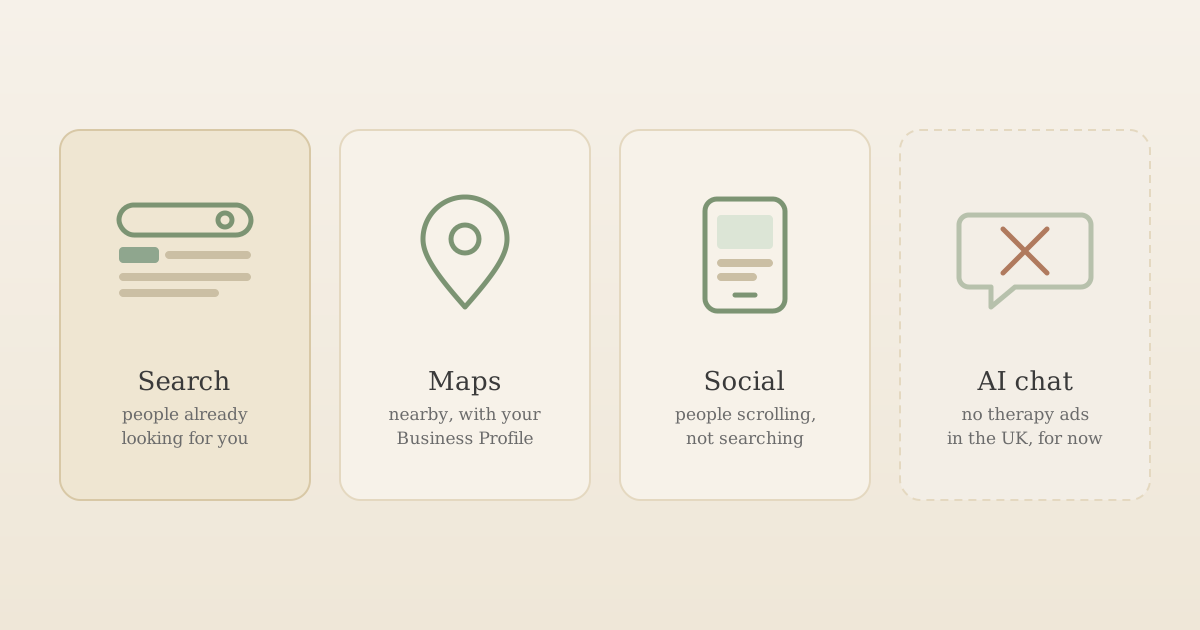
For most UK therapists, paid advertising means Google search ads, and little else. Search ads are shown to people who are already typing "therapy Leeds" or "counselling near me", so they reach someone at the moment they're looking. In our experience, that's what makes search ads different from everything else on this list: they sit at the top of the results, and the people who click have far more intent than someone scrolling a social feed, so a click is more likely to turn into an enquiry.
Everything else is either lower intent (display, YouTube, Facebook, Instagram), not open to UK therapy services (ChatGPT, TikTok in practice, Google's Local Services Ads), or better done for free (your Google Business Profile and directory listings).
Ads also don't fix a website that doesn't convert. They send more people to the same page; if that page doesn't answer "can you help with this, what does it cost and how do I get in touch?", you pay for every visitor who leaves.
Before you spend anything: five checks
- Your website answers the four questions. Who you help, how you work, what it costs and how to get in touch, all clear on a phone. Our guide to what a therapist website should include has the full list. Showing your fees up front matters more with ads, not less, because people who can't afford you will otherwise click, read and leave at your expense. Our guide to pricing a private practice covers setting them.
- The ad can land on a page that matches it. An ad for couples counselling should land on a couples counselling page, not your home page. If you have a specialism, a dedicated page for it (see our guide to therapist service pages) does more for an ad than any amount of budget.
- You can reply quickly. Someone who clicks an ad has probably clicked on others. A reply the same or next working day matters.
- Your cookie banner works properly. Ad tracking needs consent before it loads (more on this below). If your site can't do that yet, fix it first.
- You know your numbers. Roughly how many enquiries turn into a first session, and how many sessions a client usually has. Without these you can't tell whether £100 of ads was money well spent.
Every paid channel, compared
| Channel | Who sees your ad | Intent | What the rules allow for therapy (checked 20 October 2026) | Our verdict |
|---|---|---|---|---|
| Google search ads | People searching for a counsellor or therapist | High: they're actively looking | Allowed. No remarketing or customer-list audiences, because mental health counselling is a sensitive health category | The one paid channel most practices should consider first |
| Google Maps (via search ads with location assets) | People searching on Maps or Google near you | High | Allowed with a linked Business Profile; the "Advertise" shortcut in the Maps app excludes sensitive categories and service-area businesses | Worth switching on if you see clients in person |
| Google Display, YouTube, Discover and Gmail | People browsing other sites, watching videos or reading email | Low | Allowed, but the audience features that make these work are restricted for health | Rarely worth it for a solo practice |
| Microsoft Advertising (Bing) | People searching on Bing and partner sites | High, smaller audience | Has its own policies; can import Google campaigns | An easy add-on once Google search ads work |
| Facebook and Instagram (Meta) | People scrolling, chosen by location, age and broad interests | Low to medium | Allowed, but ads can't imply the viewer has a condition, and health data can't be sent through the Pixel | Possible for a workshop, group or clear specialism |
| TikTok | Mostly younger users scrolling | Low | "Medical institutions" need proof of approval from a local regulator, and ads must be 18+ only | Not a realistic option for most UK practices |
| ChatGPT | Free and Go users in conversations | Varies | Health service ads outside the US are generally prohibited, and no ads appear in mental health conversations | Closed to UK therapists for now |
| Paid directory listings | People browsing a directory for a therapist | High | Set by each directory | Often better value than ads. See our guide to whether therapy directories are worth it |
The rest of this guide takes the main ones in turn, starting with Google.
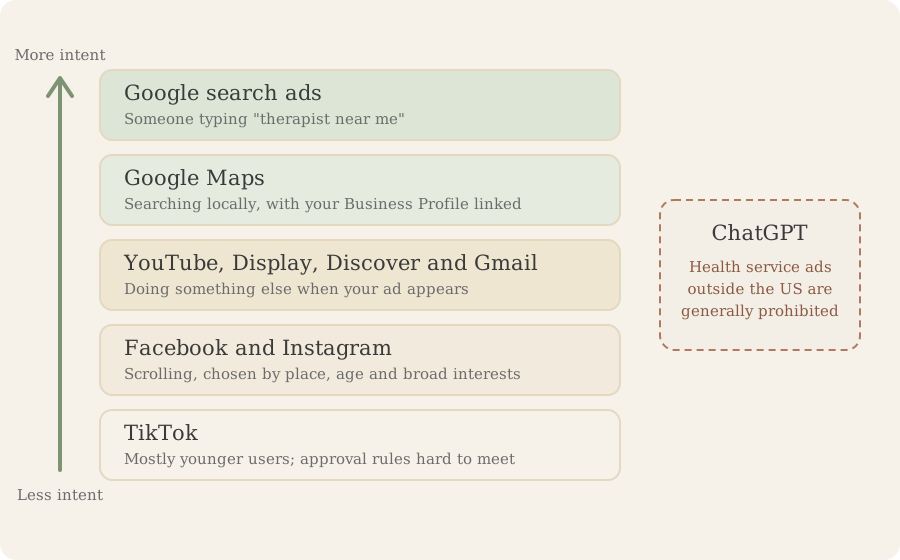
Google Ads for therapists: where your ad can appear
"Google Ads" isn't one place. Depending on the campaign type you choose, the same account can show ads in very different spots, and they're not equally useful to a therapist.
Google Search: the top of the results
Google's help page on the Search Network says search ads "can appear above or below search results on Google Search", marked as sponsored. This is where a therapist's budget usually does the most: you choose the searches (such as "counselling Harrogate" or "online CBT therapist") and pay only when someone clicks.
Choose the words clients use, not the ones therapists use. Clients don't always search the way practitioners describe themselves: "therapy" and "therapist" are often searched more than "counselling" and "counsellor", and the balance varies by area. Keyword Planner (see below) shows how often each wording is searched where you work, so check before you build a campaign around one word.
You don't need a page for every search. A broad search like "therapy near me" or "counselling Harrogate" can land on your home page, with location targeting doing the "near me" part. A specialism search like "couples counselling Harrogate" should land on a page about couples counselling. If you don't have that page, or don't offer the service, don't bid on the search.
Two settings are worth knowing. Search partners, other sites that show Google search ads, "are included by default"; you can switch them off if you'd rather keep your ads on Google itself. And location targeting decides where people have to be to see your ad, which for in-person work should match how far clients will realistically travel.
Google Maps and your Business Profile
If you link your Google Business Profile to Google Ads, you can add what Google calls location assets. Google's page on local ads says linking your Business Profile "enables location assets", and those ads can then show on Google Maps as pins and within Maps search results, with your address and details pulled from the profile. You can't run ads on Maps alone: Maps is one of several places a search, Performance Max or Demand Gen campaign can appear.
There are two shortcuts you'll see mentioned that don't really apply to therapists:
- The "Advertise" button in the Google Maps app. Google lets verified businesses create ads straight from their profile in the Maps app, but its Business Profile help page says "service area businesses and businesses in sensitive categories aren't eligible". Most therapy practices are one or the other.
- Local Services Ads, the "Google screened" boxes you may have seen for plumbers. Google's UK eligibility list covers home and trade services, plus some legal and estate agent categories in Greater London. There's no therapy or counselling category.
Online-only practices can't have a Google Business Profile at all, so for them, Maps doesn't come into it. Our local SEO checklist covers the profile itself, which is worth getting right before you pay to promote it.
Display, YouTube, Discover and Gmail
Other campaign types reach people who aren't searching. Google's Demand Gen campaigns serve ads on YouTube, Discover, Gmail and the Display Network (millions of other websites and apps), and Performance Max campaigns can use all of Google's ad inventory, including search, from one campaign.
For a therapist, these are much weaker. They rely on reaching the right person while they're doing something else, and the audience tools that make that work are the ones Google restricts for health (see below). Performance Max also decides for itself how to split your budget between search and everything else. If you try Google Ads, start with a plain search campaign so you can see exactly which searches you're paying for. Our step-by-step guide to setting up Google Ads for therapists walks through that campaign, from location settings to negative keywords.
AI Overviews
Google's AI Overviews ads page says search ads can show above or below an AI Overview. Ads inside the AI Overview are only available in a list of countries that doesn't include the UK, and Google says it doesn't show ads inside AI Overviews for sensitive verticals including healthcare. In other words, for a UK therapist, ads appear around AI answers, not in them. Being cited in the answer itself is an organic job, covered in our guide to making your therapist website ready for AI search.
What Google won't let a therapist do
Google's healthcare and medicines policy doesn't restrict ordinary counselling or psychotherapy ads in the UK, so you don't need a certification to start. Two limits do apply:
- No remarketing. Google's policy on health in personalised advertising names "counseling services for mental health issues like depression, anxiety, and addiction" as an example of a sensitive health category. Advertisers in those categories can't use their own audience lists, which rules out remarketing to past website visitors, Customer Match and lookalike audiences. Many "ultimate guides" lean on remarketing; for a therapist it isn't available, and arguably that's a good thing, since following someone around the internet after they've read about anxiety support isn't a great look.
- Addiction recovery services. Google's addiction services policy lets certified providers advertise recovery-oriented drug and alcohol services in Australia, Canada, France, Ireland, New Zealand and the US only. The UK isn't on the list, so if that's your specialism, expect those ads to be disapproved.
Microsoft Advertising (Bing)
Far fewer people search on Bing than on Google, but someone searching there for a counsellor is just as far along as on Google. Microsoft lets you import your Google Ads campaigns rather than building them again. It's a sensible second step once a Google search campaign is working, not a first one. Check Microsoft's own advertising policies when you set it up, since they aren't identical to Google's.
Facebook and Instagram ads
Meta's ads (one system, Meta Ads Manager, covers both Facebook and Instagram) are shown to people who weren't looking for a therapist, chosen by location, age and broad interests. Meta removed detailed targeting options linked to health causes in 2022, so you can't target "people interested in anxiety". What's left can still work for something specific: a local group, a workshop, a perinatal or couples specialism, or a service for a particular age group.
Two Meta rules shape what you can do.
Your ad can't imply anything about the reader. Meta's policy on personal attributes bars ads that assert or imply someone's physical or mental health. Meta's own examples make the line clear: "Depression counselling" is allowed, while "Depression getting you down? Get help now." isn't. So "Counselling for anxiety in Leeds, evenings available" is fine, and "Struggling with anxiety?" will be rejected.
You can't send health information through the Pixel. Meta's page on prohibited information says advertisers mustn't share health information through its business tools, and its examples include "mental health and psychological states" and "places of treatment and counselling". It also says your event names, conversions and audiences mustn't "reflect, imply or be based on" that information, and that you, not Meta, are responsible for what your site sends. In practice: don't name a conversion "therapy enquiry" or "anxiety page view", keep page addresses that describe a condition away from the Pixel, and expect Meta to restrict the data it accepts from a therapy website anyway. That makes Facebook and Instagram ads harder to optimise for a therapist than for most businesses.
Our guides to Facebook for therapists and Instagram for therapists cover the free side of both platforms, which for most practices is where to start.
TikTok and ChatGPT ads: not for UK therapists yet
TikTok. TikTok's healthcare advertising policy (last updated September 2026) groups the UK with several European markets. For "medical institutions", the category a therapy practice most likely falls into, ads may be allowed only with "proof of approval and certification from appropriate local regional regulating authorities", and must be shown only to over-18s. Counselling and psychotherapy aren't regulated by law in the UK, so most practices have no such approval to show (practitioner psychologists registered with the HCPC may be a different case). Add a young audience and low intent, and it's hard to see TikTok ads working for most practices.
ChatGPT. OpenAI confirmed ChatGPT ads had launched in the UK on 11 August 2026, shown to adults on the Free and Go plans, and UK businesses can now sign up to its self-serve Ads Manager. When it first announced ads, OpenAI said they "are not eligible to appear near sensitive or regulated topics like health, mental health or politics". But OpenAI's ad policies (updated 10 September 2026) say "ads for health services outside the US are generally prohibited", and list "mental and personal health conversations" among the conversations where no ads appear at all. So a UK therapist can't advertise there, and even if that changed, the conversations where someone asks for help finding a counsellor are exactly the ones kept ad-free. What matters for ChatGPT is whether it describes your practice accurately in its ordinary answers; our guide to AI search for therapists explains how that works.
Both policies are moving quickly, so check them again before ruling either out for good.
Cookie banners and GDPR: the part most ad guides skip
Running ads usually means adding a tag to your website: the Google Ads conversion tag, the Google tag, or the Meta Pixel. These are what tell the platform an ad led to an enquiry. Under UK law, they're also the part that needs the most care.
Ad tags need consent before they load
The ICO's guidance on storage and access technologies (finalised in April 2026) is clear on three points:
- Advertising needs consent. The ICO's chapter on online advertising says using these technologies for online advertising purposes requires consent, and that includes measuring ad performance. It names tracking pixels and tags, not just cookies.
- None of the exceptions cover it. The newer exceptions for analytics and for a site's appearance, added after the Data (Use and Access) Act 2025, don't apply to advertising.
- The banner has to work properly. The ICO's page on managing consent in practice says refusing should be as easy as accepting, that non-essential tags shouldn't be set before someone opts in, and that ignoring the banner isn't consent. "By continuing to use this site you agree" banners don't meet the standard.
Google has its own requirement on top. Its EU user consent policy applies to visitors in the UK as well as the EEA, and asks advertisers to get consent for cookies and for ad personalisation where legally required, and to keep records of it. Google's consent mode lets its tags respect the visitor's choice; whoever sets up your site should switch it on and default the advertising settings to "denied" until someone accepts.
Why it matters more for a therapy website
For most businesses, a pixel reporting "this person visited our site" is ordinary marketing data. For a therapist, the fact that someone visited a counselling website, or a page about a specific difficulty, can say something about their mental health, which UK GDPR treats as special category data. That's why Meta's terms say what they do, and why the safest set-up is the simplest:
- Fire the conversion tag on a plain thank-you page after an enquiry, with no condition or client detail in its address or event name.
- Keep the enquiry form's contents on your own systems; the ad platform only needs to know that an enquiry happened.
- Don't let tags load on pages where clients might pay, book or log in.
- List the ad platforms in your privacy notice and cookie notice, by name.
Our GDPR checklist for therapist websites covers the banner, privacy notice and enquiry form in detail. If you'd rather not add any ad tracking at all, that's a legitimate choice: you can still run search ads and judge them by asking each new client how they found you.
What a click costs, and what it's worth
Google Ads is an auction, so the price of a click depends on your area, your chosen searches and how many other practices are bidding. Google's free Keyword Planner, inside a Google Ads account, shows a "top of page bid" range for each search in your area, which is the most honest starting estimate you'll get.
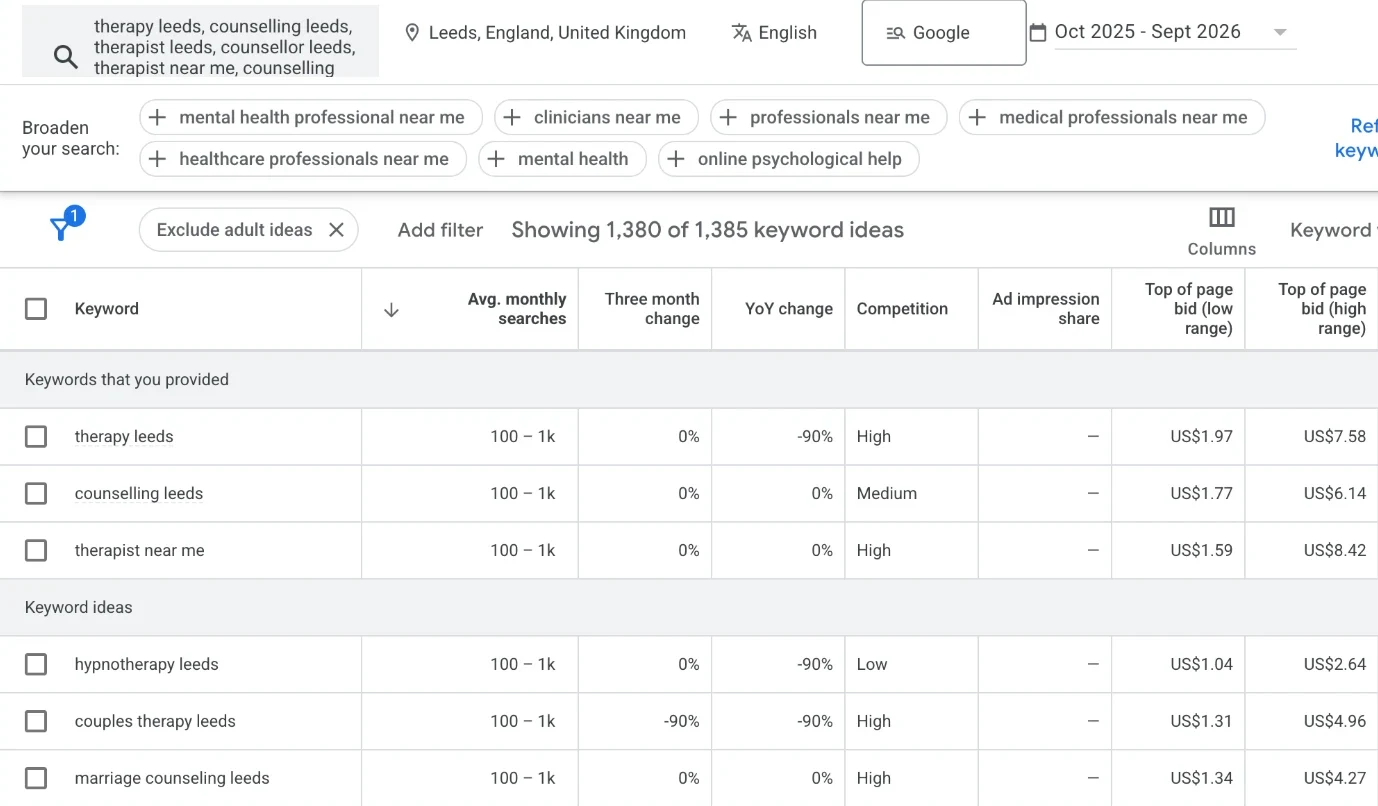
The low and high figures are a range of what advertisers have historically paid to appear at the top of the results, not a fixed price, and your own costs will depend on your bids, your ad and the competition on the day.
Here's how to turn that into a decision. Apart from the cost per click, which sits inside the Leeds range above, the numbers below are invented to show the sums, not typical results; put your own in.
| Step | Example figure | Running total |
|---|---|---|
| Monthly budget | £150 | £150 |
| Cost per click (within the Leeds range above) | £3 | 50 clicks |
| Share of visitors who send an enquiry | 1 in 15 | about 3 enquiries |
| Share of enquiries who book a first session | 1 in 2 | about 1 to 2 new clients |
| Cost per new client | about £100 | |
| Average sessions per client × your fee | 8 × £60 | £480 per client |
In this example, £100 to gain a client worth £480 in fees is clearly worthwhile. But change one line, say only 1 in 40 visitors enquires because the landing page doesn't show fees, and the same £150 brings in about one enquiry and maybe no clients. That's why the five checks at the top matter more than the bidding strategy. Give any test at least two to three months, since a single month is too few enquiries to judge, and set a budget you'd be comfortable losing.
Writing the ad: the rules that apply everywhere
Whatever the platform, the UK's advertising rules (the CAP Code, enforced by the ASA) and your professional body's code apply to paid ads exactly as they do to your website.
- No outcome claims you can't prove. The ASA's guidance on mental health treatment claims says claims to treat conditions need robust evidence. "Overcome anxiety in six sessions" is a claim; "counselling for anxiety, in person and online" is a description.
- No testimonials if you're a UKCP member. UKCP's Code of Ethics (clause 13) rules out client testimonials in any advertising. BACP members should still be cautious; our guide to testimonials for therapists explains both positions.
- Describe the service, not the reader. This keeps you inside Meta's personal attributes rule and reads better anyway.
A search ad that follows all three might read:
Counsellor in Leeds | Evening and Online Sessions BACP-registered counsellor for adults. £60 per session. Free 15-minute call to see if we're a good fit.
Compare "Feeling anxious? Get help today, guaranteed results", which fails on Meta, invites an ASA complaint and says nothing about what you actually offer. Our guide to therapist website copy has more before-and-after rewrites that work just as well for ads.
When not to advertise
- Your diary is full, or nearly. Ads bring enquiries you'll have to turn away.
- You can't reply within a day or two for the next few months.
- Your website doesn't show fees or availability, or doesn't work well on a phone.
- You haven't set up the free channels: a complete Google Business Profile (if you see clients in person), one good directory listing, and a few referral relationships. Our marketing channels comparison shows where each fits.
- The budget would cause you stress if it brought nothing back. Ads are a test, and some tests fail.
Frequently asked questions
Can therapists advertise on Google in the UK?
Yes. Google's healthcare and medicines policy doesn't restrict ordinary counselling or psychotherapy ads in the UK, so you don't need a certification to run search ads. Two limits apply: Google treats mental health counselling as a sensitive health category, so you can't use remarketing, Customer Match or lookalike audiences, and drug and alcohol addiction recovery services can't currently be certified to advertise in the UK.
Do I need a cookie banner if I run Google or Facebook ads?
If your website uses an advertising tag, such as the Google Ads conversion tag or the Meta Pixel, almost certainly yes. The ICO's guidance says storage and access technologies used for online advertising, including measuring ad performance, need consent, and none of the exceptions cover advertising. The tags shouldn't load until someone opts in, and rejecting has to be as easy as accepting.
Can I advertise my therapy practice on ChatGPT?
Not at the moment. ChatGPT ads launched in the UK in summer 2026, but OpenAI's ad policy says ads for health services outside the US are generally prohibited, and that ads aren't shown in mental and personal health conversations at all. Being described accurately in ChatGPT's ordinary answers matters far more for a therapist than its ads.
Are Facebook ads worth it for therapists?
Sometimes, for a clear specialism or a local workshop, but they reach people who weren't looking for a therapist, so expect fewer enquiries per pound than search ads. Meta's rules also bar ad copy that implies the viewer has a mental health condition, and its terms prohibit sending health information through the Meta Pixel, which limits the tracking that makes Facebook ads efficient.
Make sure your ads land somewhere that converts
Every pound you spend on ads lands on your website. If it doesn't show who you help, your fees and how to get in touch, clearly and quickly on a phone, the ad pays for visitors who leave. UpTopWeb designs and builds therapist websites with consent-ready cookie banners and clear enquiry routes, with no upfront cost.
Further reading
Related articles
Marketing12 minute read
How to Market Yourself as a Therapist
SEO11 minute read
Local SEO for Therapists: A Practical Checklist
Therapist websites11 minute read
GDPR Compliant Website for Therapists: A UK Checklist