AI search
How to Make Your Therapist Website Ready for AI Search
The specific technical checklist behind AI search readiness: what's already handled, what to check yourself, and which AI crawlers to actually let in.
On this page9 sections
Our guide to AI search for therapists covers whether this actually matters and what Google says you don't need to worry about. This one is the follow-up: the specific, checkable technical work behind "AI search ready", for anyone who wants to look under the bonnet rather than take that reassurance on trust. It's aimed at UK therapists and counsellors who want to know, concretely, what's already handled on a well-built site, what's worth checking on their own, and which AI crawlers to actually let in.
What "ready for AI search" actually means
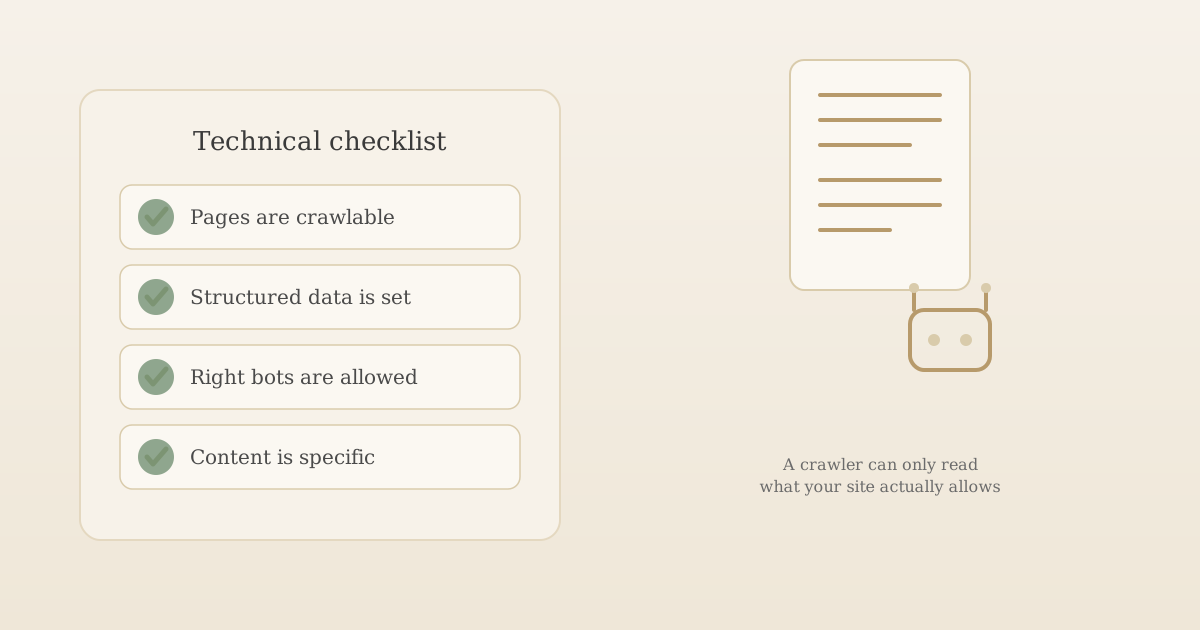
There's no separate technical standard called "AI search ready" that a website either passes or fails. What Google's own AI Overviews and AI Mode draw on is the same crawlable, indexable, well-structured page that ordinary Google Search has always needed, and what AI chat tools like ChatGPT and Perplexity draw on is whatever they can find and read when their own crawlers visit your site. Making your therapist website ready for AI search, in practice, means confirming four ordinary things are true: your pages can be crawled, your structured data is set correctly, the crawlers you want are actually allowed in, and your content is specific enough to be worth citing. None of it is exotic. Most of it is either already handled by a well-built site or a five-minute check.
Where a lot of "AI search optimisation" advice goes wrong
Search for AI search optimisation for therapists and you'll find no shortage of agencies selling audits, chunked-content rewrites and "AI schema" packages. Some of that advice is harmless but pointless. Some of it actively contradicts what Google itself says. Google's guide to optimising for generative AI features is direct on this point: there's no requirement to rewrite content into short, AI-friendly chunks, no special writing style, and no markup beyond ordinary good SEO practice. A therapist website doesn't need restructuring "for AI." It needs the same clear, accurate, genuinely useful page it would want for a human reader, built on a technical foundation that lets crawlers actually read it. The rest of this guide is that foundation.
The technical basics Google actually asks for
Google's Search Essentials documentation is unusually blunt about how little this really takes: "There are actually very few technical things you need to do to a web page; most sites pass the technical requirements without even realizing it." The requirements it does set out are the same ones that have always mattered for ordinary Search, and they're the same foundation AI Overviews and AI Mode build on, since neither is a separate index:
- Googlebot can actually reach the page. Nothing in your robots.txt or a stray
noindextag is blocking it. - The page is genuinely indexable. It returns a real 200 response, isn't accidentally canonicalised to a different URL, and isn't hidden behind a login or paywall.
- Links work. Internal links use real
<a href>markup a crawler can follow, not JavaScript-only navigation with no fallback. - The content itself is the useful part, not a thin wrapper around content that exists in full elsewhere.
Our guide to SEO for therapists covers this same foundation in more depth for ordinary Google rankings. The point worth taking from Google's own wording here is that there's no separate "AI" checklist sitting on top of it; get this right once and both the ranked results and the AI features built on top of them benefit.
The structured data this site already generates
This is the part genuinely worth being concrete about, since "structured data" gets thrown around vaguely a lot. This site automatically generates Organization and WebSite structured data site-wide, plus BlogPosting, FAQPage and BreadcrumbList data on every article, built straight from each post's own frontmatter (the title, author, dates, FAQ questions and category you're reading right now). None of it is bespoke per post. It's generated once, correctly, and applied everywhere, which is the point: structured data that's mostly right on some pages and missing on others is worse than a genuinely simple, consistent set applied everywhere.
That's also, per Google's own guidance quoted above, already enough. There's no additional "AI schema" type to add on top of Organization, BlogPosting and FAQPage. If your own website has these four covering your homepage, your bio and services, your blog posts and your FAQ content, you've covered what Google's guidance actually asks for. If you're not sure whether yours does, Google's free Rich Results Test tool will show you exactly what structured data a given page outputs, just paste in the URL.
Letting the right crawlers in
This is the one part of "AI search readiness" that's genuinely a live decision rather than something already handled, because the AI tools sit outside Google Search and each runs its own separate crawler with its own purpose. A blanket "allow everything" or "block everything" in robots.txt treats them as one thing when they're not:
| Crawler | Belongs to | What it's for | Blocking it affects |
|---|---|---|---|
| Googlebot | Standard Search indexing, including AI Overviews and AI Mode | Your Google Search visibility entirely | |
| Google-Extended | Training future Gemini models | Nothing in Search; a separate, content-licensing choice | |
| OAI-SearchBot | OpenAI | Surfacing your site in ChatGPT's search feature | Whether you appear in ChatGPT search answers |
| GPTBot | OpenAI | Training OpenAI's foundation models | Nothing in ChatGPT search; a training-data choice |
| PerplexityBot | Perplexity | Surfacing your site in Perplexity's answers | Whether you appear in Perplexity's answers |
Google's own documentation confirms that "utilizing Google-Extended doesn't affect a site's inclusion in Search, nor do we use Google-Extended as a ranking signal in Search," which is the same pattern OpenAI and Perplexity follow: the crawler that feeds their live answers is separate from the one that trains their underlying model, and only the first one affects whether you show up anywhere. OpenAI's crawler documentation lists OAI-SearchBot and GPTBot as exactly this kind of pair, and Perplexity's own documentation confirms PerplexityBot "is not used to crawl content for AI foundation models," it exists specifically to surface pages in answers.
The practical upshot: if you want your website to show up when someone asks an AI assistant a question, make sure the search-facing crawlers, OAI-SearchBot, PerplexityBot and ordinary Googlebot, aren't blocked. Whether you also allow the training-only bots, GPTBot and Google-Extended, is a separate content-licensing preference with no visibility consequence either way. Most website builders and hosting setups allow all of these by default; the thing worth actually checking is whether your robots.txt (usually at yoursite.co.uk/robots.txt) contains a blanket Disallow: / that's accidentally blocking everyone, search-facing bots included.
AI search technical readiness checklist
- Checked your robots.txt doesn't accidentally block Googlebot, OAI-SearchBot or PerplexityBot
- Confirmed your pages return a real response and aren't hidden behind a login, using the URL Inspection tool in Search Console
- Checked what structured data your key pages actually output with Google's Rich Results Test
- Made sure your bio, fees and specialisms are stated in plain, specific text rather than an image or a PDF a crawler can't read
- Confirmed internal links use real
<a href>markup, not JavaScript-only navigation - Decided your position on Google-Extended and GPTBot (block, allow, or leave the default) as a content-licensing choice, separate from any visibility concern
What this checklist won't do
Getting all of the above right makes your site technically legible to both Google and the AI tools sitting outside it. It won't guarantee a specific AI Overview mentions you, and no credible service can promise that either, a point our AI search for therapists guide covers in more detail, including why the accurate, consistent information across your website and professional listings matters as much as anything technical. Think of this checklist as removing the technical reasons an AI tool couldn't read your site properly, not as a ranking lever in its own right.
Frequently asked questions
Which structured data types does a therapist website actually need?
Five cover it in practice: Organization and WebSite site-wide, then BlogPosting, FAQPage and BreadcrumbList on each article. That's the complete set a well-built therapist website needs, generated once and applied consistently, rather than added per page by hand. There's no separate 'AI' schema type on top of these; Organization, BlogPosting and FAQPage are the same structured data Google has asked for since before AI Overviews existed.
What is Google-Extended and should I block it?
Google-Extended is a separate robots.txt token from Googlebot that controls whether your content can be used to train future Gemini models. Google states plainly that blocking it has no effect on your inclusion in Search or your rankings, since it isn't used as a ranking signal. Whether to block it is a content-licensing preference, not an SEO decision; there's no visibility cost either way.
Do I need to allow every AI crawler on my website?
No, and they're not all the same. Bots that power an AI tool's live search feature, such as OAI-SearchBot or PerplexityBot, need access if you want your site to appear in that tool's answers. Bots used only for training foundation models, such as GPTBot or Google-Extended, can be blocked without affecting your visibility anywhere, since they're not connected to search results at all.
Can a website builder stop me doing any of this?
Some can, yes. Editing robots.txt directly, or confirming exactly which structured data a page outputs, isn't always exposed in a drag-and-drop builder's settings panel. It's worth checking before you commit to a platform if this level of control matters to you; our comparison of website builders against a custom-built website covers what's typically editable and what isn't.
The short version
Being ready for AI search isn't a separate project. It's confirming your site is crawlable, that its structured data is set correctly and consistently, that the crawlers powering AI search features aren't accidentally blocked, and that your actual content is specific enough to be worth citing. Get those four things right once, on a technical foundation that's the same one ordinary SEO has always needed, and there's nothing further to chase.
A website that's technically ready from day one
UpTopWeb builds therapist websites with the right structured data, clean crawlable markup and no accidental robots.txt blocks, so nothing gets in the way of being found.
Get a free website