AI search
Will AI Search Change How Clients Find a Therapist?
What Google's AI Overviews and tools like ChatGPT actually mean for how clients find a UK therapist, and what your website genuinely needs to do about it.
On this page10 sections
Some clients now find a therapist by typing a question into ChatGPT, Copilot or Gemini rather than Google, or by reading the AI-generated summary that sits above Google's own results before they click anything at all. This guide explains what AI search for therapists actually means in plain terms, what the evidence says about how much this is really changing client behaviour in the UK, and what Google itself says you genuinely need to do about it, as opposed to what various "AI SEO" services would like you to believe you need to buy.
Key takeaways:
- AI Overviews are a feature inside Google Search, sitting above the normal results, not a separate search engine you need to optimise for differently.
- Google's own guidance, last updated July 2026, states plainly that no special files, markup or writing style are required to appear in AI Overviews or AI Mode: the same SEO fundamentals that already help your site apply.
- You do not need an
llms.txtfile for Google. It's harmless to have, but Google explicitly says it neither helps nor hurts your visibility, since Google Search ignores it. - Chat tools like ChatGPT, Copilot, Gemini, Claude and Perplexity work differently from Google and have no published rulebook, but ChatGPT dominates web traffic among them (roughly 79% per StatCounter), so it's worth the most attention if you can only focus on one.
- The same accurate, consistent information across your website and professional listings is the closest thing to good practice for all of these tools right now, since none of them publish a rulebook the way Google does.
- Local questions to AI chat tools increasingly come back as a map with pinned results, not a written answer, but a pin only shows a name, rating and category: your actual website is still what someone reads before deciding to get in touch.
- Real UK data shows AI tool use rising fast, but reading an AI summary isn't the same as choosing a therapist from it: this is a channel worth understanding, not a reason to rebuild your website.
What "AI search" actually means for therapists
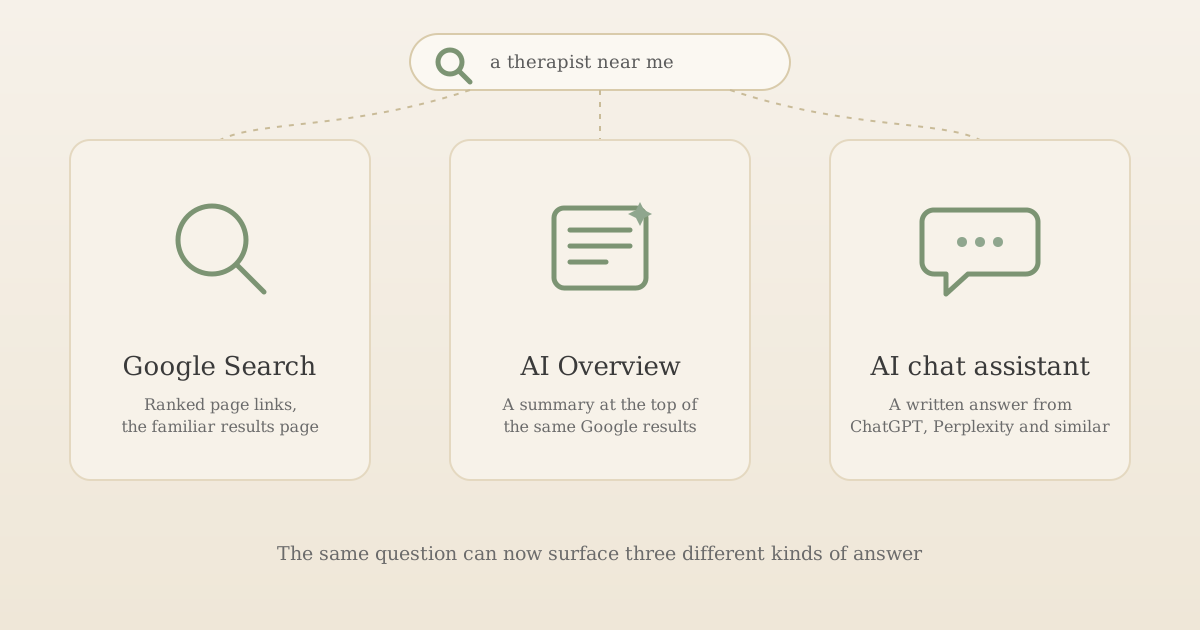
"AI search" isn't one thing, and mixing up the three versions makes it easy to either panic or ignore it entirely. For a UK therapist trying to be found online, it currently breaks down into:
- AI Overviews. A short, AI-generated summary that Google sometimes shows above its normal list of ranked links, built from the same web pages Google would otherwise show you. Google's own explanation of AI features in Search describes it as helping people "quickly grasp complicated topics" while still surfacing supporting links, not replacing them.
- AI Mode. A more conversational version of Google Search, where someone can ask a follow-up question and get a synthesised answer drawing on a wider set of sources than a typical results page shows.
- AI chat assistants. Standalone tools such as ChatGPT, Microsoft Copilot, Google Gemini, Anthropic's Claude and Perplexity, used as a destination in their own right rather than a feature bolted onto search. Someone might ask one directly "how do I find a good therapist near me" and get a written answer with no results page involved at all.
The first two sit inside Google, governed by Google's own search guidance below. The third sits outside it entirely, with no equivalent published rulebook, which is the split that matters most for what you can actually do about each one.
Which AI tools do people actually use?
Worth being specific here rather than treating "AI search" as one undifferentiated thing, because the tools genuinely aren't used equally. StatCounter's Global Stats, a widely cited web analytics tracker that measures which AI chatbot sites people actually visit, put ChatGPT at roughly 79% of worldwide AI-chatbot web traffic in August 2026, with Google Gemini a distant second at around 11%, Perplexity at around 4%, and Microsoft Copilot and Anthropic's Claude each at around 3%.
Two caveats worth stating plainly. First, this measures visits to each tool's own website, not app usage, workplace use through Microsoft 365 (where Copilot shows up without anyone visiting copilot.microsoft.com), or Gemini's presence inside Google's own apps, so treat it as a directional picture rather than an exact census. Second, it says nothing about which tool someone chooses for a question as personal as finding a therapist specifically, no provider publishes that breakdown. What it does support is a sensible order of attention: ChatGPT is worth understanding in the most detail simply because of scale, Gemini and Copilot are worth a basic awareness of given their built-in distribution through Google and Microsoft's own products, and the underlying advice, consistent, accurate information wherever you're listed, holds across all of them regardless of which one happens to be asked.
Is this actually changing how people look for a therapist yet?
It's genuinely happening, though it's easy to overstate how far it's got. Ofcom's Adults' Media Use and Attitudes 2026 report, published 2 April 2026, found that just over half of UK adults (54%) now say they use AI tools such as ChatGPT, Copilot or Gemini, up from three in ten (31%) the year before, with usage highest among 16 to 34 year-olds. Separately, more than half of adults (54%) say they read AI-generated search summaries at least sometimes, and that holds even among people who don't use a chatbot directly.
What that data doesn't show is how often reading a summary actually leads to someone choosing and contacting a specific therapist, which is a different, much less measured step. For a decision as personal as therapy, it's reasonable to expect that a name, a face and a website someone can actually read still matter more than they would for a quick factual question. Treat the Ofcom figures as evidence that this channel is real and growing, not as proof that it's already replacing how most clients find you.
What Google actually says you need to do about it
This is the part worth reading carefully, because it directly contradicts a lot of what gets sold as "AI SEO." Google's own guide to optimising for generative AI features, last updated 10 July 2026, is unusually direct:
"You don't need to create new machine readable files, AI text files, markup, or Markdown to appear in Google Search (including its generative AI capabilities), as Google Search itself doesn't use them."
That includes llms.txt specifically. Google says creating one "will neither harm nor help your site's visibility or rankings in Google Search, as Google Search ignores them." The same guidance rules out needing special schema.org markup beyond what already supports standard SEO, and rules out any requirement to rewrite your content into short chunks or a different tone "just for" AI. What Google does ask for is the same foundation covered in our guide to SEO for therapists: a clear technical structure, proper indexing, and, in Google's own words, "non-commodity content that's helpful, reliable, and people-first." If you want the specific, checkable version of that technical foundation, including which AI crawlers to actually allow in your robots.txt, see our guide to making your therapist website ready for AI search.
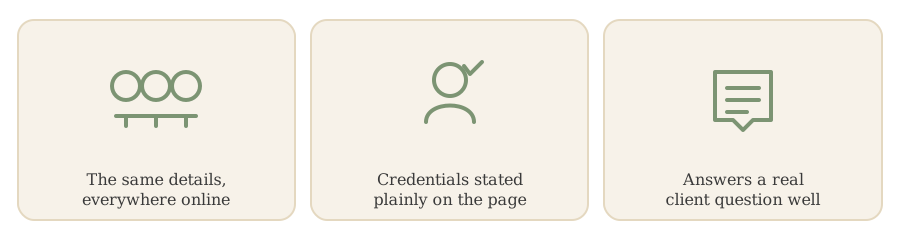
In practice, that means the trust signals already covered in our guide to what a therapist website should include, a clearly written bio, your registration body, your specialisms, your fees, matter for AI Overviews for the same reason they matter for a human reading your homepage: an AI summary can only reflect information that's actually on the page, clearly stated.
What about ChatGPT, Copilot, Gemini and the rest?
Here the honest answer is that nobody, including the AI companies themselves, has published anything close to Google's level of detail. ChatGPT, Microsoft Copilot, Anthropic's Claude and Perplexity aren't Google Search features, so Google's guidance above doesn't apply to them, and each one sources and weighs information differently. Google's own Gemini app sits somewhere in between, built by the same company as Search, but Google hasn't published assistant-specific guidance for it the way it has for AI Overviews and AI Mode. What's reasonably safe to assume, without overclaiming, is that a language model trying to answer "who's a good therapist for anxiety in Bristol" has to draw on whatever it can find: your website, your professional body listing, directory profiles, and anywhere else your name and details appear.
The practical implication is less about any single trick and more about consistency: the same name, location, credentials and areas of focus, stated the same way across your website and the other places you're listed, the kind of consistency our guide to local SEO for therapists already recommends for Google's local results. If an AI assistant finds conflicting details about you in different places, it has no reliable way to know which one is current, which is exactly the situation a well-kept website and accurate directory listings are meant to prevent regardless of who or what is reading them.
When the answer is a map, not a paragraph
Search behaviour is genuinely shifting in one specific way worth planning for: local questions increasingly come back as a map, not text. OpenAI's own help documentation for ChatGPT search confirms this directly, "ChatGPT can also use location information to find local results" and "on iOS and Android, relevant results may also include a map", the same shift Perplexity and Google's AI Mode have made in their own local results.
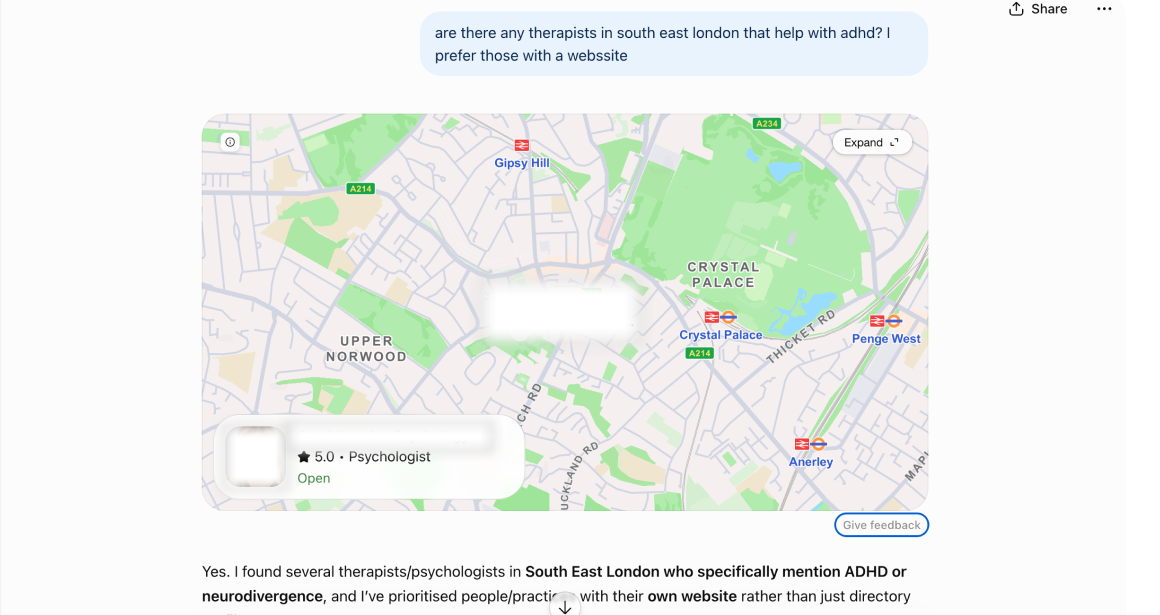
In practice, this changes how someone actually searches. A client rarely asks one perfect question. They typically start broad, "therapists in south east London who work with ADHD", then drill down once they see the map: a specific pin, a specific neighbourhood, a specific practice worth a closer look. That's the same broaden-then-narrow pattern our guide to local SEO for therapists already covers for Google, just showing up in a new place.
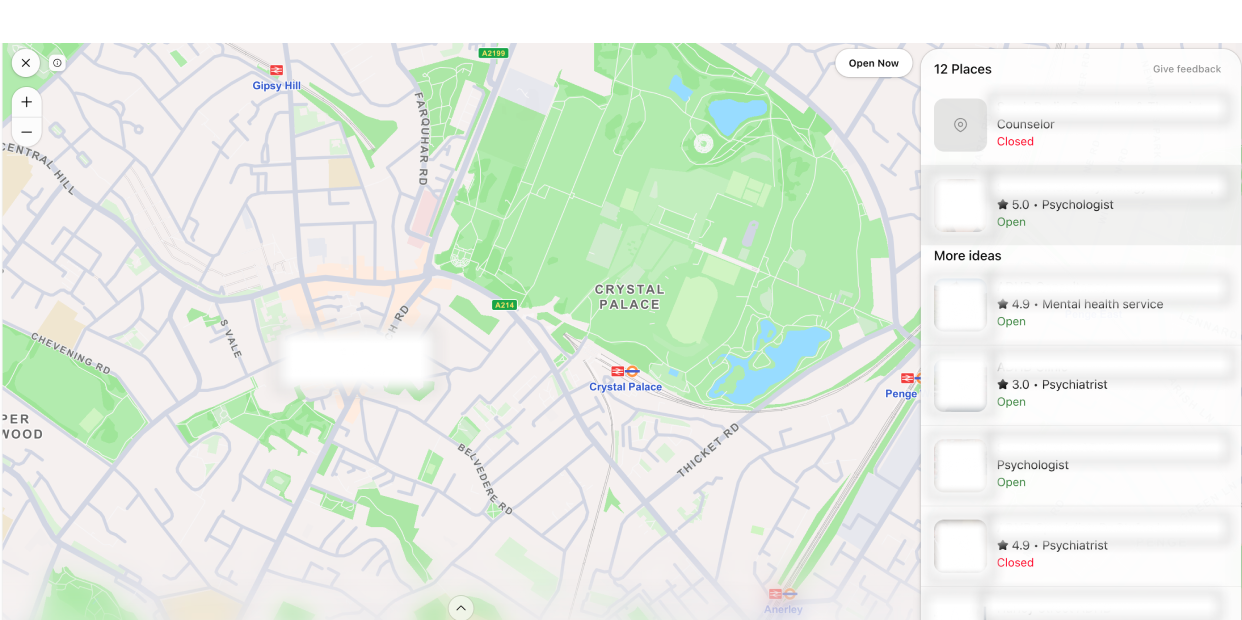
The drill-down doesn't stop at the map. Selecting "Expand" turns the handful of pins into a ranked list, in this example, twelve places, each with a rating and an open or closed status, which is exactly the kind of shortlist someone scans before picking one to look at properly.
Tapping through to one of those results is where it gets genuinely interesting. The example below shows a fuller profile: photos, a short description, an HCPC registration badge, and specific service highlights, considerably more than a bare pin. And its own next step, the button the interface itself puts front and centre next to "Directions", is labelled "Website."
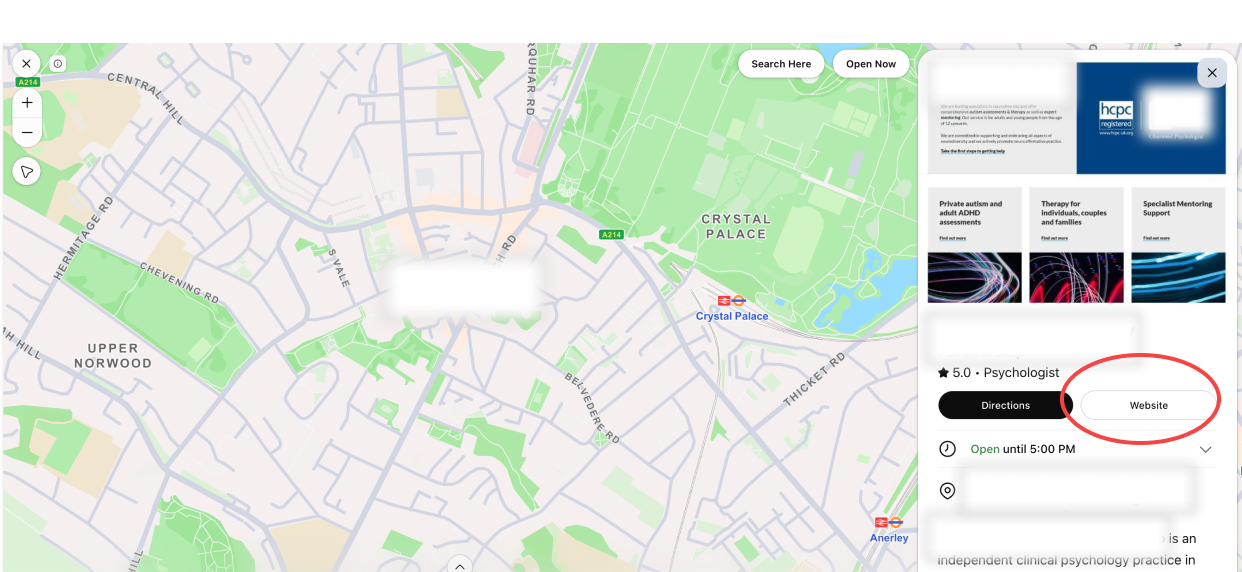
That's worth sitting with. Even inside a tool built to answer questions directly, whoever designed this particular result decided that a decision this personal, who to trust with your mental health, still needs to end at a real website rather than a completed AI answer. A photo gallery and a badge can establish some baseline credibility, but they can't substitute for the fuller bio, approach and fees only your own site states in full.
There's a related pattern worth naming: someone might ask an AI chatbot general questions about their own anxiety, low mood or ADHD long before they search for a named therapist at all. That doesn't remove the eventual need for a real, qualified person, if anything, it means the search that follows is more specific and better informed, and a specific page on your website that actually answers that narrower question is better placed to satisfy it than a thin directory profile competing with dozens of others in the same crowded map.
None of this comes with a guarantee. OpenAI is explicit that "placement is not guaranteed" in ChatGPT's search results, and the one concrete, verifiable technical step available, as opposed to a paid promise, is making sure your website allows OpenAI's own crawler, OAI-SearchBot, the same way you'd already allow Googlebot.
What to actually skip
A few things worth being sceptical of, given what Google's own guidance says above:
- Paid "AI SEO" or "GEO" audits promising guaranteed ChatGPT or AI Overview rankings. No credible party, including Google, currently offers that guarantee for any AI feature, so treat one as a sales claim rather than a technical fact.
- Rewriting your whole site "for AI." Google explicitly says there's no special writing style, chunking format or markup required. Money spent rebuilding a site that already serves human readers well is very likely better spent elsewhere, including on the genuine marketing work of being found and chosen in the first place.
- Adding an
llms.txtfile and expecting a ranking change. It's harmless, and cheap enough to add as speculative insurance for tools that might read it later, but per Google's own wording it does nothing for Google Search today. Don't pay someone to "implement" it as though it were a meaningful project.
AI search checklist for a therapist website
- Confirmed your name, location, credentials and specialisms read the same way on your website, your professional body listing and any directories you use
- Checked your website is indexed and shows up for your own name in Google, the baseline requirement for appearing in any of Google's AI features
- Made sure your bio, fees and approach are stated in plain, specific language rather than vague marketing copy, since that's what both people and AI summaries actually draw on
- Kept the existing FAQ and structured data your site already has for standard SEO, rather than adding anything new purely for "AI"
- Skipped any paid service promising a guaranteed AI Overview or ChatGPT ranking
Frequently asked questions
Do I need an llms.txt file for my therapist website?
No, not for Google. Google's own AI-optimisation guidance says explicitly that you don't need to create llms.txt or any other AI text file to appear in Google Search or its AI features, and that doing so neither helps nor harms your visibility there. Some other AI tools may read it in future, so it's a low-cost thing to have if you want the insurance, but it isn't a requirement and shouldn't be sold to you as one.
Will AI search replace Google for people looking for a therapist?
There's no evidence of that happening. AI Overviews are a feature inside Google Search, sitting above the same ranked results, not a separate system replacing it. Chat-based tools like ChatGPT and Perplexity are a genuinely different, additional way people look things up, used alongside search engines rather than instead of them for most people, based on current UK usage data.
Do I need special structured data or schema markup to appear in AI Overviews?
Google says no: there's no special schema.org markup required for generative AI search beyond ordinary good practice. The FAQ and article structured data this site (and most well-built therapist websites) already generates for standard SEO reasons is enough; you don't need to add anything extra purely for AI features.
How can clients find me through ChatGPT, Copilot or another AI assistant instead of Google?
There's no official rulebook for this the way there is for Google Search, since each AI provider works differently and none publish detailed guidance for site owners. ChatGPT is worth the most attention simply on scale, StatCounter put it at roughly 79% of worldwide AI-chatbot web traffic in August 2026, well ahead of Gemini, Perplexity, Copilot and Claude, but the same safe approach applies to all of them: keep your name, location, credentials and services accurate and consistent across your own website, your professional body listing, and any directories you're on, since that consistency is what a language model has to work with when it tries to describe you accurately.
The short version
AI search is a real, fast-growing way some clients now start looking for a therapist, but it isn't a separate discipline with its own rules to chase. Google's own current guidance says the fundamentals you'd want anyway, a clear, accurate, genuinely useful website, are the same fundamentals that help with AI Overviews, and nobody credible can yet tell you a reliable trick for the chat assistants sitting outside Google entirely. Get the basics right once, keep your details consistent everywhere you're listed, and treat anyone selling you a guaranteed AI ranking with real scepticism.
A therapist website built on the fundamentals, not the hype
UpTopWeb builds clear, accurate websites for counsellors and therapists, so whatever's reading your page, human or AI, finds the same trustworthy information.
Get a free website