Training & CPD
EMDR Training for Counsellors (UK): Who Can Train and What It Costs
Who can do EMDR training in the UK, why counsellors need full accreditation first, what the 7-day training costs, and the steps to practitioner accreditation.
On this page9 sections
EMDR training for counsellors in the UK has a firm front door: you need full accreditation with a recognised professional body before you can start, not just a counselling diploma. This guide explains who can train, what the 7-day standard training involves, what it costs, the steps from training to EMDR Europe practitioner accreditation, and how to describe each stage honestly on your website. Fees and criteria were checked on the EMDR Association UK's and trainers' own pages on 4 November 2026.
EMDR (eye movement desensitisation and reprocessing) is a trauma-focused therapy, and it's one of the few models that clients search for by name. That makes it a strong addition to a private practice, but only once you can offer it properly.
Key takeaways:
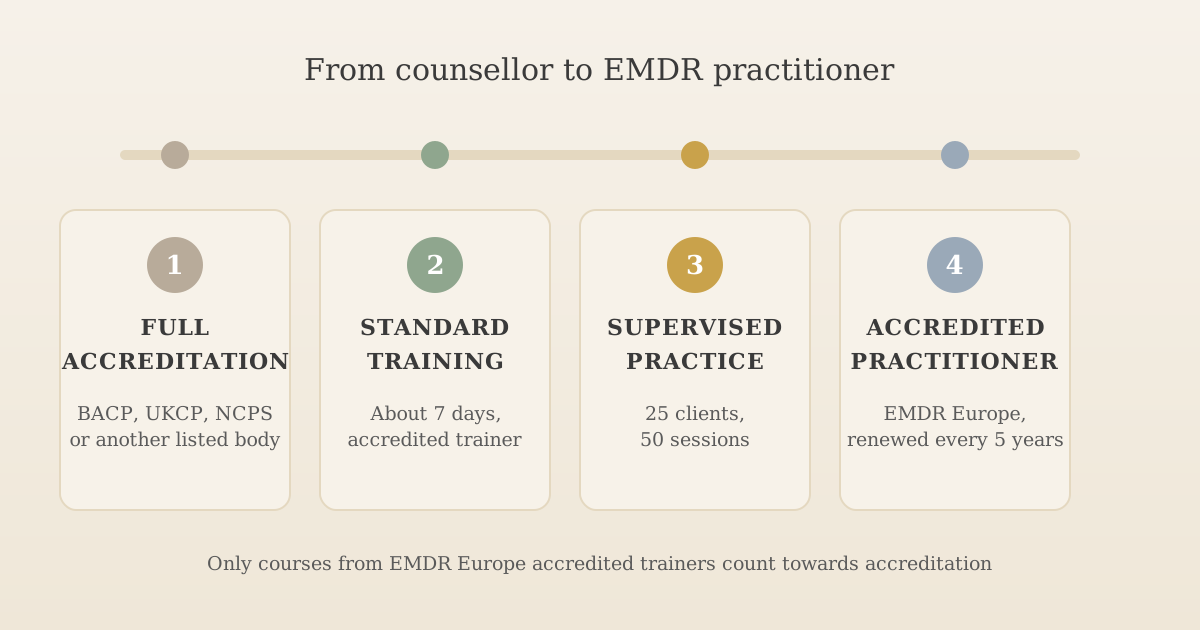
- Counsellors and psychotherapists must hold full accreditation with a listed body, such as BACP, UKCP, NCPS (Accredited Professional grade) or COSCA, before EMDR training. Registration alone isn't enough.
- You also need one-to-one therapy as a significant part of your current role, your supervisor's support and access to training cases.
- Only trainers on the EMDR Association UK's list are EMDR Europe accredited. A course from anyone else won't count towards accreditation.
- The standard training is usually seven days (Parts 1 to 3). One published price is £1,699 including VAT; supervision, membership and the accreditation fee come on top.
- Practitioner accreditation needs at least 50 EMDR sessions, 25 clients after training and around 20 hours of supervision from an accredited consultant.
- On your website, say exactly which stage you've reached.
Important: This is a practical overview, not careers or professional advice. The EMDR Association UK and individual trainers decide applications, and criteria, fees and dates change. Check the association's current pages, your trainer's terms and your professional body's requirements before you book or change how you describe your practice.
Can counsellors do EMDR training?
Yes, but not straight after qualifying. The EMDR Association UK's training page sets out entry criteria that every UK trainer must follow, as set by EMDR Europe. Counsellors and psychotherapists must hold full accreditation with one of these bodies:
- BACP (British Association for Counselling and Psychotherapy)
- UKCP (UK Council for Psychotherapy)
- BABCP (British Association for Behavioural and Cognitive Psychotherapies)
- British Psychoanalytic Council
- NCPS, at Accredited Professional grade
- COSCA (Counselling & Psychotherapy in Scotland)
- COSRT (College of Sexual and Relationship Therapists)
- FDAP members who are NCAC accredited
- Association of Child Psychotherapists
Every applicant, whatever their profession, also needs:
- one-to-one psychotherapy as a significant part of their current primary role
- the full support of their clinical supervisor to attend
- access to training cases for the whole course.
The association is blunt about the risks of getting this wrong. If you train without meeting the criteria, you won't be eligible for accreditation. If you train with someone who isn't an EMDR Europe accredited trainer, you can't join the association or apply for accreditation at all. Its page lists the accredited trainers, and it says anyone not on the list is running a non-accredited course.
If you're hoping to use EMDR in NHS services, the association also points to extra NHS England supervision, eligibility and competence requirements for EMDR therapists. Read those before you apply if NHS work is part of your plan.
How long until you're eligible
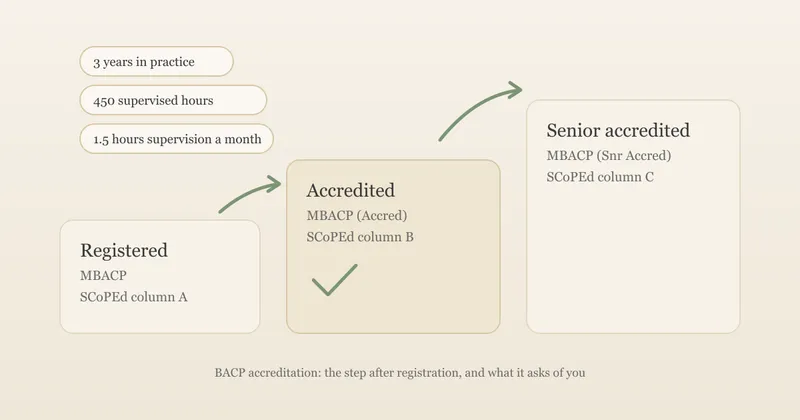
For most counsellors, the wait is the time it takes to become accredited with their own body. For a BACP member, that means at least three years in practice and 450 supervised hours before applying, as our guide to BACP accreditation explains. Other bodies set their own routes; our comparison of BACP, NCPS and UKCP covers how their accredited grades differ.
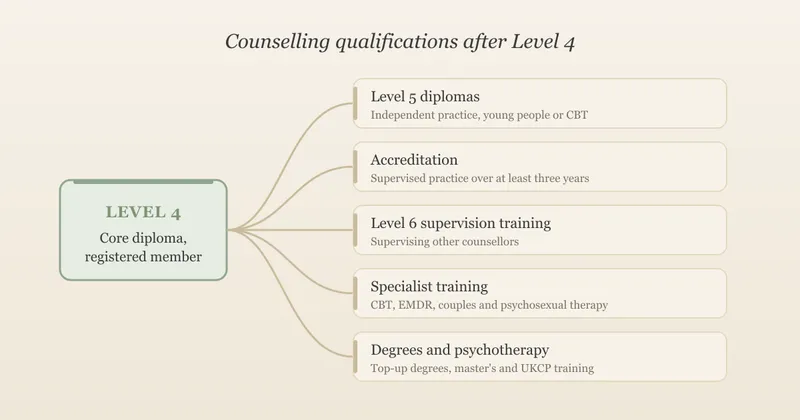
If you're earlier in your career, our guide to counselling qualifications after Level 4 compares the routes you can take in the meantime. Trauma-informed CPD and supervision with someone who works with trauma are useful preparation. A short course that calls itself "EMDR" but isn't run by an accredited trainer isn't, and it won't count later.
What EMDR standard training involves
The association describes the standard accredited training as usually a seven-day course. Trainers may call it Parts 1 to 3 or Parts 1 to 4, and older materials call it Levels 1 and 2. The parts are normally spread over several months, so you can practise between them.
Two requirements are built in:
- You must use EMDR with at least three clients in your own practice during the training. That's why access to suitable training cases is an entry criterion.
- Supervision starts during training. Some trainers include a short supervision session as the final part. The association's accreditation form counts ten hours of supervision from Parts 1 to 3 towards the 20 or so needed for accreditation, but clients discussed only at the training don't count.
Specialist training, such as EMDR with children and adolescents, comes after the standard training and has its own eligibility criteria.
What EMDR training costs
Trainers set their own fees, and several don't publish them. One that does, EMDR Masterclass, listed these prices on 4 November 2026. We use it as an example, not a recommendation:
| Part | Price including VAT |
|---|---|
| Part 1 | £696 |
| Part 2 | £222 |
| Part 3 | £696 |
| Part 4 (3 hours' supervision to complete the training) | £85 |
| Total, paying for each part | £1,699 |
| Total, paying for all parts in advance | £1,615 |
Budget for these on top:
- EMDR Association UK membership: £80 a year for full members, according to its membership page. You need to be a member to apply for accreditation, though not to train.
- Supervision from an EMDR Europe accredited consultant. Consultants set their own rates. Ask before you start, because you'll need around ten further hours after the training.
- The practitioner accreditation fee: £85 on the association's offline application form. Online applications are paid through its membership system.
- Travel and time away from clients if your training is in person.
When you compare trainers, ask each one for the full cost of Parts 1 to 3, any supervision part and VAT, so you're comparing like with like.
From training to EMDR Europe Accredited Practitioner
Finishing the standard training means you're trained in EMDR. It doesn't make you accredited. The association's accreditation page describes three levels: Practitioner, Consultant and Trainer. The practitioner application form lists these criteria:
- membership of the EMDR Association UK
- certificates for standard training Parts 1, 2 and 3
- current registration as a recognised mental health professional, with at least two years' experience after qualifying
- at least one year of using EMDR after completing the standard training
- at least 50 EMDR sessions since starting the training, and 25 clients treated after it, confirmed by your consultant
- competence across the association's framework, which it estimates takes at least 20 hours of supervision with an accredited consultant (ten of which can come from the training)
- your consultant having seen your EMDR work directly, on video or in person, and a reference from them.
Accreditation lasts five years, then you apply for re-accreditation. Accredited practitioners can be listed in the association's Find a Therapist directory, which the association says is so that potential clients and referrers can find you.
Consultant accreditation, which lets you supervise other EMDR therapists, needs further training, supervision and at least three years of EMDR practice. That's a route for later.
Is EMDR training for counsellors worth it in private practice?
For a counsellor who already works with trauma, often yes. Clients search for "EMDR therapy" by name far more often than therapists search for EMDR training, which is unusual for a therapy model. The NICE guideline on post-traumatic stress disorder recommends that adults with PTSD who present more than three months after a non-combat-related trauma are offered EMDR, typically over 8 to 12 sessions. So some clients arrive already asking for it.
Weigh these before you commit:
- Cost and time: around £1,700 for training, then supervision and membership, and well over a year to accreditation.
- Caseload: you need enough suitable clients to reach 25 after training. If trauma work is a small part of your practice, that could take a long time.
- Supervision: you'll need an EMDR consultant alongside, or as well as, your usual supervisor. Our guide to clinical supervision for counsellors covers how supervision requirements fit together.
- Insurance: check that your professional indemnity insurance covers EMDR before you use it with clients, including during training.
- Fit with private practice: trauma work can raise risk and safeguarding questions. Think about how you'll assess suitability, and what you'll do when a client needs more support than private sessions can offer.
How to describe EMDR training on your website
Clients searching for EMDR will check what you say, and the 2026 BACP Ethical Framework asks you to describe your services and competence accurately. Our BACP Ethical Framework 2026 checklist covers the detail. In practice, match your wording to your stage:
| Your stage | Wording that fits |
|---|---|
| Accredited counsellor, not yet trained | Don't mention EMDR as a service. Trauma experience can be described on its own terms |
| Partway through standard training | "Currently completing EMDR Europe accredited training (Parts 1 to 3), finishing 2027" |
| Completed standard training | "Trained in EMDR (EMDR Europe accredited standard training, 2027)" |
| Accredited | "EMDR Europe Accredited Practitioner", with a link to your Find a Therapist listing |
A few more points:
- Don't promise outcomes. "EMDR will cure your trauma" isn't a claim you can back up. If you mention NICE, quote it accurately: it recommends EMDR for specific groups with PTSD, not for every kind of distress.
- Explain it in plain words. Many clients have heard of EMDR but don't know what a session involves. A short description of the phases and what the first sessions focus on helps more than the acronym.
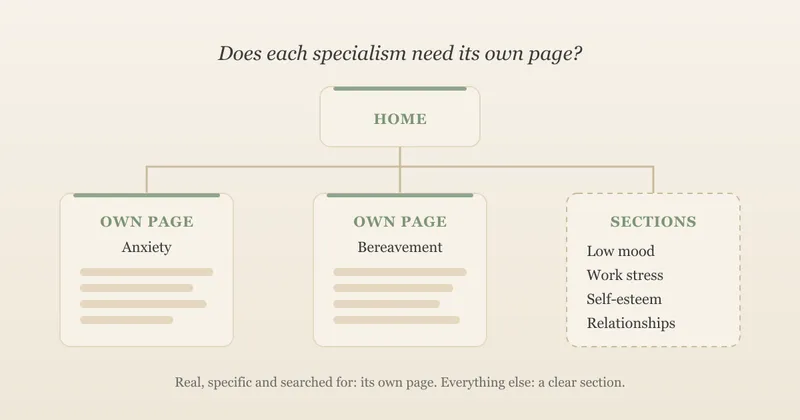
- Give it its own page if it's a big part of your work. Our guide to therapist service pages covers when that's worth it, and our guide to therapist website copy has examples of explaining an approach without jargon.
Frequently asked questions
Can I do EMDR training with a Level 4 counselling diploma?
Not on the diploma alone. The EMDR Association UK's criteria say counsellors and psychotherapists must hold full accreditation with a listed body, such as BACP, UKCP, BABCP, COSCA, COSRT, the British Psychoanalytic Council or NCPS at Accredited Professional grade. For a BACP member that means at least three years in practice and 450 supervised hours before you can apply for accreditation, so EMDR is a later step, not the next one after Level 4.
How much does EMDR training cost in the UK?
Trainers set their own fees. As one example, EMDR Masterclass listed its standard training at £1,699 including VAT for Parts 1 to 3 and the Part 4 supervision when we checked on 4 November 2026, or £1,615 paid in advance. On top of that, budget for EMDR Association UK membership (£80 a year), supervision from an EMDR Europe accredited consultant, and the practitioner accreditation fee (£85 on the association's offline application form).
How long does it take to become an EMDR Europe Accredited Practitioner?
Usually well over a year after you start training. The standard training is about seven days, normally spread over several months. Practitioner accreditation then asks for at least a year of using EMDR after training, at least 50 EMDR sessions, 25 clients after training and around 20 hours of supervision from an accredited consultant, with ten of those hours counted from the training itself.
How can I tell if an EMDR course is properly accredited?
Check the trainer against the EMDR Association UK's list of EMDR Europe accredited trainers. The association says that if a trainer isn't on its list, the course isn't accredited by EMDR Europe, and that attending a non-accredited course means you can't join the association or apply for practitioner accreditation.
The short version
EMDR training for counsellors in the UK starts with full accreditation from your own professional body, so for most counsellors it's a step for a few years after qualifying. When you're eligible, choose a trainer from the EMDR Association UK's list, budget around £1,700 for the 7-day standard training plus supervision and membership, and plan for at least a year of supervised practice before practitioner accreditation. Then say exactly which stage you've reached on your website, so clients searching for EMDR know what you offer.
Show clients what you offer, accurately
UpTopWeb builds calm, professional websites for counsellors and therapists, with clear pages for each approach you offer and unlimited edits as your training progresses, all for one monthly fee.
Further reading
Related articles
Training & CPD13 minute read
Counselling Qualifications After Level 4: Your UK Options
Training & CPD12 minute read
BACP Accreditation: Is It Worth It for Private Practice? (UK Guide)
Therapist websites16 minute read
Therapist Service Pages: Does Each Specialism Need Its Own Page?