Starting a practice
BACP vs NCPS vs UKCP: Which Professional Body to Join?
BACP, NCPS or UKCP? How the three registers compare on 2026-27 fees, entry routes, accreditation and advertising rules, plus a quick test for your practice.
On this page10 sections
BACP vs NCPS is the choice many UK counsellors face when they qualify, with UKCP as a third option for people on psychotherapy training. The short answer: all three run registers accredited by the Professional Standards Authority (PSA), so clients and most referrers treat them as equally checkable. What really separates them is which one your training leads to, what it costs each year, which referral routes and job adverts you want, and how strict each one is about advertising.
This guide is for counsellors and psychotherapists in the UK who are about to qualify, have just qualified or are thinking of adding a second membership before starting a private practice. It compares the registered level of each body side by side, explains the training routes onto each register, sets out 2026 to 2027 fees, compares how you progress to accreditation with each body, and ends with a quick decision test and how to show your membership on your website. Fees and rules are as published on each body's own website on 30 October 2026.
Important: This is a practical overview, not careers, regulatory or professional advice. Each body reviews its membership categories, fees and codes regularly, and SCoPEd alignment has been changing entry criteria during 2026. Check the current pages of the body you're joining before you apply, and talk your plans through with your tutor or supervisor.
BACP vs NCPS vs UKCP at a glance
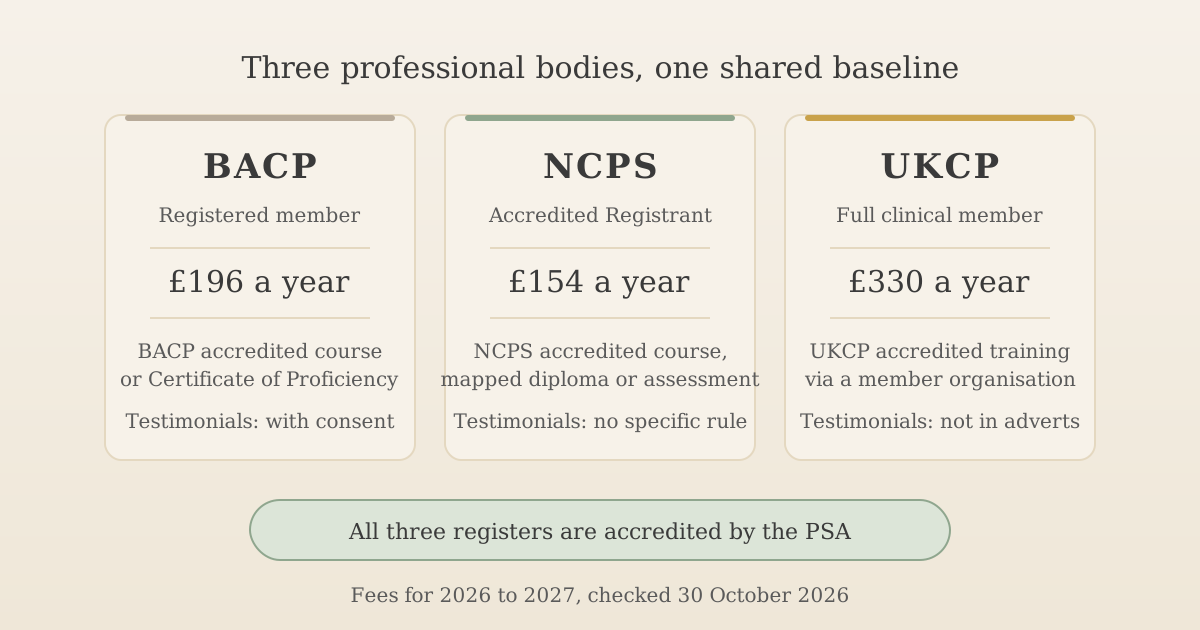
| BACP | NCPS | UKCP | |
|---|---|---|---|
| Full name | British Association for Counselling and Psychotherapy | National Counselling and Psychotherapy Society | UK Council for Psychotherapy |
| Registered level | Registered member (MBACP) | Accredited Registrant, MNCPS (Acc.) | Full clinical member, on the register as a psychotherapist or psychotherapeutic counsellor |
| Usual route onto the register | A BACP accredited course, or BACP's Certificate of Proficiency | An NCPS accredited course, a Level 4 diploma mapped to SCoPEd column A, or NCPS's competencies assessment | UKCP accredited training (or prior-learning accreditation) through one of UKCP's organisational members |
| Annual fee, 2026 to 2027 | £196 (£98 reduced) | £154 | £330 |
| Next level up | Accredited (column B), then senior accredited (column C) | Accredited Professional Registrant (column B), then Senior Accredited Registrant (column C) | No accredited grade to apply for: psychotherapeutic counsellors sit at column B and psychotherapists at column C, set by your training |
| Size | "Over 70,000" practitioners and organisations | Not published | "12K" individual members |
| Client testimonials | Not banned; BACP's directory allows short ones with permission | No specific rule; advertising must be truthful and follow the CAP Code | Not allowed "in any advertising" (clause 13) |
| PSA accredited register | Yes | Yes | Yes |
The figures come from each body's own pages, linked in the sections below. BACP's membership count includes organisations, and NCPS doesn't publish a figure, so treat size as a rough guide rather than a ranking.
What all three have in common
Counselling and psychotherapy aren't statutorily regulated in the UK: UKCP's statutory regulation page says so plainly, and adds that there is "currently no formal timetable" for that to change. In place of a legal register, the profession relies on voluntary registers that the PSA accredits. BACP, NCPS and UKCP all hold one, and all three have to meet the PSA's standards to keep it. A client can look you up through the PSA's check a practitioner search or the body's own directory, whichever register you're on.
All three are also among the six bodies that adopted the SCoPEd framework, the shared set of training and practice standards behind the "column A, B and C" language you'll see in membership criteria. NCPS's SCoPEd page says the framework was adopted in February 2023 by ACC, BACP, the British Psychoanalytic Council, NCPS, the Human Givens Institute and UKCP, and the partnership now calls itself the Partnership of Counselling and Psychotherapy Bodies. At registered level (column A), the bodies are describing broadly the same standard of qualified practitioner. That's why switching or adding a body later is usually a paperwork exercise, not retraining.
So the question isn't which body is "proper". It's which one fits your training, your budget and the work you want.
Your training decides most of it
Before comparing fees, check which register your course actually leads to. This is where most of the real difference lies.
BACP
To join BACP's register you first become an individual member, then apply for registration. BACP's individual membership page asks for a practitioner course of at least one year full time or two years part time with classroom tuition, plus a supervised placement of at least 100 client hours, and says courses that started from 1 February 2026 must align with SCoPEd. Solely online or distance courses don't qualify. You then have 24 months to "join the BACP Register".
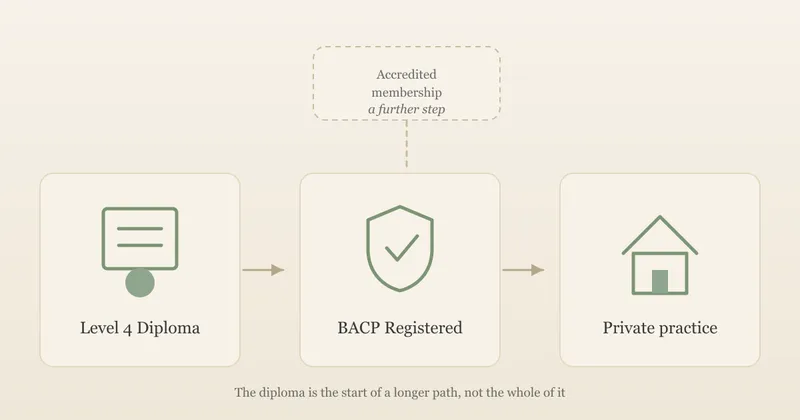
The registered membership page sets the step up: you must have "graduated from a BACP accredited course" or "passed our Certificate of Proficiency", and be in practice or have practised in the last three years. Our guide to whether a Level 4 diploma is enough for private practice walks through that route in more detail.
NCPS
NCPS's membership categories and criteria page describes the Accredited Registrant level as aligned to SCoPEd column A. You qualify with an NCPS accredited course, or an Ofqual regulated Level 4 diploma (or equivalent) that has been mapped to column A. The course must be at least two years part time with at least 300 guided learning hours and at least 100 hours of supervised placement, and online-only or distance courses aren't accepted. If your qualification hasn't been mapped, you can complete NCPS's Column A Competencies Evidence (CACE) assessment instead.
NCPS also writes its ongoing requirements into the category itself: an average of 1.5 hours of supervision a month and at least 30 hours of CPD on a rolling 12-month basis. BACP asks registered members for "adequate supervision" and ongoing CPD without fixing the numbers at registered level, as our guides to clinical supervision and CPD hours explain.
UKCP
UKCP works differently. You don't apply as an individual with any qualifying course. The pathways to full clinical membership page says you apply through an organisational member, having "completed and graduated from a UKCP accredited course" or been accredited on prior learning and experience by one of those organisations. UKCP's register page says psychotherapists "undergo a four-year, postgraduate, in-depth and experiential training", while psychotherapeutic counsellors train to a UKCP recognised standard, "normally graduate level or equivalent".
In practice, that means UKCP is mostly a choice you make when you pick your training, not when you finish it. If you're leaving a Level 4 diploma, your real comparison is BACP against NCPS. If you're on a UKCP accredited psychotherapy course, UKCP is the natural home, and some people add a second body as well (see below).
What it costs in 2026 to 2027
| Body | Category | Annual fee | Notes |
|---|---|---|---|
| BACP | Student | £94 (£47 reduced) | From the student membership page |
| BACP | Individual or registered | £196 (£98 reduced) | Reduced fee for people receiving certain state benefits or with no personal income |
| BACP | Accredited or senior accredited | £216 (£108 reduced) | Plus a one-off application fee; see our BACP accreditation guide |
| NCPS | Registrant | £154 | From the individual membership page, which says there's "no additional charge to change your membership category" |
| NCPS | Student | Reduced fee | NCPS doesn't publish the figure on its public pages |
| UKCP | Trainee | £82 | From the membership fees page |
| UKCP | Full clinical | £330 | £10 off for annual Direct Debit; quarterly instalments available; the membership year runs 1 October to 30 September |
NCPS also charges nothing for an initial application to move up a level, with small fees (£40 to £55) only for later resubmissions. BACP charges an application fee for accreditation. Membership fees for a practising therapist are usually an allowable expense, which our guide to allowable expenses for counsellors covers.
The difference between BACP and NCPS is £42 a year at full rate. That's real money in a first year of private practice, but it's small next to indemnity insurance, supervision or room hire, so it's rarely a good reason on its own to pick one over the other.
Where the difference shows up in private practice
Referral networks and insurers
Some referral routes ask for a specific status, not just "registered". Bupa's mental health network page asks for accreditation with BACP, UKCP or NCPS, and its network terms (updated February 2020) define a counsellor as "an accredited member" of one of the three. So for that route all three bodies count, but registered level alone doesn't. Our guide to referrals for therapists covers insurer networks, EAPs (employee assistance programmes) and GP routes in turn.
Job adverts and EAP contracts
Employers, charities and EAP panels write their own criteria. Some ask for "BACP registered or equivalent", some name a body, some ask for SCoPEd column B. Before you choose, read five or six real adverts or panel criteria for the work you'd want alongside private practice, and see what they actually say. That's a better guide than anyone's general impression of which body is "recognised".
Progression and accreditation
If you want to move beyond registered level one day, this is where the three bodies differ most. The shared SCoPEd framework (January 2022, amended 2025, page 13) places each body's membership levels in the same three columns:
- Column A: BACP registered member, NCPS Accredited Registrant. Around two years of core training, 300 to 400 training hours and 100 client hours.
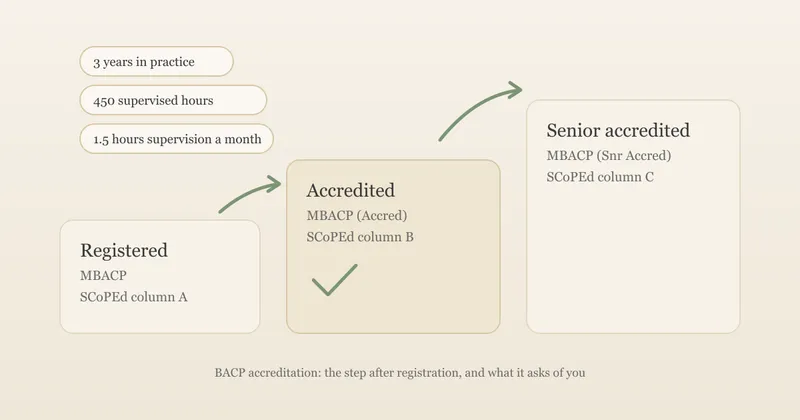
- Column B: BACP accredited member, NCPS Accredited Professional Registrant, UKCP psychotherapeutic counsellor. Three years, 450 training hours and 450 client hours.
- Column C: BACP senior accredited member, NCPS Senior Accredited Registrant, UKCP psychotherapist. Four years, at least 500 training hours and a Level 7 qualification.
UKCP has no column A category: its members join already at column B or C, depending on their training. BACP and NCPS both start at column A and let you apply to move up. Here's what that involves:
| Step up | BACP | NCPS | UKCP |
|---|---|---|---|
| To column B | Accredited member: three years in practice, 450 tutor contact hours, 450 supervised hours and 1.5 hours of supervision a month. £110 to apply if your core course was BACP accredited, £310 (with a portfolio and academic essay) if not | Accredited Professional Registrant: a year as an Accredited Registrant first, three years in practice, 450 tutor contact hours and 450 supervised hours. No fee for a first submission | Psychotherapeutic counsellor: comes with completing UKCP accredited training (Level 6 minimum, per SCoPEd), not a later application |
| To column C | Senior accredited member: accredited first, four years in practice, a Level 7 qualification with at least 500 tutor contact hours, 160 hours of personal therapy or personal development, and 50 supervised hours since accreditation. £120 to apply on the Level 7 route | Senior Accredited Registrant: a Level 7 (or equivalent) qualification, 500 guided learning hours, 160 hours of personal therapy or personal development, four years in practice and 500 supervised hours. No fee for a first submission | Psychotherapist: a four-year postgraduate training, Level 7 minimum |
| Membership fee once there | £216 a year | £154 a year, with "no additional charge to change your membership category" | £330 a year |
The BACP figures come from its accreditation routes and senior accreditation Level 7 route; the NCPS figures from its categories and criteria page.
What this means in practice:
- Neither body gets you to column B on a Level 4 diploma alone. Both ask for 450 tutor contact hours, while column A training, the standard a Level 4 diploma is built to, is 300 to 400 hours in SCoPEd. You'll need further training, such as a Level 5 diploma or a progression course, whichever body you choose. Our guide to whether a Level 5 diploma in counselling is worth it covers that step.
- NCPS is cheaper to progress with. No fee for a first application at either level and no change in your annual fee, against BACP's application fees and £20 a year more for accredited membership. The time cost is similar: both need three years and 450 supervised hours.
- BACP's route is harder if your core course wasn't BACP accredited. Its recognition of prior learning route adds a portfolio and an academic essay. BACP's column B and C progression courses haven't run yet; it expects the first graduates in 2027 to 2028.
- Column C means a Level 7 qualification with any of the three. That's Master's level, which is where UKCP's psychotherapist training already sits; BACP and NCPS also ask for 160 hours of personal therapy or personal development.
- With UKCP, progression is training, not an application. Moving from psychotherapeutic counsellor to psychotherapist means further training to the psychotherapist standard (Level 7 minimum in SCoPEd).
- Column B travels well, column A less so. At column B there are routes both ways: NCPS accepts BACP accredited members and UKCP registrants as Accredited Professional Registrants, and BACP's £35 dual membership route accepts column B members of NCPS or UKCP. At column A it's one-way: a BACP registered member can join NCPS's register on that basis, but BACP's registered membership asks for a BACP accredited course or its Certificate of Proficiency.
- Accreditation opens the same doors with any of the three. Bupa's network, for example, accepts accredited members of BACP, UKCP or NCPS. If accreditation is your plan, the body you start with matters less than starting a supervision and hours log from your first client, as our BACP accreditation guide explains.
Advertising and testimonials
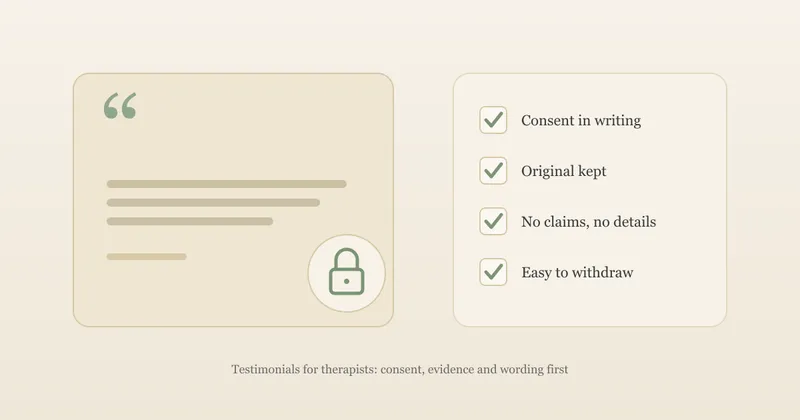
This is the difference most likely to affect your website. UKCP's Code of Ethics and Professional Practice says at clause 13 that members must "not make any claims which you cannot demonstrate to be true or include testimonials from clients in any advertising". BACP doesn't ban testimonials: its directory listing criteria allow short ones with the client's permission, and the BACP Ethical Framework 2026, mandatory from midday on 3 November 2026, still expects accurate information and confidentiality.
The NCPS Code of Ethics has no testimonials clause. Its advertising section asks for advertising that gives "a truthful, honest and accurate picture" of you, says any claims about the outcome of therapy must rest on "verifiable, fully-documented evidence", requires compliance with the advertising codes, and tells members not to advertise a pending accreditation or grade until it's granted. Our guide to testimonials for therapists covers the consent and consumer-law side, whichever body you're with.
Holding two memberships
Plenty of practitioners belong to two bodies: often UKCP plus BACP or NCPS, or BACP plus NCPS. NCPS publishes equivalent membership categories that make this simpler, for example:
- "BACP Registered - Can apply for Accredited Registrant with NCPS"
- "BACP Accredited - Can apply for Accredited Professional Registrant with NCPS"
- "UKCP Registration - Can apply for Accredited Professional Registrant with NCPS"
It works the other way too: BACP has a dual membership route to accreditation for members who also hold column B membership with ACC, NCPS or UKCP, covered in our BACP accreditation guide.
Two memberships mean two fees, two sets of renewal and CPD records, and two codes of ethics. Where the codes differ, follow the stricter one everywhere you advertise. If you're on the UKCP register, for instance, leave testimonials off your website even if your BACP or NCPS membership would allow them.
A quick decision test
Run through these in order and stop at the first one that applies:
- You're on a UKCP accredited psychotherapy or psychotherapeutic counselling course. Join UKCP. Add BACP or NCPS later only if a specific job, panel or directory you want asks for it.
- Your course is BACP accredited. BACP registration is the most direct route, and you can add NCPS through the equivalent route later if you want it.
- Your course is NCPS accredited or mapped to column A, but not BACP accredited. NCPS registration is the direct route. Joining BACP would mean passing the Certificate of Proficiency first.
- The jobs or panels you want name one body. Join that one, even if it costs more.
- None of the above. Compare the codes, ask two or three practitioners you trust which body supports them well, and choose on fit and cost. Either register lets a client check you.
Showing your membership on your website
Whichever body you join, your website is where most clients will check it. A few things get this right:
- Use the body's own letters and wording. "Registered Member of BACP (MBACP)", "MNCPS (Acc.)" or the title on your UKCP register entry, not "fully accredited" or "BACP approved". BACP's promoting your membership guidelines set out the exact wording and logo rules for each level.
- Show your registration number and link to your live register entry, so a client can check it in one click. Our guide to what a therapist website should include shows where this sits on an About page.
- Don't advertise a grade before you have it. NCPS's code says so directly, and "working towards accreditation" written as if it were accreditation is the most common slip.
- Keep every profile in step. When your membership changes, update your website, directory profiles, Google Business Profile, LinkedIn and email signature at the same time.
Frequently asked questions
Is NCPS as good as BACP?
Both run registers accredited by the Professional Standards Authority, both are partners in the SCoPEd framework, and both have registered, accredited and senior levels. BACP is much larger. NCPS costs less (£154 a year for registrants against £196 for BACP registered membership in 2026 to 2027). Bupa's mental health network, for example, accepts accredited members of BACP, UKCP or NCPS. Whether one is better for you depends on your training route and the referral routes you want.
Can you be a member of BACP and NCPS at the same time?
Yes. Many practitioners hold two memberships. NCPS publishes equivalent routes: a BACP registered member can apply to be an NCPS Accredited Registrant, a BACP accredited member can apply for Accredited Professional Registrant, and a UKCP registrant can apply for Accredited Professional Registrant. You then follow both codes of ethics, so apply the stricter rule wherever they differ.
Do I have to join a professional body to work as a counsellor in private practice?
Not by law. UKCP's own statutory regulation page says psychotherapy and counselling are not currently statutorily regulated in the UK. In practice, insurers, referral networks, directories and most clients expect you to be on a PSA accredited register, and being on one is how a client can check you.
Which professional body is cheapest for counsellors?
As checked on 30 October 2026, NCPS registrant membership is £154 a year, BACP registered membership is £196 a year (£98 at the reduced rate for eligible members) and UKCP full clinical membership is £330 a year. UKCP mostly suits people on UKCP accredited psychotherapy or psychotherapeutic counselling training, so for most counsellors leaving a Level 4 diploma the real comparison is BACP against NCPS.
The short version
BACP, NCPS and UKCP all run PSA accredited registers and all signed up to SCoPEd, so none of them is the "unofficial" option. UKCP is mostly a choice you make with your psychotherapy training. For counsellors, the BACP vs NCPS choice usually follows your course: BACP is much larger, NCPS costs £42 a year less and writes its supervision and CPD minimums into membership. For accreditation, both need more training than a Level 4 diploma and three years in practice; NCPS is cheaper to progress with, and column B membership moves between the bodies more easily than column A. Check the adverts and panels you care about, follow the stricter code if you join two, and make your register entry easy to find on your website.
Make your registration easy to check
UpTopWeb designs and builds your therapist website for free, with your BACP, NCPS or UKCP letters, registration number and register link set out clearly, and updated whenever your status changes.
Further reading
Related articles
Training & CPD12 minute read
BACP Accreditation: Is It Worth It for Private Practice? (UK Guide)
Training & CPD13 minute read
Level 4 Diploma in Counselling: Is It Enough for Private Practice?
Marketing12 minute read
Testimonials for Therapists: What UK Rules Allow (and What to Do Instead)