Starting a practice
Clinical Supervision for Counsellors in Private Practice: A UK Guide
How much supervision BACP and UKCP actually expect, where the 1.5 hours a month rule really applies, and how to choose, contract and record supervision.
On this page7 sections
Clinical supervision for counsellors is one of the few things that follows you from training straight into private practice, and it's also one of the most misquoted. The figure everyone repeats, 1.5 hours a month, is real, but for BACP it's only a fixed minimum for accredited members, people working towards accreditation and students. If you're a registered member who isn't accredited, BACP deliberately doesn't give you a number: you're expected to decide what's appropriate for your caseload and be able to show it.
This guide is for UK counsellors and psychotherapists setting up or running a private practice. It covers how much supervision you actually need, how to choose a supervisor, what to agree in a contract, and how to keep records that will stand up to an audit. It reflects BACP's and UKCP's published guidance as checked on 29 September 2026, and goes into most detail on BACP because that's where most counsellors register. NCPS, the HCPC and other bodies set their own expectations, so check yours.
Key takeaways:
- BACP's 1.5 hours per calendar month is mandatory for accredited members, those working towards accreditation and students, not for every registered member.
- Registered members who aren't accredited must have supervision appropriate to their practice; BACP recommends 1.5 hours a month, or adequate supervision for your needs, if you see contracted clients.
- UKCP members follow the supervision requirements of UKCP, their modality college and their organisational member, so check with your college.
- BACP says your supervisor should be experienced and ideally trained in supervision, and that you should have a contract covering fees, length and frequency.
- Keep a simple record of every session. If you're audited, BACP gives you around six weeks to send it.
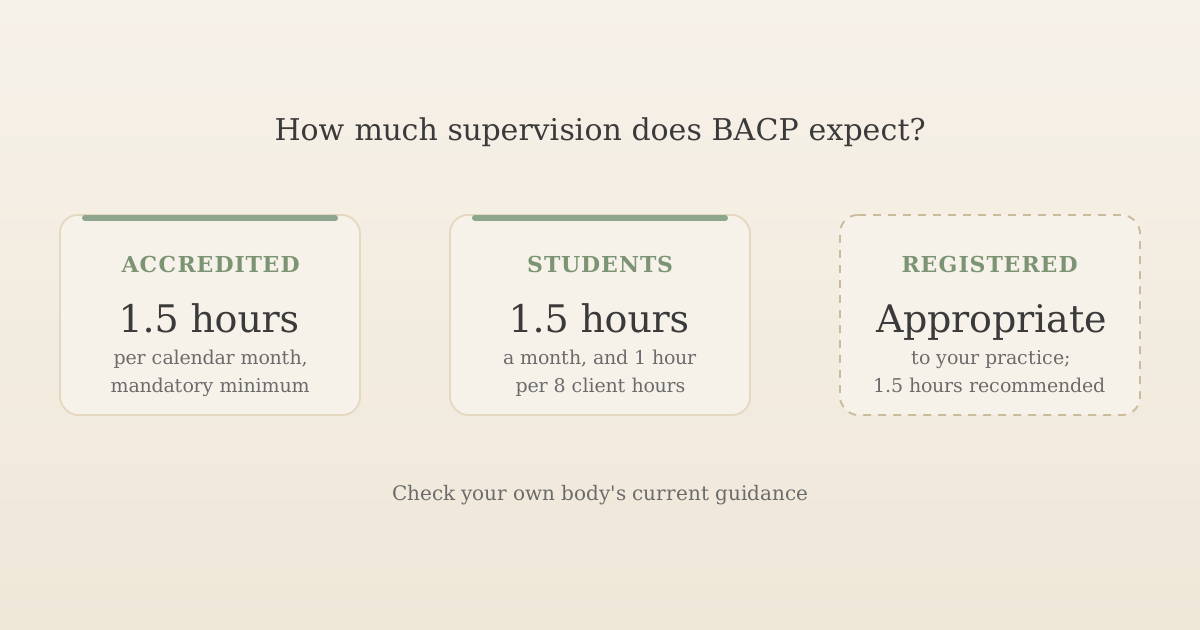
Important: This is a practical overview, not professional or regulatory advice. Supervision requirements differ between professional bodies, colleges, membership levels and training courses, and they change. Check your own body's current guidance, and your course's if you're still training, before relying on anything here.
How much clinical supervision do counsellors need?
It depends on your professional body and your membership level. BACP sets it out by category on its supervision page:
| Who you are | What BACP says | Mandatory? |
|---|---|---|
| Accredited member | Minimum of 1.5 hours per calendar month, regardless of how many contracted clients you have. You may need more with a full caseload | Yes, if you're practising with contracted clients |
| Working towards accreditation | 1.5 hours per calendar month | Yes |
| Registered member (not accredited) | 1.5 hours a month, or adequate supervision for your needs, if you see contracted clients | Supervision is required; the 1.5 hours is recommended |
| Student on placement | Minimum of 1.5 hours per calendar month, at a ratio of 1 hour of supervision to 8 hours of counselling, with supervision every two weeks | Usually, and your course may ask for more |
BACP's Register guide to supervision puts the registered-member position plainly: it doesn't give a specific number of hours because different members have different requirements, and you "must take responsibility for your own supervision needs".
For UKCP members, clause 25 of the UKCP Code of Ethics and Professional Practice asks you to secure supervision "sufficient to meet the requirements of UKCP, its modality colleges and its organisational members". In practice, that means your college or organisational member sets the detail, so ask them rather than assuming the BACP figure applies.
Two details that catch people out
It's per calendar month, not every four weeks. BACP is specific about this for the 1.5 hours minimum. If you see clients from 4 June to 18 July, you need supervision in June and in July. A four-weekly session will eventually leave a month with none.
Text-based supervision doesn't count towards the monthly time. BACP says it can be useful if you offer text-based therapy, but it has to sit on top of supervision that happens face to face, by video or by phone.
Deciding how much supervision your private practice needs
If you're registered but not accredited, the decision is yours, and so is the responsibility for it. BACP asks you to consider:
- how much counselling you do and in which settings
- how complex the work is
- your experience and training
- your development needs and aims
- any specific issues or difficulties you're facing
It also says your supervision should let you discuss all aspects of your work, in all your work contexts, when necessary. That matters in private practice, because many counsellors start out with a few private clients alongside an agency role. Supervision arranged through an agency is often focused on that agency's clients. Your private clients need a place in supervision too, so check that your current arrangement covers them or set up a separate one.
Private practice also takes away the colleagues down the corridor. There's no team meeting and no manager to check in with after a difficult session, so supervision is often the main place your work gets looked at by someone else. That's a reason to err towards more rather than less while you're building up, and to review the arrangement as your caseload grows. If you're planning to apply for accreditation later, 1.5 hours a month from the start saves you having to explain gaps.
How to find a clinical supervisor who suits your practice
BACP's Register guidance says your supervisor should be "sufficiently experienced in counselling and psychotherapy, or a closely related field, and ideally have some training and qualifications in supervision". BACP also publishes a short guide on how to choose a supervisor. Two directories make a good starting point, and colleagues and your training course are often just as useful for recommendations.
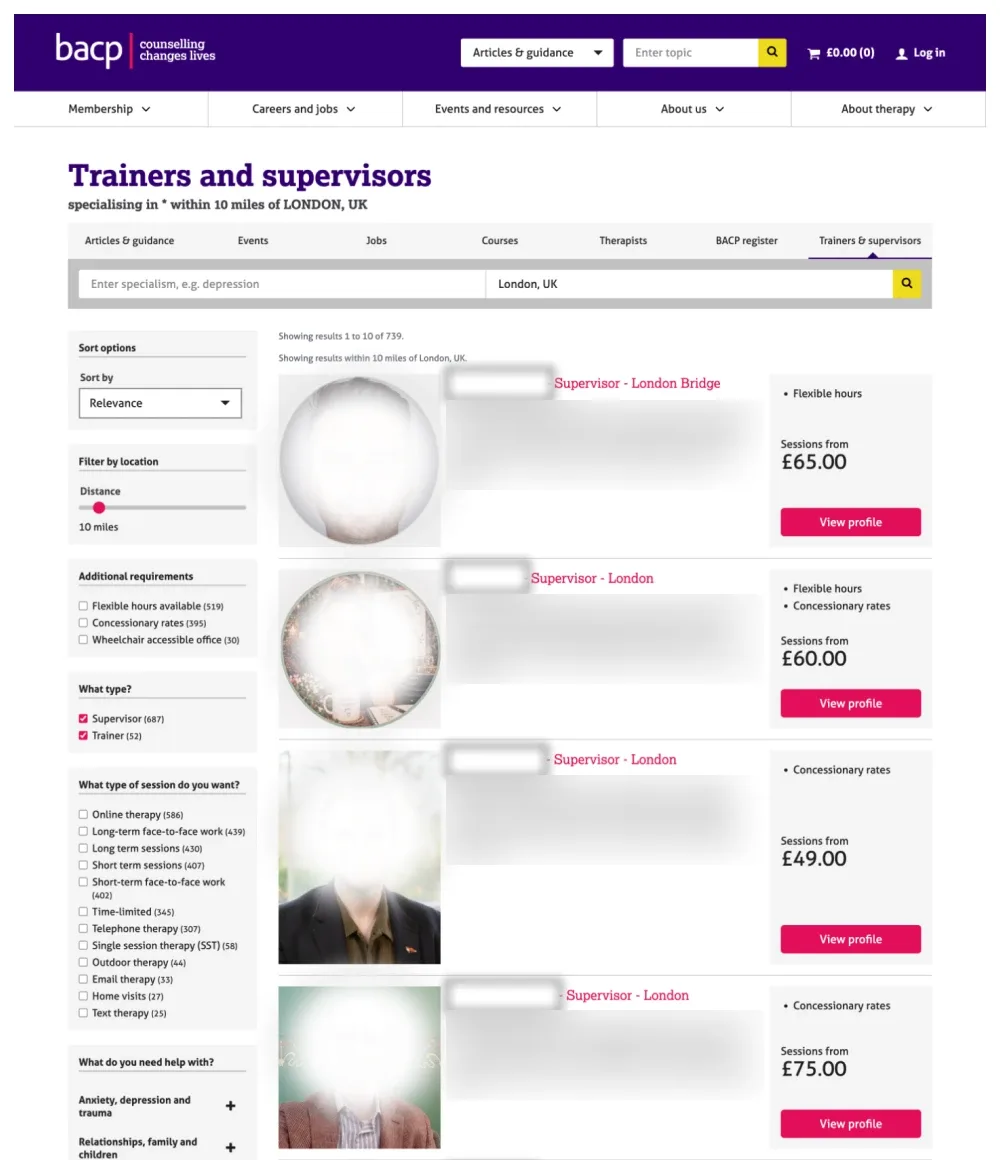
BACP's trainers and supervisors directory needs a city or postcode, and you can add a specialism. You can filter by flexible hours, concessionary rates, wheelchair-accessible office, language and type of session. The session filters use the same wording as the therapist search, so tick "Online therapy" or "Telephone therapy" if you want supervision that way. Under "Who is the therapy for?", "Trainees" narrows it to supervisors who work with students, and "Groups" to those offering group work. Most result cards show a "Sessions from" price, so it's the quicker place to get a feel for fees in your area. In a London search on 29 September 2026, four of the first five listings started at between £49 and £75 a session, and the fifth said to contact the supervisor for their rate. Tick only "Supervisor" under "What type?" if you don't want trainers mixed in.
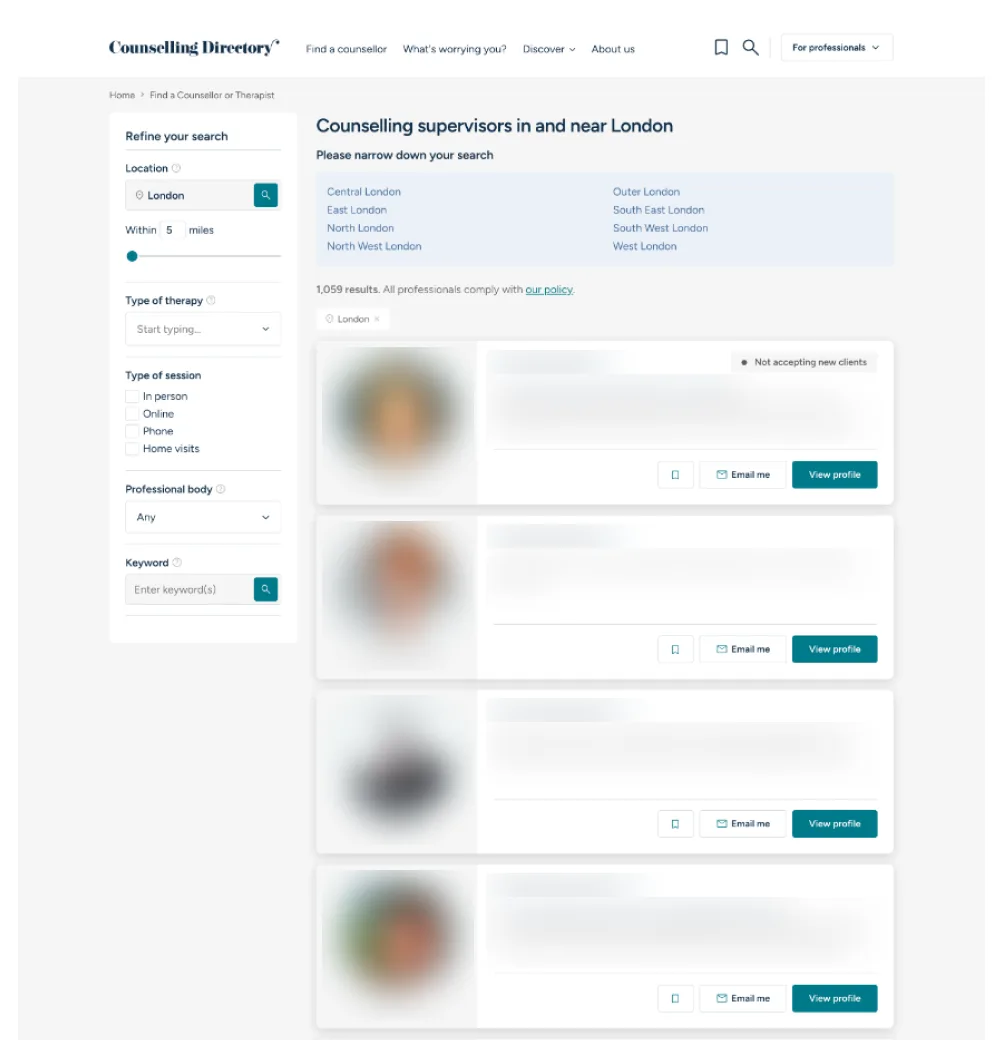
Counselling Directory's supervisor search lists supervisors from several professional bodies, not only BACP, and lets you filter by type of therapy, type of session (in person, online, phone or home visits), professional body and keyword. The cards show each supervisor's credentials and flag anyone who isn't accepting new clients, but don't show a price, so you'll need to open the profile or ask. That makes it the better place to look if you're with UKCP, BABCP, the HCPC or another body and want a supervisor who knows its requirements.
Most supervisors offer an initial conversation. These questions tend to show quickly whether the fit is right:
- Do you supervise people in private practice? Someone who has run their own practice can help with the business-shaped ethical questions too: fees, endings, cancellations, advertising, working from home.
- What's your approach, and do you work with my modality? You don't always need the same one, but you do need a supervisor who respects how you work.
- Do you have supervision training? BACP prefers it, and it's a fair question to ask.
- Can we meet online, in person, or both? And will that suit the calendar-month rule if you need it?
- What are your fees and cancellation terms? BACP's directory shows a starting price on most listings, but check what's included and how cancellations work.
- What happens if I need to talk something through between sessions? Some supervisors offer ad hoc contact for urgent safeguarding questions, some don't. Better to know before you need it.
- Do you offer group supervision? It can be a good addition, but check how the time counts (see below).
If you also work in an agency, BACP's Ethical Framework says a substantial part, or preferably all, of supervision should be independent of line management, which is worth remembering if your agency manager offers to supervise your private work.
Group and peer supervision
For accreditation, BACP accepts a mix of one to one, peer, telephone and online supervision. For peer or group supervision, a group of up to four can claim 50% of the time together, and in a group of five or more the time is divided equally. So a two-hour group of four counts as one hour each, and a two-hour group of six counts as 20 minutes each. BACP recommends peer supervision in addition to contracted one to one supervision, not instead of it.
What to put in a supervision contract
BACP says you should have a contract with your supervisor covering practical arrangements "such as fees and the length and frequency of sessions", with the supervisor's role and responsibilities clearly discussed and included. Beyond that, these are the things we'd suggest agreeing in writing, because they're the ones that cause friction later:
- Frequency, length and format. For example, 90 minutes once a calendar month, online.
- Fees, payment and cancellations. Including what happens if either of you has to cancel close to the date.
- Confidentiality. How you'll refer to clients without identifying them, and the limits: when your supervisor might need to act on a safeguarding concern.
- Contact between sessions. Whether it's available, how, and whether it's charged.
- Audit. BACP asks you to tell your supervisor that the Register team may contact them. Put it in the contract so it's not a surprise.
- Review and ending. A date to review how it's going, and notice if either of you wants to stop.
Your clients should know about supervision as well. Many counsellors say in their client contract and their privacy notice that they discuss their work in supervision without identifying details. It's also worth a line on your website's confidentiality or FAQ section, since prospective clients sometimes worry about who else hears what they say.
Keeping supervision records that pass an audit
BACP lets you record supervision any way you like, and it provides a Register template if you want one. Whatever you use, it needs:
- the date and length of each session
- the format (for example peer, one to one or group)
- how it was delivered (for example in person or online)
- the work context it relates to
If you're selected for audit, you'll also need to give examples of how supervision has affected your practice, so a line or two after each session saves a lot of remembering later. Don't put personal, confidential or identifiable client material in the record unless BACP asks for it.
BACP gives you around six weeks to send your records and may contact your supervisor to confirm the arrangement. Its stated approach is facilitative: if something falls short, it will explain why and ask you to clarify. Members who haven't engaged with supervision at all, though, can be removed from the Register and from membership.
Keep this record separate from your CPD log. BACP treats them as two different Register requirements, and supervision doesn't count as CPD, as our guide to how many CPD hours counsellors need explains.
Supervision and the rest of your practice
Supervision is a running cost, so build it into your fees from the start. Our guide to how much counsellors should charge walks through working out a session fee that covers supervision, insurance, room hire and the rest before anything counts as income. It also sits on the same checklist as insurance, registration and policies in our step-by-step guide to setting up a private therapy practice.
One more thing to watch: BACP's new Ethical Framework becomes mandatory at midday on 3 November 2026. Point numbers and wording may change, so recheck anything you quote from it in your contract or on your website after that date.
On your website, being in regular supervision is a quiet but genuine trust signal. A single sentence on your About page, alongside your qualifications and membership, tells a prospective client that your work isn't done in isolation. Our guide to what a therapist website should include covers where that kind of detail fits.
Clinical supervision for counsellors: the short version
For BACP, the 1.5 hours a month minimum is mandatory for accredited members, people working towards accreditation and students. Registered members must have supervision appropriate to their practice, with 1.5 hours a month recommended if they see contracted clients. UKCP members follow their college's and organisational member's requirements. Whichever applies to you, choose an experienced supervisor, ideally one trained in supervision, agree a written contract, and keep a simple record after every session, so an audit is a formality rather than a scramble.
Show clients how you practise
UpTopWeb builds clear, professional websites for counsellors and therapists, with room for your qualifications, membership and how you work, including supervision and confidentiality.
Get a free website