Starting a practice
Counselling Practice Names: Ideas and UK Rules
Counselling practice name ideas, plus the UK rules on business names, sensitive words and protected titles, what to do about similar names, and your domain.
On this page12 sections
Your practice name is one of the first decisions in private practice, and one of the easiest to rush. The name goes on your website, your directory profiles, your invoices and your Google Business Profile, and changing it later means updating all of them. For most UK counsellors the choice comes down to your own name or a separate business name, and a few legal rules narrow the options more than people expect.
This guide is for UK counsellors and psychotherapists setting up in private practice, or thinking about renaming. It covers the four common kinds of name, the UK rules on business names, sensitive words and protected titles, the checks to run before you commit, how names work on Google, choosing a domain, and what to update if you change your name later. Rules are as checked on GOV.UK, HCPC and Google's guidelines on 16 November 2026.
Key takeaways:
- Your own name is the simplest choice and often the strongest: it's personal, and it matches how clients find you on professional body registers.
- Generate ideas from a few patterns (your name, your area, a nature or process word, who you work with), then test the best against the rules.
- A business name gives you room to grow into a group practice, but it must follow the UK rules, and it shouldn't be one another practice near you already uses.
- Business names can't include "Ltd" or "plc" unless you're a company, and words such as "Accredited", "Association", "Institute", "Society", "Trust", "Health centre" and "NHS" need permission first.
- "Art therapist", "dramatherapist", "music therapist" and psychologist titles such as "counselling psychologist" are protected by law; "counsellor" and "psychotherapist" aren't.
- Before you commit, check Companies House, the trade mark register, Google, directories and whether the domain is free.
Your own name or a business name?
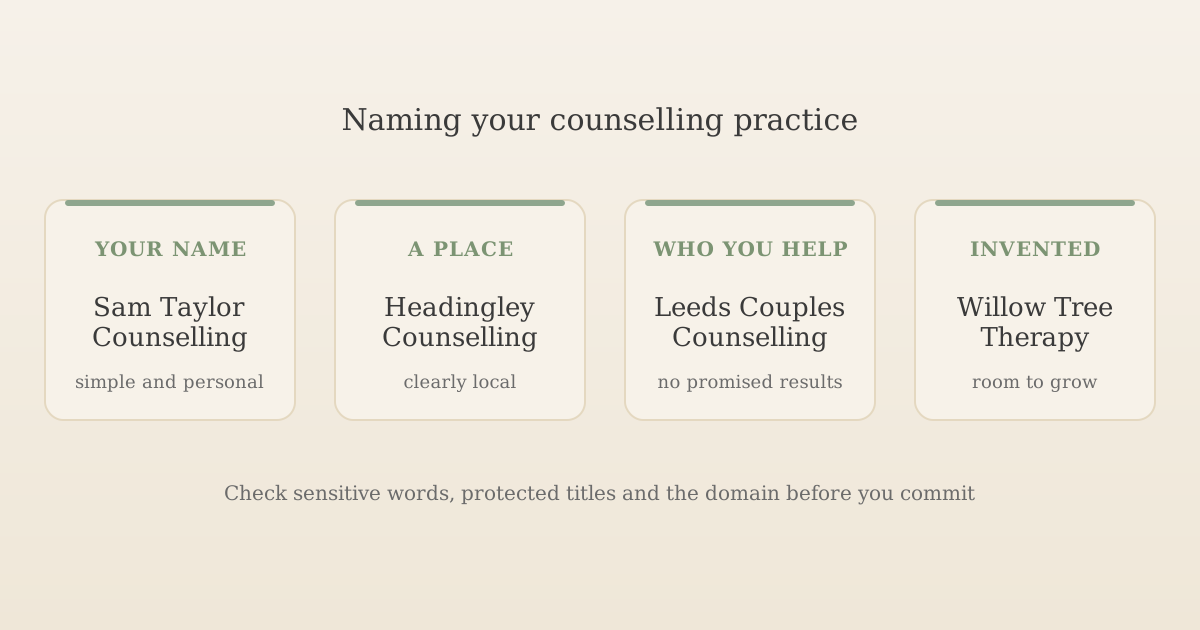
You can trade under your own name or choose a business name (GOV.UK also calls it a trading name). Most counselling practice names fall into one of four types:
| Type | Example (invented) | Good for | Watch out for |
|---|---|---|---|
| Your own name | Sam Taylor Counselling | Trust and simplicity; matches your register entry | Harder to hand over if you grow into a group practice |
| A place | Headingley Counselling | Showing you're local | Feels limiting if you move or work mostly online |
| Who you work with | Leeds Couples Counselling | Telling clients straight away whether you're a fit | Ties you to one client group; must not promise results |
| An invented name | Willow Tree Therapy | A brand that can grow beyond you | Says nothing on its own; more checks for similar names |
There's no single right answer. A few questions help:
- Will anyone else ever work under this name? If you might take on associates, a practice name is easier to share. Our guide to starting a group practice covers the bigger decisions that come with it.
- How private do you want to be? A practice name doesn't hide you. Your name still goes on your invoices, your register entry and usually your website's About page, so choose a practice name because you like it, not to stay anonymous.
- Might you move, or change focus? Place names and specialism names age fastest.
- Can people say it and spell it? Someone who hears your name from a GP or a friend needs to find you by typing it.
Counselling practice name ideas
The easiest way to find a name is to generate a long list from a few patterns, then test the best few against the rules and checks below. Here are six patterns, with invented examples:
| Pattern | Invented examples | Works well when |
|---|---|---|
| Your name, in different formats | Sam Taylor Counselling; Counselling with Sam Taylor; Taylor Counselling | You'll always be the only practitioner |
| Your town, neighbourhood or a local landmark | Headingley Counselling; Riverside Counselling Leeds | You see clients in person in one area |
| A nature or place word | Lantern Counselling; Harbour Therapy; Hillside Counselling | You want a calm brand that can grow |
| A word about the process | Next Step Counselling; Open Door Therapy | You want the name to say something about how you work |
| Who you work with | Leeds Couples Counselling; Parent and Teen Counselling | You only work with one client group |
| A combination | Lantern Counselling Leeds; Sam Taylor at Riverside Counselling | A simple name is too common on its own |
A few tips for generating ideas:
- Write down at least 20 before judging any. The best names often come from combining two weaker ones.
- Use words from your own approach and setting, not from other therapists' websites. Names borrowed from other practices are the ones most likely to clash.
- Avoid words that promise a result, such as "cure", "healing" or "anxiety-free", for the advertising reasons covered below.
- Expect your favourite to be taken somewhere. Nature and process words are popular, so check every one using the steps further down.
These examples are invented to show the patterns, and some may already be used by real practices, so check any name you like before you use it.
The UK rules for business names
Whatever you choose, these rules apply.
If you're a sole trader. GOV.UK's page on choosing your business name says you can trade under your own name or another name. Sole trader names must not include "limited", "Ltd", "LLP" or "plc", be offensive, or be too similar to another company's trade mark, because you may have to change it if someone complains. You must include your name and any business name on official paperwork such as invoices and letters.
If you set up a limited company. GOV.UK's guide to choosing a company name says your company name can't be the same as another registered company's, and usually ends in "Limited" or "Ltd". You can still trade under a different business name. Our guide to sole trader or limited company helps you decide which structure suits you.
Sensitive words need permission. GOV.UK's list of sensitive words for company and business names includes several that counsellors are tempted by:
| Word or phrase | Why you might want it |
|---|---|
| Accredited | To signal professional status. GOV.UK's own example says you need permission to use "Accredited" in a company name |
| Association, Society, Institute, Federation | To sound established |
| Foundation, Trust, Charity | To sound non-profit |
| Health centre, Medical centre, NHS, Nurse | To suggest a health service |
| British, English, Royal, University | To sound bigger or more official than one practice |
If you need one of these, the list says who to ask. Most solo practices are better off avoiding them. Describing yourself accurately, for example "Registered Member of BACP", belongs in your About page and profiles, not your practice name. Our guide to BACP accreditation explains what you can and can't call yourself.
Protected titles. "Counsellor" and "psychotherapist" aren't protected by law in the UK, but some related titles are. HCPC's page on professions and protected titles says you must be registered with HCPC to use one. They include art therapist, art psychotherapist, dramatherapist, music therapist, practitioner psychologist, registered psychologist and specialist psychologist titles such as counselling psychologist and clinical psychologist. Don't put one in your practice name unless you're registered in that profession.
Don't imply endorsement. A professional body's name or logo in your practice name can suggest the body runs or endorses your practice. BACP's guidelines on promoting your membership set out how members can describe their status and use its logo, which BACP owns as a collective mark.
A name is advertising too. The ASA's guidance on mental health treatment claims applies to your marketing, and your practice name is part of it. "Anxiety Free Counselling" or "Healing Minds Clinic" can read as a promise of a result. Describe who you work with, not what you'll fix.
Checks to run before you commit
Once you have a shortlist of two or three names, spend half an hour checking each one:
- Companies House. Search the register for companies with the same or a very similar name, even if you're a sole trader.
- The trade mark register. GOV.UK's trade mark search shows whether a similar name is already protected.
- Google. Search the name on its own and with your town. Another therapist nearby with a similar name will confuse clients and referrers.
- Directories. Search the BACP, UKCP or NCPS registers and the directories you plan to join.
- The domain. Check whether the .co.uk is free, and the .com if you want it too. See below.
- Social media handles, if you plan to use them.
- Say it aloud. Ask a friend to spell it after hearing it once, and to tell you what kind of service they think it is.
If a name fails one of these, it's much easier to move on now than after you've printed cards and built a website.
When other practices already use the same or a similar name
It happens often. You find a name you love, then discover a practice in another town with the same name, or three with something close. Counselling names draw on the same small set of words (mind, calm, space, willow, oak, path), so some overlap is almost unavoidable. The question is how much is too much.
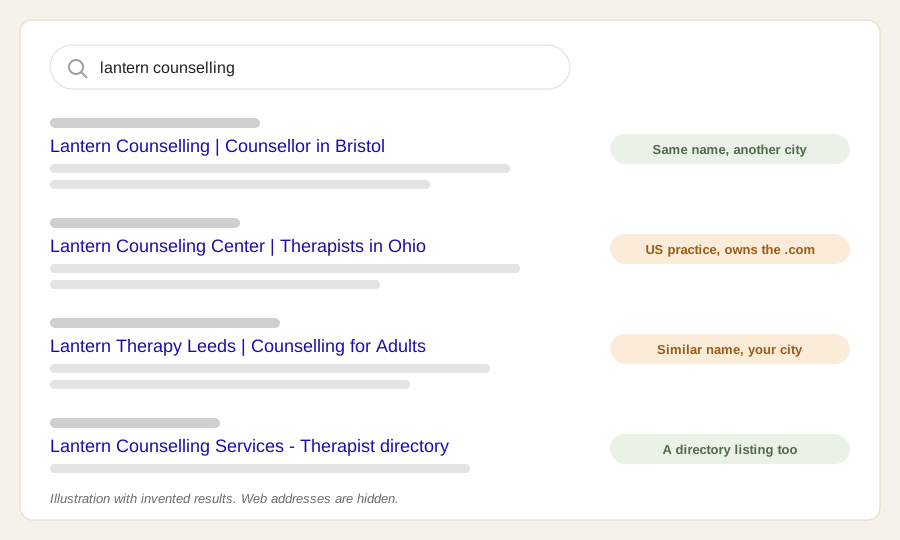
Business.gov.uk's guide to naming your business advises avoiding generic names, or names similar to other brands, "so customers can find you online". It also says you can't use a name that's a trade mark if your services could be confused with the trade mark owner's.
You have three options:
| Option | Pros | Cons |
|---|---|---|
| Use the name anyway, with a different domain (a hyphen, .com instead of .co.uk, or a town added) | You keep a name you like. Can be workable if the other practice is far away, offers something different and hasn't registered a trade mark | Clients and referrers may find the other practice instead, reviews and directory listings get mixed up, emails go to the wrong address, hyphenated domains are easy to mistype, and an established practice may object |
| Adapt it, for example by adding your name, your town or what you offer | Keeps the feel of the name while making it distinct, and is often enough to avoid confusion | Longer, and still risky if the other practice is nearby and offers the same thing |
| Choose a different name | No confusion and no risk of having to change later | Back to the shortlist |
A few questions help you decide:
- Is the other practice near you, or online across the UK? Two "Willow Tree Therapy" practices 300 miles apart, both seeing clients in person, are much less likely to be confused than two in the same city, or one that works online everywhere.
- Is the other practice abroad? Many counselling names are also used by practices in the US, Canada or Australia. That's less likely to confuse UK clients if you see people in person, but it can still mean the .com is taken, the social media handles are gone, and the other practice appears above you when someone searches the name alone. If you work online, overlap with an English-speaking practice abroad matters more. For trade marks, what counts is protection in the UK, which GOV.UK's trade mark search shows.
- Do they offer the same service? A similar name for a yoga studio matters less than one for another counselling practice.
- Have they registered it as a trade mark? Check GOV.UK's trade mark search. If they have, choose something else.
- How established are they? Even without a trade mark, a business that has traded under a name for years may be able to object if yours causes confusion (known in law as "passing off"). If you ever receive a complaint about your name, take legal advice rather than arguing it out.
- Can you get a clean domain? If the only domain left is "the-willow-tree-therapy-leeds.co.uk", that's usually a sign the name is too crowded.
As a rule of thumb, if a search for the name in your area shows another counselling practice on the first page of results, choose something else or adapt it. If the only matches are far away, unrelated or clearly inactive, you're on safer ground. Either way, register your domain and social handles as soon as you decide, so the clean versions are yours.
Practice names and Google
It's tempting to choose a name full of search terms, such as "Best Anxiety Counselling Leeds". It rarely helps and can cause problems.
Google's guidelines for Business Profiles say your name should reflect your business's real-world name, as used consistently on your website, stationery and signage. Adding unnecessary information to the name "isn't permitted", Google says, and could get your profile suspended.
If a place or client group genuinely is part of your name, that's fine. But your location, services and specialisms belong in your profile's other fields and on your website, where Google reads them anyway. Our guide to local SEO for therapists covers setting up your profile and keeping your name, address and phone number identical everywhere.
Does a niche name help with SEO?
It's tempting to think a name like "Couples Counselling Leeds" or a domain such as menscounselling.co.uk will help you rank for those searches. Google's SEO starter guide says otherwise: keywords in a domain name have "hardly any effect" on ranking beyond appearing in the breadcrumbs under a search result. It also says the domain ending, such as .co.uk or .com, only matters if you're targeting a particular country, and even then it's usually a low-impact signal.
So:
- A keyword in your name won't make you rank on its own. What ranks is a site that's clearly about that work: useful pages on who you help and how, and other sites linking to you.
- A .co.uk won't bring you a national audience by itself. If you work online across the UK, your website's content is what reaches people in other towns.
- Owning the .com doesn't mean you own the search term. It mainly stops someone else using that address.
A niche name can still help in other ways. Someone searching for couples counselling can see at a glance that your result is relevant, and a GP or friend can remember "the couples counselling one". It also suits a website that's entirely about that work, which is what helps you rank. Our guide to finding your niche as a therapist covers choosing one.
Weigh that against the downsides covered above: descriptive names are often crowded and hard to protect, they tie you to one client group if your work changes, and adding "UK" can make a solo practice sound like a national organisation. Choose a niche name because it describes your practice well, not for a ranking boost.
Choosing your domain name
Your domain is your web address, and it's easiest if it matches your practice name.
- .co.uk or .com? For a UK practice, a .co.uk tells visitors you're based here and is often easier to get with your exact name. If you can, register the .com of the same name too so no one else takes it.
- Keep it short and typeable. Avoid hyphens and unusual spellings if you can. "samtaylorcounselling.co.uk" is easier to pass on by word of mouth than "s-taylor-therapy-uk.com".
- Use it for email too. An address like hello@samtaylorcounselling.co.uk looks more professional than a free email address. Our guide to secure email for therapists covers the options.
A worked example
Here's an invented example. Sam is a newly qualified counsellor in Leeds who works with adults, in person and online, and might take on an associate in a few years. Their shortlist:
| Name | How it fared |
|---|---|
| Leeds Anxiety Counselling | Ties Sam to one issue, could read as a promise, and two similar names already appear in Google results for Leeds |
| Headingley Counselling Rooms | Another practice nearby has a similar name, which would confuse referrers |
| Sam Taylor Counselling | Clear, available as a .co.uk, no conflicts on Companies House or the trade mark register |
Sam chooses Sam Taylor Counselling for now. If an associate joins later, Sam can add a practice name then, with the website and profiles updated at the same time.
If you change your name later
Renaming is possible, but plan it as one job so clients and referrers don't find mismatched details:
- your website, and a redirect from the old domain if it changes;
- your Google Business Profile and directory listings;
- your professional body record, if your practice name appears there;
- your insurer, bank account name and invoices;
- your contracts, privacy notice and email signature;
- HMRC or Companies House, depending on your structure.
Tell current clients and regular referrers before the change, so a new name on an invoice or email isn't a surprise.
Frequently asked questions
Can I use my own name for my counselling practice?
Yes, and many counsellors do. It's simple, personal and matches how clients will find you on professional body registers. As a sole trader you can trade under your own name or choose a business name, and GOV.UK says you must include your name, and any business name, on official paperwork such as invoices and letters.
Do I need to register my business name?
Not as a sole trader: there's no register of sole trader business names. If you set up a limited company, your company name is registered at Companies House and can't be the same as an existing company's. Either way, registering a trade mark is the only way to protect a trading name, and a name too similar to someone else's trade mark may have to change if they complain.
Can I call my practice a clinic or a centre?
'Health centre' and 'Medical centre' are on GOV.UK's list of sensitive words that need permission in a company or business name. 'Clinic' and 'centre' on their own aren't on that list, but they can suggest a medical service or a larger organisation. Only use them if they accurately describe what clients will find.
Should my practice name include my town?
It can help clients recognise you as local, but it can feel limiting if you move or work mainly online. Your location belongs on your website, Google Business Profile and directory listings anyway, so a name doesn't need to carry it. Google says your Business Profile name must be your real-world name, so don't add a town to it unless that's genuinely your practice's name.
The short version
Your own name is the simplest and often the strongest choice for a solo counselling practice. A practice name gives you room to grow, but it must follow the UK rules: no "Ltd" or "plc" unless you're a company, no sensitive words such as "Accredited", "Institute" or "Health centre" without permission, and no protected titles such as "art therapist" or "counselling psychologist" unless you're HCPC registered. Avoid names that promise results, check Companies House, the trade mark register, Google and the domain before you commit, and if another counselling practice near you already uses the same or a similar name, adapt yours or choose another. Keep keywords out of your Google Business Profile name.
Got your name? Let's build the website
UpTopWeb designs and builds websites for counsellors and therapists, and covers the cost of your .co.uk domain, so your practice name is online and easy to find.
Further reading
Related articles
Starting a practice11 minute read
How to Set Up a Private Therapy Practice in the UK
Starting a practice10 minute read
Sole Trader or Limited Company for Therapists? A UK Comparison
SEO11 minute read
Local SEO for Therapists: A Practical Checklist