Training & CPD
BACP Accreditation: Is It Worth It for Private Practice? (UK Guide)
What BACP accreditation asks for, what it costs, how long it really takes and when it's worth it for a private practice, plus how to show it on your website.
On this page8 sections
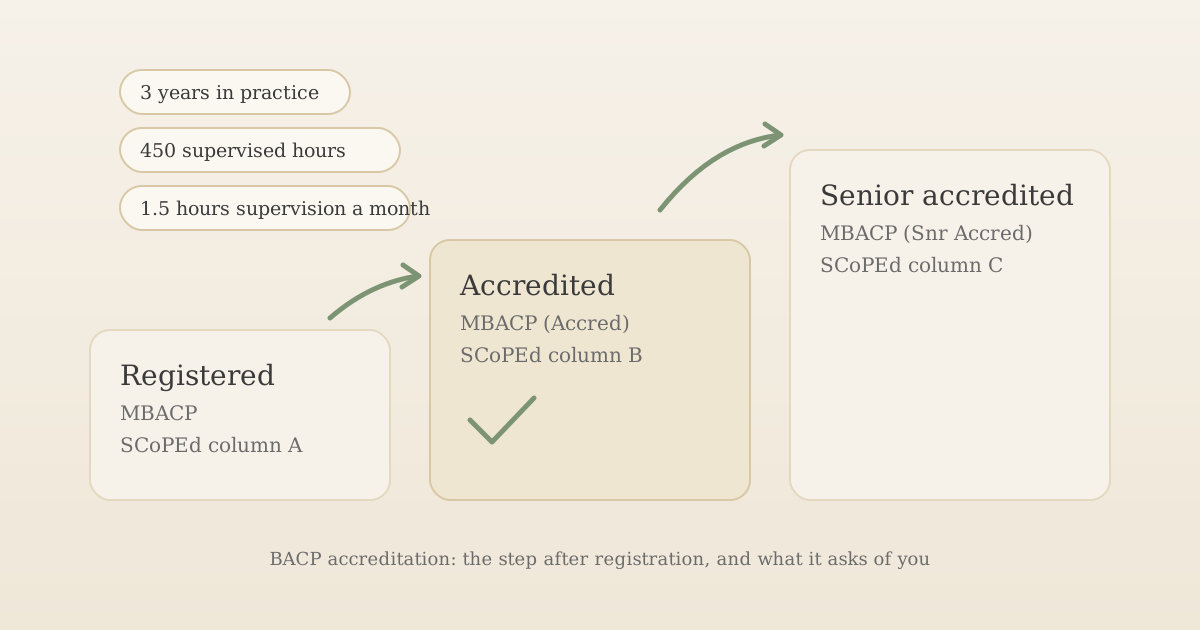
BACP accreditation is the step after registration: an extra membership level for counsellors and psychotherapists who have been in practice for at least three years, with at least 450 supervised hours, and who pass a written application assessed by other practitioners. It isn't required to run a private practice. It is required for some referral routes, it costs less in money than most people expect, and it takes longer in time than most people plan for.
This guide is for UK counsellors and psychotherapists who are BACP registered members, or about to be, and are wondering whether and when to apply. It covers the requirements, the four routes, a worked timeline, what the application involves, when it's worth it for a private practice, and how to show it accurately on your website. Fees and rules are as checked on BACP's and Bupa's websites on 16 October 2026. If you're with NCPS or UKCP, or still choosing a professional body, our comparison of BACP vs NCPS vs UKCP sets out how accreditation works with each.
Important: This is a practical overview, not regulatory or professional advice. BACP reviews its accreditation routes, fees and guidance regularly, and some routes are still changing as new progression courses launch. Check the current route page and application guide before you apply, and talk your plans through with your supervisor.
BACP registered vs accredited: what actually changes
The two are easy to confuse because BACP uses "accredited" for courses, services and people. BACP's accreditation FAQs put it plainly: "Accreditation and senior accreditation is an additional membership level." All practising members must be registered or working towards registration; accreditation is the optional next step.
| Registered member | Accredited member | |
|---|---|---|
| How you get there | Graduate from a BACP accredited course, or pass BACP's Certificate of Proficiency | Apply as a registered member after at least three years in practice, and pass assessment |
| Designatory letters | Registered Member MBACP | Registered Member MBACP (Accred) |
| How you can describe yourself | Registered Member of BACP; registered counsellor or psychotherapist | Accredited Member of BACP |
| SCoPEd alignment you can advertise | Column A | Column B |
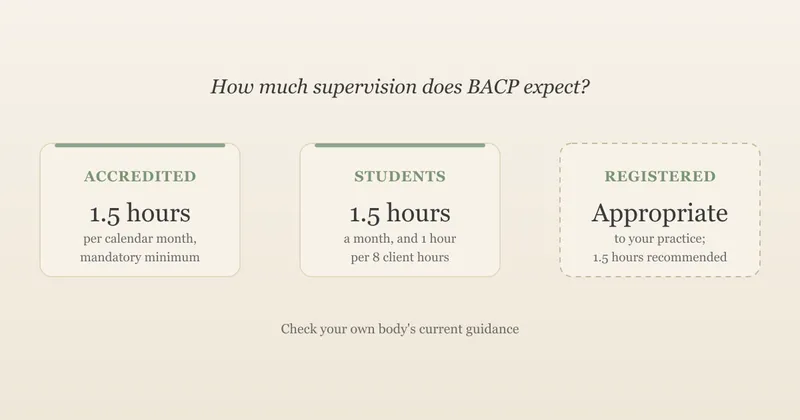
| Supervision | Supervision appropriate to your practice | At least 1.5 hours a month, under a current contract |
| Membership fee, 2026 to 2027 | £196 a year (£98 reduced) | £216 a year (£108 reduced) |
| Listed on the BACP Register | Yes | Yes, with your accredited status shown |
The fees come from BACP's registered membership and accredited membership pages. The supervision difference is covered in more detail in our guide to clinical supervision for counsellors, and it's the one people most often miss: once you're accredited, 1.5 hours a month is a minimum, not a recommendation.
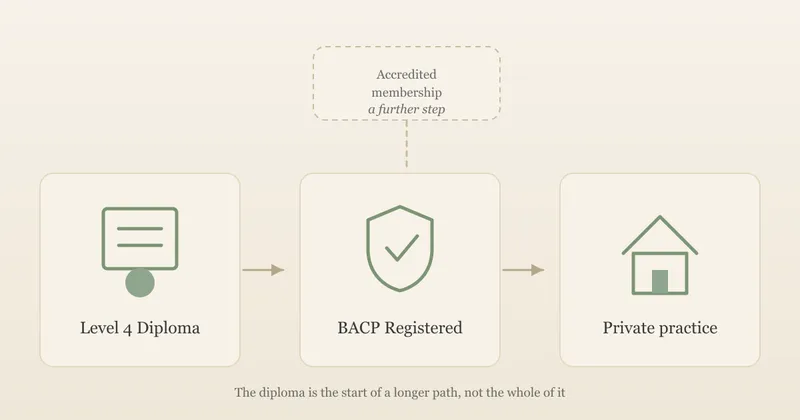
One common mix-up is worth naming. Training on a BACP accredited course doesn't make you a BACP accredited counsellor. The FAQs are clear that a course and a practitioner are accredited separately, and that passing the Certificate of Proficiency "enables registration only". Our guide to whether a Level 4 Diploma is enough for private practice explains how course accreditation gets you onto the Register in the first place.
BACP accreditation requirements and the four routes
Most registered members will apply through one of two routes, depending on whether their core training course was BACP accredited. The core eligibility criteria are the same for both. From BACP's streamlined route page, you need to:
- be a registered member of BACP;
- have been in practice for at least three years when you apply;
- have at least 450 tutor contact hours of practitioner training (core training, plus certificate or progression training if needed);
- have at least 450 hours of supervised practice accumulated within three to six years, which don't have to be consecutive;
- have at least 150 of those hours after completing your core training, counted from the date on your award certificate;
- have been supervised for at least 1.5 hours a month throughout the practice you submit, and have a current supervision contract at that level.
| Route | Who it's for | Application fee shown | What's different |
|---|---|---|---|
| 1: Streamlined | Graduates of a BACP accredited core course, or of an accredited or approved column B progression course | £110 | Reflective practice criteria and a supervisor's statement |
| 2: Recognition of prior learning | Core training that wasn't BACP accredited but meets the standard (at least 450 tutor hours, a supervised placement, and at least two years long, or one year full time if it started before February 2026) | £310 | Adds a portfolio of evidence and an academic essay |
| 3: Dual membership | Members who also hold column B membership with ACC, NCPS or UKCP | £35 | Three years of supervision at 1.5 hours a month, plus BACP's own reflective criteria |
| 4: NHS pathway | Those who completed the NHS Psychotherapeutic Counselling core training pathway | See BACP's route page | Specific to that pathway |
Each route page shows a "list price" of £230 at the top and a different figure under "Costs" further down, so check the amount at checkout. BACP also notes that column B progression courses "have not yet run", with the first graduates expected in 2027 to 2028, so for now route 1 is in practice for BACP accredited course graduates. If you're thinking about a Level 5 diploma, our guide to whether a Level 5 diploma in counselling is worth it covers how it fits with column B. Financial support is available: members on a full reduced membership fee pay a £25 administration fee instead, and members on the sliding scale can ask for the same percentage off their application.
If you're already accredited and thinking further ahead, BACP also runs senior accreditation (column C). Its specialist supervisor and children and young people accreditations are currently paused while BACP revises them.
How long BACP accreditation really takes: a worked example
The 450 hours get most of the attention, but for many people the three-year period is what actually sets the date. BACP's route 1 application guide says you can start counting the three years "from when you see your first client", which may let you include supervised placement hours from training, and that if you reach the hours sooner "you still need to show a full three-year period of practice".
Here's an invented example of a counsellor who trained on a BACP accredited course:
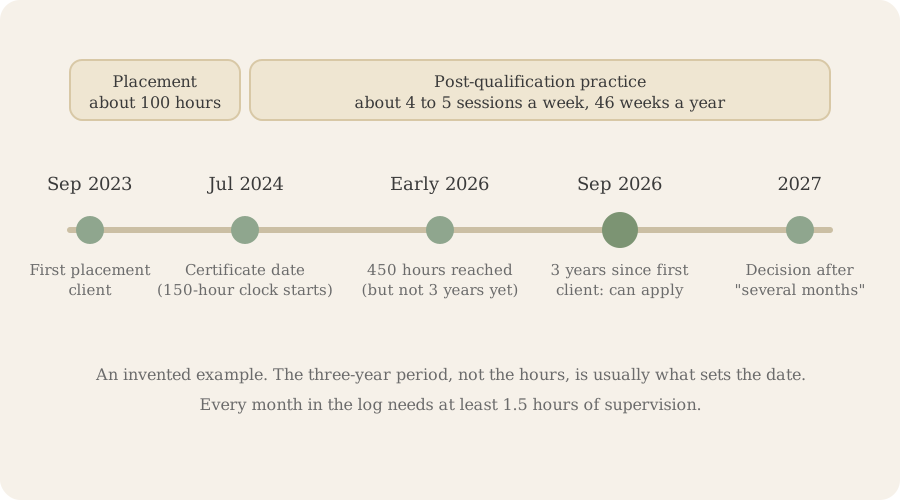
- September 2023: sees their first placement client. About 100 supervised placement hours follow during training.
- July 2024: the date on their diploma certificate. The 150 post-qualification hours start counting from here.
- From July 2024: works in an agency and a small private practice, averaging 4 to 5 sessions a week for about 46 weeks a year, which is roughly 200 to 230 hours a year.
- Early 2026: passes 450 hours in total, with well over 150 after qualifying. They can't apply yet.
- September 2026: three years since the first client, with about 550 to 600 hours logged. They can apply.
- 2027: a decision. BACP's assessment process page says processing "can take several months", and a deferred application gets up to six months to resubmit, then up to four months for the decision on that.
Two things can quietly push the date back. The first is supervision: the guide says every month of practice you log needs at least 1.5 hours, you "must not average supervision out across the year", and arrangements such as "one hour every three weeks" won't meet the requirement on their own. Practice from months that fall short can't go in the log. The second is the kind of work: helpline, counselling skills, coaching, guided self-help and text-based work aren't eligible, and only sessions that took place count, not assessments, supervision or missed appointments.
What the application involves
For the streamlined route, the application guide asks for:
- Your training, with certificates (not needed again if your course was BACP accredited).
- A two-week diary of current practice, consistent with the monthly caseload you declare, with clients shown by a letter and age, never a name.
- A practice log showing your 450 hours and your supervision arrangements across them.
- Criterion 1 (up to 2,500 words): your way of working, in your own words, across your client groups.
- Criterion 2 (up to 3,000 words): case material about one or two clients, ended no more than six months before you apply, showing that approach in practice.
- A supervisor's statement, which comments on your case material.
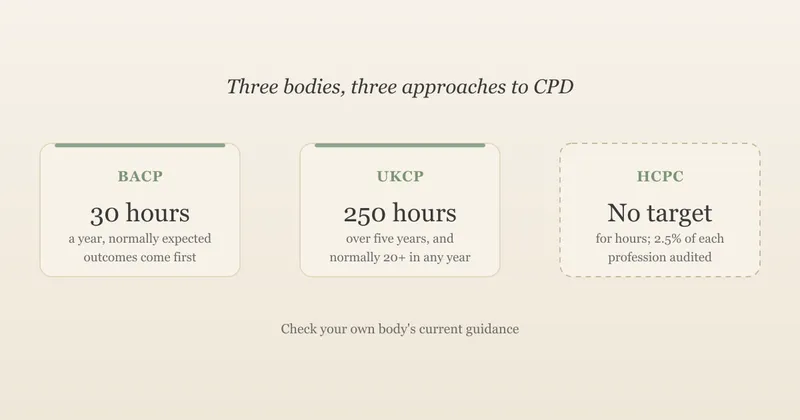
Route 2 adds a portfolio of evidence about your professional experience and CPD, and its criterion 2 is an academic essay. A tidy record of CPD helps with both; our guide to how many CPD hours counsellors need covers what BACP expects you to keep.
Three practical points from the guide are easy to miss:
- Client anonymity. BACP says to "make sure the client can't be identified from what you write", and you don't need to send written permission. The same recognition test we describe in writing about clients is a sensible check here too.
- AI tools. You can use them for spelling, grammar, dictation or understanding terms, but not to write or rephrase any part of your answers. BACP warns that putting client material into AI tools, "even when anonymised", breaches both its Ethical Framework and GDPR, and that misuse may be referred under its Professional Conduct Procedure.
- Apple devices. The guide says the online form "is not compatible with Apple devices". If you work on a Mac or iPad, ask BACP for the Word version instead.
If your application is deferred, you'll get an assessment report, up to six months to resubmit with no fee, and the option of a 30-minute telesurgery with an assessor for £25. An appeal costs £195 (refunded if it succeeds) and is only possible on procedural or fairness grounds. If a resubmission or appeal is unsuccessful, you wait 12 months before a new application.
Is BACP accreditation worth it for private practice?
BACP describes the benefits as professional recognition, the right to the MBACP (Accred) letters and logo, column B alignment in your advertising, and the application itself as a developmental process that works as "self-reflective CPD". Whether that's worth it for you depends mostly on where your clients come from.
| It's worth prioritising if... | It can reasonably wait if... |
|---|---|
| You want health insurance referrals. Bupa's mental health network asks for "accreditation" with BACP, UKCP or NCPS, and its network terms (updated February 2020) define a counsellor as "an accredited member" of one of them | Most of your clients find you directly, through your website, a directory or word of mouth, and your diary is full enough |
| Job adverts or EAP contracts you actually want ask for accredited status or column B | You're under three years in practice, or your supervision hasn't been at 1.5 hours every month |
| You're thinking about supervising or training others later, and the courses or roles you're looking at ask for accredited status | You'd be writing the application in a stretch of your life with no spare evenings. A rushed application risks a deferral |
| You'd value a structured reason to reflect on your practice, and your supervisor is willing to support it | Your core training wasn't BACP accredited and the academic essay on route 2 needs more preparation first |
The money is rarely the obstacle: on the streamlined route it's £110 to apply and £20 a year more in membership. The real cost is time, mainly the two written criteria and gathering three years of supervision records. If you might apply one day, the cheapest thing you can do now is keep a monthly log of supervision hours and client hours from your first client onwards, so the evidence is there when you need it.
Insurer networks also have conditions beyond accreditation. Bupa, for example, asks for at least three years' post-qualification experience full time or five years part time, a supervisor reference, indemnity insurance and a recent enhanced DBS check. Our guides to referrals for therapists, DBS checks and professional indemnity insurance cover those in turn.
How to show BACP accreditation on your website
BACP's promoting your membership guidelines (dated 1 February 2026) set out exactly what each membership level can say, and they warn that promoting your services inaccurately may breach the Ethical Framework. These are the wordings that most often need fixing:
| Instead of | Write | Why |
|---|---|---|
| "BACP accredited counsellor" (when you're registered) | "Registered Member of BACP (MBACP), registration number 123456" | Accreditation is a membership level; training on an accredited course isn't the same thing |
| "Fully accredited" | "Accredited Member of BACP, MBACP (Accred)" | Use BACP's own wording so it matches your register entry |
| "BACP approved" next to a non-counselling service | Name the service on its own | BACP says not to imply that adjunct services, such as reiki, are recognised by BACP |
| The logo, recoloured to match your site | The logo exactly as downloaded | BACP asks members not to change colour, typeface, orientation or aspect ratio, and the logo must show it's a collective mark |
BACP also says registered members should show their registration number on all promotional materials, so clients can check the Register. On a website, that means the number beside your letters and a link to your live register entry, as described in our guide to what a therapist website should include. Our page on counsellor website design shows how we set out registration and accreditation on a counsellor's site.
When an application succeeds, BACP updates your register entry and its own directory listing automatically. Everything else is yours to change: your About page, the trust strip in your footer, your other directory profiles, your Google Business Profile description, LinkedIn and your email signature. And if you ever leave BACP, the guidelines say any mention of membership and the logos should come off your website and materials "straight away".
Frequently asked questions
How long does it take to become BACP accredited?
At least three years from your first client. BACP asks for three years in practice and at least 450 hours of supervised practice within three to six years, with at least 150 of those hours after the date on your core training certificate. Even if you reach 450 hours sooner, you still need the full three years. BACP then says processing can take several months.
How much does BACP accreditation cost?
As checked on 16 October 2026, BACP's route pages give application fees of £110 for the streamlined route, £310 for the recognition of prior learning route and £35 for the dual membership route, although each page also shows a £230 list price, so confirm the amount at checkout. Accredited membership then costs £216 a year for 2026 to 2027, compared with £196 for registered membership. Reduced fees and other financial support are available for eligible members.
Do I need BACP accreditation to work in private practice?
No. BACP requires practising members to be registered or working towards registration, not accredited. Accreditation is an optional extra membership level. It can matter for some referral routes, though: Bupa's terms for its mental health network define a counsellor as an accredited member of BACP, UKCP or NCPS.
Is a BACP accredited course the same as being BACP accredited?
No. A BACP accredited course is a training course BACP has assessed, and graduating from one lets you join the BACP Register. Accredited membership is a separate status for registered members with at least three years of practice who pass BACP's application and assessment. Describe yourself by your membership level, not your course.
Plan for it early, apply when it's useful
BACP accreditation isn't a test of whether you're good enough to be in private practice; registration already covers that. It's a recognised next step that opens some doors, mostly insurer and employer ones, and asks for three years of steady, well-supervised work plus a careful written application. If you might want it, start the supervision and hours log now, then decide when the timing suits your practice rather than when the three years happen to end.
Credentials your clients can check
UpTopWeb designs and builds your therapist website for free, with your BACP letters, registration number and register link shown clearly, and updated when your status changes.
Further reading
Related articles
Training & CPD13 minute read
Level 4 Diploma in Counselling: Is It Enough for Private Practice?
Starting a practice11 minute read
Clinical Supervision for Counsellors in Private Practice: A UK Guide
Training & CPD7 minute read
How Many CPD Hours Do Counsellors Need in the UK?