Blogging & content
Can Therapists Write About Clients? Confidentiality in Blogs and Posts (UK)
Can UK therapists write about client work in a blog or post? What BACP, UKCP and the ICO say, why disguise often fails, and how to write about the issue instead.
On this page12 sections
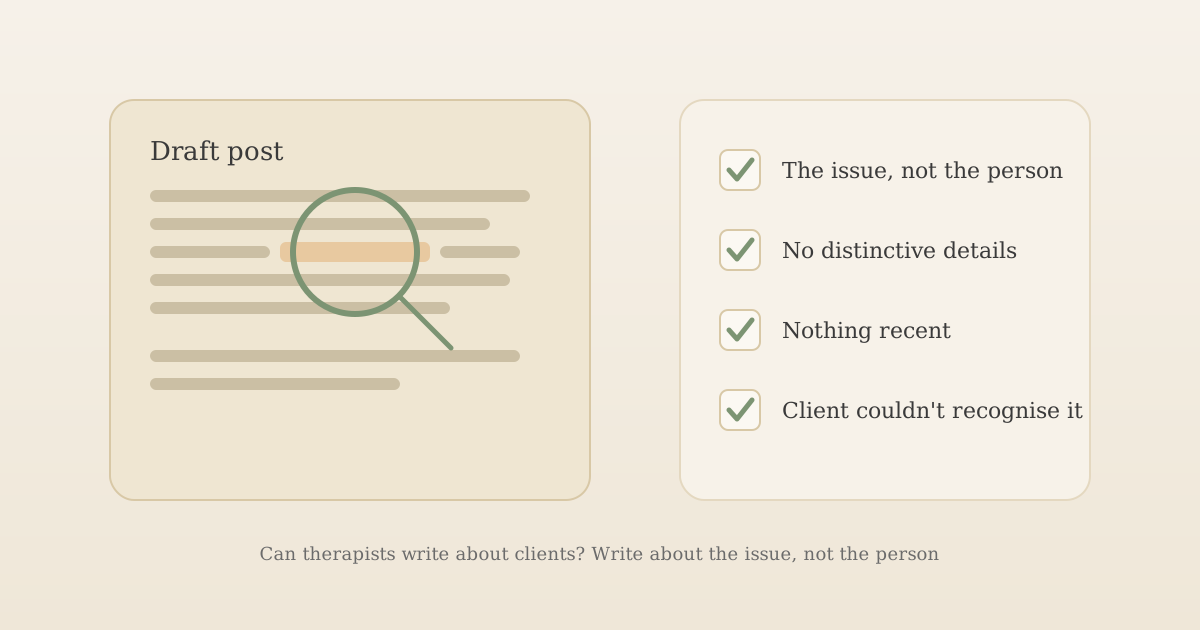
Can therapists write about clients? In a public blog post, social media caption or newsletter, the short answer for UK counsellors and psychotherapists is: write about the issues your clients bring, not about your clients. That sounds like a small distinction. In practice it decides whether a post builds trust or quietly breaks it, because the person most likely to recognise a "disguised" client story is the client.
This guide is for UK therapists in private practice who write for their own website, social media or a newsletter. It covers what BACP, UKCP and the ICO say, why changing names and details often isn't enough, when consent comes into it, the newer question of AI drafting tools, and how to turn a session that inspired a post into something you can safely publish. Rules are as checked on 15 October 2026.
Important: This is a practical overview, not legal, regulatory or professional advice. Professional-body rules differ and change over time, BACP's 2026 Ethical Framework becomes mandatory on 3 November 2026, and data protection guidance on anonymisation is under review. Check your own body's current guidance, and talk it through in supervision before publishing anything that draws on client work.
Can therapists write about clients? What the rules say
Neither BACP nor UKCP bans therapists from writing. What both protect is the client's privacy, and each source below puts the line in a slightly different place.
| Source | What it says | What it means for a blog or post |
|---|---|---|
| BACP Ethical Framework 2026 (mandatory 3 Nov 2026) | Confidentiality principle: "only disclosing it with the service user's consent, or when required or permitted by law". Public communications must "reflect the ethical principles" of the framework (1.3d) | A blog post is a public communication. Client information in it is a disclosure |
| BACP Ethical Framework 2018 (in force until then) | Use "thoroughly anonymised information about clients where this provides a practical alternative" (55g). Teaching examples need consent or anonymisation so the person "cannot be identified by any means reasonably likely to be used" (78) | Anonymisation was always meant to be thorough, not a name change |
| UKCP Code of Ethics and Professional Practice | Safeguard welfare and anonymity "when any form of publication of clinical material is being considered", with verifiable consent where either may be compromised, including where a client "might recognise themselves" despite changed names or circumstances (clause 19) | The client recognising themselves counts, even if nobody else could |
| BACP social media guidance | "You shouldn't publish anything which could identify a client online in any non-secure medium" and be cautious of "separate information that could be combined" | Small details add up, across posts as well as within one |
| ICO anonymisation guidance | Public release needs "a very robust approach to anonymisation", and "personal knowledge combined with anonymous information can lead to identification" | Readers who know the client are the risk, not strangers |
The sources are the BACP Ethical Framework 2026, the 2018 framework, the UKCP Code, BACP's social media guidance and the ICO's page on making anonymisation effective. If you belong to NCPS, BABCP or the HCPC, check your own code too; this guide doesn't cover them.
The recognition test: who could spot the client?
Most therapists ask "could a stranger work out who this is?" That's the wrong reader. The ICO describes a "motivated intruder", someone who wants to identify a person from apparently anonymous information, and warns that identification risk arises "where one person or group knows a great deal about another person". For a therapy blog, the readers with the most prior knowledge are, in order:
- The client. They know exactly what they said, when, and how you responded. A changed name and a different job don't hide a conversation they were in.
- Their partner, family and friends. They may know the client is in therapy, roughly when, and what they've been struggling with.
- Colleagues and people in the same community. Especially in a small town, a specialist niche, or a close-knit faith, cultural or professional group.
- Other clients. Someone reading your posts may wonder whether you'd write about them too, which matters even if they never recognise anyone.
UKCP's clause 19 makes the first of these explicit: the code expects you to think about a client recognising themselves "despite the changing of names or actual circumstances". BACP's social media guidance adds the second half of the problem: it warns that clients "can react or be affected by posts in unexpected ways". A client who believes, even wrongly, that a post is about them has a reason to stop trusting what they tell you.
What's usually fine, what needs care, and what to leave out
Not all client-adjacent writing carries the same risk. This is how the main types of post tend to sort out.
| Type of writing | Example | Usually |
|---|---|---|
| General explanation of an issue | "What anxiety at work can look like" | Fine. You're drawing on training and broad experience, not a person |
| Common patterns across many clients | "Many people tell me they waited years before booking a first session" | Fine if it's genuinely common and contains no distinctive detail |
| How you work | "What happens in a first session with me" | Fine, and often the most useful post you'll write |
| Your own reflections on the work | "What I've learned about endings" | Needs care. Keep it about you and your practice, not a particular ending |
| A composite or invented example | "Imagine someone who..." | Needs care. Short, generic, clearly labelled, no distinctive real detail |
| A disguised story about one client | "A client (I'll call her Sarah) came to me after her divorce..." | Leave out of public writing |
| Something a client said in a session | "A client said something today that stayed with me" | Leave out, even without a name |
| Anything recent | A post about a theme the week it came up in a session | Leave out. Timing alone can identify someone |
The last row catches people out. A post written the same week a client raised something distinctive, especially one published on the account that client follows, can feel personal to them even if every detail is changed.
Three rewrites: from client story to useful post
The usual reason a client story ends up in a draft is that something in a session genuinely sparked an idea. You can keep the idea and lose the client. These examples are invented.
Before:
Last week a client in her fifties told me she'd never once said no to her adult children. When she finally did, over Sunday lunch, she said it felt like jumping off a cliff.
After:
Saying no to people we love can feel physically frightening, especially if we've spent decades being the one who copes. That fear doesn't mean the boundary is wrong. It often means it's new.
The "before" version has an age range, a family structure, a specific occasion and a quote. Any one of those might be harmless; together, the client would know it was her within a sentence. The rewrite keeps the insight and drops the person.
Before:
I've been working with a young man who's a junior doctor at our local hospital, and his burnout is a reminder of how much the NHS asks of people.
After:
People in high-pressure caring roles often come to therapy only when exhaustion has started to affect their sleep, relationships or sense of who they are. If that's you, it isn't a personal failing.
A profession, an employer and a town together can identify someone to every colleague on their ward. The rewrite speaks to a group of readers instead of describing one of them.
Before:
Sarah (not her real name) was grieving her twin brother, and I'll never forget the session she brought his old football shirt.
After:
Grief sometimes lives in objects: a jumper, a mug, a voice message we can't delete. Bringing one into a session, or just talking about it, can be a way of keeping someone close while we learn to carry the loss.
A twin bereavement is rare enough to identify someone on its own, and the shirt is exactly the kind of detail a client remembers sharing. Generalising to "objects" makes the post more relatable to more readers, not less.
For more on writing website copy that speaks to the reader without promising outcomes, see our guide to writing therapist website copy.
Why disguise and composites don't settle it
Changing the name, age and job is the most common approach, and the weakest. It protects against strangers, who were rarely the main risk. The things that make a story worth telling (what was said, the turning point, the emotional detail) are exactly what the client remembers, and you can't change them without losing the story.
Composites, blending details from several clients into one invented person, are safer, but they aren't a free pass. Each contributing client may recognise their own piece. A composite works best when it's short, generic enough to describe many people, and labelled honestly ("an invented example" rather than "a client of mine"). If you notice yourself keeping a detail because it's vivid and true, that detail probably belongs to someone.
Time doesn't settle it either. A client from five years ago may still read your blog, still remember the session, and still feel exposed. Ending therapy doesn't end the confidentiality.
Consent: where it fits and why it rarely suits a marketing blog
Both bodies allow for consent. BACP's 2026 confidentiality principle permits disclosure "with the service user's consent", and UKCP's clause 19 expects "verifiable consent" wherever a client's welfare or anonymity may be compromised. So asking is possible. For promotional writing, there are good reasons most therapists don't:
- It's hard to say no to your therapist. A current client may agree because they want to please you or fear it will affect the work. BACP's framework asks members not to "abuse our position by taking unfair advantage of people" (1.1c).
- The benefit is yours, not theirs. A blog post promotes your practice. Teaching and research, where consent is more established, at least serve the profession.
- Consent can change, but publication can't easily be undone. Posts are copied, shared and cached. BACP's social media guidance puts it simply: "All social media comments are permanent."
- It changes the relationship. Once a client knows they might become content, what they bring to sessions may shift.
If you're writing something where real client material genuinely matters, such as a professional article, a book or a conference paper, that's a different decision to take with your supervisor, your body's specific guidance and, where needed, written consent obtained well away from the therapy itself. A practice blog rarely needs it.
AI drafting tools and client material
This is newer, and it's easy to slip into. Pasting a few lines of session notes or an anonymised summary into ChatGPT or a similar tool to "turn this into a blog post" is itself a disclosure, before anything is published.
The BACP Ethical Framework 2026 addresses it directly. From 3 November 2026, members must assess the risk of any AI or digital tool before using it, understand how data is handled and stored, and "have the informed consent of those using our services before inputting any of their personal data into AI or digital tools" (2.1e). Notes about a therapy session are health information, which UK GDPR treats as special category data; our guide to GDPR for therapists explains what that means for records. Our BACP Ethical Framework 2026 checklist covers the rest of the AI and digital-tools section.
A safer habit: if you use AI to help with writing at all, give it the topic and your own general knowledge ("write about how anxiety can affect sleep, for adults considering therapy"), never anything that came from a session, and edit the result heavily so it sounds like you.
Small towns, niches and the people who follow you
Two settings raise the risk more than therapists tend to expect.
Small places and close communities. In a market town, a rural area, or a tight-knit community, a single detail (a local employer, a school, a recent event) can narrow a story down to one family. Local posts are good for being found, as our local SEO guide explains, but keep the local part to places and services, never to people.
Niche practices. If you specialise, say in perinatal loss, a particular profession or a specific community, your readers and your clients overlap heavily. A pattern that's genuinely common in general can be distinctive within a small specialism, so keep examples broader than you would on a general blog.
The same thinking applies across channels. A detail in an Instagram caption, a detail in a newsletter and a detail on your blog can combine, which is exactly the "separate information" BACP's social media guidance warns about. Our guides to social media for therapists and Instagram for therapists cover the wider boundaries for each platform.
If a client asks "Was that post about me?"
Even with careful writing, a client may see themselves in something you've published. If it happens:
- Take it seriously and thank them for raising it. It took courage, and it tells you something about how your writing lands.
- Answer honestly. If it wasn't about them, say so plainly, and explain that you write about general themes, not individual clients. If any part of it did draw on their work, say so and apologise; BACP's 2026 framework expects members to explain "fully and promptly" when something hasn't gone to plan (2.2a).
- Offer to take it down or change it if it's causing distress, whatever its origin. A post is easy to replace; trust isn't.
- Take it to supervision. It may also be useful material for the work itself.
Some therapists add a line to their contract or privacy information saying they write about general themes and never about individual clients. It sets expectations early and gives you something to point back to. Our guide to therapy contracts covers what else belongs in that document.
A five-question check before you publish
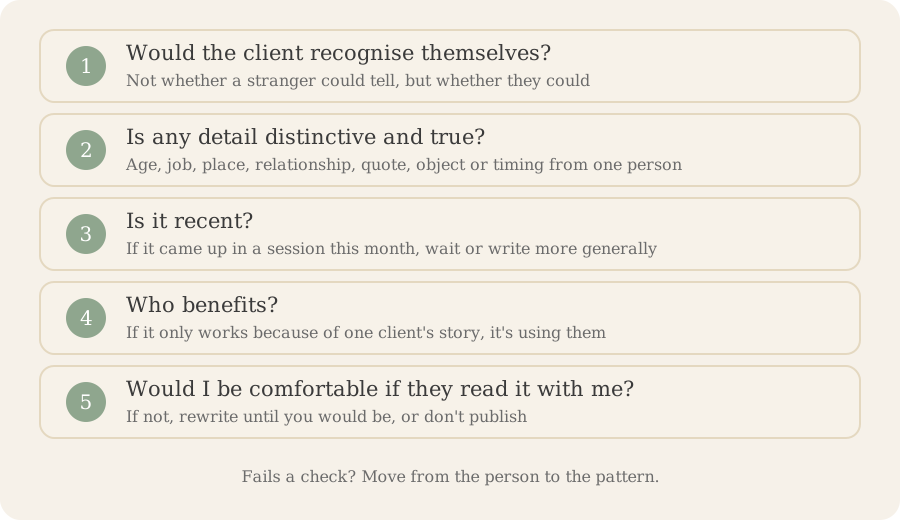
Run these on any draft that a session helped to inspire:
- Would the client recognise themselves? Not "could a stranger tell", but could they.
- Is any detail distinctive and true? An age, job, place, relationship, quote, object or timing that came from one person.
- Is it recent? If the theme came up in a session this month, wait, or write it more generally.
- Who benefits? If the post only works because of one client's story, that's a sign it's using them.
- Would I be comfortable if they read it with me? If not, rewrite it until you would be, or don't publish.
If a post fails any of these, the fix is almost always the same: move from the person to the pattern, as in the rewrites above. If you're unsure, show it to your supervisor before it goes live; our guide to clinical supervision covers how to use that time well.
Frequently asked questions
Can a therapist write about a client if they change the name and details?
Changing the name and a few details is rarely enough for a public blog post. UKCP's Code says members must safeguard anonymity in any publication of clinical material, including where a client might recognise themselves despite changed names or circumstances. The person most likely to recognise the story is the client, and they know every detail you left in. Write about the general issue instead of the person.
Can I write about a client with their consent?
Professional codes allow disclosure with consent, and UKCP expects verifiable consent where anonymity may be compromised. For a marketing blog, though, consent is hard to make truly free: a current client may find it difficult to say no to their therapist, and the post benefits your practice, not their therapy. Most therapists keep client stories out of promotional writing entirely.
Is a composite case study safe to publish?
A composite (details blended from several people) is safer than one disguised client, but it isn't automatically safe. Each client whose story contributed may recognise their own part in it. If you use one, keep it short, generic and clearly labelled as invented, and check that no single distinctive detail comes from a real person.
Can I use ChatGPT or another AI tool to turn session notes into a blog post?
Not without the client's informed consent, if you're a BACP member. The 2026 Ethical Framework, mandatory from 3 November 2026, requires informed consent before putting anyone's personal data into AI or digital tools. Draft from your general knowledge of an issue instead, and never paste notes, messages or session details into a public AI tool.
Write about the issue, not the person
The posts that work best for a therapy practice rarely need a client story anyway. A clear explanation of an issue, an honest description of how you work, or a gentle answer to a question people are too shy to ask will show a prospective client how you think without asking anyone to give up their privacy for it. If you're just getting started, our guide to blogging for therapists covers what to write about and a posting rhythm you can keep.
A website with room for careful writing
UpTopWeb designs and builds your therapist website for free, with a blog included, so the posts you write have a proper home that clients can actually find.
Further reading
Related articles
Blogging & content10 minute read
Blogging for Therapists: A Complete Guide
Social media13 minute read
Should Therapists Use Social Media? Boundaries and Ethics
Marketing12 minute read
Testimonials for Therapists: What UK Rules Allow (and What to Do Instead)