Social media
Instagram for Therapists: What to Post (and What Not To)
A UK guide to Instagram for counsellors and psychotherapists: setting up your profile, post ideas that build trust, and what BACP, UKCP and ASA rules rule out.
On this page10 sections
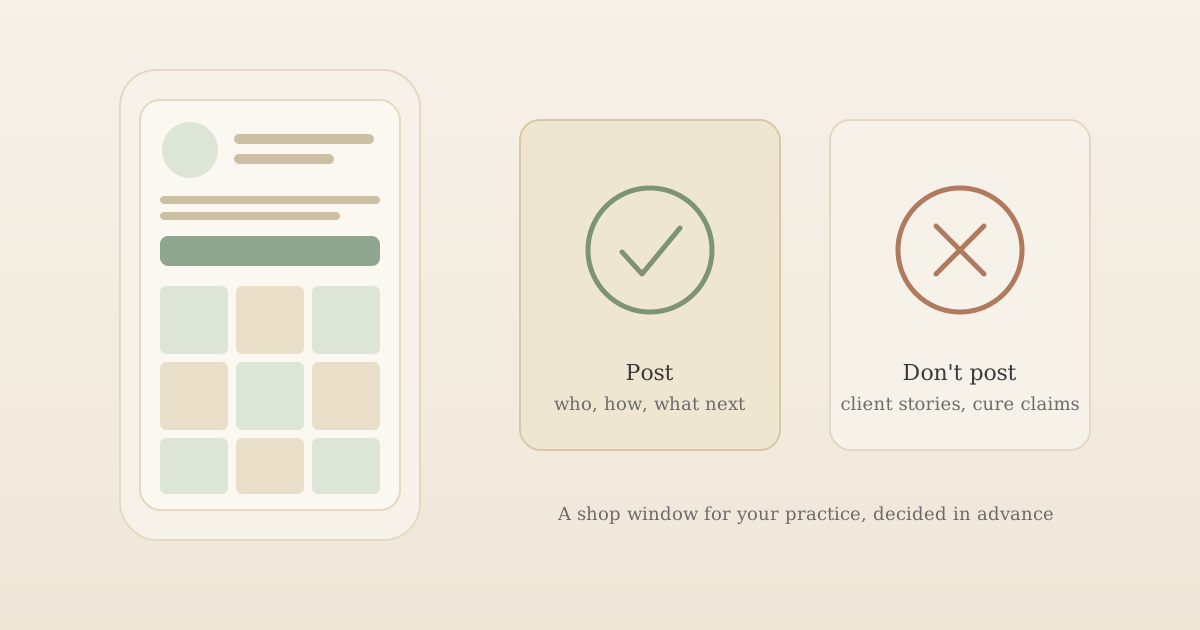
Instagram for therapists works best as a shop window, not a stage. Most people who find you there are doing what they'd do with any new professional: checking you're real, getting a feel for who you are and how you talk, and looking for the next step. Very few will book because of a single post. So the useful questions aren't "how do I go viral" or "how do I get more followers", they're "what will someone see when they land on my profile" and "what do I post so it feels like me, without crossing a professional line".
This guide is for UK counsellors, psychotherapists and arts therapists in private practice who are on Instagram already or thinking about it. It covers setting up a profile that does its job, six kinds of post that build trust, what not to post under BACP, UKCP and UK advertising rules, three caption rewrites, how to handle messages and comments, and a posting rhythm you can actually keep up. For the wider question of whether to be on social media at all, and what BACP and UKCP say about boundaries in general, start with our guide to social media boundaries and ethics for therapists.
Important: This is a practical overview, not legal, professional or regulatory advice. Advertising and conduct rules vary by professional body and change over time, and Instagram's features change often. Check your own body's current guidance and Instagram's help centre before relying on any of this.
Instagram for therapists: what it is actually for
It helps to decide what the account is for before you post anything, because that decision answers most of the "should I post this?" questions later.
For most solo practices, Instagram does three jobs well:
- Reassurance. Someone has your name from a directory, a GP or a friend and wants to see a real person before they make contact. A few clear, warm posts and a tidy profile do this.
- Recognition over time. People who follow you for a while get used to your voice. When they're ready for therapy, you're already familiar.
- A route to your website. Your profile can't hold your fees, your cancellation terms, your privacy notice or a proper enquiry form. Your website can, so the profile's main job is to send people there.
What it does badly is just as important. It isn't a reliable source of new clients on its own (an algorithm decides who sees each post), it isn't a safe place to give individual support, and follower count tells you very little about whether the right people are finding you. Our guide to marketing yourself as a therapist covers where social media fits next to your website, directories and referrals, and how much time it's worth giving it.
Set up your profile before you post anything
A good profile matters more than any single post, because it's what people see every time they tap through. A few things to get right first.
Business, creator or personal account
Instagram offers two kinds of professional account, Business and Creator. Its help centre describes Business accounts as best for "service providers", which fits a private practice. A professional account lets you add a Contact button near the top of your profile (with a phone number, email address and directions), shows a category label under your photo, and gives you insights on who's seeing your posts.
Two trade-offs to know about, both stated in that same help article:
- Professional accounts can't be set to private. Anything you post is public, and switching from a private personal account to a professional one accepts all pending follow requests.
- Your posts and Reels may appear in search engine results, so people outside Instagram can find them. You can turn this setting off.
Both are good reasons to keep a separate, private personal account for friends and family, and to treat the professional account as part of your advertising, the same as your website or directory profile.
Name, bio and links
- Name field. This is searchable inside Instagram, so it's worth including what you do as well as who you are, for example "Alex Morgan | Counsellor, Leeds".
- Bio. Answer the same questions your website's first screen answers: who you work with, how (in person, online or both), where, and what to do next. Four short lines is plenty.
- Links. Instagram lets you add up to five links to your profile. Put your website first. If you add more, link to useful pages such as fees or how to book, rather than to another links page that adds a tap before anyone reaches you.
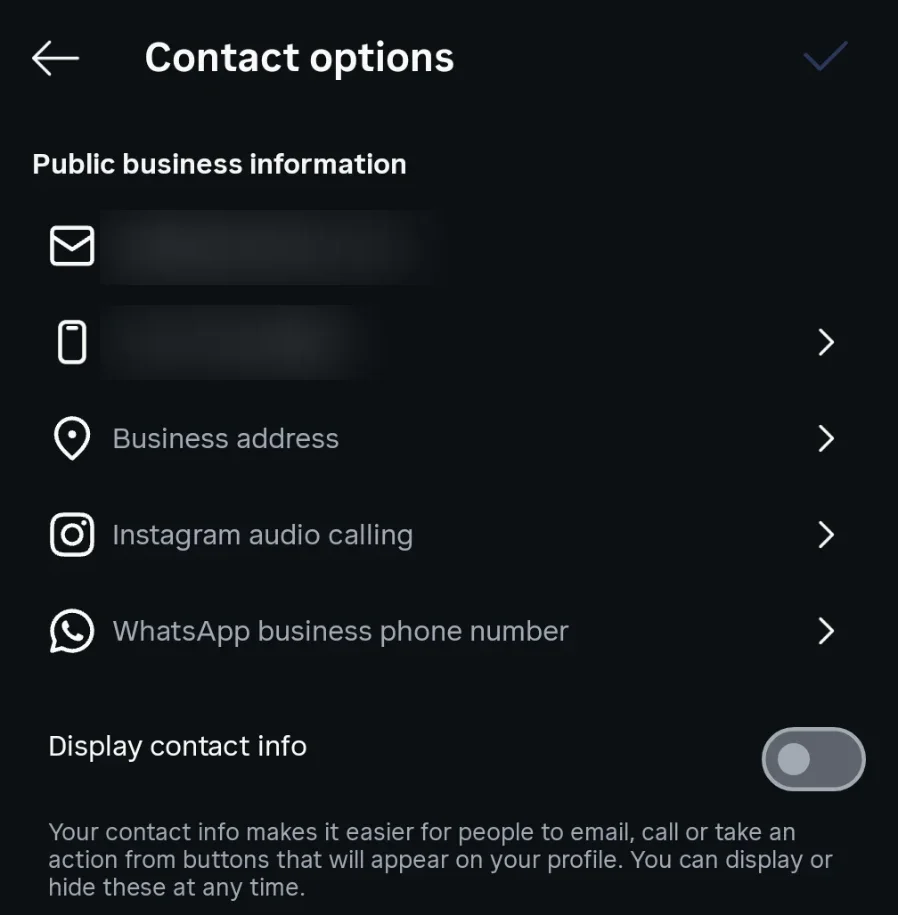
- Contact options. Choose an email address or phone line you're happy to be public, since Instagram notes that anyone who taps Contact can see the details. The same screen also offers a business address, Instagram audio calling and a WhatsApp business number. Each one is another place an enquiry can arrive, so only switch on the ones you'll check and are comfortable replying from. Leave the address blank if you work from home and don't publish it elsewhere.
- An urgent support line. Something like "Not monitored for urgent support, see the link for crisis contacts" sets expectations before anyone messages you.
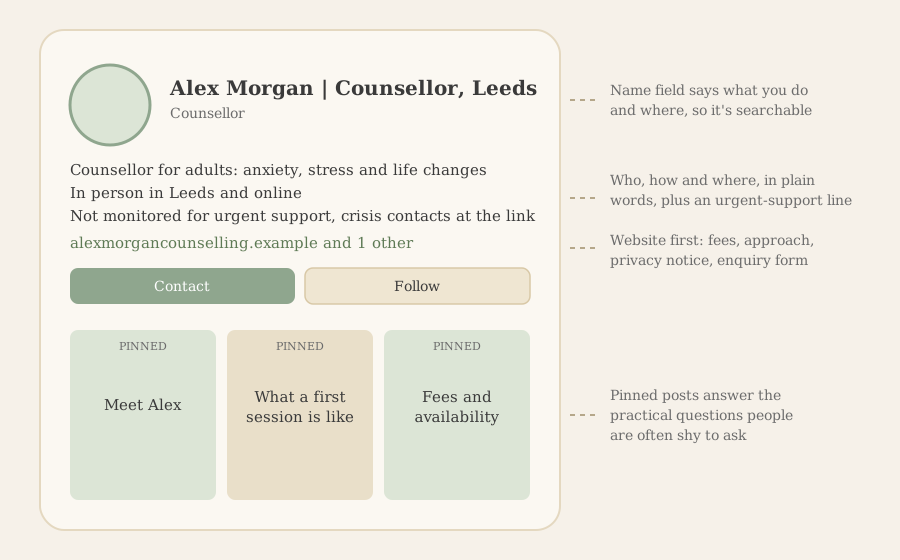
The bio is advertising copy, so the same wording rules apply as on your website. Our guide to writing therapist website copy has before-and-after examples of describing what you work with without promising an outcome, and that works just as well in 150 characters.
Six kinds of post that build trust
Once the profile is in place, these are the post types that tend to help a prospective client most. You don't need all six, and a handful of each, pinned or saved to Highlights, covers a lot of ground.
| Post type | What it does for a prospective client | Example | Watch out for |
|---|---|---|---|
| Introduce yourself | Shows a real person before they make contact | A photo of you and a few lines on why you became a counsellor and who you work with | Over-sharing personal history; keep it to what you'd say in a first session |
| Your room, or how online sessions work | Makes the first session feel less unknown | A photo of your therapy room, or a short Reel on what happens when they join a video session | Anything that reveals a home address you don't publish elsewhere |
| What a first session is like | Answers "what happens next?", one of the biggest worries | A carousel: before, during, after, and what you'll ask | Implying every client's experience will be the same |
| Practical information | Answers the questions people are often too shy to ask | Fees, session length, availability, whether you have a waiting list | Out-of-date figures; update the post or link to your fees page |
| Your approach in plain English | Helps people work out whether you're a fit | "What person-centred counselling means in practice" | Jargon, and comparing your approach favourably with other therapists' |
| Gentle, general information | Builds familiarity with your voice | Common reactions after a bereavement, or what burnout can feel like | Diagnostic-style posts ("5 signs you have...") and anything that reads as advice for one person |
A few patterns hold across all six. Write captions as you'd speak to a new client, not as you'd write for a training panel. Put the main point in the first line, because Instagram cuts captions short until someone taps "more". And end with one clear next step, usually "more about working with me at the link in my bio", rather than asking people to comment or share.
If you already write blog posts, Instagram is a good place to share a short version with a link to the full piece. Our guide to blogging for therapists covers what to write about and the same confidentiality line that applies here.
What not to post on Instagram as a therapist
Most of the real risk sits in a short list. Decide on these once, and you won't have to weigh them every time you open the app.
Anything that could identify a client. That includes anonymised stories, "a client said something today that stayed with me", and details that seem harmless on their own but add up. BACP's social media guidance reminds members that social networking sites, even closed groups, are public. A client who recognises themselves in a post, even wrongly, has a reason to lose trust in you.
Client testimonials and thank-you messages. Professional bodies differ here. UKCP's Code of Ethics and Professional Practice says members must not "include testimonials from clients in any advertising" (clause 13). BACP has no equivalent outright ban, but the ASA's testimonials and endorsements guidance (updated 21 September 2026) says you must hold documentary evidence that a testimonial is genuine and must not use one without permission. A screenshot of a client's message fails on confidentiality before you even get to the advertising rules.
Claims to treat or cure a condition. Your Instagram posts promoting your practice are marketing, so UK advertising rules apply. The ASA's guidance on mental health treatment claims treats conditions including depression, OCD, eating disorders and addictions as serious, and says claims to treat them can only be made where treatment is supervised by a suitably qualified medical professional. More broadly, it says a claim that a therapy can treat or cure a condition is unlikely to be acceptable without robust evidence. "I work with adults experiencing anxiety" describes your work; "Therapy that will free you from anxiety" promises an outcome.
Pressure tactics that aren't true. "Only two spaces left this month!" is fine if it's accurate and you update it. As a recurring line to create urgency, it's misleading, and it sits badly with a client group that may already feel anxious about reaching out.
Advice to one person. Replying in comments or messages with specific guidance for someone's situation starts a therapeutic conversation without a contract, an assessment or any of the safeguards you'd normally have. Keep comments general and move individual questions to your enquiry route.
Your own hard days, in real time. You don't have to be a blank screen, but a post about an exhausting week can land very differently for a client who wonders if it was about them. If you share something personal, share it after you've had time to think about how it reads.
For BACP members, the 2026 Ethical Framework (mandatory from 3 November 2026) has more to say about accuracy in public communications and online presence; our BACP Ethical Framework 2026 checklist covers what changes for your website and social media.
Three caption rewrites
Here are three invented captions, rewritten. Each "before" is the kind of thing that's easy to post on a busy day.
1. The outcome promise
Before: Struggling with anxiety? Therapy can heal you. I help clients overcome anxiety for good. DM me to start your healing journey today!
After: Anxiety can make ordinary things feel hard: phone calls, sleep, leaving the house. I work with adults who want to understand what's going on for them and find ways of coping that suit their life. If you're wondering whether counselling could help, the link in my bio explains how I work, what it costs and how to get in touch.
The "after" describes the work rather than promising a result, drops the instruction to message (see the next section for why), and sends people to the place that has fees and an enquiry form.
2. The client story
Before: Had such a moving session today. My client finally opened up about her mum after six months, and I'm so proud of her. This is why I do this work.
After: Many people tell me it took months, or years, before they felt ready to talk about a family relationship. There's no right speed. In counselling, we go at the pace that feels manageable for you.
The "before" includes three details (gender, the relationship, the timescale) that a client could recognise. The "after" says something true and reassuring about the work without being about anyone.
3. The jargon post
Before: My integrative practice draws on psychodynamic and person-centred modalities, holding space for unconscious material to emerge within the therapeutic frame.
After: I mostly listen, and I ask questions that help you notice patterns, including ones from earlier in your life. You lead what we talk about. If you'd like to know more about how I work, it's all on my website.
Both say the same thing about the approach. Only one is written for a prospective client rather than a fellow therapist.
Messages and comments: decide before they arrive
Direct messages are where Instagram is most likely to blur a boundary, because they feel informal and immediate. A few decisions make them much easier.
Have a standard reply. Write it once, save it in your phone's notes, and use it every time someone asks for help or describes their situation. For example:
Thank you for getting in touch. I'm not able to offer support through Instagram messages, but I'd be glad to hear from you through the enquiry form on my website, or by email at [your address], and I'll reply within two working days. If you need urgent support, in England you can call NHS 111 and choose the mental health option, call Samaritans on 116 123, or call 999 in an emergency.
The urgent support wording above follows the NHS page on where to get urgent help for mental health. If you practise in Scotland, Wales or Northern Ireland, use the local equivalents.
Move enquiries off Instagram. Instagram messages aren't a good place to collect anything about someone's mental health, and they don't come with the privacy notice your website's contact form should have. Our GDPR checklist for therapist websites covers what your contact form and privacy notice need, which is a good reason to keep enquiries in one place you control.
Keep comments general. If someone comments with something personal, a short, kind reply ("Thank you for sharing this. If you'd like to talk it through, my details are in my bio.") is enough. Hiding or deleting comments that could identify someone, including the person who posted them, is reasonable.
Know your position on clients following you. A client following your professional account is common and usually fine; following them back, liking their posts or messaging outside sessions is where dual relationships start. Our social media boundaries guide has a short policy you can adapt and mention when you first contract with a client.
Make your posts accessible
A lot of mental health content on Instagram is text on an image, which a screen reader can't read unless you add a description. Instagram generates automatic alt text, but its help centre explains that you can replace it with a better description when you post, under Accessibility, or edit it afterwards.
- Add alt text that includes the words on the image, not just "quote graphic".
- Repeat the key text in the caption, so it's readable for everyone, and searchable.
- Add captions to Reels with speech, since many people watch with the sound off.
- Keep text large and high contrast. Pale grey on beige looks calm but is hard to read on a phone in daylight.
The same principles apply to your website; see our guide to website accessibility for therapists for the UK legal background.
A posting rhythm you can keep
There's no right number of posts. What tends to work for a solo practice is a pace you can still manage in a busy month:
- Set up your foundations once. Pin three posts to the top of your profile, for example who you are, what a first session is like, and fees and availability. Save a few Stories as Highlights for the same questions.
- Then one considered post a week, or every fortnight, drawn from the six types above. Write a few in one sitting and schedule them.
- Stories when you feel like it. They're lower effort and disappear after a day, which suits small updates like "I have a space on Tuesday evenings".
- Check insights occasionally, not daily. Profile visits and link taps matter more than likes, because they show people moving towards getting in touch.
- Review your profile with your supervisor now and then. BACP's social media guidance suggests discussing and reviewing your profiles with your supervisor from time to time, which is a useful sense check on tone and boundaries.
If a month gets busy and you don't post, nothing breaks. A clear profile and a few pinned posts keep working while you're seeing clients.
Instagram works best when it leads somewhere
Every route through Instagram ends at the same question from a prospective client: "can I see more, and how do I get in touch?" That's your website's job. It's where your fees, availability, approach, qualifications, privacy notice and enquiry form live, and it's what you control when an algorithm changes. Our guide to what a therapist website should include covers what someone should find when they tap the link in your bio.
It's also worth checking what your link looks like when it's shared. When someone sends your website to a friend, the preview card comes from your site's own settings, not from Instagram, and our social media guide explains how to check it.
Frequently asked questions
Should a therapist use a business or personal Instagram account?
For your practice, a professional account (Instagram calls the two types Business and Creator) gives you a Contact button, insights and a category label. The trade-off is that Instagram's help centre says professional accounts can't be set to private, so everything on it is public. Most therapists keep a separate personal account, set to private, for friends and family, and treat the professional one as part of their advertising.
Can therapists share client testimonials on Instagram?
It depends on your professional body, and Instagram counts as advertising. UKCP's Code of Ethics (clause 13) says members must not include testimonials from clients in any advertising. BACP has no equivalent outright ban, but the ASA's rules still apply: you need permission and documentary evidence that a testimonial is genuine, and it can't make a claim you couldn't make yourself. Screenshotting a thank-you message from a client is the riskiest version of this, because it can identify them.
What should a therapist do if someone asks for help in Instagram messages?
Have a standard reply ready rather than deciding in the moment. A short message that thanks them, explains you don't offer support through Instagram, points them to your enquiry form or email, and gives urgent support details (in England, NHS 111 and the mental health option, Samaritans on 116 123, or 999 in an emergency) keeps you warm without starting therapy in a chat window. Put the same 'this account isn't monitored for urgent support' line in your bio.
How often should therapists post on Instagram?
There's no number that works for every practice. A pace you can keep up, such as one considered post a week plus a few Stories, does more than a burst of daily posts that stops after a month. Many therapists get more from a well set-up profile with a handful of pinned, evergreen posts than from posting often, because most people visit your profile to check you're real before they get in touch.
Give the link in your bio somewhere good to go
Instagram builds familiarity. Your website answers the questions that come next: what you offer, what it costs and how to get in touch. UpTopWeb designs and builds it for you, with no upfront cost.
Further reading
Related articles
Social media13 minute read
Should Therapists Use Social Media? Boundaries and Ethics
Marketing12 minute read
How to Market Yourself as a Therapist
Therapist websites14 minute read
How to Write Therapist Website Copy (With Before-and-After Examples)