Social media
Should Therapists Use Social Media? Boundaries and Ethics
BACP and UKCP both allow therapists on social media, but expect clear boundaries. What their guidance actually says, and a simple policy you can use.
On this page10 sections
Social media for therapists isn't off-limits under UK professional guidance. Both BACP and UKCP allow members to use it, personally and professionally, and plenty of counsellors build a genuine following without ever crossing an ethical line. The real question isn't whether you're allowed on social media, it's whether you've thought through the boundaries before you need them, not after a client sends a friend request or an old post resurfaces mid-session.
This guide covers what BACP and UKCP guidance actually says about social media, the practical decisions worth making before you post, where the real risk sits (mostly confidentiality and dual relationships, not having an opinion online), and a short policy you can adapt for your own practice. It's aimed at UK-registered counsellors, psychotherapists and arts therapists in private practice.
Important: This is a practical overview, not legal, professional or regulatory advice. Advertising, confidentiality and conduct rules vary by registering body and can change over time. Check the current guidance from your own professional body before relying on any of this.
Social media for therapists: what BACP and UKCP actually say
BACP has dedicated guidance on the use of social media, refreshed with input from its Private Practice division, covering members using social networking sites or blogs to communicate with friends, family, professional networks and clients. Its central point is straightforward: the same ethical obligations that apply in the room apply online. The BACP Ethical Framework states that "reasonable care is taken to separate and maintain a distinction between our personal and professional presence on social media where this could result in harmful dual relationships with clients." That single line covers most of what follows in this article.
UKCP doesn't publish a social-media-specific policy in the same way. Instead, its Code of Ethics and Professional Practice sets out general obligations, acting in a client's best interests, respecting their autonomy, avoiding exploitation of the therapeutic relationship, that apply just as much to an online interaction as an in-person one. If you're registered with a body that covers arts therapies, such as art, drama or music therapy, the HCPC also publishes its own social media guidance aimed specifically at its registrants.
None of these bodies ban personal opinions, hobbies or a professional presence online. What they all converge on is the same underlying principle: keep client confidentiality intact, keep the professional relationship free of dual relationships, and use ordinary professional judgement about what you post.
Which social media networks do therapists actually use?
Every network reaches a different audience and works a different way, so "should I use social media" is really several smaller decisions, one per platform, rather than a single yes or no. Age is still the clearest dividing line in who's actually there:
| Network | Who's there | Good for | Main risk |
|---|---|---|---|
| Highest daily reach of any platform among over-55s (62%), against 49% among 15-24s | Local community groups, word-of-mouth referral threads, peer discussion groups | Personal and professional life blur easily once family, friends and clients share one feed | |
| Highest daily reach among 15-24s (53%), broad use across working-age adults too | Visual warmth, showing your space and approach, building recognition before a client makes contact | A saturated wellness-influencer space; easy to drift from your own scope into general advice-giving | |
| TikTok | Reaches under-25s far more than any other group; UK 15-24s average close to two hours a day on it (118 minutes), against 5% daily reach among over-55s | Short, high-reach explainer content aimed at a younger audience | Short-form mental health content is where scope-of-practice concerns come up most; practitioners have been publicly criticised for giving advice that reads as clinical guidance |
| Working-age professionals rather than the general public | Peer knowledge-sharing, referrals from GPs, HR teams and EAPs, workplace wellbeing content | Lower confidentiality risk, but also lower direct client reach; treat it as a referral and CPD channel rather than a client-acquisition one | |
| Younger and largely anonymous, and international rather than UK-specific | Peer discussion in UK-specific communities like r/UKTherapists, or the larger but US-heavy r/therapists, and a read on what people search for when looking for support | Anonymity cuts both ways: useful for honest peer talk, but not somewhere to represent your practice under your own name | |
| X (formerly Twitter) | Smaller UK reach than Instagram or TikTok, weighted toward news, academic and professional discourse | Following research, professional debate and sector news | The platform BACP's guidance most associates with pile-ons and public disputes; think before joining a live argument |
Age-based reach and time-spent figures for Facebook, Instagram and TikTok are from UKOM's Ipsos iris data (industry-standard UK audience measurement, August 2023 base). LinkedIn, Reddit and X don't have an equivalent published UK daily-reach breakdown, so those rows are described qualitatively rather than with an invented figure. More broadly, Ofcom's Adults' Media Use and Attitudes 2026 report, published 2 April 2026, found that active posting has fallen across UK platforms generally: only 49% of adult social media users now post, share or comment, down from 61% in 2024. Building a following through regular posting is a genuinely bigger commitment than it was two years ago, worth weighing against a quieter presence used mainly for a client to check you're real before they get in touch.
Professional communities and peer groups
Beyond client-facing use, several of these networks double as places therapists talk to each other. Private, therapist-run Facebook and LinkedIn groups are common for CPD discussion, general practice questions and passing on referrals when your own caseload is full, and Reddit's r/therapists is a large, active English-language space for informal peer talk, though it's dominated by US contributors and isn't moderated or endorsed by any UK professional body.
Treat these groups with the same confidentiality discipline as public posting, not less. A peer group is still made up of people you don't fully know, screenshots travel, and BACP's guidance is explicit that "even closed groups" count as public. Describing a difficult case for peer input is a normal, useful part of practice, but keep it as anonymised as you would in supervision, and if you're a BACP member, the same suggestion to review your social media profiles with your supervisor from time to time applies just as well to what you post in these groups.
It's worth keeping peer communities and client-facing visibility separate in your own mind, too. A therapist-only Facebook group isn't a marketing channel, using it as one risks exactly the dual-relationship and reputational issues covered earlier. Local, general-audience Facebook groups (a neighbourhood or parenting group, for example) are a different case: genuine "can anyone recommend a good counsellor nearby" threads do happen there, and replying is reasonable, but check your professional body's advertising rules before promoting yourself directly in a reply, since the same standards that apply to your website and directory listing apply here too.
Make sure your website looks right when it's shared
Once you're posting on social media, or a client, colleague or directory sends someone your link directly, it's worth checking what actually shows up when that link lands in someone's feed or a WhatsApp chat. Paste a URL into most platforms and you'll see a preview card: a title, a short description and an image, pulled automatically from a page's Open Graph tags rather than typed in by whoever shared it. Get those tags right and a link to your site looks deliberate; leave them unset and the platform guesses, often pulling a random image, your site's generic homepage description, or nothing at all.
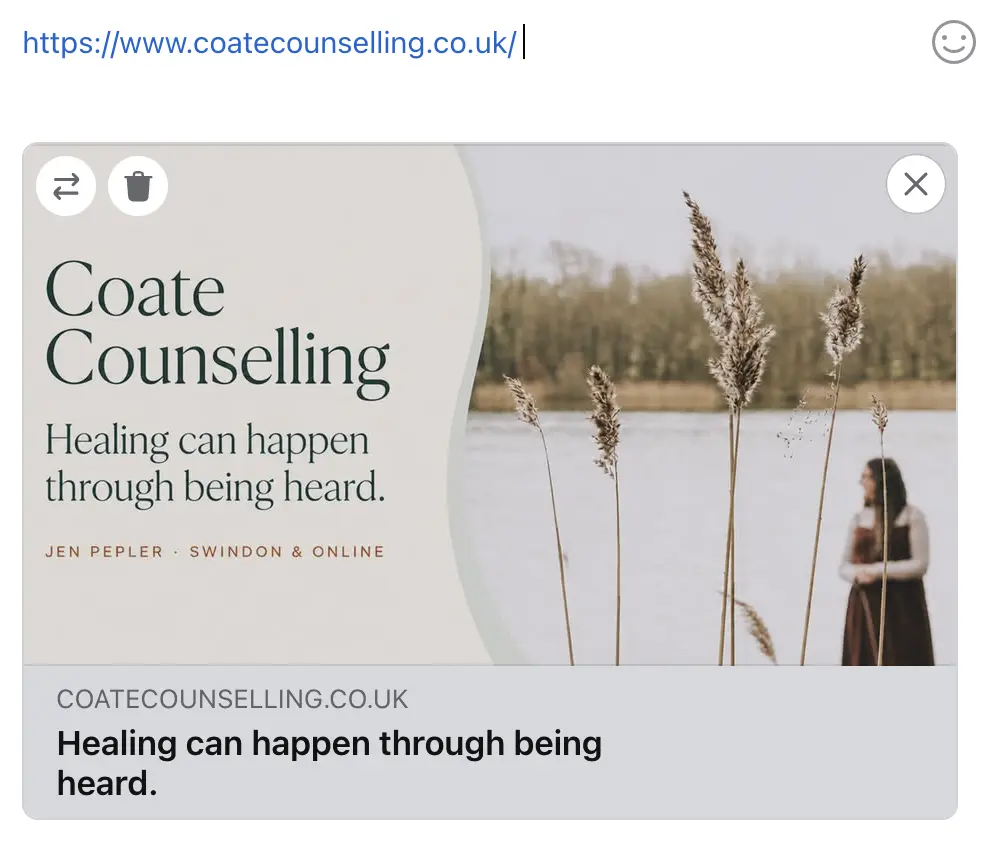
Meta's own developer documentation sets out the basics: an og:title, og:description and og:image tag on each page, so the crawler behind Facebook, WhatsApp and Instagram (and, in practice, most other platforms and messaging apps) has something specific to show rather than a best guess. Its sharing guidance recommends a 1.91:1 image ratio, commonly built as 1200 by 630 pixels, the same size this site uses for every article's own preview image.
A few things worth getting right on a therapist website specifically:
- Use a real image, not a placeholder. A preview card with your practice name, and ideally a calm, on-brand image rather than a generic stock photo, reads as more professional and trustworthy than a blank grey box or a mismatched logo.
- Keep it legible small. Preview thumbnails are tiny, often under 300 pixels wide, on a phone screen. Dense text or a busy photo just looks like noise at that size.
- Set a specific title and description per page, not the same one everywhere. A shared link to your fees page should preview differently to a shared link to your homepage.
- Check what actually renders. Paste your own URL into a fresh WhatsApp message to yourself, or use a tool like Facebook's Sharing Debugger, before relying on it. Cached previews can also lag behind a recent change, which the debugger can force to refresh.
This is one of the places a done-for-you website has a real, unglamorous advantage over some DIY builders: not every platform makes it straightforward to set a custom preview image and description per page. See our comparison of website builders versus a custom-built website if this is a detail worth checking before you commit to a platform.
Setting up your accounts with clients in mind
A few practical habits do most of the work before you ever post anything:
- Check what's already there. Search your own name the way a prospective client would, and ask a friend to review your profiles from a client's perspective: photo, tone, what a stranger would conclude about you as a therapist.
- Review your privacy settings regularly, not just once. Platform updates reset settings more often than most people expect, and clients, their families and even employers do look.
- Treat closed groups as public. Anything posted online is recordable, shareable and searchable, even after you delete it, and even inside a "private" group.
- Decide on separate accounts if you can manage it. A personal account that never mentions your profession is still traceable, but keeping personal and professional presences distinct genuinely reduces the chance of an awkward overlap.
Handling clients on social media
The moment a client can see your posts, or you can see theirs, the relationship changes shape slightly. A few situations come up often enough to be worth deciding on in advance rather than in the moment:
Friend and connection requests. There's no rule against accepting one, but most therapists decline them as a standing policy and say so clearly when they first contract with a client. Deciding this in advance, and stating it plainly, avoids an awkward judgement call with a specific person watching for your response.
What you post about your own life. You don't have to disappear from the internet, but it's worth pausing on posts about difficult days, strong opinions or personal struggles. A client who reads that you've had "an exhausting week" might reasonably wonder if it was about their session, even when it wasn't. Consider how a post would land for the client who is currently finding things hardest, not the average reader.
Client-adjacent content. Anything that could let a client identify themselves, directly or by combining small details, is a confidentiality issue regardless of how it's framed or how anonymised it feels to you. If you write about client work at all, even in general terms, that's a separate decision worth its own thought; our guide to what a therapist website should include covers the same confidentiality principle for website content and case examples.
Where the real risk sits
Most of the difficult situations BACP describes aren't really about having an opinion online, they're about two specific failure modes: a confidentiality breach, or a dual relationship that blurs your professional role.
Confidentiality is the more concrete of the two. Posting anything that could identify a client, even indirectly through combined details, breaches the fundamental commitment to "protecting client confidentiality and privacy" in the Ethical Framework. This applies just as much to data handled through booking tools, email lists or analytics on your website; see our guide to GDPR for therapists for how that principle extends beyond social media specifically.
Dual relationships are more about accumulation than a single mistake: following a client, commenting on their posts, or letting a professional boundary blur into a personal one over time. BACP notes there are limited circumstances where a member's non-client-related social media conduct can be considered through its Article 12.6 conduct process, separate from the more common route of a direct confidentiality or boundary breach. In practice this is reserved for conduct that risks public confidence in the profession, not an ordinary personal opinion.
A simple social media policy you can actually use
BACP doesn't require a formal written policy, but having one, even three or four sentences, makes the boundary consistent rather than something you decide fresh each time. A starting point:
- I don't accept friend or connection requests from current or former clients on personal accounts.
- I don't discuss or reference client work in a way that could identify someone, even anonymised.
- I review my own public profiles and privacy settings periodically, and treat everything I post as permanent.
- If a client raises social media during our work together, we'll talk about it openly rather than leave it unspoken.
Mention this briefly when you first contract with a new client, the same way you'd cover confidentiality or cancellation terms. It costs a sentence or two and removes the guesswork later. For the wider context of what belongs in your client-facing paperwork and website, see our guide to getting your first counselling clients, which covers where social media fits alongside referrals, a directory listing and your own site.
Frequently asked questions
Can therapists accept friend requests from clients on social media?
There's no outright ban from BACP or UKCP, but it's worth deciding your position before a client asks rather than in the moment. BACP suggests discussing social media when you first contract with a client, so your boundary is clear from the start rather than something you're negotiating on the spot. Many therapists have a standing policy of not accepting client friend or connection requests on personal accounts, and saying so plainly in their welcome pack or contract.
Do therapists need a written social media policy?
Not as a formal requirement from BACP or UKCP, but it's genuinely useful to have one written down, even a short one, for yourself and to share with clients. BACP's own guidance recommends discussing social media boundaries when contracting with a client, and having your position already written out makes that conversation quicker and more consistent than deciding fresh each time.
Can BACP take action over a therapist's social media posts?
In limited circumstances, yes. BACP's guidance states there are some situations where concerns about a member's non-client-related social media posts may go through one of its conduct processes, referred to as the Article 12.6 process. This sits alongside the more common route: posts that identify a client or breach confidentiality are a straightforward Ethical Framework issue regardless of Article 12.6.
Should therapists keep personal and professional social media accounts separate?
It's widely recommended, though not the only workable approach. BACP notes that even a private, professional-free personal account can usually still be traced back to you, so separation reduces risk without eliminating it entirely. Some therapists instead keep a single, carefully curated account and simply post nothing they wouldn't want a client, employer or regulator to see.
Start with a boundary, not a ban
Social media isn't something UK therapists need to avoid, and for many it's a genuine way to build warmth and visibility over time; our guide to marketing yourself as a therapist covers where it fits alongside a website and directory listing as a client-acquisition channel. The ethics side is simpler than it looks: decide your boundaries before you need them, keep client confidentiality non-negotiable, and apply the same professional judgement online that you'd use anywhere else.
Get a website that does the heavy lifting
A clear, professional website gives clients everything a social profile can't: your fees, your approach and a proper way to get in touch. UpTopWeb builds it for you, with no upfront cost.
Get a free website