Marketing
Testimonials for Therapists: What UK Rules Allow (and What to Do Instead)
Can counsellors use client testimonials? What BACP, UKCP, the ASA and the UK's fake reviews law say, how to get consent properly, and safer ways to build trust.
On this page8 sections
Testimonials for therapists sit in an awkward spot. In most businesses, a page of happy customer quotes is an easy win. In a counselling or psychotherapy practice, the same page touches confidentiality, health data, professional-body rules, advertising law and, since April 2025, the UK's fake reviews law. None of that makes testimonials impossible for most therapists, but it does mean a quote from a client is one of the hardest things on your website to get right, and one of the easiest to leave out without losing much.
This guide is for UK counsellors and psychotherapists in private practice deciding whether to use client testimonials on their website, directory profile or social media. It covers what BACP and UKCP say, the ASA's testimonial rules, why picking only the best quotes is now a legal question as well as an ethical one, how to get consent that's actually informed, how to reply to a review without confirming someone is your client, and what tends to build trust better. Rules are as checked on 13 October 2026.
Important: This is a practical overview, not legal, regulatory or professional advice. Professional-body rules differ and change over time, BACP's 2026 Ethical Framework becomes mandatory on 3 November 2026, and how consumer law applies to a particular practice depends on the facts. Check your own body's current guidance, and take legal advice if you're unsure.
Testimonials for therapists: five sets of rules at once
The reason this topic confuses people is that no single rulebook covers it. A testimonial on a therapist's website is checked against at least five, and they each ask a different question.
| Rule source | What it says | What it means for you |
|---|---|---|
| UKCP Code of Ethics and Professional Practice | Members must not "include testimonials from clients in any advertising" (clause 13) | If you're a UKCP member, don't use client testimonials to promote your practice |
| BACP Ethical Framework 2026 and Therapist Directory criteria | No outright ban. The directory allows testimonials with the client's permission, in line with the ASA's rules; the framework requires accurate information, ethical public communications and confidentiality | Allowed, but consent, accuracy and anonymity carry the weight |
| ASA and the CAP Code (section 3) | You need documentary evidence a testimonial is genuine, permission to use it, and it mustn't mislead | Keep the original and the consent; don't edit a quote into a claim |
| Digital Markets, Competition and Consumers Act 2024 (fake reviews) | Fake reviews, hidden incentives and publishing reviews "in a misleading way" are banned practices | Never write or commission quotes, never reward them without saying so, and be careful about cherry-picking |
| UK GDPR | Information that reveals someone has had therapy is health data, a special category | A testimonial that could identify a client is sensitive personal data, not just a nice quote |
If you belong to another body (NCPS, BABCP, or the HCPC for arts therapists and psychologists), check its own code before going further; this guide doesn't cover them in detail. Our comparison of BACP vs NCPS vs UKCP sets out how NCPS's advertising rules differ.
Which professional body you belong to changes the answer
UKCP members. The UKCP Code of Ethics and Professional Practice is unusually direct. Clause 13 says members must "not make any claims which you cannot demonstrate to be true or include testimonials from clients in any advertising." A practice website, a directory profile and a promotional social media post all exist to bring in clients, so the safest reading is that they count. If you're dual-registered with BACP, the stricter rule is the one to follow.
BACP members. BACP doesn't ban testimonials. Its Therapist Directory listing criteria say short quotes "can help demonstrate your experience and skills", that you must have permission from the person who gave the testimonial, and that testimonials must comply with the endorsements and testimonials requirements in section 3 of the UK advertising code.
The 2026 Ethical Framework, mandatory from 3 November 2026, doesn't mention testimonials by name either. Three of its commitments still apply to them:
- Accuracy (1.2a): be honest about your work and give "clear, accurate information about services offered". A testimonial is information about your services.
- Public communications (1.3d): make sure public communications "reflect the ethical principles set out in this Ethical Framework".
- Confidentiality (3.1a): respect people's rights to privacy and keep information shared confidential. The framework's confidentiality principle allows disclosure "with the service user's consent", which is why consent is the whole question for BACP members.
Our BACP Ethical Framework 2026 checklist covers the other changes that land on your website before the November deadline.
What the ASA's testimonial rules mean in practice
The Advertising Standards Authority applies the same rules to a counsellor's website as to anyone else's marketing. Its testimonials and endorsements guidance (dated 21 September 2026) sets out the parts of the CAP Code that matter most:
- Evidence (rule 3.47). You must hold documentary evidence that the testimonial is genuine. A quote you remember someone saying isn't evidence; the original email, card or form is.
- Claims (rule 3.49). Claims within a testimonial must not mislead. A client's words don't let you make a claim you couldn't make yourself.
- Permission (rule 3.50). You can't feature a testimonial without permission.
- Editing. Testimonials should not be taken out of context or edited in a way that misleads.
Rule 3.49 is the one therapists trip over. If you couldn't write "counselling cured my anxiety" on your homepage, quoting a client who says it doesn't make it acceptable. The ASA's guidance on mental health treatment claims is the place to check what counts as a treatment claim. Our guide to writing therapist website copy covers the same line for the rest of your pages.
Three testimonials, before and after
The quotes below are invented for illustration. The "after" versions are shorter quotes taken from the same message, which keeps them in context, not new words put in a client's mouth.
| Original quote | Problem | A safer extract |
|---|---|---|
| "Sarah cured my depression in eight weeks. I'd recommend her to anyone." | A treatment claim and an outcome promise the therapist couldn't make, plus a first name and timescale | "I felt listened to from the first session." |
| "After my divorce and losing my job at the hospital, Tom helped me find my feet again." | Life details that could identify the client to anyone who knows them | "Tom helped me find my feet again at a really difficult time." |
| "Best therapist in Harrogate, much better than the last two I tried!" | A comparison with other practitioners that can't be shown to be true | "Calm, warm and easy to talk to." |
If the only quote that fits is one you'd need to rewrite, leave it out. Changing a client's words until they say what you'd like isn't a testimonial any more.
Picking only the best quotes: the fake reviews law
Since 6 April 2025, Schedule 20 of the Digital Markets, Competition and Consumers Act 2024 has banned outright a set of practices around consumer reviews. Paragraph 13 covers fake reviews, reviews that hide that they were incentivised, and publishing reviews "in a misleading way". The Act's examples of misleading publication include "failing to publish, or removing from publication, negative consumer reviews whilst publishing positive ones" and "giving greater prominence to positive consumer reviews over negative ones".
The CMA's fake reviews guidance (CMA208), published 4 April 2025, says a consumer review is "a broad concept" that doesn't have to be written by a consumer, and that reviews published by a trader "on their own website" are covered. On cherry-picking, it says this "might be done either through suppressing negative reviews that have been submitted or by encouraging just those who are satisfied to leave reviews", or by "selecting only favourable reviews to be presented".
The guidance doesn't talk about therapists or a practice's testimonials page specifically, and how it applies to a handful of quotes on a counsellor's website hasn't been tested. But a page of hand-picked praise, gathered only from the clients you knew were happy, is close to what it describes. In practice that means:
- Never write, commission or tidy up a testimonial into existence. Quotes from friends, family or colleagues presented as client feedback are fake reviews.
- Never reward a testimonial without saying so. A free session or discount in exchange is an incentive, and an incentivised review has to be clearly identified as one.
- Don't present a few quotes as typical. Avoid headings like "What my clients say" above three hand-picked lines. Something like "A few words from former clients, shared with permission" is more honest about what the reader is seeing.
- If you show ratings from another site, show them fairly. The CMA guidance says a business displaying ratings from a review site on its own website should check that site's policies for tackling fake reviews. Linking to the full set of reviews is safer than copying across the best ones.
Asking for Google reviews has its own rules, including Google's ban on selectively asking happy customers; our local SEO checklist for therapists covers those.
Consent that's actually informed
Under UK GDPR, information that reveals something about a person's physical or mental health, including that they've used a health service, is health data. The ICO's guidance on what special category data is is clear that inferred health information counts, and that details about someone's mental health are likely to be "much more sensitive" than many other kinds. A testimonial that could be traced to a real person tells the world that person had therapy with you.
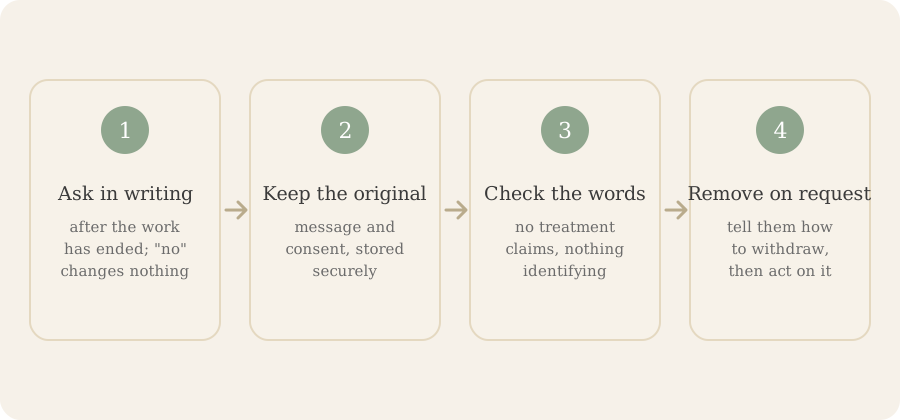
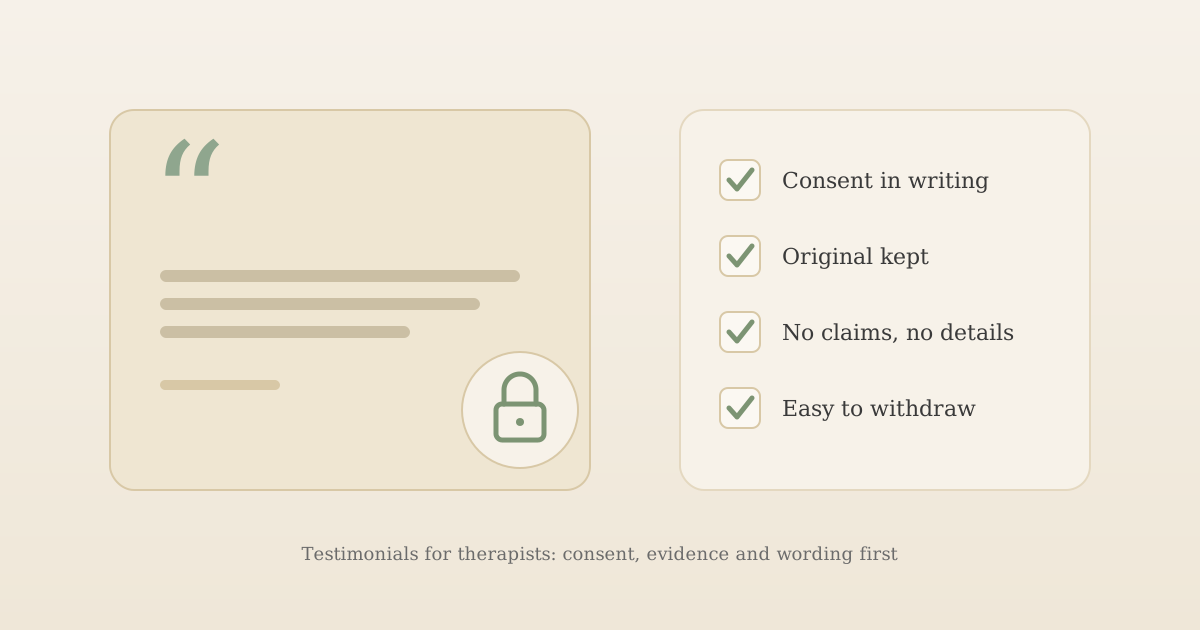
If you decide to use testimonials, a consent process that stands up looks something like this:
- Ask after the work has ended, in writing. Asking mid-therapy makes "no" hard to say. Make it clear that declining changes nothing.
- Show them the exact wording and where it will appear. Website, directory profile, Instagram: each is a separate yes. Consent to one isn't consent to all.
- Agree how they'll be named, if at all. Initials, a first name or "former client" all carry different risks. In a small town, a first name and a detail can be enough.
- Explain how to withdraw it. Say you'll remove it promptly if they change their mind, and then do. Remember that copies may live on in search engine caches or screenshots, and tell them so.
- Keep the original and the consent together. That's your ASA evidence. Store it as carefully as your client notes; our guide to GDPR and client records for therapists covers how.
- Mention it in your privacy notice. If you hold and publish testimonials, your website privacy notice should say so. Our GDPR checklist for therapist websites covers what the notice needs.
What not to use: a screenshot of a thank-you message, a card on your windowsill in a photo of your room, or a quote someone left on a directory profile copied across without asking. Our guide to Instagram for therapists covers why the screenshot version is the riskiest of all.
Replying to reviews without confirming someone is your client
Some feedback arrives whether you ask for it or not: a Google review, a directory review, a comment on a post. The confidentiality risk then sits in your reply. Thanking someone by name for "our sessions", or answering a complaint with details of what happened, confirms in public that they were your client.
A short, general reply works for both good and bad reviews:
Thank you for taking the time to leave feedback. For confidentiality reasons, I never confirm whether someone is or has been a client, but I read every review and take what people say seriously. If you'd like to talk about anything directly, please get in touch through my website.
For a negative review that might be from a client, take it to supervision before replying, and keep anything specific out of the public reply.
What tends to build trust better than testimonials
Testimonials answer the question "did this work for someone else?", which is the question a therapist is least able to answer honestly in public. The questions a hesitant visitor is really asking are closer to: are you right for me, what happens next, what does it cost, and how do I get in touch. You can answer all four without a single client quote:
- What a first session is like, step by step, in your own words.
- Your fees, session length and cancellation terms, shown before anyone has to ask.
- Your registration, with a link to check it on your professional body's register.
- Real photos of you and your room, or a short video of you explaining how you work.
- A short, honest "who I work with" section, including who you might not be the right fit for.
These are the same things our guide to what a therapist website should include puts first, and they're harder to fake than a quote, which is part of why readers trust them. When we build a therapist's website, we don't add testimonials unless the therapist confirms they hold permission and the original, and we don't copy quotes across from directory profiles. For the wider picture of marketing within professional rules, see our guide to how to market yourself as a therapist.
Frequently asked questions
Can BACP counsellors use client testimonials?
BACP doesn't ban them. Its Therapist Directory allows short testimonials if you have the client's permission and they follow the ASA's rules on endorsements and testimonials. The 2026 Ethical Framework, which becomes mandatory on 3 November 2026, still expects accurate information about your services, public communications that reflect its principles, and confidentiality, so consent, accuracy and anonymity all matter.
Can UKCP psychotherapists use testimonials on their website?
UKCP's Code of Ethics and Professional Practice says members must not include testimonials from clients in any advertising (clause 13). A practice website and directory profile exist to promote your practice, so the safest reading is that the rule covers them. If you're unsure how it applies to something specific, ask UKCP before publishing.
Can I ask a client for a testimonial while I'm still seeing them?
Nothing in the BACP or ASA rules sets a timing rule, but asking mid-therapy puts a client in an awkward position: it's hard to say no to someone you're relying on. Many therapists who use testimonials only ask after the work has ended, in writing, with a clear note that saying no is fine and changes nothing.
Can I put my Google reviews on my website?
You can, but you then become a publisher of those reviews under the UK's fake reviews rules. The CMA's guidance says a business showing ratings from another review site should check that site's policies for tackling fake reviews. Showing every review, or linking to the full set, is safer than copying across only the glowing ones.
Build trust without needing client quotes
UpTopWeb designs and builds therapist websites that answer the questions clients actually ask: how you work, what it costs and what happens next. No upfront cost, and testimonials only if you want them and have the consent to back them up.
Further reading
Related articles
Marketing12 minute read
How to Market Yourself as a Therapist
Therapist websites9 minute read
What Should a Therapist Website Include?
Therapist websites14 minute read
How to Write Therapist Website Copy (With Before-and-After Examples)