Training & CPD
Level 5 Diploma in Counselling: Is It Worth It?
Whether a Level 5 counselling diploma is worth it for UK counsellors heading into private practice: what it adds to Level 4, costs, funding, SCoPEd and accreditation.
On this page10 sections
A Level 5 diploma in counselling is the usual next step for UK counsellors who've finished a Level 4 diploma and want to go deeper. The question most people ask before spending a year and a couple of thousand pounds on it is simple: is it worth it? This guide is for qualified counsellors in the UK weighing up a Level 5, especially those heading into private practice. The short answer: you don't need one to see private clients, but the Psychotherapeutic Counselling diploma is designed for independent practice, and it's worth it if you want that depth, a step towards accreditation or supervision, or a specific route such as working with young people. Below is what each Level 5 diploma covers, what it costs, how it fits with SCoPEd and accreditation, how to avoid unregulated look-alikes, and what to change on your website once you've qualified.
Important: This is a practical overview, not careers, regulatory or financial advice. Qualification requirements, professional-body routes and student finance rules change. Check the current specification with your training provider, your professional body's criteria and GOV.UK before you enrol or apply.
Key takeaways:
- You don't need a Level 5 diploma to work in private practice. A Level 4 diploma plus registration, supervision and insurance is enough to start.
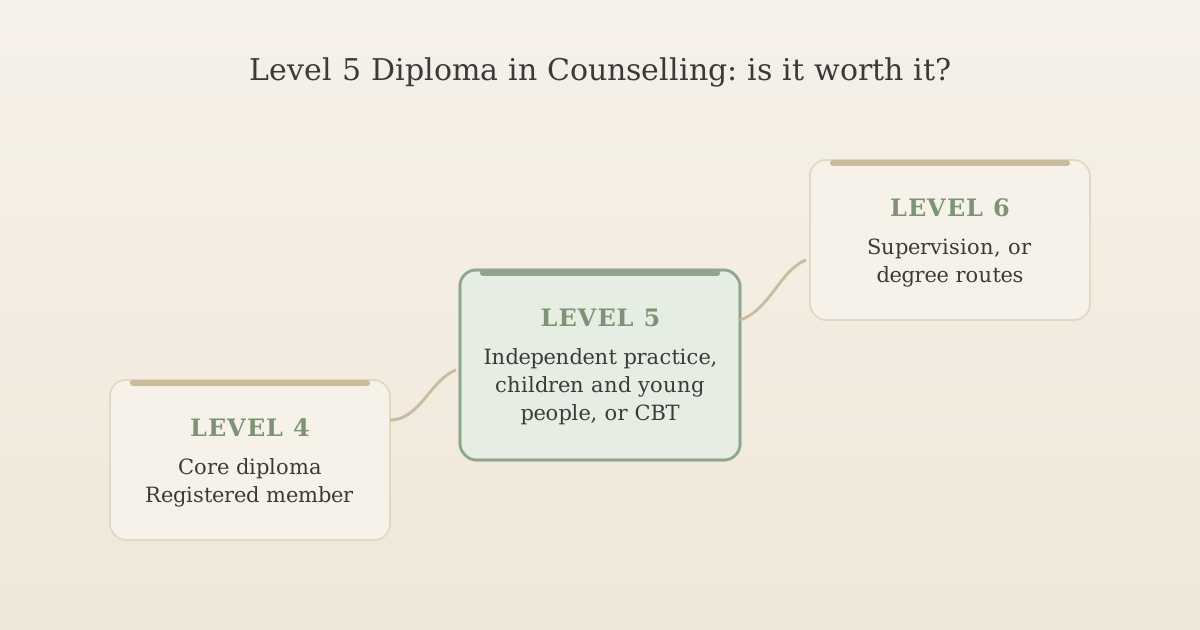
- CPCAB, the awarding body behind most UK Level 5 counselling diplomas, offers three: Psychotherapeutic Counselling, Counselling Children and Young People, and CBT Skills and Theory. Each needs a Level 4 diploma first.
- The Psychotherapeutic Counselling diploma is the one designed for independent practice. CPCAB says it meets SCoPEd column B competences, but it doesn't make you BACP Accredited on its own.
- A Level 5 diploma is at the same level as a foundation degree, but it isn't a degree.
- Search for the qualification on the government register before you pay. Some cheap online "Level 5 counselling diplomas" are endorsed certificates, not regulated qualifications.
What a Level 5 diploma in counselling is
In the UK, "Level 5" refers to the Regulated Qualifications Framework. GOV.UK's list of qualification levels puts a level 5 diploma alongside a foundation degree, a diploma of higher education (DipHE) and a higher national diploma (HND). A bachelor's degree with honours is Level 6.
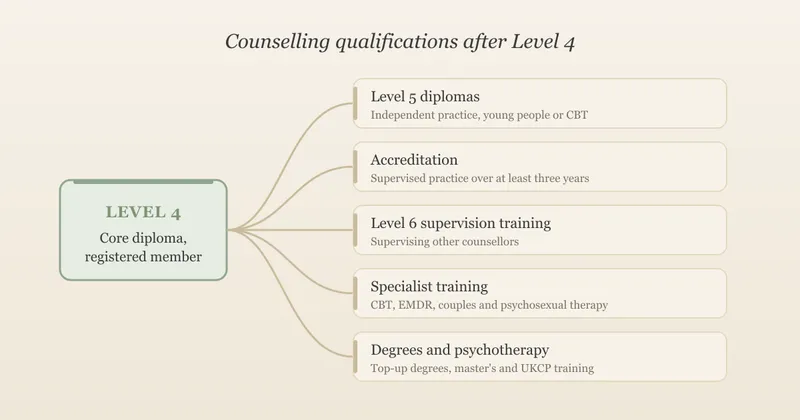
For counselling, Level 5 diplomas are post-qualifying courses. You take one after your core training, not instead of it, and they're one of several routes you can take after Level 4; our guide to counselling qualifications after Level 4 compares them all. CPCAB's three Level 5 diplomas all ask for its Level 4 Diploma in Therapeutic Counselling or an equivalent Level 4 qualification of at least 300 guided learning hours aligned with SCoPEd column A.
Interest in them is growing. UK Google searches for "level 5 counselling" showed up in 24 of the 53 weeks to 22 October 2026, and the most recent three months averaged about 1.7 times the first three months of that period. That's still a small, specialist search, which fits: it's a question people ask once they're already qualified.
The three CPCAB Level 5 diplomas compared
| Psychotherapeutic Counselling (PC-L5) | Counselling Children and Young People (CYP-L5) | CBT Skills and Theory (CBT-L5) | |
|---|---|---|---|
| What it's for | Working at greater depth as a self-employed counsellor in independent practice, or a senior role in an agency | Working with children and young people aged 11 to 18 | Integrating CBT skills and theory into your counselling work |
| Entry | Level 4 diploma or equivalent | Level 4 diploma or equivalent | Level 4 diploma or equivalent |
| Guided learning hours | 120 | 120 | 120 |
| Total qualification time | 458 hours | 435 hours | 388 hours |
| Client work during the course | At least 60 hours of contracted one-to-one counselling, including assessment | At least 60 hours of contracted one-to-one counselling with children and young people | At least 30 hours of one-to-one work with at least three clients, using the CBT model |
| Personal counselling | At least 40 hours by the end of the course, 10 of them during it | At least 20 hours, 10 of them during the course | None stated |
| SCoPEd | CPCAB says it meets column B competences | Not stated | Not stated |
Figures are from CPCAB's qualification pages and 2026 to 2027 specifications, checked on 23 October 2026.
The CPCAB PC-L5 page is explicit about who it's for: it's designed to give learners what they need "to work as self-employed counsellors in independent practice". Its learning outcomes cover the parts of private practice that you carry alone once you leave an agency: a coherent approach to assessing clients, working with clients at risk of suicide or self-harm, referral, evaluating your work with clients, and managing boundaries in independent practice.
The children and young people diploma is aimed at school, college and agency counsellors, and also at adult counsellors in private practice who want to extend their work to 11 to 18 year olds. The CBT diploma adds a specific approach rather than depth; it's not the same as becoming a BABCP-accredited CBT therapist, which is a separate process.
Is a Level 5 diploma worth it? Who it suits and who it doesn't
| It's probably worth it if... | It can probably wait if... |
|---|---|
| You're moving into private practice and want more confidence with assessment, risk and running your own caseload | You've just qualified and haven't yet built up client hours; most of what you need now is experience under supervision |
| You want to work towards BACP or another body's accredited membership, or towards supervision training later | Your main goal is more clients; a Level 5 won't bring enquiries by itself |
| Job adverts or contracts you want ask for column B or Level 5 | You'd be taking it mainly for the title; employers and clients care more about registration, experience and fit |
| You want to work with young people and need training to do it competently | The cost would stretch you while you're still building a practice |
The honest middle ground: a Level 5 makes you a more confident, better-equipped independent practitioner, and it opens doors to later steps. It doesn't change what you're allowed to do in private practice, and it won't fill your diary. If you're unsure, talk it through with your supervisor, who knows your work and where you want to take it.
What it means for SCoPEd and accreditation
SCoPEd is the shared framework that sets out training and practice standards in three columns, A, B and C. BACP maps its Registered, Accredited and Senior Accredited membership onto those columns. Our guide to whether a Level 4 diploma is enough for private practice explains what column A means for Level 4 graduates.
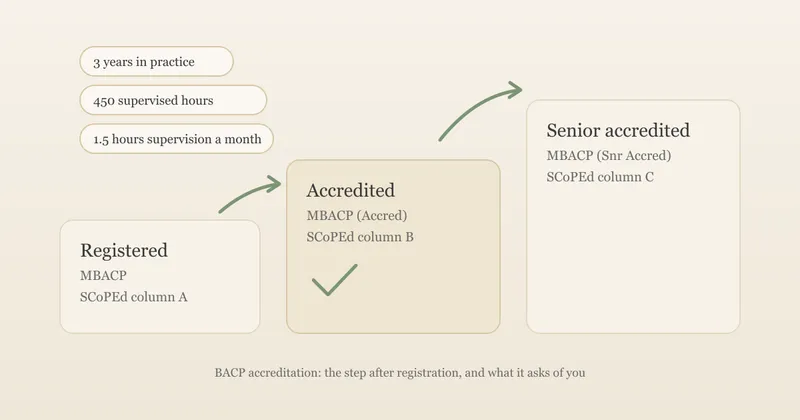
CPCAB says the Psychotherapeutic Counselling diploma "meets the competencies" of column B, and that "with sufficient practice hours" it provides a route to membership and accreditation with professional bodies such as BACP, NCPS and ACC. Those last words matter. Completing the diploma doesn't put you in column B on its own. BACP's Accredited membership has its own routes, including one for graduates of BACP accredited or approved column B progression courses, and each route has supervised practice and time requirements. When we checked in October 2026, BACP said its column B progression courses hadn't yet run, so which route applies to a CPCAB Level 5 graduate is worth confirming with BACP's accreditation team before you plan around it. Our guide to BACP accreditation covers the routes, fees and the 450 hours in detail.
UKCP is a separate path. CPCAB says that someone with both its Level 4 and Psychotherapeutic Counselling diplomas "may be eligible to apply" for UKCP registration as a psychotherapeutic counsellor through one of UKCP's accrediting organisations, but the route needs more: a minimum of 105 hours of personal counselling, and assessment against what CPCAB describes as a standard that is normally graduate level. CPCAB is clear that its CYP and CBT diplomas don't count for this.
Is a Level 5 diploma the same as a degree?
No, although it's at the same level as some degree-type qualifications. GOV.UK lists a level 5 diploma separately from degrees, alongside a foundation degree, DipHE and HND. CPCAB's own documents describe the Psychotherapeutic Counselling diploma as at the same higher education level as a foundation degree, and list progression to the Open University's Foundation Degree in Counselling and credit transfer to university study.
If a degree matters to you, for example for some employed roles or for a later master's, ask the university whether your Level 4 and Level 5 diplomas can count towards a top-up degree before you enrol anywhere.
How much it costs, how long it takes and funding
Time. CPCAB describes the Psychotherapeutic Counselling diploma as one year part time, and the providers we checked run it over one academic year: one day a week in college, or a series of online evening sessions. CPCAB allows an extra year after the diploma to complete outstanding client hours.
Cost. On 23 October 2026, two providers offering the CPCAB Psychotherapeutic Counselling diploma for 2026 to 2027 or later listed tuition of £1,849 and £2,238. The CPCAB registration fee is on top: £398 in the 2026 to 2027 specification, though one provider listed £385. Then budget for the placement costs: supervision for your 60 client hours and 40 hours of personal counselling if you don't already have them. Prices vary widely, so compare what's included.
Funding. GOV.UK's Advanced Learner Loan covers Level 3 to 6 courses for people aged 19 or over. For Level 4 to 6 courses starting on or after 1 January 2027, GOV.UK says to apply through the new Lifelong Learning Entitlement instead, with applications opening at the end of October 2026. The government's qualification record for CPCAB's Psychotherapeutic Counselling diploma shows it approved for both. Not every provider takes part, though: at least one we checked said it isn't in the loan scheme. Ask before you apply.
Check it's a regulated qualification before you pay
Search for "Level 5 counselling diploma" and you'll also find online courses for a few hundred pounds, with no placement, completed in weeks. Some describe themselves as accredited or endorsed. That isn't the same as a regulated qualification, and one we looked at said in its own FAQs that it's "an endorsed certification, not a regulated qualification". Courses like this won't meet professional bodies' training requirements.
Before you pay, check three things:
- The awarding body. For the diplomas in this guide, that's CPCAB. Look for the qualification title and number, for example 500/8386/7 for the Psychotherapeutic Counselling diploma.
- The register. Search GOV.UK's find a regulated qualification service. CPCAB's specifications for all three of its Level 5 diplomas say they're regulated by Ofqual, Qualifications Wales and CCEA.
- The placement. A genuine Level 5 counselling diploma includes supervised client work. If there's no placement, it isn't one.
What to change on your website once you've qualified
A new qualification is worth showing, but describe it accurately. What you say about your training has to match what you hold; our guide to writing therapist website copy covers wording that's specific without overclaiming.
- Name it in full. "Level 5 Diploma in Psychotherapeutic Counselling (CPCAB)" is clearer and more checkable than "Level 5 qualified". Put it on your about page with your Level 4 diploma and your registration.
- Don't imply a status you don't hold. A Level 5 diploma isn't BACP accreditation or UKCP registration. If you mention SCoPEd, follow your professional body's guidance on how members can describe their column.
- Let it change what you offer, not just what you list. If you've trained to work with young people, that may justify a focused service page, with how you work with parents, consent and confidentiality for this age group. Our guide to therapist service pages covers when an area earns its own page, and our DBS checks guide covers the checks for working with under-18s.
- Describe CBT skills carefully. "I use CBT skills within my integrative work" is accurate after a CBT skills diploma. Calling yourself a CBT therapist suggests something different.
- Update your directory profiles at the same time, so clients see the same qualifications wherever they find you. Our guide to writing a counselling directory profile covers what to include.
A Level 5 diploma is often the point at which a counsellor narrows their focus, so it's a natural time to look again at your niche. Our guide to finding your niche as a therapist covers choosing one you can back up.
Frequently asked questions
Do I need a Level 5 diploma to work in private practice?
No. A Level 4 diploma from a recognised course, plus registration with a professional body, supervision, insurance and the other basics, is enough to see private clients in the UK. A Level 5 diploma adds depth for independent work, such as assessment, risk and running your own practice, and can help with some roles and with progression, but it isn't a legal or registration requirement for private practice.
Is a Level 5 diploma equivalent to a degree?
Not exactly. GOV.UK lists a level 5 diploma at the same level as a foundation degree, a diploma of higher education and an HND, but it lists it separately rather than as a degree. A bachelor's degree with honours is Level 6. Some Level 5 counselling diplomas can count towards a degree through credit transfer or a top-up route, so check with the university you're interested in.
Does a Level 5 diploma make me BACP Accredited?
No. BACP Accredited membership has its own application routes with supervised practice and time requirements. CPCAB says its Level 5 Diploma in Psychotherapeutic Counselling meets the competences of SCoPEd column B and, with sufficient practice hours, provides a route to accreditation with bodies such as BACP, NCPS and ACC. Which BACP route applies depends on your training, so check the route criteria or contact BACP's accreditation team before you apply.
How long does a Level 5 counselling diploma take?
CPCAB's diplomas are usually taught part time over one academic year, for example one day a week or a series of evening or weekend sessions. You'll also need to complete placement hours: for the Psychotherapeutic Counselling diploma that's at least 60 hours of contracted one-to-one client work and 40 hours of personal counselling by the end of the course.
The short version
A Level 5 diploma in counselling isn't required for private practice, but CPCAB's Psychotherapeutic Counselling diploma is designed for it, and for many counsellors it's worth the year and the roughly £2,200 to £2,650 in tuition and registration fees we found. It suits you if you want more depth in assessment, risk and independent work, plan to work towards accreditation or supervision, or want to train for a specific group such as young people. It doesn't make you BACP Accredited or degree-qualified on its own, and it won't bring clients by itself. Check the qualification is regulated, ask about funding before 2027 changes affect you, and once you've qualified, describe it accurately on your website and profiles.
Show your training the way clients understand it
UpTopWeb builds websites for counsellors and therapists with clear, accurate qualification details and focused pages for the work you're trained to do.
Further reading
Related articles
Training & CPD12 minute read
IFS, CFT or DIT? Extra Therapy Training for Counsellors (UK)
Training & CPD13 minute read
Counselling Qualifications After Level 4: Your UK Options
Training & CPD12 minute read
BACP Accreditation: Is It Worth It for Private Practice? (UK Guide)