Therapist websites
Therapist Service Pages: Does Each Specialism Need Its Own Page?
When an issue you work with deserves its own page on your therapy website, when a section is better, and how to avoid thin pages Google ignores.
On this page8 sections
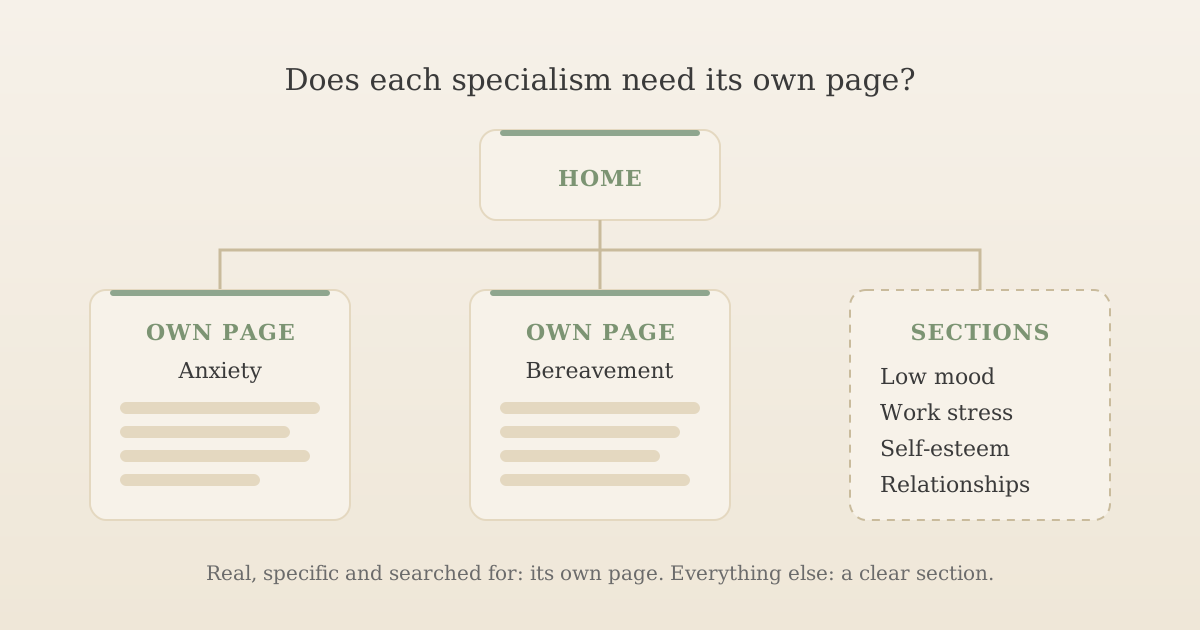
Therapist service pages are where a visitor works out whether you can help with the specific thing they're struggling with. The question most therapists hit while planning a website is whether each issue, therapy or client group needs its own page, or whether one services page will do. This guide is for UK counsellors, psychotherapists and other talking therapists planning a new site or tidying an existing one. The short answer: give an area its own page only when you can fill it honestly with something specific, and keep everything else as sections. Below is a three-question test for deciding, a worked example of one practice's site before and after, what a good service page includes, and the two patterns (thin pages and town pages) that tend to backfire.
Important: This is a practical overview, not legal, regulatory or professional advice. What you can say about the issues you work with is covered by advertising rules and your professional body's guidance, which change over time. Check the current ASA guidance and your own body's code before publishing.
Key takeaways:
- A separate page earns its place when the area is a real, current part of your work, you can say something specific about it, and people search for it.
- Areas you'd describe in the same words belong together as sections on one page, not as near-identical pages.
- A page per issue doesn't help if each page is a paragraph long. Google says it has no preferred word count; it looks for pages that are useful.
- Near-identical pages for every nearby town are what Google's spam policies call doorway abuse. A "Getting here from..." section on one location page usually serves those clients better.
- Start small. One or two focused pages that answer a client's questions beat ten that don't.
Why this decision matters for clients and for Google
For a prospective client, a focused page is reassurance. Someone searching for help after a bereavement who lands on a page about bereavement, written in plain words about what that work looks like with you, doesn't have to wonder whether you'd take them on. The same person landing on a list of thirty issues with "bereavement" somewhere in the middle has to do that work themselves.
For Google, a focused page gives it something specific to match against a specific search. Our beginner's guide to SEO for therapists lists "one thin Services page instead of focused pages" as a common mistake, and that's true. The opposite mistake is just as common, though: a dozen pages that each say the same two paragraphs with a different issue swapped in. Google's guidance on creating helpful, people-first content (updated 1 October 2026) asks whether you're "producing lots of content on many different topics in hopes that some of it might perform well in search results", which is a fair description of that pattern.
Three questions to ask before writing therapist service pages
Run each area of your work through these three questions. If the answer to all three is yes, it's a good candidate for its own page. If any answer is no, it's probably a section on a broader page.
1. Is this a real, current part of your practice?
A service page tells a stranger you're a good person to see about this. That has to be true now, not true of a placement five years ago or a weekend CPD course. BACP's Ethical Framework (good practice point 13) says "We must be competent to deliver the services being offered to at least fundamental professional standards or better", and point 45 asks that what you say about your experience and working methods is accurate and honest. Other bodies' codes say much the same.
A useful check: would you be comfortable explaining to your supervisor why this area has its own page? If you'd mention it as one issue among many, it's a section.
2. Can you say something specific about it?
Try writing three sentences about the area that wouldn't be true of any other page on your site. For example, for couples work: who's in the room, how sessions are structured, what happens if one partner wants to stop, and whether the fee is different. For work with young people: the age range, how parents are involved, and how confidentiality works for them.
If the three sentences come out as "I offer a safe, non-judgemental space to explore..." with a different issue name dropped in, the area doesn't need its own page yet. Our guide to writing therapist website copy has worked examples of turning that kind of general wording into something a client can use.
3. Do people search for it in their own words?
Clients search in plain language: "bereavement counselling Leeds", "couples therapy online", "counsellor for anxiety". They rarely search for a modality on its own unless they've already heard of it, and EMDR or CBT are exceptions because people ask for them by name. If you're not sure, start with the questions people ask in enquiries and the filters on a directory such as Counselling Directory's "What's worrying you?" list. Our guide to writing a counselling directory profile covers how those filters work. Once your site has been live for a few months, Google Search Console shows which searches it already appears for, and a search showing up against a page that only mentions it in passing is often a sign that the area deserves a page of its own.
A worked example: one practice's site, before and after
Here's an invented but typical solo practice: an integrative counsellor seeing adults in person in one town and online, with most of their work in anxiety and bereavement, some couples work, and occasional clients with work stress, low self-esteem or relationship difficulties.
Before, the site had nine pages: Home, About, Anxiety, Depression, Bereavement, Stress, Self-esteem, Relationships, Contact. Each issue page was about 120 words, and six of the seven used the same opening paragraph. Couples work wasn't mentioned at all, because it didn't fit the "issue" pattern. Fees were on the contact page.
Running the three questions:
| Area | Current and competent? | Something specific to say? | Searched for? | Decision |
|---|---|---|---|---|
| Anxiety | Yes, most of the caseload | Yes, how they pace early sessions | Yes | Own page |
| Bereavement | Yes, trained and experienced | Yes, open-ended work, anniversaries, no "stages" | Yes | Own page |
| Couples counselling | Yes, a separate training | Yes, different format and fee | Yes | Own page |
| Depression | Sometimes, alongside anxiety | Not really, same approach | Yes, but the page said nothing new | Section |
| Stress, self-esteem, relationships | Occasionally | No | Some | Sections |
After, the site had six pages: Home, About, Anxiety counselling, Bereavement counselling, Couples counselling, and a "Other things I can help with" page with short sections on low mood, work stress, self-esteem and relationship difficulties. Fees moved to their own page (with the couples fee shown separately), and contact became a short page with the form, a privacy line and the nearby towns clients come from.
It's fewer pages, but each one now answers a question the old site didn't. The couples page is the clearest gain: before, a couple searching for help had no page to land on at all.
What a good therapist service page includes
Whether it's a full page or a section, each area of work should answer the same handful of questions, in this order:
- Who it's for. In the client's words, with any limits: adults only, individuals rather than families, a specific age range.
- What it can look like. A few plain sentences about how the issue shows up in someone's life, without diagnosing or listing symptoms like a checklist.
- How you work with it. What sessions are actually like, and any approach you use for this area, explained rather than just named.
- Practicalities that differ. Session length, fee, online or in person, how many sessions people tend to have, if any of these differ from your other work.
- What happens next. The same primary call to action you use elsewhere on the site, so a visitor doesn't have to go looking for it.
One line to hold on every page: describe what you work with, not what you'll cure. The ASA's guidance on mental health treatment claims says claims to treat or cure conditions like depression and anxiety need robust evidence. "I work with adults experiencing anxiety" is fine; "I'll help you overcome anxiety for good" is a claim.
Link each service page to your about page, your fees page and your contact page or form. The essentials every therapist website should include covers those pages, and a visitor who's decided you might be right for them will usually want fees and next steps within a click.
Two patterns that tend to backfire
Thin pages for every issue
A page per issue with a paragraph on each is the most common version of this mistake. It doesn't help clients, because each page tells them nothing they couldn't guess. It doesn't reliably help with Google either: the helpful content guidance is clear that Google has no preferred word count, and what it looks for is whether a page gives the reader something useful. Near-identical pages can also end up competing with each other for the same searches, which splits your relevance rather than adding to it.
If you already have pages like this, merging them is usually an improvement. Combine the weakest into one page with clear sections, and make sure the old addresses redirect to the new page so any links to them still work.
Near-identical pages for every town nearby
The second pattern is location pages: "Counselling in Harrogate", "Counselling in Knaresborough", "Counselling in Ripon", each identical apart from the place name, from a therapist who sees clients in one room in one town. Google's spam policies (updated 28 August 2026) list "having multiple domain names or pages targeted at specific regions or cities that funnel users to one page" and "creating substantially similar pages" as examples of doorway abuse.
That doesn't mean a town can never have its own page. The test is the same three questions as before, especially the second: does the page say something useful that isn't on your other pages? A separate location page is justified when:
- It's a different venue. You rent rooms in two towns, and each page has its own address, access and parking details, room photos and the days you're there.
- You genuinely work there differently. For example, you see clients at a GP surgery, school or community centre in that town, or offer walk-and-talk sessions in a local park.
- The practicalities there are different. Different days, different fees, home visits only in that area, or a different booking route, so a client from that town genuinely needs different information.
Directions alone rarely make a page distinct, because everything else on it (you, your room, your fee, your approach) is the same as your main page. For most therapists who see clients in one place, a better pattern is one location page with a "Getting here from..." section: a short paragraph for each nearby town, with the bus or train route, rough journey or drive time, where to park and step-free access from that direction. A client from Knaresborough gets exactly what they need, the town names are on your site in a natural context, and you have one strong page instead of several thin ones.
It also helps to look at what a search for a town actually shows. When we searched Google UK for "counselling in Harrogate" on 5 October 2026 (signed out, with non-essential cookies rejected), the first thing on the page wasn't a therapist's website at all. It was a map of local practices, then directory pages from BACP and Counselling Directory, then Harrogate Mind, a local charity.
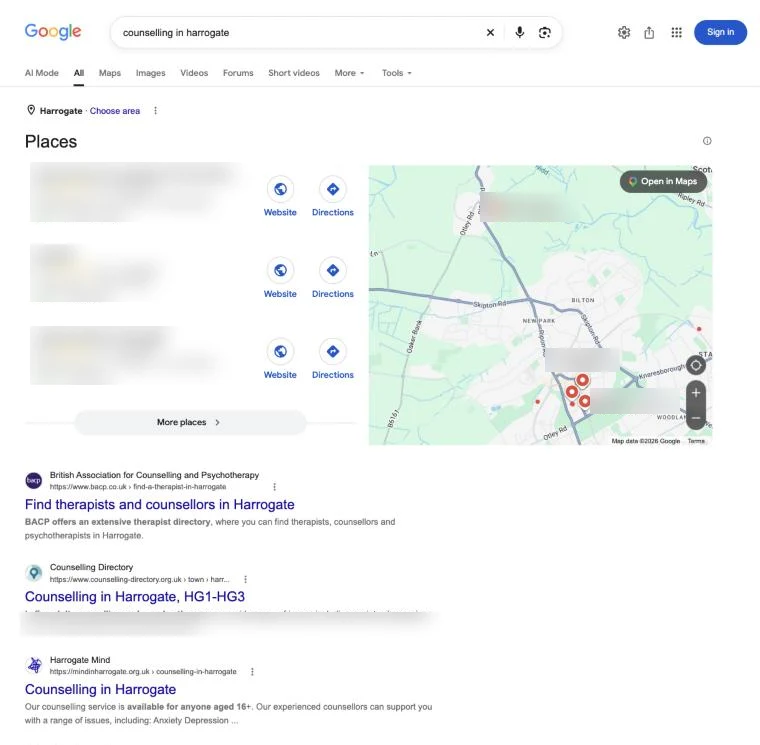
Results vary by person, device and day. A second check the same day, through a search data tool, showed an AI Overview near the top and Psychology Today's Harrogate listings as the first ordinary result. The pattern held, though: in the top nine ordinary results, only one individual practice had its own pages; the rest were directories, an NHS page and a services marketplace.
That's the real competition for a town page, and it points to three things worth doing well, in this order:
- Your Google Business Profile. The map listings come from Google Business Profiles, and Google says local results are "mainly based on relevance, distance, and popularity". A complete, accurate profile is how you appear in that map; a page for a town ten miles away rarely gets you into it. Our local SEO checklist for therapists covers setting it up.
- Your directory profiles. The directory pages that rank for a town are lists of profiles, so a clear, specific profile is how you stand out on them. Our guide to writing a counselling directory profile shows how.
- Your own focused pages. A strong page of your own on the first page of results, alongside a good profile on the map and on the directories, means you appear several times for the same search. For a solo practice, that's doing well.
"Counselling in Harrogate" is a broad, top-level search, and it's the hardest one for a single practice to win. More specific searches can look quite different. In a check the same day through the same search data tool, "couples counselling harrogate" returned individual practices for six of its top ten results, several of them a practice's own couples or relationships page. "Bereavement counselling harrogate" was led by free local services (a bereavement charity, a hospice, the NHS and the council), and the one individual practice in the top nine ranked with a page specifically about bereavement.
That's the case for niching down. A focused page about the type of counselling you offer and the clients you most want to work with, in the place you see them, speaks directly to the person searching and faces different competition from a general "counselling in [town]" page. It's also worth searching your own niche before you write: where free services dominate, as they did for bereavement, say clearly what your service offers that's different, such as availability, session length, a particular approach or no waiting list.
The same groundwork carries over to AI search. Google builds AI Overviews from the pages it already ranks, with no special steps needed, and ChatGPT increasingly answers local questions with a map of pinned results; our guide to AI search for therapists covers both. None of this is quick. Google's SEO starter guide says "some changes might take effect in a few hours, others could take several months", so treat your own pages as a long-term channel and let your profile and directory listings do the work in the meantime.
If you have a set number of focused pages to plan, pages that combine a real area of your work with the place you actually see clients ("bereavement counselling in Harrogate") are usually a better use of them than a page for each surrounding town.
If you work only online, town pages make even less sense. A clear statement of where you can see clients from (the UK, or specific countries your insurance covers) is more useful. Our guide to offering online counselling in private practice covers that decision.
Start small, then add pages as your practice shows you what to add
You don't need to plan every page on day one. A newer practice can start with a single well-structured services page, or even one scrolling page with clear sections, and add focused pages when a pattern emerges: the same type of enquiry arriving month after month, a new training completed, or a search phrase showing up in Search Console that your site doesn't really answer yet.
When that happens, a new service page is a better home for the topic than a blog post if it describes something you offer. Blog posts suit questions people ask before they're ready to choose a therapist; our guide to blogging for therapists covers that side. Service pages are for the moment they're deciding.
The two work together. Once a service page exists, every related blog post has somewhere specific to link to: a post about the first anniversary of a loss can link to your bereavement page with plain anchor text like "bereavement counselling in Harrogate", rather than to a general services list. Google says it uses links as a signal "when determining the relevancy of pages", and that attention to internal anchor text "can help both people and Google make sense of your site". It's also the natural route for a reader: from a question they had, to the page where they decide whether to get in touch. Internal links make a good page easier to find, though; they don't rescue a thin one. They're a reason to make your main service pages strong, not a reason to make more of them.
If cost is part of the decision, more pages usually means a higher build price with a freelancer or agency. Our breakdown of how much a therapist website costs covers how page count affects each route.
Frequently asked questions
Should each therapy or issue I work with have its own page?
Not automatically. Give an issue its own page when you work with it often and competently, can write something specific about it (who it's for, how you work with it, what's different about sessions), and people plausibly search for it. Issues you see less often, or that you'd describe in the same way, usually work better as short sections on one services page.
How many service pages does a counselling website need?
There's no right number. Many solo practices do well with one services page, or one to three focused pages for their main areas of work plus a general page for everything else. Google says it has no preferred word count, so more pages only help if each one is genuinely useful to the person reading it.
Should I make a page for every town near me?
Usually not. Google's spam policies describe substantially similar pages targeted at specific regions or cities that funnel users to one page as doorway abuse. A separate page makes sense for a real second venue, or a town where you genuinely work differently. For nearby towns clients travel from, a 'Getting here from...' section on one location page, with routes, journey times and parking, is more useful and avoids thin pages.
Is one scrolling page enough for a therapy website?
It can be, especially for a newer practice or a focused specialism. A well-structured single page with clear sections and a jump menu answers most clients' questions. It gives Google less to match against specific searches than focused pages would, so if you work with two or three distinct areas, separate pages are usually worth adding later.
The short version
Give an area of your work its own page when it's a real, current part of your practice, you can say something specific about it, and clients search for it. Group everything else into clear sections on one page. Write each page for the client who's trying to decide whether you can help: who it's for, how you work with it, what's different about the practicalities, and what to do next. Avoid near-identical issue pages and town pages that differ only by name (a "Getting here from..." section does that job better), link your blog posts to the service pages they relate to, and add pages over time as your enquiries and search data show you where they'd help.
Service pages that answer the right questions
UpTopWeb builds websites for counsellors and therapists with focused pages for the work you actually do, written in plain words, with fees and next steps a click away.
Get a free websiteFurther reading
Related articles
Therapist websites13 minute read
Squarespace vs Wix for Therapists: A Fair UK Comparison
Therapist websites10 minute read
Best Website Builder for Therapists: Squarespace, Wix or Airo?
Therapist websites14 minute read
How to Write Therapist Website Copy (With Before-and-After Examples)