Starting a practice
Offering Online Counselling in Private Practice: A UK Guide
What UK counsellors need before offering online sessions: BACP's competence framework, choosing a platform, online contracts, risk planning and clients abroad.
On this page11 sections
Online counselling is now a standard part of private practice in the UK, not a stopgap. Many counsellors run an online private practice alongside a room, and some work online only. Moving sessions onto a video call is the easy part. The parts that take more thought are whether you're competent to work this way, which platform you use and on what terms, how you contract and manage risk when you're not in the room, and what changes when a client is in another country.
This guide is for UK counsellors and psychotherapists adding online sessions to a private practice, or setting one up online from the start. It's built around BACP's online and phone therapy (OPT) competence framework, which BACP updated in August 2026, and it reflects the sources as checked on 1 October 2026. If you belong to a different professional body, the same practical questions apply, but check your own body's guidance too.
Key takeaways:
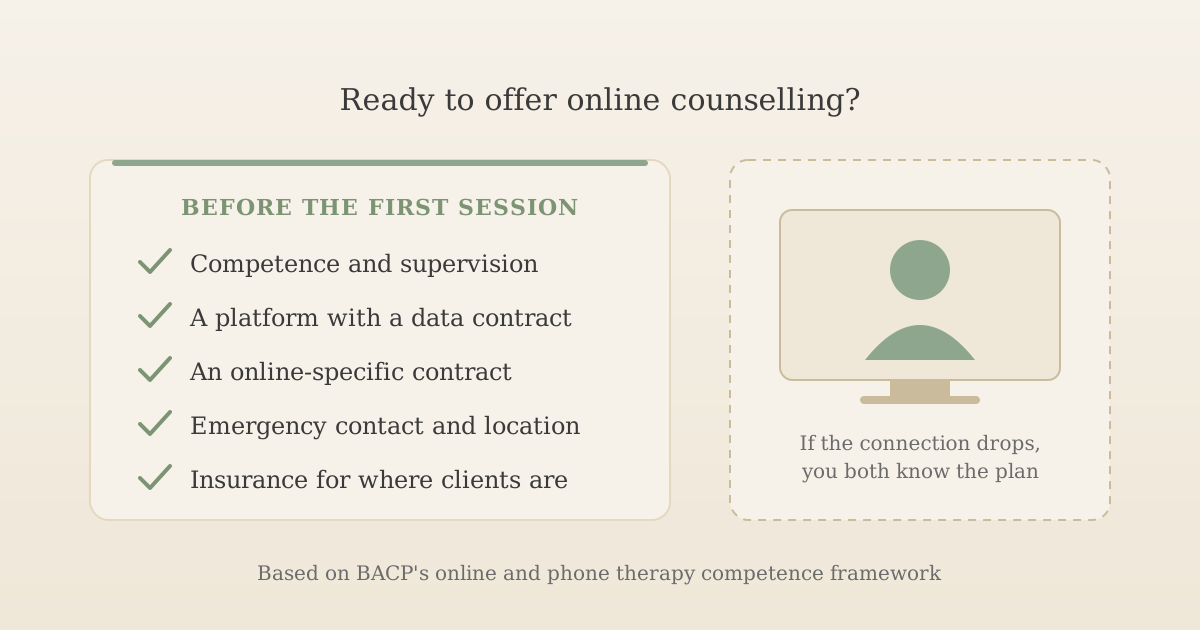
- There's no separate qualification to work online. BACP says that if you're competent across its OPT framework you don't need more training, and if you have gaps, you should fill them with training or CPD.
- Your video platform is a data processor. Under UK GDPR, you need contract terms with it, so check the plan you use comes with them.
- Contract specifically for online work: who starts the call, what happens if the connection fails, and the client's private space.
- Take an emergency contact and GP details at the start, and know where your client is each session.
- Clients abroad raise insurance and legal questions. Check your policy before you accept them.
- If you work only online, you won't qualify for a Google Business Profile, so your website does more of the work.
Important: This is a practical overview, not legal, data protection or professional advice. Professional-body guidance and platform terms change, and how they apply depends on how you work. Check your professional body's current guidance, your insurer's terms and the ICO's guidance for anything that affects your own practice.
Is online counselling right for your private practice?
BACP's framework is even-handed about this. It lists real benefits of online and phone work, including accessibility for clients with some disabilities, limited transport or long distances, and flexibility around clients' lives. It also lists real limitations: technical problems, data security, fewer non-verbal cues, and the chance that remote work could make some clients' circumstances worse, such as isolation.
It also asks you to assess whether online work suits each client, not just whether it suits you. The framework's assessment section lists factors to consider. Does the client need a high level of care and support? Are they struggling to function, or at significant risk of suicide or self-harm? Do they have the technology, a private space and the confidence to use it? A practice that's online for some clients and in person for others gives you somewhere to refer a client who isn't suited to working remotely. If you're online only, decide in advance where you'd refer them.
Online work also changes what your practice costs to run. With no room to hire, your overheads may be lower, and some practitioners price online sessions slightly lower as a result. Others charge the same for both. Our guide to how much counsellors should charge covers both approaches.
Do you need extra training to offer online counselling?
There's no separate licence or qualification to work online in the UK. BACP's guidance on OPT training says that if you feel you're competent in all areas of the framework, you don't need to undertake further training, and that if there are gaps in your knowledge or skills, you should take additional training or CPD to comply with the Ethical Framework.
That puts the judgement on you, so make it an honest one. Many counsellors moved online quickly in 2020 and learned as they went. That's experience, but it doesn't mean every part of the framework is covered. Read the framework's sections on contracting, risk, data protection and working internationally, note where you're unsure, and take those gaps to your supervisor. A focused online therapy course is a reasonable way to close them, and it counts towards your CPD. Our guide to how many CPD hours counsellors need covers how that's recorded.
The framework also asks you to tell clients about your level of skill and training in online work, so be ready to answer that question plainly.
Supervision for online work
BACP's framework suggests using supervision that parallels the way you work, such as online supervision if you see clients online, and using it to reflect on how online work is affecting both you and your clients. If your supervisor has little experience of online work, consider whether that still fits. Our guide to clinical supervision for counsellors covers how to find and contract with a supervisor.
Choosing a video platform
The platform question gets more attention than it deserves, while the data protection question that sits behind it gets less. There isn't a single approved platform for counselling. What matters is the terms you use it on and how you set it up.
Under UK GDPR, a video platform that carries your sessions and holds your clients' details is acting as your processor. The ICO's guidance on when a contract with a processor is needed quotes the law directly: processing by a processor "shall be governed by a contract or other legal act". In practice, that means checking a few things:
- Data processing terms. Check that the plan you're on comes with data processing terms (sometimes called a data processing agreement or addendum). Terms can differ between free, personal and business plans, so check the plan you actually use.
- Where data is stored. Find out whether data leaves the UK and what safeguards the provider relies on if it does.
- Recording. Keep recording off. BACP's framework expects any recording, by you or by the client, to be carefully agreed in advance.
- Waiting rooms and unique links. Use a waiting room or a unique link for each client, so one client can't join another's session.
- Your own records. Note which platform you use and why in your data protection records. Our guide to GDPR for therapists covers ICO registration, special category data and what to do if something goes wrong.
If you use Google Meet
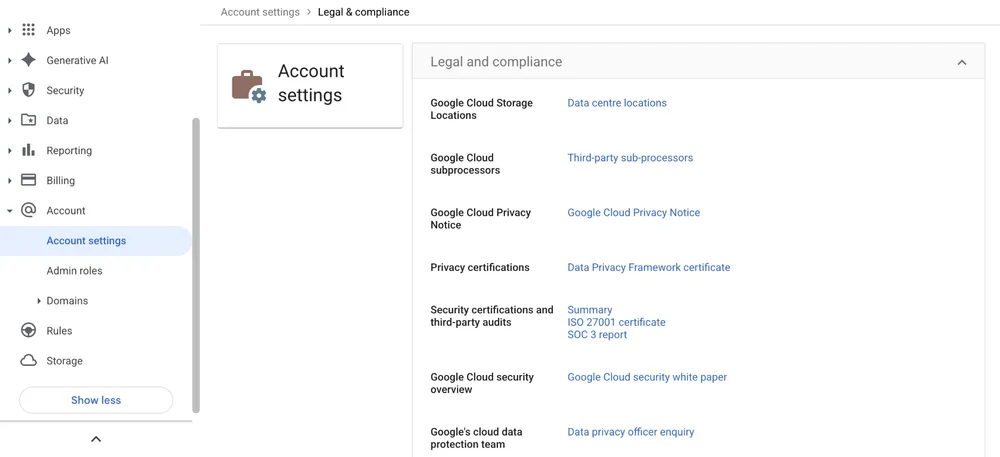
Google Meet is a common choice for counsellors who already use Gmail, and it's where the account you use matters most. Google's processor terms, its Cloud Data Processing Addendum, are offered through Google Workspace, its paid business service. Google says you only need to opt in if your Workspace agreement doesn't already include them. If you run sessions from a free personal Gmail account, check what terms actually apply before you rely on it for client work. If your practice email is already on Workspace, an administrator can see Google's sub-processors and data centre locations in the Admin console under Account, then Account settings, then Legal and compliance, and Google's guidance linked above explains how to check whether the data processing terms are already part of your agreement.
Meet also has a built-in equivalent of a waiting room. Google's Meet security guidance says participants who aren't on the calendar invite must ask to join by "knocking", and the organiser has to accept them. Send each client their own invite, or admit them yourself, rather than sharing one standing link.
Use the same platform consistently, and keep the client's experience simple. A client who has to download something new and create an account before their first session may give up before they start.
Contracting for online sessions
Your usual contract still applies, but online work adds terms of its own. BACP's framework lists several that are worth writing into your agreement:
- Who starts the session. Decide whether you send the link or call, or the client joins at a set time.
- What happens if the connection fails. Agree a backup, such as moving to a phone call, and whether a session cut short by a technical problem is charged or rescheduled.
- A private, consistent space. Ask the client to find somewhere they won't be overheard, and to tell you if they're joining from somewhere different.
- No distractions on either side. Close other apps and turn off notifications, and ask the client to do the same where they can.
- Contact outside sessions. Keep contact within the agreed frame, such as email for rescheduling only, and not through social media or text.
- Your training. Tell the client about your level of skill and training in online work.
Most online clients agree terms by email or an online form, which matters for consumer law as well. Our guide to therapy contracts for UK counsellors explains the 14-day cancellation right that usually applies to contracts agreed at a distance, and how to handle a client who wants to start sooner.
Risk and safety when you're not in the room
This is where online work differs most from working in a room, and BACP updated this part of the framework in August 2026 to reflect current research. The framework notes that assessing risk online can be harder: non-verbal cues are reduced, especially by phone or text, you may have less information to judge how serious things are, and there's a limit to how far you can step in from a distance.
So agree with the client in advance how risk will be handled. The framework gives practical examples of what to collect at the start:
- An emergency contact, agreed with the client from the beginning of therapy.
- GP details, or a family member or friend who could be contacted in a crisis.
- The client's location each session. If a client usually joins from home but is somewhere else today, you need to know, in case you have to call emergency services to their address.
Check these at the start of each session if you can, not only at assessment. And state clearly, in your contract and on your website, that you're not an emergency service and how to get urgent help.
Seeing clients outside the UK
Online work makes it easy for someone in another country to book with you. BACP's framework treats this as a separate competence, with three expectations:
- Know the professional and legal requirements, and limitations, of working across borders for any country where you provide online therapy.
- Understand your ethical responsibilities and how you'd manage risk for a client in another country.
- Make sure your insurance is valid in the country or countries where your clients are located.
Rules differ between countries, and some regulate who can provide therapy to people living there. Professional indemnity policies set out which territories they cover, and you can't assume a client abroad is included. Our guide to professional indemnity insurance for therapists covers what to check in your policy.
The simplest way to handle this is to decide your limits in advance. Some UK practitioners offer online counselling to clients in the UK only, and say so on their website and in their contract. If you do work with clients abroad, ask your insurer to confirm cover in writing for the specific countries involved, and think through how you'd find local emergency services before you need them. A UK client who travels during therapy raises the same question for a short time, so cover it in your contract too.
Setting up your own space
Clients notice your environment more on a screen than you might expect. BACP's framework asks you to be mindful of what the client can see, so a few practical points help:
- A private room you can close, where no one else in the house can overhear you. Headphones help, but they don't stop people hearing your side of the conversation.
- A plain, neutral background. Clear away family photos, post with your address on and anything you wouldn't want a client to see.
- A wired or reliable connection, with your phone ready as a backup.
- Lighting from the front, so the client can see your face clearly.
- A short buffer between clients. You lose the walk out of the room that marks the end of a session, so a few minutes between calls helps you reset.
Getting found when you work online
Working online widens the area you can see clients from, but it also changes how clients find you. If you work only online, you won't qualify for a Google Business Profile. Google's business eligibility guidelines say a business "must make in-person contact with customers during its stated hours", and they list online-only businesses as ineligible. If you see some clients in person as well, you can still have a profile for that part of your practice. Our guide to local SEO for therapists covers how to set one up, including whether to show your address.
Without a profile, your website and directory listings do more of the work, so make online sessions obvious on both. Say clearly on your website:
- That you work online, and by phone if you do, on the homepage and not only on a fees page.
- Who you can see: UK only or wider, and any time zones you work across.
- Which platform you use and what the client needs, so the first session feels less unfamiliar.
- Your online fee, if it's different from your in-person fee.
- That you're not an emergency service, with where to get urgent help.
Searches without a location, such as "online counsellor for anxiety", are more competitive than local ones, because you're competing with every practitioner and platform in the country. A clear specialism helps you stand out. Our guide to what a therapist website should include covers the pages and details clients look for before they get in touch.
A readiness checklist for online counselling
| Area | Ready when... |
|---|---|
| Competence | You've read BACP's OPT framework against your own practice and addressed any gaps with training, CPD or supervision |
| Supervision | Your supervisor understands online work, ideally with some sessions held online too |
| Platform | You're on a plan with data processing terms, recording is off, and each client has a waiting room or unique link |
| Data protection | Your privacy notice and records mention the platform, and you know where its data is stored |
| Contract | It covers who starts the call, technology failure, the client's private space and contact between sessions |
| Risk | You take an emergency contact and GP details at the start, and check the client's location each session |
| Clients abroad | You've decided whether to accept them, and your insurer has confirmed cover in writing if you do |
| Insurance | Your policy explicitly covers online sessions |
| Your space | A private room, a neutral background, a reliable connection and a phone backup |
| Website | It says you work online, who you can see, what clients need, your fee and how to get urgent help |
Frequently asked questions
Do I need extra training to offer online counselling?
Not automatically. BACP's guidance says that if you feel competent in all areas of its online and phone therapy (OPT) competence framework, you don't need further training, but if there are gaps in your knowledge or skills you should take additional training or CPD. Read the framework honestly against your own practice, and discuss any gaps with your supervisor.
Is Zoom, Teams or Google Meet GDPR compliant for counselling?
No platform is compliant or non-compliant on its own; what matters is how you use it. Under UK GDPR, a video platform that handles your clients' personal data is acting as your processor, and the ICO says that processing must be governed by a binding contract. Check that the plan you use comes with data processing terms, find out where data is stored, keep recording switched off unless it's been explicitly agreed, and record your choice in your own data protection records.
Can I see clients who live outside the UK online?
Possibly, but check first. BACP's competence framework expects you to know the professional and legal requirements of any country where you provide online therapy, and to make sure your insurance is valid in the countries where clients are located. Insurance policies set out which territories they cover, so check yours before accepting a client abroad, and remember that some countries regulate who can provide therapy to people living there. Some UK practitioners simply limit online work to clients based in the UK.
Can an online-only therapist have a Google Business Profile?
Not usually. Google's eligibility guidelines say a business must make in-person contact with customers during its stated hours, and they list online-only businesses as ineligible. If you also see clients in person, or plan to, you can create a profile for that part of your practice. If you only work online, your website and directory listings do the job a profile would otherwise do.
The short version
Offering online counselling in private practice doesn't need a separate qualification, but it does need you to be honestly competent against BACP's online and phone therapy framework, or your own body's equivalent. Choose a platform on the strength of its data processing terms rather than its features. Write online-specific terms into your contract. Take an emergency contact and GP details at the start, and know where your client is each session. Decide in advance whether you'll see clients outside the UK, and check your insurance before you do. Then make sure your website says clearly that you work online, because if you're online only, it's doing the job a Google Business Profile would otherwise do.
A website that makes online sessions clear
UpTopWeb builds websites for counsellors and therapists that say clearly how you work, online, in person or both, with fees, session details and who you can see set out before clients get in touch.
Get a free website