Starting a practice
EAP Counselling Work in the UK: Rates, Requirements and Contracts
Thinking of joining an EAP network as an affiliate counsellor? What providers ask for, what the work pays, how sessions and paperwork work, and whether it suits your practice.
On this page11 sections
EAP counselling work is a common way for UK counsellors to add clients alongside their own practice. Employers buy an employee assistance programme (EAP) for their staff, the EAP provider takes the calls and assesses each person, and self-employed affiliate counsellors deliver the short-term counselling. You don't market yourself or set the fee. You also don't control the number of sessions, the paperwork or, often, the rate.
This guide is for counsellors and psychotherapists in the UK who are thinking of joining an EAP network, or already have and want to check the terms. It covers how EAP work operates, what providers ask for, what it pays and how to work out whether it's worth it, how confidentiality works when an employer is paying, and what to check in the contract. It's a companion to our guide to associate counsellor work, which covers working for a practice or platform. Sources are as checked on 18 November 2026.
Key takeaways:
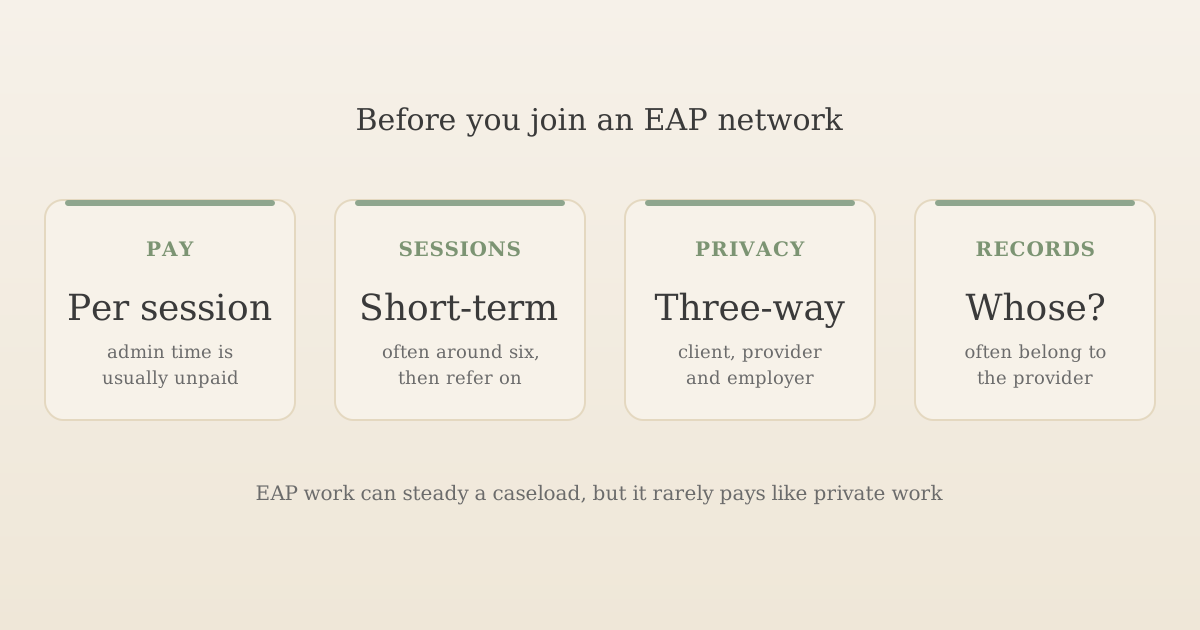
- EAP work is short-term: on average five sessions per case, according to EAPA UK, with extra sessions only in exceptional cases.
- Most providers pay a rate per session, and rates are rarely published. In a 2026 NCPS member survey, the most common face-to-face rate was £31 to £35 per hour, usually with admin time unpaid.
- Published criteria commonly ask for three or four years' post-qualification experience, professional body membership or accreditation, indemnity insurance, a DBS check and arranged supervision.
- The employer pays, so the contract is three-way. Know what, if anything, is reported back, and make sure the client knows before you start.
- Records often belong to the provider, not to you. Check what you keep, for how long, and what happens if a client wants to continue privately.
Important: This is a practical overview, not legal, tax or employment advice. Every EAP provider's contract is different. Read yours carefully, ask the provider about anything unclear, and check your professional body's current guidance.
What EAP counselling work is
An employee assistance programme is a service an employer pays for so its staff can get confidential support with personal and work problems, usually through a phone line, online resources and a short course of counselling. HMRC's guidance on welfare counselling explains why employers buy them: welfare counselling provided by an employer for its employees is generally exempt from tax, and the manual names "Employee Assistance Programmes" as one form it takes.
The market is large. EAPA UK, the trade body for EAP providers, says in its Focusing on the Job report 2025 that EAPs were available to 18.675 million employees, which it describes as more than half of all UK employees, and that providers delivered about 1,115,500 counselling sessions in the year its data covers.
A typical case runs like this:
- An employee contacts the EAP, usually by phone or online.
- The provider's clinical team assesses them, including for risk, and decides whether short-term counselling is suitable.
- The provider allocates the case to an affiliate counsellor near the client, or for phone or video work.
- You see the client for an authorised number of sessions, keep records and report back to the provider as the contract requires.
- The case closes, or the client is referred on if they need something the EAP doesn't offer.
You work for the provider, not for the client or the employer. The client doesn't pay you, and you usually never deal with the employer at all. A January 2026 article in BACP's Workplace journal, by a clinical director at an EAP provider, says any contact with the employer is typically managed by the EAP's case managers and clinical teams.
What EAP providers ask for
Each provider sets its own criteria. Three UK providers publish theirs on their own sites, which gives a fair picture of what to expect:
| Wisdom Wellbeing | Vita Health Group | CiC | |
|---|---|---|---|
| Qualification | Counselling or psychotherapy qualification | Ideally a postgraduate diploma, Level 4 or above | Diploma or master's level training |
| Professional body | BACP membership or accreditation eligibility, or equivalent | BACP (or equivalent) accredited membership | Accredited or registered, for example BACP or UKCP |
| Experience | 4 years post-qualification, including recent private client hours | At least 3 years' counselling experience | 450 post-qualification hours, over 2 years in private practice, short-term EAP experience |
| Insurance | Indemnity insurance of at least £1,000,000 | Not stated | Not stated |
| DBS | Enhanced, within 3 years | Not stated | Not stated |
| Other | ICO registration, supervision arrangement, suitable therapy rooms | Payment within 15 days, invoicing per session | Suitable rooms for face-to-face work |
Sources: Wisdom Wellbeing careers (Health Assured's affiliate page now redirects to Wisdom Wellbeing), Vita Health Group's counsellor network page and CiC's counsellor area, all checked 18 November 2026. None of the three publishes a per-session rate.
EAPA UK's standards for EAP providers (January 2023) explain where some of these numbers come from. They ask providers to check that affiliates have completed at least 450 hours of tutor-led training with a placement, 450 supervised practice hours and at least three years of practice, and to recheck professional body membership and insurance every year. Affiliates working online or by phone should also have training in digital delivery.
If you're newly qualified, that usually means EAP work is something to plan for, not start straight away. Our guides to BACP accreditation and professional indemnity insurance cover two of the most common requirements, and our guide to DBS checks for therapists explains which level applies.
Applying usually means a CV, copies of your certificates, insurance and DBS, references, and sometimes photos of your room. Joining a network doesn't promise any work: EAPA UK's counsellors' guide says there's "no guarantee of referrals". Referrals depend on which employers the provider holds contracts with, where you are, and whether you have availability when a case comes in.
How EAP work differs from private practice
Short-term, with a fixed number of sessions
EAP counselling is brief by design. EAPA UK's 2025 report says providers deliver five sessions per employee case on average, and in an NCPS member survey, Working with Employee Assistance Programmes and Online Therapy Platforms (around March 2026, 206 respondents), six sessions was the most common limit. Extra sessions can be requested, but EAPA UK's counsellors' guide says only in exceptional circumstances, and they aren't always authorised.
That shapes the work. You'll need to contract clearly for a short piece of work from the first session, focus on what's achievable in the time, and plan endings early. In the NCPS survey, 23% of respondents said session limits harmed their ability to provide effective therapy, so it's worth asking yourself honestly whether brief work suits how you practise.
Someone else assessed the client
The provider's clinical team assesses each client before the case reaches you, and EAPA UK's standards require a mental health assessment at first contact. But EAPA UK's counsellors' guide is clear that an assessment may not uncover everything, and that the clinical picture can change once you meet the client. If it does, you contact the provider's case manager rather than extending the work yourself.
You may need to refer on
Clients who need longer-term work, specialist help or a medical assessment are referred on, usually to their GP or another service. Providers expect you to know what's available locally, and to use the case management team when a client's needs go beyond what the EAP offers.
Response times are tight
Providers aim to see clients quickly. EAPA UK's counsellors' guide says providers are under pressure to arrange the first session within 3 to 5 working days of the client's first call. If you can't offer an appointment within the provider's window, the case may go to someone else.
What EAP work pays
Providers rarely publish their rates. EAPA UK's counsellors' guide says the most common arrangement is a rate per session, although some providers pay a fixed rate per case, that "there is no industry standard", and that rates "typically will be lower than you might expect to charge" privately.
The NCPS survey gives the clearest recent picture from counsellors' side:
- The most common face-to-face rate was £31 to £35 per hour, with remote rates in a similar range. The same practitioners typically charged £60 or more for private work.
- 52% were dissatisfied or very dissatisfied with their pay, and 89% had seen no rate rise in the previous 12 months.
- 68% said their rate didn't include admin time. The most common time spent on admin was 11 to 20 minutes per session.
- The most common wait for payment was 20 or more working days after invoicing.
To compare EAP work with your own fees, work out what each session really pays per hour. The figures below are an illustration, using a rate within the survey's most common band and admin time within its most common range:
| Illustrative EAP session | Amount |
|---|---|
| Rate per session | £33 |
| Session length | 50 minutes |
| Unpaid admin (notes, forms, portal updates) | 15 minutes |
| Effective rate per hour of your time | about £30 |
That's before your supervision, insurance, room hire, travel and tax, all of which you pay as a self-employed affiliate. Our guide to how much counsellors should charge explains how private fees are set, and our guide to associate counsellor work shows how to work out what you keep after costs and tax.
The rate isn't the only factor. A steady flow of assessed clients can be worth something to a counsellor building a practice, filling quiet daytime hours, or adding hours towards accreditation. EAPA UK's 2025 report also says almost half of providers found it more difficult to recruit associate or affiliate counsellors, and gives higher pay expectations as one of the causes. If you're experienced and have availability, it's reasonable to ask whether the rate is negotiable.
Confidentiality when an employer is paying
EAP work is a three-way arrangement: the client, the EAP provider and the employer that pays for the service. EAPA UK's counsellors' guide goes as far as saying the organisation "is your client as well as the individual concerned". That makes confidentiality more complicated than in private practice.
What usually happens:
- Employers get anonymised information, not case details. EAPA UK's standards say reports to the employer must protect individual confidentiality and anonymity.
- Manager referrals have agreed feedback. If a manager refers an employee, the standards require the employee's informed consent to the level of feedback the manager will get, such as whether they attended.
- Disclosure to the employer is rare. EAPA UK's counsellors' guide describes it as "always a last resort", for situations such as a credible threat to other staff, and something handled by the provider after internal consultation, not by you alone.
- Risk goes through the provider. You'll usually have no direct contact with the workplace, so the contract will set out who you contact, and how quickly, when a client is at risk.
The BACP Ethical Framework 2026, in force since 3 November 2026, asks members to make sure clients are "aware of and agree to any foreseeable limitations to confidentiality". In EAP work, that means explaining at the first session what you share with the provider, what the provider may share with the employer, and when. Our guide to the BACP Ethical Framework 2026 covers what's changed.
Records, data and paperwork
In private practice, your client notes are usually yours to keep and manage. In EAP work they often aren't. EAPA UK's standards say affiliates must be told in writing that records are the property of the provider, and its counsellors' guide says records should be kept for seven years.
Expect paperwork beyond your usual notes:
- Assessment and session forms on the provider's portal or system.
- An outcome measure. EAPA UK's standards say face-to-face counselling must have one in place, though they don't name a particular tool.
- Closing reports and invoices, often per session.
Ask each provider what you'll need to complete, how long it usually takes and whether any of that time is paid. Then check how it fits with your own data protection set-up. Wisdom Wellbeing asks affiliates for ICO registration, and our guide to GDPR for therapists covers who owns the notes when you work for an EAP, agency or group practice.
Questions to ask before you join
- What is the rate per session, and is it the same for face-to-face, video and phone work?
- How many sessions are usually authorised per case, and how do I request more?
- What forms and outcome measures do I complete, and is admin time paid?
- How do I invoice, and how long does payment take?
- Who do I contact when a client is at risk, and how quickly will they respond?
- What, if anything, is reported to the employer, and how is the client told?
- Who owns the records, where are they kept and for how long?
- What happens if a client wants to continue with me privately after the EAP sessions end?
- Do you expect a minimum number of hours or a set response time from me?
- How much notice is there on either side if I want to leave the network?
If you're also offered associate work with a practice or platform, many of the same checks apply. Our guide to associate counsellor work has a matching list.
Seeing EAP clients privately afterwards
Some clients will want to keep working with you once their EAP sessions end. Whether that's allowed, and when, depends on your contract with the provider. In the NCPS survey, the most common answer to whether practitioners could take EAP clients into private practice was "Yes, but a break is required".
Whatever your contract says, keep the decision with the client. Offer clear information about their options, such as their GP, other local services or continuing privately at your usual fee, and avoid anything that looks like using the EAP to recruit private clients. If you do continue privately, start a new contract on your own terms and keep the private records separate from the provider's.
Is EAP work right for your practice?
EAP work tends to suit counsellors who:
- enjoy brief, focused work and are comfortable with fixed endings;
- have gaps in their diary they'd rather fill with lower-paid work than leave empty;
- are building hours, for example towards accreditation; or
- want variety alongside a longer-term private caseload.
It's harder to make work if most of your hours go to EAP clients. EAPA UK's counsellors' guide itself warns against becoming over-reliant on this type of work. A provider can lose an employer contract, change its rates or stop sending referrals, and your income goes with it.
Many counsellors use EAP work as one strand of a practice rather than the whole of it, alongside private clients who find them directly. Our guide to getting referrals as a therapist covers insurer and EAP networks as a referral source, and our guide to how many clients a counsellor should see helps you decide how much of your week to give each strand.
Frequently asked questions
What is EAP counselling work?
An employee assistance programme (EAP) is a service employers buy so their staff can get confidential support, including short-term counselling. EAP providers run networks of self-employed affiliate counsellors who see those clients, usually for a small, fixed number of sessions, and are paid by the provider rather than by the client or the employer.
How much do EAP counsellors get paid in the UK?
Providers rarely publish their rates, and EAPA UK's counsellors' guide says there is no industry standard. In an NCPS member survey published in 2026, the most common face-to-face rate was £31 to £35 per hour, while the same practitioners typically charged £60 or more for private work. Most respondents said their rate didn't include time spent on administration.
What do you need to become an EAP affiliate counsellor?
Requirements vary by provider, but published criteria commonly ask for a counselling or psychotherapy qualification (often Level 4 diploma or above), membership or accreditation with a professional body such as BACP, UKCP or NCPS, around three or four years' post-qualification experience, professional indemnity insurance, a DBS check, suitable rooms or a private space for remote work, and arranged clinical supervision.
How many sessions do EAP clients get?
EAP counselling is short-term. EAPA UK's 2025 report says providers deliver five sessions per employee case on average, and six sessions was the most common limit in an NCPS member survey. Extra sessions are usually only authorised in exceptional cases, so clients who need longer-term work are referred on.
Can I see an EAP client privately after their sessions end?
Check your contract with the provider first. Some prevent it or require a break before a client can continue with you privately, and in an NCPS survey the most common answer was that a break is required. Whatever the contract says, the decision should be the client's, made with clear information and not as a way of moving clients into your own practice.
The short version
EAP counselling work can steady a caseload and bring you assessed clients without marketing, but it's short-term, closely managed and usually paid well below private fees. Before you join a network, work out what a session really pays once admin is counted, understand what's shared with the provider and the employer, check who owns the records, and keep it as one part of your practice rather than all of it.
Building your own client base alongside EAP work?
UpTopWeb builds calm, professional websites for UK counsellors and therapists, so clients who find you directly can see who you are, what you charge and how to get in touch. Hosting and updates included in one monthly fee.
Further reading
Related articles
Starting a practice13 minute read
Associate Counsellor Work in the UK: What to Check Before You Sign
Marketing15 minute read
Referrals for Therapists: How to Build a Network That Sends You Clients (UK)
Starting a practice8 minute read
How Much Should Counsellors Charge? Pricing a Private Practice