Starting a practice
How Many Clients Should a Counsellor See? UK Caseload Guide
There's no BACP limit on how many clients a counsellor sees. What the rules say, the real hours behind a caseload, and a free caseload planner spreadsheet.
On this page10 sections
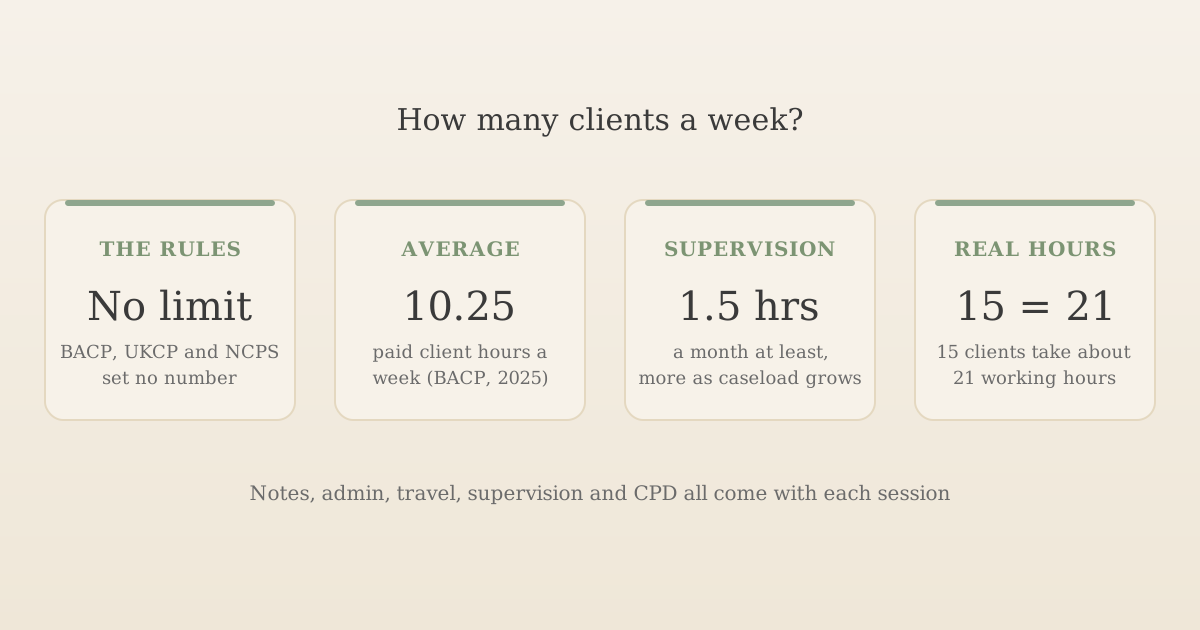
How many clients should a counsellor see a week? There's no official answer. BACP, UKCP and NCPS don't set a maximum, so the number is yours to decide, with your supervisor. What they do set are duties that limit it in practice: looking after your own health, having supervision that matches your caseload, and keeping proper notes. The real cost of each client is also more than the 50 minutes in the room.
This guide is for UK counsellors and psychotherapists in private practice, or mixing private clients with NHS, agency or other work. It covers what the rules say, what BACP's own survey shows counsellors actually work, what 10, 15 and 20 clients a week take in real hours, and how to decide on your own number. Rules are as checked on BACP's, UKCP's and NCPS's websites on 11 November 2026.
Key takeaways:
- BACP, UKCP and NCPS set no maximum number of clients. Your caseload is a judgement for you and your supervisor.
- BACP's 2026 Ethical Framework says you must look after your own health and be "sufficiently resilient" for the work, and that supervision must reflect your caseload.
- In BACP's 2025 survey, respondents averaged 10.25 paid client hours a week.
- Each client hour takes more than an hour of your week. In our worked example, 15 clients a week takes about 21 working hours.
- Decide your number before your diary fills up, and show your current availability on your website.
- Our free caseload planner spreadsheet works out your real weekly hours and tracks your caseload against your own limit.
What the rules say about caseload
No UK professional body for counsellors gives a number. What they give instead are duties that make some caseloads harder to justify than others.
The BACP Ethical Framework 2026, in force for BACP members since 3 November 2026, has two clauses that bear directly on how many clients you see:
| Clause | What it says | What it means for your caseload |
|---|---|---|
| 2.3 Maintain our health and wellbeing | We must "monitor and respond to our psychological and physical health needs" and "ensure we are sufficiently resilient to undertake work with the people using our services" | If your caseload is wearing you down, the framework expects you to notice and act, not to push on |
| 4.3 Have adequate supervision | Regular supervision must be undertaken "in accordance with BACP membership requirements, the practitioner's level of experience, training and caseload" | A bigger caseload usually means more supervision, not the same amount spread thinner |
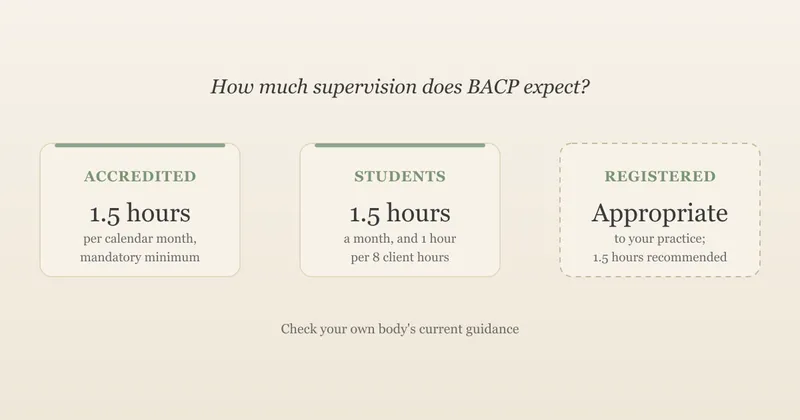
BACP's supervision requirements set a minimum of 1.5 hours per calendar month for accredited members, those working towards accreditation and students. Registered members who aren't accredited need supervision appropriate to their practice, and BACP recommends 1.5 hours a month if you see contracted clients. NCPS writes an average of 1.5 hours of supervision a month into its membership criteria. These are minimums, and clause 4.3 ties supervision to your caseload, so a larger caseload may need more. Our guide to clinical supervision for counsellors explains who needs what.
UKCP's Code of Ethics and Professional Practice doesn't set a number either. It asks members not to work with clients when they can't for physical or mental health reasons (clause 26), and to have supervision that meets UKCP's and their college's requirements (clause 25). If you belong to another body, check its own code. The principle is the same across all three: no number, but a duty to stay fit to do the work.
The nearest thing to a number: BPS guidance for NHS psychologists
The only published UK caseload figure we found comes from psychology, not counselling. The British Psychological Society's 2023 guidelines on job planning for practitioner psychologists in the NHS and social care say that "a maximum of 25 cases for individual face-to-face work should not be exceeded".
Treat that as a ceiling from a different setting, not a target for private practice. It's written for psychologists in NHS and social care services, whose weeks also include team work, assessment, groups and management, and a "case" isn't the same as a weekly session. The same chapter makes two points that apply to anyone: a caseload should never be so large that you can't keep track of every client, and supervision and CPD need to be part of the calculation, not squeezed around it.
What counsellors actually work: BACP's survey
The closest thing to a UK average comes from BACP's Working Practices survey for 2025. On average, respondents worked 10.25 paid client hours a week. That's across everyone who answered, including people who also have other jobs.
Read it as a sense of scale, not a target. It suggests a caseload in the low teens is common, and 20 or more a week is well above the average. It also says nothing about how those counsellors feel about their workload, and 4,028 people responded, so it may not represent all members. Our therapist salary guide covers what the same survey says about income.
Why one client hour is more than an hour
The figure that matters for your week isn't the number of sessions. It's everything that comes with them. Here's an invented example of a counsellor in private practice seeing clients for 50-minute sessions in a rented room:
| Each week | 10 clients | 15 clients | 20 clients |
|---|---|---|---|
| Sessions (50 minutes each) | 8.3 hours | 12.5 hours | 16.7 hours |
| Notes (10 minutes per session) | 1.7 hours | 2.5 hours | 3.3 hours |
| Admin: enquiries, emails, invoices, diary | 2 hours | 3 hours | 4 hours |
| Travel to and from the room | 1.5 hours | 2 hours | 2.5 hours |
| Supervision (1.5 hours a month) | 0.35 hours | 0.35 hours | 0.35 hours |
| CPD (30 hours a year over 44 working weeks) | 0.7 hours | 0.7 hours | 0.7 hours |
| Total | about 14.5 hours | about 21 hours | about 27.5 hours |
Your own figures will differ. If you work online from home, travel drops out. If you write longer notes, or see couples, or have a complicated week with a client at risk, the totals go up. But the pattern holds: 15 clients is a substantial part-time job, and 20 is close to a full working week before you've done any marketing, bookkeeping or CPD planning.
The 30 hours of CPD above is NCPS's annual minimum, used here as a round figure. BACP doesn't fix a number of CPD hours for registered members.
How many clients a day?
There's no rule for a day either. A few questions help more than a number:
- Can you write your notes the same day? If notes slip to the weekend, the day is too full. Our guide to writing counselling notes covers what they need to include.
- Do you get a proper break? Not just five minutes between clients, but time to eat and step away.
- Is the last client getting the same you as the first? This is the question the framework's resilience duty is really asking.
- Can you absorb a hard session? A day with no slack has no room for a client in crisis, a session that runs into a risk conversation, or a phone call you need to make afterwards.
Many counsellors leave a gap between sessions for notes and a breather rather than booking back to back. Spreading clients across more days, with shorter days, is another way to keep the same weekly number manageable.
Caseload and income
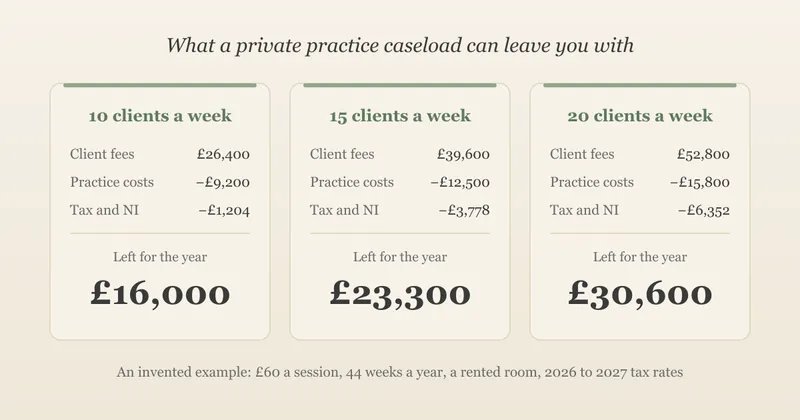
The other side of the decision is money. In our salary guide's worked example, a counsellor charging £60 a session in a rented room for 44 weeks a year is left with about £16,000 at 10 clients a week and about £30,600 at 20, after costs, Income Tax and National Insurance. Each extra weekly client adds about £1,500 a year.
That makes it tempting to plan around the higher number. Two things are worth weighing first:
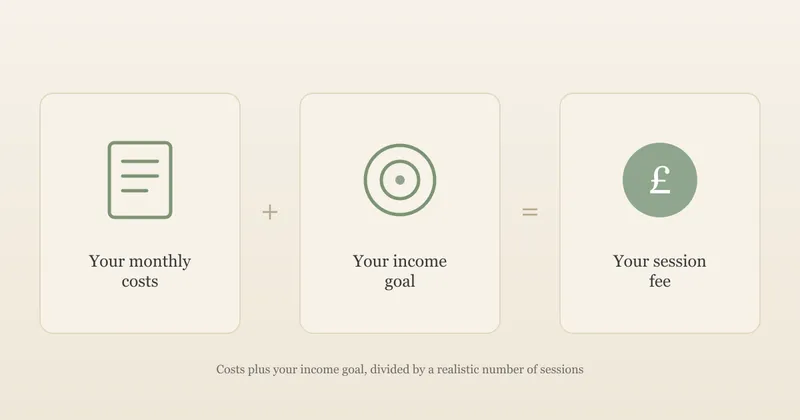
- Your fee. Raising your fee lets you earn the same from fewer clients. Our guide to how much counsellors should charge walks through setting it from your costs and a realistic number of sessions.
- Your other income. Many counsellors mix private practice with NHS, agency, EAP, teaching or supervision work. That can mean a smaller private caseload is right for you, even if you could fill more.
A caseload you can keep up for years usually earns more over time than one you can only manage for a few months.
Deciding your own number
Work it out before your diary fills up, while you can still choose. A simple way to do it:
- Start from your week, not your diary. Use the table above with your own figures for notes, admin and travel, and see how many client hours fit into the working hours you actually want.
- Count all your work. Clients from an agency, an EAP or a placement still count, and so does a day job. Supervision has to cover your whole caseload.
- Set a maximum and a comfortable number. For example, "12 is comfortable, 15 is my limit." Agree both with your supervisor and review them every few months.
- Watch for the early signs. Notes slipping, dreading certain days, cancelling your own breaks, being short with people outside work, or using supervision mostly to catch up on admin. These are reasons to pause new referrals, not to push through.
- Plan your breaks in advance. A caseload that only works if you never take a holiday is too big. Give clients reasonable notice of planned breaks, which the framework also asks for (4.5).
If you're new to private practice, you probably won't have the opposite problem for long: caseloads usually build slowly at first. Our guide to getting your first counselling clients covers where they tend to come from.
Free caseload planner (spreadsheet)
We've made a free spreadsheet to go with this guide. It works in Excel, Google Sheets and Numbers, and has two working tabs:
- Weekly hours. Enter your clients, session length, notes, admin, travel, supervision and CPD, and it works out your real working hours, with a what-if table to compare 10, 15, 20 or any other number of clients.
- Caseload. One row per client, with day, time, session type, frequency, start date, next review, status and referral source. It counts your active clients and sessions a week against your own comfortable number and limit, and highlights reviews that are due.
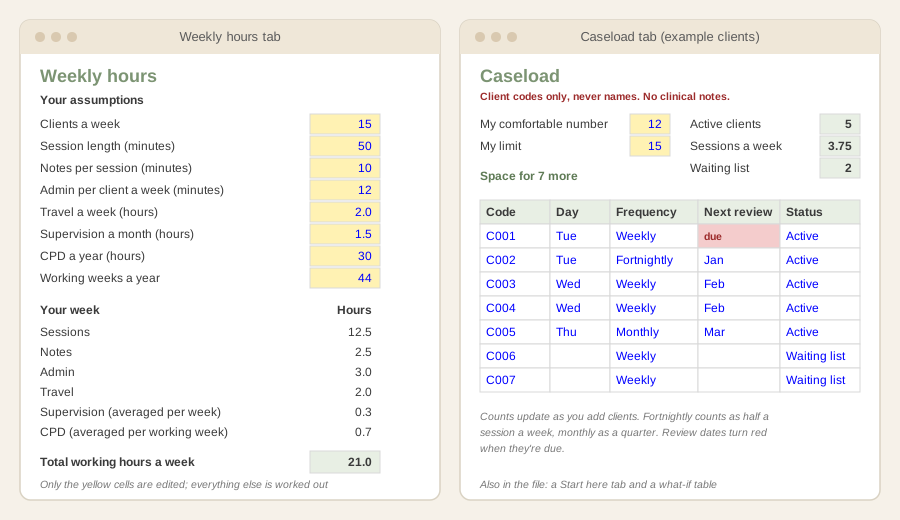
It uses client codes, not names, and has no space for clinical notes. A list showing who sees you for therapy is still health data under UK GDPR, so keep the file somewhere protected and the key to your codes somewhere separate. Our guide to GDPR for therapists covers storing client information securely. You can use and adapt the planner freely; it isn't approved by any professional body.
When you're full: say so on your website
Once you reach your number, tell people before they get in touch. A short line on your homepage and fees page saves enquirers time and saves you from writing the same reply over and over:
- "Currently taking new clients for weekday daytimes."
- "Currently full. I expect to have space from March; you're welcome to join my waiting list."
- "Evening spaces are full; daytime spaces available."
Update it when it changes, along with your directory profiles. If you run ads, pause them while you're full, as our guide to paid advertising for therapists suggests. And if you keep a waiting list, tell people roughly how long it is and how you'll contact them. It fits naturally on your fees page, next to the other practical details covered in our guide to what a therapist website should include.
Frequently asked questions
Does BACP set a maximum number of clients?
No. BACP's Ethical Framework doesn't give a number. It says you must monitor and respond to your own psychological and physical health needs and be sufficiently resilient for the work (2.3), and that your supervision must reflect your experience, training and caseload (4.3). How many clients that allows is for you to decide with your supervisor.
How many clients a day can a counsellor see?
There's no rule. A useful test is whether you can still write your notes the same day, take a proper break, and give the last client of the day the same attention as the first. Many counsellors leave a gap between sessions for notes and a breather rather than booking back to back.
Is 20 clients a week full time for a counsellor?
For many counsellors it's a full week, because each client hour comes with notes, admin, supervision and CPD. In our worked example, 20 clients a week takes about 27 to 28 working hours. BACP's 2025 survey found respondents averaged 10.25 paid client hours a week, so 20 is about double the average.
How many private clients can I see alongside an NHS or agency job?
First check your employment contract allows outside work. Then count the total, not just the private clients: supervision has to cover your whole caseload, and the framework's health and resilience duty applies across all your work. A handful of evening or weekend clients is a common starting point.
The short version
There's no official limit on how many clients a counsellor sees. BACP's framework asks you to look after your own health, stay resilient enough for the work and have supervision that matches your caseload. BACP's 2025 survey averaged 10.25 paid client hours a week, and each client hour takes more than an hour once notes, admin, travel, supervision and CPD are counted: about 21 working hours for 15 clients in our example. Work out your own comfortable number and your limit, agree them with your supervisor, and say on your website when you're full.
Show clients when you have space
UpTopWeb builds websites for counsellors and therapists with your fees, availability and waiting list set out clearly, so enquirers know where they stand before they get in touch.
Further reading
Related articles
Starting a practice16 minute read
Therapist Salary UK: What Private Practice Really Pays
Starting a practice12 minute read
Clinical Supervision for Counsellors: BACP Requirements (UK)
Starting a practice8 minute read
How Much Should Counsellors Charge? Pricing a Private Practice