Starting a practice
How to Write Counselling Notes: Examples and What to Include
How to write counselling notes: what to include and leave out, invented examples, process notes, risk entries, AI tools, client access and a free template.
On this page14 sections
How to write counselling notes comes down to one question: what would a colleague or the client need to understand this session? Record the date and length, the main themes, what you did, any risk and what you decided, and the plan for next time. A few factual lines are usually enough. Write them as if the client will read them, because one day they might.
There's no official format. BACP asks its members to keep records that are "factual, adequate and relevant", and says it doesn't stipulate what notes should look like. That freedom, along with differences in training and modality, is why counsellors end up with such different habits. This guide reflects sources checked on 6 November 2026, including the BACP Ethical Framework 2026 and BACP's fact sheet on confidentiality and record keeping, updated in March 2026. It gives you a simple structure, invented examples of notes that do and don't work, and a free template to download.
Key takeaways:
- UK law doesn't require private counsellors to write session notes, but BACP recommends them and members may have to justify not making them.
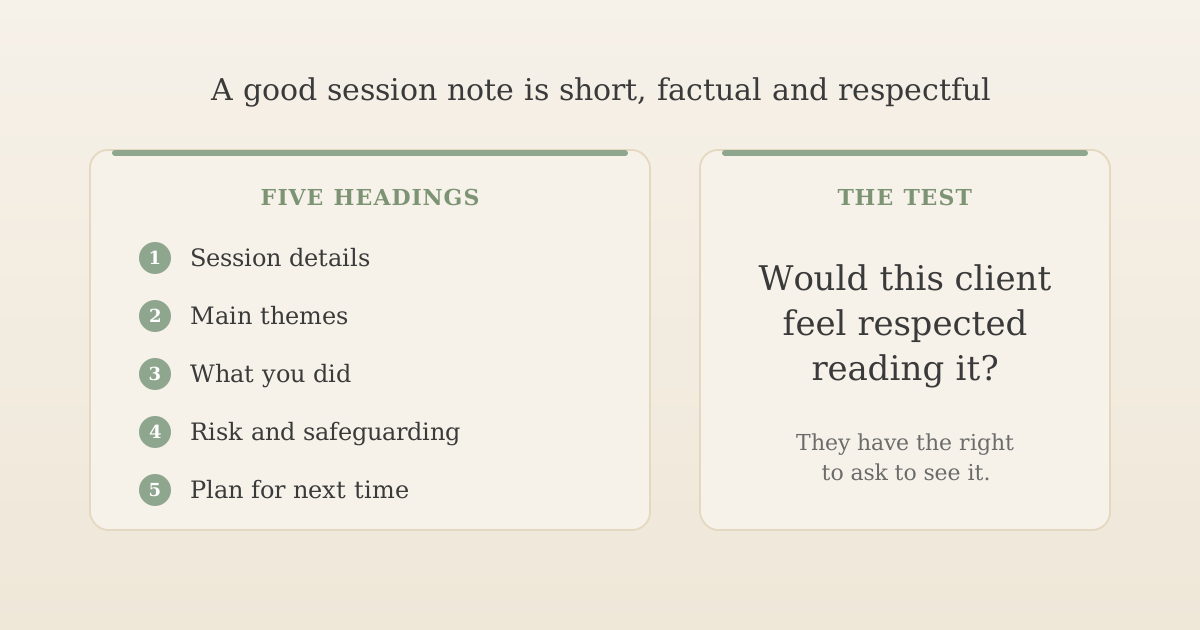
- Keep notes factual, brief and respectful. Five headings cover most sessions: session details, main themes, what you did, risk and safeguarding, and the plan.
- Leave out details you don't need, named third parties and any diagnosis you aren't qualified to make.
- Process notes aren't automatically private. If they can be linked to a client, BACP treats them as client records.
- Clients can ask to see what you hold, and you normally have one month to respond.
- SOAP and DAP are optional formats, and no UK body requires them.
Important: This is a practical overview, not clinical or legal advice. Your training, setting and professional body may ask for something different. Take specific questions to your supervisor or your insurer's legal helpline. All the client examples here are invented.
What counselling notes are for
Good notes do four jobs. They help you pick up where you left off, especially with a full caseload. They give you something accurate to take to supervision. They show your reasoning if a risk decision or a complaint is questioned later. They also help a colleague if something happens to you and your clinical executor has to step in.
They aren't a transcript, a case study or a private diary. They also don't need to be written for a courtroom. As psychotherapist Erene Hadjiioannou told Therapy Today, "we write notes for clinical purposes and not criminal proceedings".
What the rules actually say
Most of the anxiety around notes comes from not knowing what's a rule and what's a habit. Here's what we could find.
| Question | Short answer | Source |
|---|---|---|
| Does the law require session notes? | No, not for private therapists, though there's a growing expectation of notes | BACP blog, March 2026 |
| Can a BACP member choose not to keep them? | BACP leaves the decision to the practitioner, but the member would have to give reasons if a complaint is submitted | Same blog |
| What standard applies? | Records must be factual, adequate and relevant to the service, and stored securely | Ethical Framework 2026, 3.2 |
| What counts as a record? | All communications, notes and other information you hold about a client, so messages count as well as session notes | Ethical Framework 2026, 3.2 |
| Is a particular format required? | No. BACP doesn't stipulate one | BACP blog |
| Does data protection law apply? | Yes. Notes about someone's mental health are special category data | Our GDPR guide |
BACP's fact sheet on confidentiality and record keeping adds some useful detail. It asks for notes that are accurate, respectful and proportionate, and free of personal reflections or assumptions. It also says all client notes should be pseudonymised, which means they're kept apart from contact details and anything else that could identify the client when the two are put together.
If you're a member of NCPS, UKCP or another body, check its code and any guidance on records as well. We've used BACP's wording here because its 2026 framework and fact sheet are the most recent we checked for this guide.
How to write counselling notes: five headings
Here's a simple structure that works for most sessions. It's our suggestion rather than an official standard, so adapt it to your training and modality.
| Heading | What to write | Example wording |
|---|---|---|
| Session details | Client code, date, session number, length, how you met, and anything unusual about attendance | C-014, session 6, 50 minutes, online. Started 10 minutes late |
| Main themes | Two or three lines on what the client brought, in plain language | Stress at home and worry about how to raise it with partner |
| What you did | The work and how the client responded | Explored options for that conversation. Grounding exercise, which client said helped |
| Risk and safeguarding | What you asked or heard, what you decided and why. If you routinely ask, record that too | Asked about risk to self. Client reported no thoughts of self-harm |
| Plan | What comes next, including anything you agreed to do | Continue weekly. Client wants to return to family boundaries. Review at session 8 |
Write the note soon after the session, while it's fresh, and date it. If you notice a mistake later, add a dated correction rather than quietly rewriting the original, so the record stays honest.
Keep other contact in the same system too. If a client emails to say they're struggling, or you call their GP with their consent, the framework counts that as part of your records. Our guide to secure email for therapists covers how to handle those messages safely.
Counselling notes examples: too much, too little, about right
These three notes describe the same invented session.
Too much
Sam came in looking exhausted. Her husband Mark is drinking again and she found bottles in the garage. She thinks he's seeing Julie from work. Her mum, who's bipolar, rang twice. I think she's avoiding the real issue and I wonder about a borderline pattern. I felt irritated with her today.
The note names two other people and shares a family member's health information. It records a suspicion about an affair that doesn't help the work, and suggests a diagnosis the counsellor may not be qualified to make. It also mixes the counsellor's own reactions into the client's record. Imagine Sam reading "I felt irritated with her today", or a solicitor reading it aloud.
Too little
Session 6. Talked about home. Same time next week.
Nobody could be misled by this note, but it doesn't help much either. You couldn't use it to prepare for session 7, and a colleague couldn't tell what the work was. It also says nothing about risk, in a session where the client talked about tension at home. Some practitioners do keep very brief notes by choice, and BACP accepts that styles differ. Just be sure you could explain the choice.
About right
C-014, session 6 of 12. 6 March, 50 minutes, in person. Client arrived 10 minutes late.
Themes: Stress at home and worry about partner's drinking. Conflict with a family member this week.
Work: Explored what client wants from a conversation with partner. Practised a grounding exercise; client said it helped.
Risk: Asked about safety at home and thoughts of harming self. Client said they feel safe and have no such thoughts. No further action.
Plan: Continue weekly. Client wants to look at family boundaries next. Review at session 8.
This note takes a minute or two to write, gives you what you need for next week, and would be fine for the client to read. The partner's drinking is mentioned only because it's what the client brought, and it's framed as the client's worry rather than as a fact about the partner.
What to leave out of your notes
Before you save a note, take out anything that falls into these groups:
- Names and identifying details of other people. "Partner" or "manager" usually works just as well. When a client asks for their records, the ICO says you must consider other people's information before you disclose it, so leaving it out saves difficult decisions later.
- Diagnoses you aren't qualified to make. Record what the client told you ("client says their GP diagnosed depression in 2024") rather than your own label.
- Unnecessary detail about events. You rarely need the full account of a trauma or an argument, and the themes are usually enough. It's also a good habit if the client ever becomes involved in a court case, because you aren't there to take a statement.
- Your own feelings about the client. These belong in supervision or personal reflection, which we'll come to below.
- Judgements dressed up as facts. "Client was manipulative" tells the reader about you. "Client asked twice to change the fee" describes what happened.
BACP's fact sheet makes a good point about this: no note is completely neutral. What you emphasise, what you leave out and the words you choose all shape how the client is seen by whoever reads it. The test we'd suggest is simple. Would this client feel respected if they read this?
Process notes: are they really private?
Process notes are your own reflections on the work: your reactions, your hunches, what you want to take to supervision. Many counsellors were taught to keep them separate and think of them as private.
BACP's fact sheet is clear that this depends on the content, not the label or where you keep them:
| What's in your process notes | How BACP treats them |
|---|---|
| Identifiable client information | Client records, with the same access rights as your clinical notes |
| Nothing identifying alone, but the client could be identified when combined with another document | Client records too, so a shared client code doesn't protect them |
| No identifiable client information at all | Not classed as client records |
If reflective writing helps you, write it with no link to the client: no code, no date of session, no distinctive detail. Take what you can to supervision, then consider destroying it. In supervision itself, BACP asks you to use first names or client codes only. Our guide to clinical supervision covers how supervision records fit in.
Recording risk and safeguarding
Risk entries are the one place where it's worth writing more, because you may need to show how you reached a decision. Record what the client said, what you asked, what you decided, why you decided it, and who you spoke to. If you considered breaking confidentiality and chose not to, write that down too, with your reasons.
This invented example shows the shape of an entry. It isn't guidance on how to assess risk:
Risk: Client said they'd had thoughts of not wanting to wake up on two nights this week. Asked directly about plans and intent: client said no plan and no intent, and named their children and sister as reasons for living. Discussed who they'd contact if the thoughts got stronger: sister, GP, NHS 111 mental health option, Samaritans. Client agreed. Offered to contact GP together; client declined for now. On what they told me, I didn't think there were grounds to break confidentiality. Will ask again next session and take to supervision on 12 March.
Follow your contract and your own safeguarding procedure, and take anything you're unsure about to your supervisor straight away. If you've worked through a difficult ethical decision, the framework's ethical decision-making steps give you a useful structure for recording your reasoning.
SOAP, DAP and BIRP: do you need a format?
If you search for note templates, you'll quickly find these three acronyms, mostly on software sites and US websites. No UK body requires any of them. They're simply ways of organising a note, and they can be handy if your work suits a structure.
| Format | Stands for | Fits best with | Watch out for |
|---|---|---|---|
| SOAP | Subjective, Objective, Assessment, Plan | Medical or multidisciplinary settings | "Objective" and "Assessment" can push you towards clinical judgements that don't fit relational work |
| DAP | Data, Assessment, Plan | Counsellors who want something shorter | "Assessment" can invite labels if you're not careful |
| BIRP | Behaviour, Intervention, Response, Plan | Structured, goal-based work such as CBT | "Behaviour" can feel a poor fit for exploratory work |
| Five headings (above) | Details, themes, work, risk, plan | Most private practice talking therapy | Less familiar to services that have their own format |
If you work for an agency, an EAP or the NHS, use the format they ask for. Their policy will also usually decide how long notes are kept and who holds them.
AI note-taking tools
Many practice software products now offer AI that transcribes or summarises sessions. If you're a BACP member, the Ethical Framework 2026 requires you to assess the risks, understand how data is handled and have informed consent before entering a client's personal data (2.1e). Our guide to the framework covers that in more detail.
Before you try one, check a few practical things:
- What's kept: does the provider keep a recording or a transcript, and for how long? If you hold it and it relates to a client, treat it as part of the record.
- Where it goes: where is data processed, is it used to train models, and is there a data processing contract? Our practice management software comparison explains what to look for.
- Whether the client can say no: explain what the tool does in plain language, and be ready to work without it if they decline. BACP's fact sheet also says recording a session needs separate, explicit consent.
- Whether the note is accurate: AI summaries can sound confident and still be wrong, or add emphasis the client didn't give. The note is still yours, so read and correct it.
Never paste session details into a general-purpose chatbot on a personal account. We say more about this in our post on writing about clients.
Who can see your notes
The client
Clients can ask to see what you hold, which BACP says includes clinical notes, administrative records and correspondence. The ICO gives you one month, which can be extended by two more if the request is complex, and you generally can't charge.
There's a narrow exception where releasing health information would be likely to cause serious harm to someone's physical or mental health. This is one to check before you act, because the rules differ depending on whether you count as a "health professional" under the Data Protection Act 2018. That definition includes HCPC-registered professions and child psychotherapists, but it doesn't list counsellors. The ICO says someone who isn't a health professional must not disclose health information unless the person has already seen or knows about it, or a recent opinion from the appropriate health professional says the serious harm test isn't met. If you get a request, call your insurer's legal helpline before you reply.
The police, courts and solicitors
In England and Wales, police requests for a victim's counselling records now face a higher bar. Under the victim information requests code of practice, published in January 2026, the police must believe the information is relevant to a reasonable line of enquiry, that the request is necessary and proportionate, and that the records are likely to have substantial probative value.
A request isn't a court order. BACP's fact sheet says you can decline a police or CPS request you don't believe is reasonable or necessary, but you must comply with a court order or a request from someone with statutory authority. In most cases your first steps are to talk to the client, ask for the request in writing with its reasons and legal basis, and call your insurer's helpline. Requests from solicitors or family courts follow different routes, and the rules in Scotland and Northern Ireland differ, so get advice on the one in front of you.
Your supervisor and your clinical executor
Your contract should say that you discuss your work in supervision and that a named executor might need access if something happens to you. Our therapy contract guide and clinical will template both cover the wording.
Storing notes and telling clients about them
We've covered the practical side in other guides, so here's the short version:
- Keep notes apart from identifying details. Use a client code, and keep the list that links codes to names separately. Our practice management software guide sets out a folder system you can copy.
- Decide how long you'll keep them. There's no single legal period. BACP notes that clients have three years to complain, and your insurer may have a requirement of its own. See how long to keep client records.
- Tell clients before you start. BACP's blog says best practice is to make clear before therapy begins whether you keep notes, how long you keep them and what happens to them.
That last point belongs in your contract and privacy notice, and a line on your website helps too. A short answer on your fees and FAQs page, such as "I keep brief, secure notes and you're welcome to ask to see them", can reassure someone who's nervous about starting therapy. Only say it if it's true, and make sure it matches your website privacy notice.
Free counselling notes template
We've made a two-page template you can use straight away. Page one is a blank session note with the five headings, plus a box for contact between sessions. Page two is a filled-in invented example and a short check to run before you save.
- Download the counselling notes template (PDF, 2 pages, 5 KB)
- Download the editable version (Word, 37 KB)
You can use and adapt it freely in your own practice. It isn't approved by any professional body, so check it against your own body's requirements and talk it through with your supervisor. If you complete it digitally, keep it somewhere secure rather than in a general downloads folder.
Frequently asked questions
Do counsellors have to keep notes by law?
No UK law says a private counsellor must write session notes. BACP does expect members to keep accurate and appropriate records, recommends making notes, and says a member would be responsible for giving reasons for not making them if a complaint is submitted. Data protection law applies to whatever you do keep.
Can a client ask to see their counselling notes?
Yes. Clients can make a subject access request under UK GDPR. It can cover clinical notes, administrative records and correspondence. You normally have one month to respond and generally can't charge a fee. There are limited exceptions, including one about serious harm, so speak to your insurer's legal helpline if you're unsure what to release.
Are process notes private?
Not if they can be linked to the client. BACP says process notes with identifiable client information, or notes that could identify the client when combined with another document, count as client records and carry the same access rights. Reflective notes with no identifiable client information aren't classed as client records.
Do I have to give my notes to the police?
A police request isn't the same as a court order. BACP says you can decline a police or CPS request you don't believe is reasonable or necessary, but you must comply with a court order or a request from someone with statutory authority. Talk to the client where you can, and call your insurer's legal helpline before releasing anything.
Can I use AI to write counselling notes?
You can only do so with care. BACP's Ethical Framework 2026 requires members to assess the risks of AI and digital tools, understand how data is handled, and have informed consent before entering a client's personal data. Check what the tool stores, where it stores it, and what contract you have with the provider, and always read and correct what it produces.
How long should I keep counselling notes?
UK law sets no single period for private practice. Data protection law says to keep personal data only as long as it's needed. BACP notes that clients have three years after therapy ends to complain, so that could be used as a minimum, and your insurer may have its own requirement. Put your chosen period in your privacy notice and follow it.
The short version
Write down what you'd need to pick the work up again and what you'd want to be able to show about your decisions. Keep it factual, brief and respectful, use a client code, and record more only when there's risk. Don't rely on the label "process notes" to keep anything private. Tell clients what you keep, and know who to call if somebody asks to see it.
Spend your admin time on your clients
UpTopWeb writes, builds and looks after websites for counsellors and therapists, including your privacy notice pages, so your website is one less job on your list.
Further reading
Related articles
Starting a practice18 minute read
Secure Email for Therapists: Options and Tools Compared (UK)
Starting a practice9 minute read
Christmas Break for Therapists: Telling Clients and Updating Your Website
Starting a practice15 minute read
BACP vs NCPS vs UKCP: Which Professional Body to Join?