Starting a practice
Clinical Will for Therapists: Free UK Template and Guide
What a clinical will is, what BACP, UKCP, BABCP and BPC expect, how to choose a clinical executor, and a free editable clinical will template for UK counsellors.
On this page12 sections
A clinical will is a short document that says who will contact your clients, and what they should do, if you die or suddenly can't work. It names a clinical executor, usually a trusted colleague, and tells them where to find your caseload, how to reach each client and supervisee, and what to do with your records. It's separate from your legal will and covers your practice only.
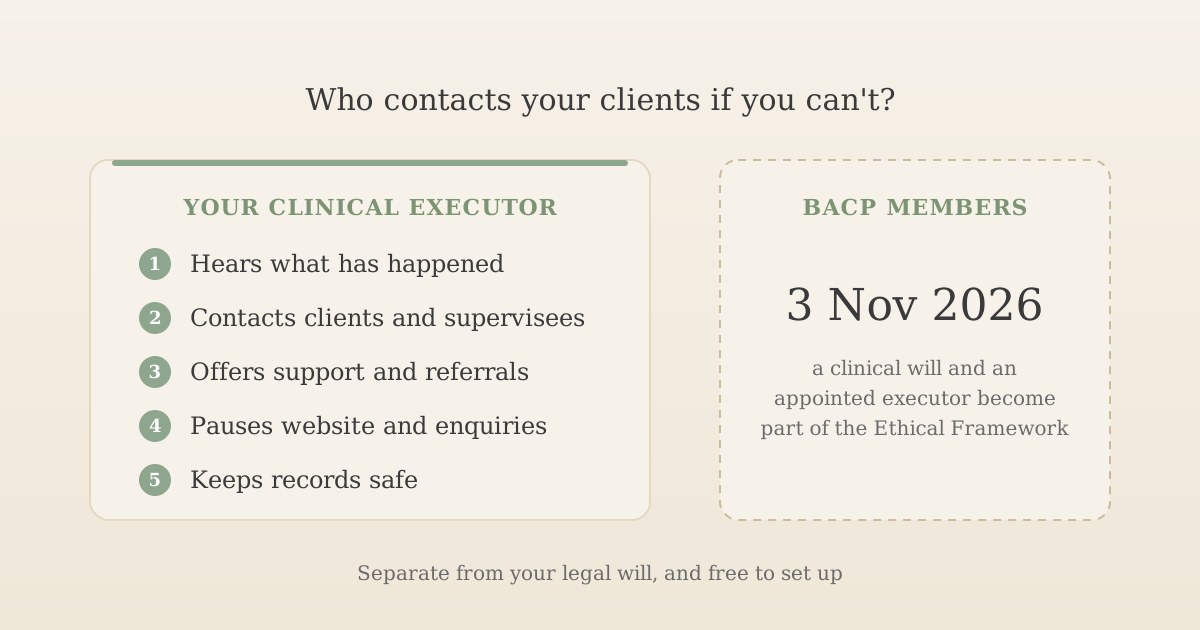
For BACP members it's no longer just good practice. The Ethical Framework for the Counselling Professions 2026 becomes mandatory at midday on 3 November 2026, and it requires members to have one. This guide reflects the sources as checked on 2 October 2026. It explains what each UK professional body expects, how to choose an executor, what to include, and the parts most clinical wills miss. At the end there's a free clinical will template you can download, as a PDF or an editable Word file.
Key takeaways:
- From 3 November 2026, BACP members must "ensure we have a clinical will in place and have appointed an executor" (Ethical Framework 2026, section 4.5).
- UKCP, BABCP and BPC also expect arrangements for your clients if you die or can't work. BPC registrants need two Professional Trustees.
- Your clinical executor should be a practitioner bound by confidentiality, not the person who deals with your estate. Name a backup too.
- The hardest part is usually access: your executor needs a secure way to reach your caseload list without you being there to unlock it.
- Remember your website, email, voicemail and directory profiles. If nobody pauses them, new enquiries keep coming in.
- Tell clients about the arrangement in your contract and privacy notice.
Important: This is a practical overview, not legal or professional advice. Professional-body requirements change, and some bodies set out specific arrangements their members must use. Check your own body's current guidance, and ask your supervisor or your insurer's helpline about anything you're unsure of.
What is a clinical will?
A clinical will is a set of instructions for the colleague you've chosen to step in if you die or become unable to practise. It's sometimes called a professional will, and the colleague may be called a clinical executor, professional executor or clinical trustee.
It exists because of a simple problem: if a counsellor in private practice dies suddenly, often nobody else knows who their clients are. Clients turn up to a locked room, or wait for a video call that never starts, and may only find out what happened weeks later, if at all. Supervisees lose their supervisor without warning. A clinical will means someone who understands confidentiality can contact them quickly and kindly.
It doesn't replace your legal will. Your legal will deals with your personal property and is handled by the executor of your estate, who usually isn't a therapist and shouldn't see client information. The clinical will deals with your practice, and it's carried out by a professional colleague.
What BACP, UKCP, BABCP and BPC require
Each professional body puts it slightly differently, so check your own body's wording.
| Professional body | What it expects | Where it's set out |
|---|---|---|
| BACP | A clinical will and an appointed executor, mandatory from midday on 3 November 2026 | Ethical Framework 2026, section 4.5 |
| UKCP | Arrangements for informing clients, and supporting them where appropriate, if you're ill or die | Code of Ethics and Professional Practice, clause 28 |
| BABCP | A process to make sure action is taken if you unexpectedly become unavailable, with a clinical will policy setting out what it should contain | Clinical Wills Policy |
| BPC | Two Professional Trustees who hold a list of your patients and supervisees | Professional Trustees guidance |
BACP
Section 4.5 of the 2026 Ethical Framework is about managing breaks and endings in ways that minimise the impact on clients. It says members must "ensure we have a clinical will in place and have appointed an executor who, bound by confidentiality, can communicate with clients and service users if we are unable to contact them ourselves, or if we die."
The framework's glossary describes the executor as someone "named in a clinical will to manage the affairs of a deceased or incapacitated member", who "will usually be a trusted colleague or a specially appointed trustee or supervisor". Until midday on 3 November 2026, members keep working to the 2018 framework. After that, the requirement applies to everyone, so now is a good time to set one up.
UKCP
Clause 28 of UKCP's Code of Ethics and Professional Practice asks practitioners to "have arrangements in place for informing clients and, where appropriate, providing them with support in the event of your illness or death." It doesn't use the words "clinical will", but a clinical will is the usual way to meet it.
BABCP
BABCP's Clinical Wills Policy links back to its standards of conduct, which require a process for action to be taken if you unexpectedly become unavailable. The policy lists what a clinical will should contain, including the names of the person who raises the alarm and the executor, where your client list is kept, and arrangements for records. It also expects former clients to still be able to get their records, so make sure the person you name to hold the records knows that.
BPC
The BPC asks registrants to nominate two colleagues as Professional Trustees to hold a list of patients and supervisees, so they can be contacted if the registrant can't work or dies. If you're BPC-registered, use the BPC's own arrangement and documents. A general template like ours can sit alongside them, but it doesn't replace them.
Other bodies
We couldn't find a specific clinical will requirement in NCPS's published code of ethics when we checked. Even where your body doesn't require one, a clinical will is still good practice, and some insurers and supervisors will ask whether you have one.
Choosing your clinical executor
Your executor is the most important decision in the whole document. A good executor:
- Is a qualified practitioner, ideally one with clinical experience, so they can handle distressed clients and understand confidentiality and safeguarding.
- Has agreed in writing, and has read your clinical will with you.
- Is someone you trust to act quickly, because the first few days matter most for clients with sessions coming up.
- Doesn't have a conflict of interest, such as seeing some of your clients' partners or family members.
Many practitioners ask a peer, a former training colleague or their supervisor. Some swap roles, each acting as the other's executor. Avoid naming a partner or close family member as executor: they may be grieving, and they aren't bound by professional confidentiality in the same way.
Always name a backup executor too. People move, retire, become ill or have their own emergencies, and it's one reason BPC asks its registrants for two trustees rather than one.
It also helps to name a first contact: the person most likely to know first that something has happened, often a partner or family member. Their only job is to call your executor and give them the access route you've agreed. They don't need, and shouldn't have, any client information.
Talk to your executor about expenses. Contacting a full caseload and supporting clients through an ending takes time, so agree whether they'll be paid a fee or their expenses, and write it down.
What to include in a clinical will
A clinical will doesn't need to be long, but it does need to be specific. Most include:
- Your practice details: your name, trading name, professional body and membership number, where you see clients, and your insurer's details.
- The people involved: your executor, backup executor, first contact and supervisor, with contact details for each, and whether each one knows about the others.
- Where things are: your caseload list, supervisee list, client records, diary, booking system, email, phone and devices.
- How to access them: who holds the passwords or access codes, without writing the passwords themselves into the document.
- Step-by-step instructions: who to contact first, how, and roughly what to say.
- Onward referral: colleagues your executor could suggest to clients who want to keep going.
- Your public channels: website, enquiry form, email auto-reply, voicemail and directory profiles.
- Records: who holds them, for how long, who handles requests from clients, and when they're securely destroyed.
- Practical matters: refunds of prepaid sessions, room hire, and telling your professional body and insurer.
- A review log: when you last checked it, and what changed.
Our free template covers all ten, in that order.
Giving your executor access to your caseload
This is where clinical wills most often fail in practice. A beautifully written document doesn't help if your executor can't get to your client list because it's on a locked laptop or behind a password only you know.
Options practitioners use include:
- A current caseload list in an encrypted file, with the file location held by your executor and the password held separately by your first contact, so neither can open it alone.
- A sealed envelope with access details, held by your first contact or your executor.
- The emergency access feature in a password manager, which lets a nominated person request access after a waiting period you choose.
- An executor login on your practice management system, if your system supports one. Some practice management tools now offer this.
Whichever you choose, keep the caseload list current. A list from last year that's missing three new clients isn't much use. Include each client's name, contact details, preferred contact method and next session, and nothing clinical. Your executor needs to reach people, not read their notes.
Write down which approach you've chosen in your clinical will, and test it at your annual review. Our guide to GDPR for therapists covers keeping client information secure more broadly.
What happens to your website, email and directory profiles
This part of a clinical will is easy to forget. If you die or become seriously ill, your website, directory profiles and booking links keep working. New clients keep sending enquiries, and nobody replies. Someone may book and pay for a first session online that will never happen.
Give your executor what they need to pause your public channels:
- Email: an automatic reply saying you're not taking enquiries, with the executor's details for current clients only.
- Voicemail: a matching message.
- Website: the name and contact details of whoever looks after your site, so they can add a short notice and switch off the enquiry form and any online booking. If you manage the site yourself, include how to reach your login.
- Directory profiles: a list of every directory you're on, such as Counselling Directory, Psychology Today or your professional body's register, so each one can be paused or removed. Our guide to whether therapy directories are worth it is a good prompt to list them all.
- Booking and payment tools: so future bookings can be cancelled and prepaid sessions refunded.
If your website is looked after by a provider, it's worth telling them who your executor is now, so they know who to take instructions from. Our guide to website maintenance for therapists covers who has access to what.
Your records after you die
Your clients' records don't stop mattering when you do. Clients are still living people with rights over their personal data, a former client may ask for a copy of their notes, and a complaint or claim can arise after the work has ended.
Your clinical will should say:
- Who holds the records, whether that's your executor, a colleague or a secure storage arrangement.
- How long they're kept, in line with your existing retention policy. Our guide to GDPR for therapists explains how to set a retention period.
- Who handles requests from former clients for their records.
- When and how they're destroyed once the retention period ends.
Ask your executor not to destroy anything straight away. It's also worth asking your insurer whether your policy includes run-off cover for claims made after you stop practising, and what your executor should tell them. Our guide to professional indemnity insurance explains run-off cover.
Who becomes responsible for your records in law after you die is a question to check with your insurer's legal helpline or a solicitor, especially if you trade as a limited company.
Tell your clients about it
A call from a stranger saying their therapist has died is hard to hear. It's a little easier if the client already knew this arrangement existed.
Add a sentence to your therapy contract and your privacy notice, such as:
If I'm ever unable to contact you myself, for example because of serious illness or death, a named colleague who is bound by confidentiality will contact you on my behalf. They'll only use your contact details for this purpose.
Your privacy notice should already explain who you share personal data with and why, so your executor belongs there too.
Common mistakes with clinical wills
- Writing it and never testing the access route. Check every year that your executor can actually reach your caseload list.
- Naming a family member as executor, rather than a practitioner bound by confidentiality.
- Not naming a backup, so the plan fails if your executor is unavailable.
- Keeping passwords in the document itself, which makes it a security risk.
- Forgetting supervisees and trainees, who need to find new supervision quickly and may have course or placement requirements.
- Leaving your website and directory profiles live, so new clients keep enquiring.
- Not telling clients, so the first they hear of the arrangement is when it's used.
Free clinical will template
We've written a free clinical will template for UK counsellors and psychotherapists, with notes to guide you through each part. There's a PDF to print and fill in by hand, and a Word version you can edit. It includes:
- the people involved, and what each one does
- where everything is and how to access it, without writing passwords down
- step-by-step instructions for your executor, with suggested wording for a first message to clients
- a section on pausing your website, email and directory profiles
- arrangements for client records
- an action log for your executor and an annual review log
- a card to give your first contact
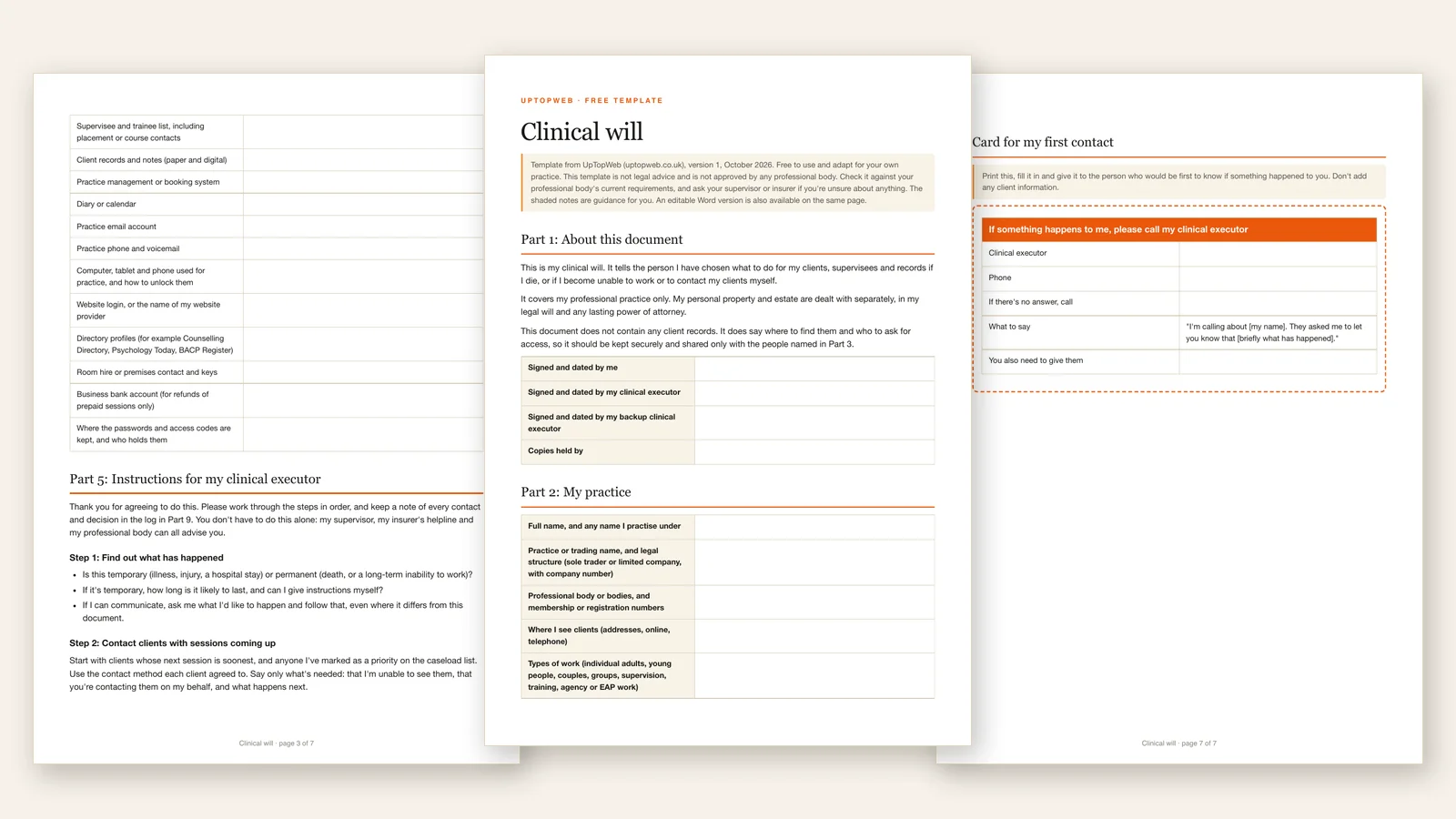
- Download the clinical will template (PDF, 7 pages, 200 KB)
- Download the editable version (Word, 8 KB)
You can use and adapt it freely for your own practice. It isn't approved by any professional body, so check it against your own body's requirements, and if you're BPC-registered, use it alongside the BPC's own documents rather than instead of them.
Frequently asked questions
Is a clinical will a legal requirement for therapists?
Not in law. A clinical will isn't a legal document like your personal will, and there's no statute that requires one. It's a professional requirement or expectation instead. BACP's Ethical Framework 2026, which is mandatory for members from midday on 3 November 2026, requires members to have a clinical will and an appointed executor. UKCP, BABCP and BPC each expect similar arrangements in their own codes or policies.
Who can be my clinical executor?
Usually a trusted colleague, a supervisor or a specially appointed trustee, which is how BACP's 2026 glossary describes the role. It should be someone with clinical experience who understands confidentiality, can talk to distressed clients, and has agreed in writing to act. Many practitioners avoid choosing a partner or family member, because that person may be grieving and isn't bound by professional confidentiality. Name a backup as well, in case your first choice can't act.
Is a clinical will the same as my legal will?
No. Your legal will deals with your personal property and estate, and the executor of your estate shouldn't see client information. A clinical will covers your professional practice only: who contacts your clients and supervisees, how they're supported, and what happens to your records. The two should mention each other, so the people involved know who to talk to.
Should clients be told I have a clinical will?
Yes. Mention it in your contract and privacy notice, so clients know that if you were ever unable to contact them, a named colleague bound by confidentiality might get in touch and might need to see their contact details. It's a short sentence, and it means a call from your clinical executor won't come as a surprise.
The short version
A clinical will names the colleague who will contact your clients and supervisees if you die or suddenly can't work, and tells them what to do. BACP members need one from midday on 3 November 2026, and UKCP, BABCP and BPC all expect similar arrangements. Choose a practitioner as your executor, name a backup, give them a reliable way to reach your caseload list, and include your website, email and directory profiles so new enquiries stop. Tell clients about it in your contract and privacy notice, and review it every year.
If you're still setting up, the clinical will sits alongside insurance, supervision and data protection in our guide to setting up a private therapy practice in the UK.
A website someone else can pause for you
UpTopWeb builds and looks after websites for counsellors and therapists. Tell us who your clinical executor is, and we'll know who to take instructions from if you can't.
Get a free website