Starting a practice
Therapist Salary UK: What Private Practice Really Pays
What UK therapists really earn in private practice: BACP income data, 539 directory fees by region and worked examples at 10, 15 and 20 clients a week.
On this page9 sections
If you've searched for a therapist salary UK figure, you've probably found numbers that don't match each other, and most of them don't describe private practice at all. Self-employed therapists don't have a salary. They have fees, costs and whatever is left, and that depends mostly on how many clients they see.
This guide is for counsellors and psychotherapists in the UK who are in private practice or thinking about it. It sets out what the published data shows, what therapists charge by region, experience and type of work, what a caseload leaves you with after costs and tax, and what working for yourself offers beyond the money. Pay and tax figures were checked on 9 November 2026 and use 2026 to 2027 rates.
The short answer: in BACP's latest survey, the middle of the range for people working in private practice was £20,001 to £30,000 a year from counselling work. In our worked example, a caseload of 15 to 20 clients a week leaves about £23,000 to £31,000 after costs and tax. Income is only part of why people choose this work, and for many the bigger draw is choosing who they work with and how.
Key takeaways:
- Most published "salary" figures describe employees. Private practitioners are mostly self-employed, so those figures tell you little about what a practice pays.
- 66% of BACP survey respondents earned £30,000 or less from counselling work, and 32% agreed they could earn a living from it.
- In our sample of 539 BACP directory listings, the median "from" fee was £60, and London's was only £5 higher, although its top end was much higher.
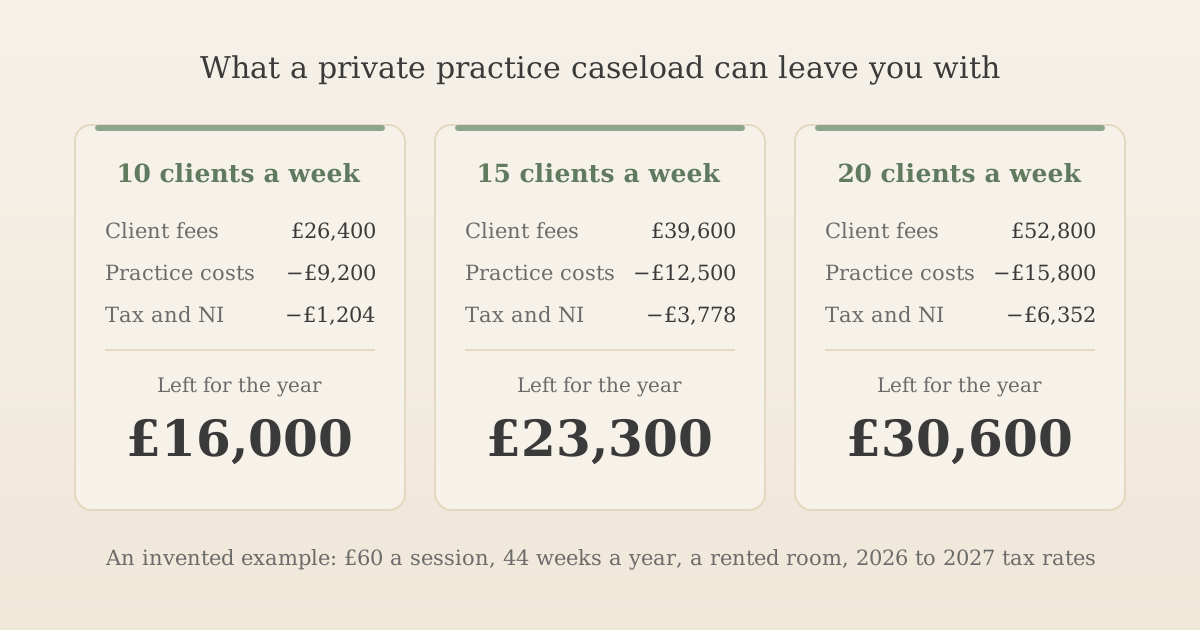
- At £60 a session in a rented room, 10 clients a week leaves about £16,000 a year, and 20 clients about £30,600.
- Room costs and your fee can matter as much as adding more clients.
- Private practice lets you choose your clients, niche, hours and approach. You'll need to fund your own pension and time off, and you can combine a practice with employed work.
Important: This is a practical overview, not tax, financial or careers advice. The worked examples are invented and use rates for England, Wales and Northern Ireland; Scotland has its own Income Tax bands. Check current guidance on GOV.UK, or speak to an accountant, about your own position.
Therapist salary UK figures: why most of them mislead
Three kinds of figure come up when you search, and each answers a different question.
Job-site and salary-calculator estimates are built from job adverts and employee reports. They tell you what employers advertise, often for a named company or postcode. They don't include people running their own practice.
Official earnings data covers employees too. The latest ONS earnings tables by occupation (provisional figures for 2026) give a median of £38,317 for full-time "psychotherapists and cognitive behaviour therapists", from a small sample with a coefficient of variation of 11%. The row for "counsellors" has no estimate at all, for pay or for number of jobs. So if a website quotes an official average salary for UK counsellors, it's worth asking where the number came from.
Practitioner surveys are the closest thing we have to private practice data, and BACP's is the largest we found.
What BACP's survey says counsellors earn
BACP's Working Practices survey for 2025 asked members about their income from counselling-related work. The full report gives the bands below. The left column is everyone who answered, and the right column is those working in private practice.
| Annual income from counselling work | All respondents | Private practice |
|---|---|---|
| £0 | 8.78% | 0.5% |
| Up to £12,500 | 22.54% | 24.25% |
| £12,501 to £20,000 | 16.7% | 19.32% |
| £20,001 to £30,000 | 18.2% | 20.71% |
| £30,001 to £40,000 | 14.19% | 14.40% |
| £40,001 to £50,000 | 7.59% | 8.03% |
| £50,001 to £75,000 | 4.33% | 4.22% |
| £75,001 to £100,000 | 0.85% | 1.12% |
| £100,001 to £150,000 | 0.20% | 0.27% |
| Over £150,000 | 0.03% | 0.04% |
| Did not wish to disclose | 6.60% | 7.12% |
By our reading, about 65% of the private practice group earned £30,000 or less, and under 6% earned more than £50,000. On average, respondents worked 10.25 paid client hours a week. Just under a third (32%) agreed they could earn a living from counselling work, while 52% disagreed.
Read these figures with some care:
- 4,028 people responded, 7.5% of those invited, so it may not represent all members.
- The private practice column appears to include people who also work elsewhere, as the columns add up to more people than took part.
- The question is about income from counselling-related work overall, not from private practice alone.
- The report doesn't say whether "income" means before or after costs and tax, so a self-employed respondent might have answered either way.
- Many people will be part-time by choice, or building a practice alongside other work. A low figure doesn't always mean a practice has struggled.
What therapists charge: 539 directory fees, sorted
Income starts with the fee, so we looked at what therapists actually advertise. BACP's Therapist Directory doesn't let you sort by price, so we did it ourselves. On 9 November 2026 we took about the nearest 60 listings around each of 11 UK locations and sorted the "sessions from" fee. Of 559 listings, 539 showed a fee.
| "Sessions from" fee | Listings | Share |
|---|---|---|
| Under £40 | 5 | 1% |
| £40 to £49 | 35 | 6% |
| £50 to £59 | 169 | 31% |
| £60 to £69 | 197 | 37% |
| £70 to £79 | 77 | 14% |
| £80 to £99 | 42 | 8% |
| £100 to £124 | 10 | 2% |
| £125 or more | 4 | 1% |
The median was £60, and two thirds of listings sat between £50 and £69. Sorted from the bottom, the floor is clearer than you might expect: only 7% advertised under £50.
This is our own snapshot, not BACP data, and it comes with limits:
- It's a "from" price, so it shows the lowest fee on offer, and a therapist's standard fee may be higher. 56% of listings also mentioned concessionary rates.
- It only includes BACP members who pay for a directory listing, and fees may be out of date.
- Fees cluster on round numbers and the groups below are small, so a £5 gap is only a hint.
Does London charge more?
Yes, but by less than you might think, and mostly at the top end.
| Location | Median fee | Middle half of listings | Top 10% start at |
|---|---|---|---|
| London | £65 | £60 to £75 | £100 |
| Newcastle upon Tyne | £65 | £60 to £70 | £75 |
| Birmingham | £60 | £50 to £75 | £92 |
| Manchester | £60 | £51 to £70 | £92 |
| Bristol | £60 | £55 to £70 | £81 |
| Edinburgh | £60 | £55 to £69 | £80 |
| Cardiff | £60 | £50 to £65 | £77 |
| Norwich | £60 | £55 to £60 | £70 |
| Leeds | £55 | £50 to £65 | £75 |
| Truro | £55 | £50 to £61 | £75 |
| Belfast | £55 | £50 to £60 | £70 |
The gap widens for in-person work. Among listings offering long-term face-to-face sessions, the median was £75 in London, £62.50 in Manchester and £60 in Bristol, from about 35 listings each. Room costs are higher in London too, so a higher fee doesn't necessarily mean higher income.
Experience and accreditation
The directory has no field for years of experience, so we used membership level from 330 of the profiles as the nearest measure.
| BACP membership shown | Profiles | Median fee | Average fee |
|---|---|---|---|
| MBACP (registered member) | 223 | £60 | £59.90 |
| MBACP (Accredited) | 104 | £60 | £65.80 |
| MBACP (Senior Accredited) | 3 | Too few to say | Too few to say |
The typical fee is the same, but accredited members are more likely to charge at the higher end. Accredited members have usually been practising for longer, so we can't tell whether accreditation itself lifts fees or just goes along with experience.
Type of therapy
Listed approach made little visible difference. In those 330 profiles, the median was £60 for 14 of the 16 most common approaches, including person-centred, integrative, psychodynamic and CBT. Gestalt and creative therapy were at £65. Most therapists list several approaches, and 86% included person-centred, so these groups overlap heavily.
Specialist training may show up a little more. Listings mentioning EMDR had medians of £75 in London, £70 in Manchester and £65 in Bristol, against £65, £60 and £60 for all listings in those cities. That's a text match on about 100 listings, so it doesn't prove each person practises it. It's worth weighing against what EMDR training costs.
Who you work with
| Listings filtered by client group | London | Manchester | Bristol |
|---|---|---|---|
| All listings | £65 | £60 | £60 |
| Works with couples | £75 | £65 | £65 |
| Works with children | £70 | £60 | £60 |
Couples work was £5 to £10 higher, and the true gap may be larger because a "from" price may be the individual rate. Therapists who listed families or groups also had a higher median (£65), though from only 29 and 40 profiles. Listing EAP (employee assistance programme) work made no difference to the advertised fee, but EAP networks set their own session rates, so that work may pay differently.
Online or in person
We can't say whether online sessions are cheaper, because each listing shows one "from" price. Nearly everyone (316 of 330 profiles, 96%) listed online therapy. The median for those who also listed face-to-face work was £60, and the 12 who didn't list online at all had a median of £55. What the data doesn't support is assuming you have to discount online work. The clearer financial difference is the room cost, which the worked example below shows.
Supervision as extra income
Supervision listings near London, Manchester and Bristol had a median of £65 from 106 fees: £70 in London and £65 in the other two, about £5 above therapy fees in the same places. In BACP's survey, 21% of respondents were supervisors. It needs further training and experience, but it can add income at a similar or slightly higher hourly rate.
Small fee differences add up. At 15 clients a week, £5 more per session is £3,300 more in fees over a year, or about £2,440 after Income Tax and National Insurance at basic rates.
What a caseload actually leaves you with
Surveys show the spread. To see your own likely position, start from sessions and work down. The examples below are invented, for a sole trader with no other income, and assume:
- £60 a session (the median in our directory sample), every session paid, for 44 weeks a year (8 weeks of holidays, illness and quiet periods).
- £15 a session for a rented therapy room.
- About £2,600 a year of other costs: BACP individual membership at £196, insurance £100, clinical supervision of 1.5 hours a month at £60 an hour (£1,080), CPD £300, website, software and phone £500, and directories and accounting £400.
- Income Tax at 20% above the £12,570 Personal Allowance, and Class 4 National Insurance at 6% on the same slice of profit.
| 10 clients a week | 15 clients a week | 20 clients a week | |
|---|---|---|---|
| Sessions a year | 440 | 660 | 880 |
| Client fees | £26,400 | £39,600 | £52,800 |
| Room hire | £6,600 | £9,900 | £13,200 |
| Other practice costs | £2,600 | £2,600 | £2,600 |
| Profit before tax | £17,200 | £27,100 | £37,000 |
| Income Tax | £926 | £2,906 | £4,886 |
| National Insurance | £278 | £872 | £1,466 |
| Left for the year | £15,996 | £23,322 | £30,648 |
| Left per session | £36.36 | £35.34 | £34.83 |
So a £60 fee leaves about £35. That's before any pension saving, and it doesn't count the unpaid hours spent on notes, supervision, admin and marketing. Every example here assumes no cancellations, gaps or unfilled weeks, so real years usually come in lower, especially while you're building your first caseload.
Whether 20 clients a week is right for you is a clinical and personal judgement as much as a financial one. It's about double the survey's average paid hours, and we wouldn't treat it as a target. Our guide to how many clients a counsellor should see shows the real working hours behind 10, 15 and 20 clients a week.
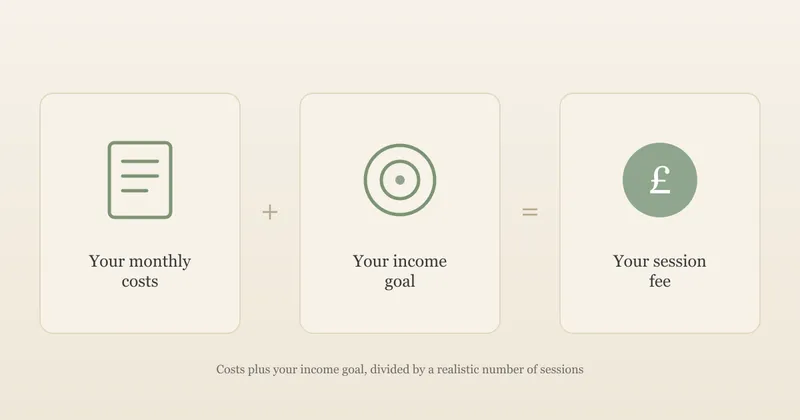
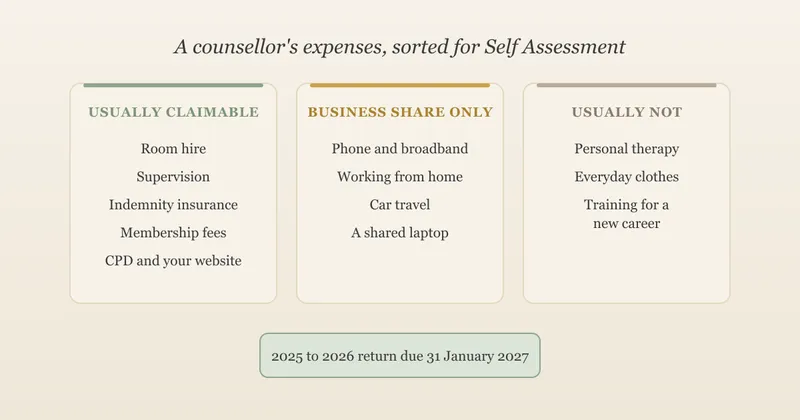
Your costs will differ from these. Our guide to allowable expenses for counsellors shows what comes off your profit, and how much to charge works the sum the other way, from the income you need to the fee you set.
Two tax points are worth checking as your income grows. Making Tax Digital is based on turnover rather than profit, so the 15-client example would be brought in from April 2027 even though its profit is under £30,000. And a practice's profits are taxed differently if you run it as a limited company.
Three ways to reach the same income
Seeing more clients isn't the only route. Using the same assumptions, these three practices all make £37,000 profit and leave £30,648 after tax:
| Route | Clients a week | Fee | Room cost per session | Sessions a year |
|---|---|---|---|---|
| See more clients | 20 | £60 | £15 | 880 |
| Charge more | 15 | £75 | £15 | 660 |
| Work online | 15 | £60 | £0 | 660 |
Each route has limits. A higher fee has to be realistic for your area, experience and clients, and it can make therapy harder to reach for some people. Online work removes the room cost, but it has its own requirements and doesn't suit every client. The useful point is that 220 fewer sessions a year can produce the same income, so it's worth working through your own numbers before assuming the only answer is a fuller week.
Why earnings aren't the whole picture
Plenty of therapists choose private practice for reasons a pay table can't show. Working for yourself gives you a say in things that matter:
- Who you work with. You can build your practice around a niche or client group you care about and are trained for, and refer on work that isn't right for you.
- How you work. The approach you believe in, how long you work with someone, and whether that's in a room, online or both.
- When you work. Your hours can fit around family, health or other work.
- How much you take on. Ten clients a week may be exactly right for you, even if twenty would pay more.
Our directory sample offers some reassurance here. The approach therapists listed made little visible difference to their fees, so working the way you prefer doesn't appear to mean charging less. Success in private practice doesn't have to mean the highest possible income. It can mean a sustainable caseload of clients you're glad to work with.
Private practice, employed work or a mix of both
You don't have to pick one. Some therapists run a practice full-time, others keep an employed or agency role for part of the week, and some take self-employed associate work for a practice (our guide to associate counsellor work covers what to check before you sign). Using NHS pay scales for 2026 to 2027 as a benchmark, here's how three invented set-ups compare:
| Full-time private practice | Three NHS days plus a small practice | Full-time NHS post | |
|---|---|---|---|
| Who decides your clients, hours and approach | You | You, on your private days | Mostly the service |
| Private clients a week | 20 | 8 | None |
| Roughly left for the year | £30,600 | £30,100 | £29,200 |
| Paid leave, sick pay, employer pension | Arrange your own | On your NHS days | Included |
The figures use Band 6 at its entry point of £39,959 (£23,975 for three days a week), after tax, National Insurance and NHS pension contributions, with private work on the same assumptions as above. Bands depend on the post, NHS roles have their own training requirements, and pay can differ in Scotland, Wales and Northern Ireland.
All three land within about £1,500 of each other, so the decision may have less to do with money than with how you want to work. A mix can give you a steady income while your practice grows, or let you keep a foot in a team you value. Check your employment contract first, as many employers have rules about outside work.
The main thing to plan for if you're self-employed is cover. The practice columns have no paid leave or sick pay built in, and the full-time practice figure has nothing saved for retirement, whereas the NHS employer pension rate is 23.7% of pay. It's worth setting aside money for a pension and time off from the start. Your National Insurance does still build your State Pension: profits of £7,105 or more count towards your record, and you generally need 35 qualifying years for the full new State Pension, currently £241.30 a week.
How a website and marketing help you earn more and choose your clients
Your fee sets what each session is worth, but the diary decides how many sessions you get. In the worked example, each extra weekly client adds about £1,500 to what's left for the year. Going from 10 clients a week to 15 adds about £7,300. For many therapists, that makes steady enquiries the biggest thing they can change.
A website and marketing work together on that, and each has a different job.
Getting found. Marketing brings people to you: local search, directories, referrals and the other channels in our marketing guide. Many of those people will look you up before getting in touch, so your website is where that attention lands.
Being understood and trusted. Choosing a therapist is personal, and people want to know who you help, how you work and whether you're properly qualified before they write to a stranger. A directory profile gives you limited space alongside other therapists. Your own site can show your approach in your own words, your memberships and what a first session is like. Being clear about who you work with also makes it more likely that the enquiries you get are for the work you want to do.
Making it easy to enquire. Someone who's nervous about reaching out may give up if they can't find your fees or what happens next. A clear website answers those questions first, then gives them a simple, privacy-conscious way to get in touch.
The sums don't need to be large to work. After room hire, each session in the example leaves £45 before tax. If your website and directory listings cost £400 a year, about nine sessions cover them: one new client attending weekly for around two months.
A website can't promise you clients, and it won't fill a diary on its own. Results depend on your area, your niche, your fee and how much local competition you have. A site nobody can find won't bring many enquiries, and marketing that sends people to a vague page wastes the attention it earns. They work best together, and even then, how much of your capacity you want to fill is up to you.
Frequently asked questions
How much do therapists earn in the UK?
There's no single figure, because most private practitioners are self-employed and don't have a salary. In BACP's 2025 survey of its members, about two thirds of respondents earned £30,000 or less from counselling work, and among those working in private practice the middle of the range fell between £20,001 and £30,000. In our November 2026 sample of BACP directory listings, the median advertised fee was £60 a session. NHS roles follow set pay bands: Band 6 in England runs from £39,959 to £48,117 in 2026 to 2027.
Can you make a living as a counsellor in private practice?
Some counsellors do, but many find it hard from counselling alone. In BACP's 2025 survey, 32% of respondents agreed they could earn a living from counselling work and 52% disagreed. The average was about 10 paid client hours a week. Your fee, your caseload, your room costs and whether you have other income all make a large difference.
How many clients do you need to earn £30,000 as a therapist?
In our invented example, a sole trader charging £60 a session and paying £15 a session for a room needs about 20 clients a week for 44 weeks to be left with around £30,600 after costs, Income Tax and National Insurance. Working online or charging £75 gets to the same figure with about 15 clients a week. Use your own costs, because these change the answer a lot.
Can you work in the NHS and private practice at the same time?
Often, yes, as long as your employment contract allows it, so check your employer's rules on outside work first. In our invented example, three NHS days at Band 6 plus eight private clients a week leaves about £30,100 a year after tax, National Insurance and pension contributions, close to a full-time private practice of 20 clients. A mix can give you steady income while keeping control of your private work.
Help the right clients find your practice
UpTopWeb builds calm, professional websites for UK counsellors and therapists, with your fees and next steps easy to find, for one simple monthly fee.
Further reading
Related articles
Starting a practice8 minute read
How Much Should Counsellors Charge? Pricing a Private Practice
Starting a practice14 minute read
Allowable Expenses for Counsellors: A UK Self Assessment Guide
Starting a practice8 minute read
How to Get Your First Counselling Clients