Starting a practice
Renting a Therapy Room: Costs, Terms and What to Check (UK)
Hourly, weekly slot, membership or your own room? What therapy room rent costs in the UK, a worked cost example, what to check on a viewing, and what to put online.
On this page10 sections
Renting a therapy room is usually the biggest running cost of an in-person practice, and the arrangement you pick changes it more than the hourly rate does. This guide is for counsellors and psychotherapists in the UK who are choosing or reviewing where they see clients face to face. It compares the four common ways of renting a therapy room, shows what published rates looked like when we checked on 8 October 2026, works through a cost example, and covers the parts other guides skip: what to check on a viewing, renting in two locations, what working from home involves, and how your room shows up on your website and Google.
The short answer: work out what each option costs per session you actually deliver, then visit before you commit. A cheap hourly rate on a fixed weekly slot can cost more per session than a dearer ad hoc rate, because a slot is often charged in weeks you're on holiday.
Key takeaways:
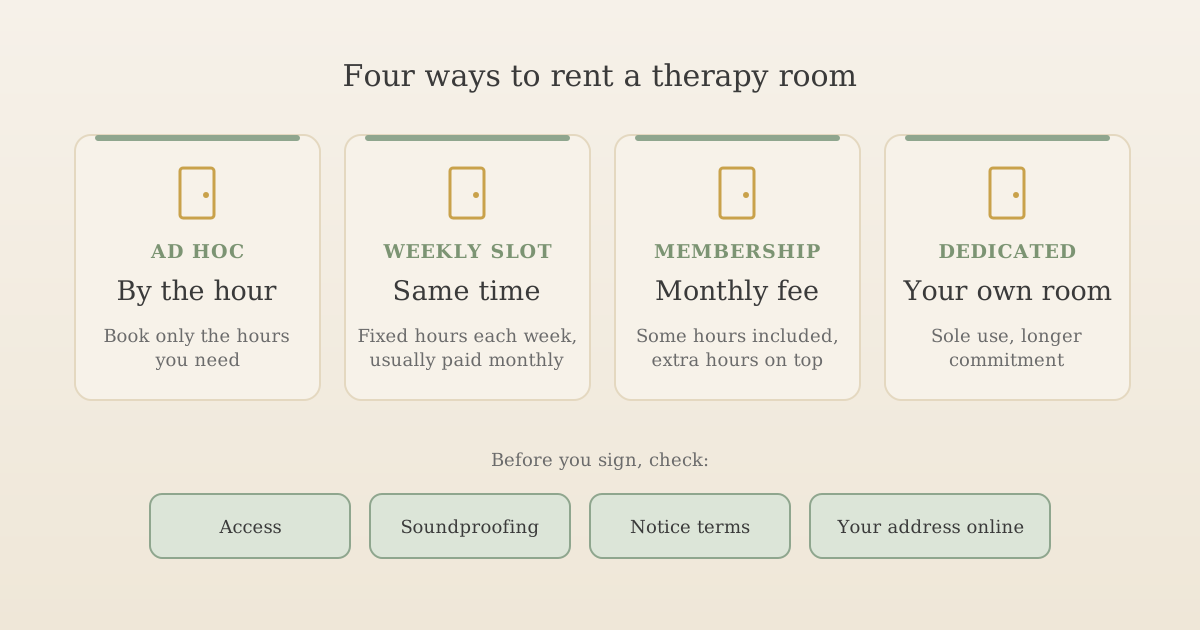
- The four common arrangements are ad hoc hourly hire, a fixed weekly slot, a monthly membership with hours included, and a dedicated room of your own.
- Published rates we checked outside London ran from £9 an hour to from £20 an hour, with London weekly slots at about £10 to £15 an hour.
- Compare cost per session delivered, including holidays and quiet weeks, not the headline hourly rate.
- On a viewing, check soundproofing, the waiting area, step-free access, storage for notes and the booking terms.
- Two rooms in two places can widen your area, but each needs its own cost sum, fixed days and its own page on your website.
- Seeing clients at home can mean business rates, insurance and privacy questions to settle first.
- Only list a rented room on Google Business Profile if you can meet Google's signage and staffing rules for that address.
Important: This is a practical overview, not legal, tax or property advice. Room agreements, business rates and insurance depend on your own circumstances and the exact terms you're offered. Read any agreement in full, and speak to a solicitor, accountant or your insurer if something isn't clear.
The four ways of renting a therapy room
Most therapy centres, clinics and shared practices rent rooms in one or more of these ways. The names vary, so read what's actually on offer rather than the label.
| Arrangement | How it works | Suits | Watch out for |
|---|---|---|---|
| Ad hoc hourly | Book individual hours when you need them, often online | A new or small caseload, or clients who can't commit to a fixed time | Your usual time may be taken; some centres give regular members priority |
| Weekly slot | The same hours every week, usually billed monthly | A steady caseload who like the same day and time | You may pay for the slot in weeks you don't work |
| Membership | A monthly fee that includes some hours, with extra hours charged on top | A mix of regular and occasional clients | Unused included hours often don't roll over |
| Dedicated room | The room is yours alone, on a longer agreement | A full caseload, or work that needs equipment left in place (play or art therapy, for example) | Notice period, deposit, and what happens if your income drops |
Many therapists start with ad hoc hours, move to a weekly slot once two or three clients settle into the same day, and only take a dedicated room when they're seeing clients most days. If you're still at the start of that path, our guide to setting up a private therapy practice in the UK covers the choice between in-person, online and hybrid work first.
How much does it cost to rent a therapy room?
There's no official benchmark, so here are published rates from four centres that came up in a UK Google search for therapy room hire, all checked on 8 October 2026. They're a snapshot, not a typical range, and prices change. We're not recommending these centres; they're simply what the search turned up.
| Centre | Published price | Arrangement |
|---|---|---|
| Hove Counselling and Psychotherapy, Hove | £9 an hour, with 24 hours' cancellation notice | Pay as you go, no monthly fee |
| Chichester Counselling Services, Chichester | From £20 an hour | Room hire, subject to availability |
| North London Therapy Practice, Finchley | From £11.50 an hour ad hoc, or from £155 a month for a 4-hour weekly block | Ad hoc or block booking |
| The Practice Rooms, King's Cross | £76 a month including 4 hours, then £17 an hour on weekdays; weekly slots from £14.45 an hour (3 to 9.5 hours a week) down to £10.12 an hour (20 hours or more) | Membership or weekly slot |
Two things stand out. First, the same city can have very different prices, so it's worth comparing three or four centres near you rather than taking the first room you find. Second, the cheapest hourly rates come with a commitment, either a fixed weekly slot or a monthly fee, which is where the real cost can creep up.
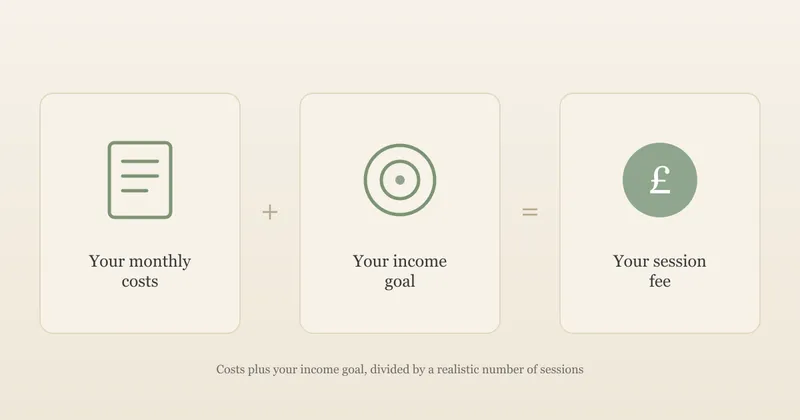
Whatever you pay, it comes out of your session fee before you earn anything. Our guide to how much counsellors should charge shows how to build room hire into a fee that still leaves you a fair income.
A worked example: cost per session, not cost per hour
This is an invented example to show the method. Sam sees eight clients a week, all in person, and takes six weeks off a year, so Sam delivers about 368 sessions a year (8 clients × 46 weeks). Sam is choosing between two options at the King's Cross prices above.
Option 1: a weekly slot. Sam books 9 hours a week (eight sessions plus a break) at £14.45 an hour. That's £130.05 a week. If the slot is charged every week, holidays included, that's £6,762.60 a year, or about £18.38 per session.
Option 2: ad hoc hours. Sam books 8 single hours a week at £17 an hour, only in the 46 weeks Sam works. That's £6,256 a year, or exactly £17 per session.
The lower hourly rate costs Sam more over a year, because six weeks of empty slot add up. The slot still has real advantages: the same room at the same time every week, which many clients value, and no risk of a regular time being booked by someone else. The point isn't that ad hoc is always cheaper. It's that you should do this sum with your own caseload, holidays and the centre's actual terms (some let you release slot weeks with notice) before deciding.
The same thinking applies to cancellations. If a client cancels late and you still pay for the room, your therapy contract is where your own cancellation policy lives, so it's worth making sure the notice you ask of clients roughly matches the notice the centre asks of you.
What to check when you view a room
Photos of a therapy room tell you very little about whether it works. Visit, ideally at the time of day you'd use it, and check these:
| Check | Why it matters |
|---|---|
| Soundproofing | Stand outside with someone talking at a normal volume inside. Ask whether rooms have white noise machines. Confidentiality depends on it |
| Waiting area and toilets | Where do clients wait, and could they run into someone they know? Is there a toilet clients can use? |
| Step-free access | Is there a lift or ground-floor room? This affects who can see you, and what you can honestly say on your website |
| Getting there | Bus and train routes, parking, and how easy the entrance is to find for an anxious first-time client |
| Safety | Who else is in the building in the evening? Is there a way to call for help if you need to? |
| Storage | Is there a lockable cabinet if you keep any paper notes, or will you carry everything in and out? |
| Booking terms | Notice to cancel a booking or leave a slot, price rise terms, what happens if the room is double-booked |
| Insurance | Whether the centre requires you to hold public liability cover, and at what level |
| The feel of the room | Light, temperature, furniture, and whether you'd be comfortable there for a full day |
On storage, the ICO's guide to data security expects security appropriate to the risk, including physical security such as locks and control of who can get into the premises, which for therapy notes in a shared building usually means locked storage or not leaving notes there at all. Our guide to GDPR and client records for UK therapists covers what that means for notes, email and booking systems.
On insurance, the centre's own policy is there to protect the centre, so don't assume it covers you. Our guide to professional indemnity insurance for therapists explains how public liability fits alongside your professional cover.
On access, the Equality Act 2010 requires service providers to think ahead about barriers that affect disabled people, and that includes small practices. A room up two flights of stairs isn't automatically ruled out, but you'll need to be upfront about it, and to think about what you'd offer a client who can't manage the stairs, such as online sessions or a different room.
With hourly and sessional hire, the centre's written booking terms are often the only agreement there is. Get them in writing before you take bookings from clients, and read them properly, especially the notice period. For a dedicated room on a longer agreement, it's worth having a solicitor look at it before you sign.
Renting rooms in two locations
Some therapists rent in two places: a town-centre room on weekdays and a second room nearer home on a Saturday, or one room in each of two towns they want to serve. It can widen the area you draw clients from, and it can suit clients who can only get to one of them. It also brings a few extra costs and decisions.
- Do the cost sum twice. Each room needs its own cost per session, and two half-filled rooms can cost more than one well-used one. If one location only has two or three clients, ad hoc hours there may make more sense than a weekly slot.
- Count travel time. An hour between venues is an hour you can't see a client, so it belongs in your sums even though it doesn't appear on an invoice.
- Keep each location to fixed days. "Harrogate on Mondays and Tuesdays, Ripon on Thursdays" is easy for clients to remember and easy to state on your website. Moving between venues week to week makes booking harder for everyone.
- Decide where clients stay. Most clients will want to stay in one place. If someone needs to move between your venues, agree it with them rather than switching by default.
- Plan your notes and kit. If you keep paper notes, you'll either need secure storage at both places or a way to carry them safely between the two. Digital notes avoid most of that.
- Check both agreements. The two centres will have different notice periods and cancellation terms, and you'll want to know you can give up one room without losing the other.
On your website, a real second venue is one of the few cases where a separate location page is worth having, with its own photos, access details, directions and the days you're there. Our guide to therapist service pages explains why that works when near-identical town pages don't.
Seeing clients at home instead
A room at home avoids rent and travel, and plenty of therapists work this way. It does bring its own checks.
- Business rates. GOV.UK's page on business rates for working from home says you don't usually pay them if you use a small part of your home for your business, but you may need to pay them as well as Council Tax if you "sell goods or services to people who visit your property". Seeing clients at home can fall into that, so ask your council or the Valuation Office Agency about your situation rather than assuming either way.
- Insurance, mortgage and tenancy. Tell your home insurer that clients visit, since ordinary home cover may not include a business activity. Check your mortgage or tenancy terms for anything about running a business from the property.
- Privacy. Think about who else is in the house during sessions, what clients pass on the way to your room, and whether family photos or post are on show.
- Safety. You're alone with clients you may not know well yet, in the place you live. Some therapists only see established clients at home, or see new clients online first.
- Your address. You don't have to publish your home address on your website. Showing your area or postcode district, and giving the full address when a session is booked, is a common and sensible approach.
Room hire and tax
HMRC lists the costs of business premises among the allowable expenses for self-employed people, and room hire for seeing clients falls under that. If you work from home, the same page says you can claim a reasonable proportion of costs such as heating, electricity and rent, divided by a method like the number of rooms you use or the time you spend working there.
The simpler alternative is HMRC's flat rate for working from home: £10 a month for 25 to 50 hours of business use, £18 for 51 to 100 hours, and £26 for 101 hours or more. It doesn't include phone or internet, which you claim separately. Expenses reduce your profit, but not your turnover, so they don't help with the Making Tax Digital threshold, which is based on income before expenses.
Your room on your website and Google
Where you see clients is one of the first things a prospective client wants to know, and it's often the part of a therapist's website with the least detail.
On your website, include:
- The town or area, and the full address if you're happy to publish it (a rented room in a therapy centre usually is fine to name; a home address usually isn't).
- A real photograph of the room and, if possible, the entrance. It answers "what will it be like?" better than any wording.
- Step-free access, toilets, parking and the nearest bus or train stop, stated honestly.
- What days you're there, if you only rent the room on certain days.
If clients travel from several nearby towns, a short "Getting here from..." section on one location page usually serves them better than a separate page for each town, as our guide to therapist service pages explains. And our guide to website accessibility for therapists covers making the page itself easy to use, not just the building.
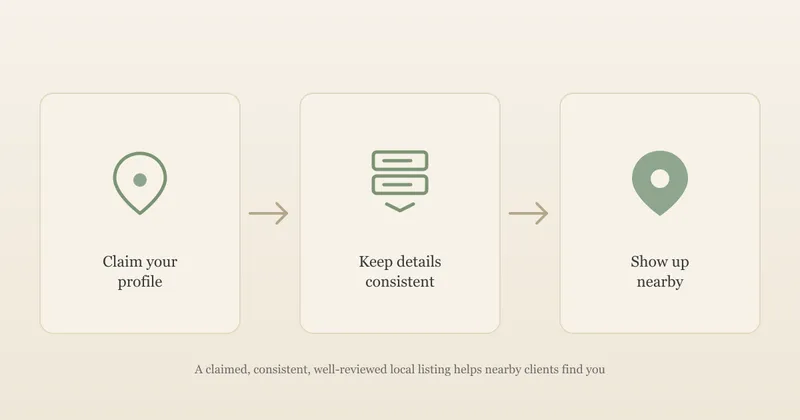
On Google Business Profile, the rules are stricter than most therapists expect. Google's guidelines say businesses showing their address "should maintain permanent fixed signage of their business name at the address", and that an office at a co-working space can only be listed if it has clear signage, receives customers during business hours and is staffed during those hours. An individual practitioner should have their own profile if they work in a public-facing role and can be contacted directly at the verified location during stated hours.
In practice:
- A dedicated room with your name on the door or the building's sign board, and set hours when you're there, usually fits these rules. Show the address, as our guide to local SEO for therapists recommends for a room clients travel to.
- A few hours a week of hourly hire usually doesn't. Google's rules don't have a neat category for a practitioner who rents a room part-time, so ask the centre whether practitioners are listed on its signage and how others there handle their profiles. Listing an address you can't meet the rules for risks the profile being suspended.
- Two locations. Google's guidelines say not to create more than one profile for each location of a business, so one profile per venue is the most you can have, and each venue has to meet the rules above by itself. The guidelines don't say anything specific about a solo practitioner with two part-time rooms. A dedicated room in one place and occasional hours in another usually means one profile, for the dedicated room, with the second venue covered on your website.
If a profile doesn't fit, your website, a good counselling directory profile and the centre's own listing can still do the work of helping local clients find you.
Frequently asked questions
How much does it cost to rent a therapy room in the UK?
It varies a lot by area and arrangement. Published rates we checked on 8 October 2026 ranged from £9 an hour at a centre in Hove to from £20 an hour in Chichester, with London centres offering weekly slots at about £10 to £15 an hour and ad hoc hours at £11.50 to £17. Compare the cost per session you actually deliver, not just the hourly rate, because fixed slots are often charged in weeks you don't work.
Can I see counselling clients in my own home?
Many therapists do, but check a few things first. GOV.UK says you may need to pay business rates as well as Council Tax if you sell services to people who visit your property, so ask your council. Tell your home insurer, check your mortgage or tenancy terms, think about who else is in the house during sessions, and consider showing only your area, not your full address, on your website.
Can I put a rented therapy room on my Google Business Profile?
Only if you can meet Google's rules for that address. Google says businesses showing an address should have permanent fixed signage there, and a co-working office needs signage, staff during business hours and customers received there. A dedicated room with your name on the door and set hours usually fits. A few hours a week of hourly hire usually doesn't, so ask the centre how other practitioners handle it.
Is therapy room hire a tax-deductible expense?
Room hire for seeing clients is a business premises cost, which HMRC lists among allowable expenses for the self-employed. If you work from home instead, you can claim a reasonable proportion of household costs, or use HMRC's simplified flat rate of £10, £18 or £26 a month depending on how many hours you work there. Check your own position with HMRC's guidance or an accountant.
Do the sum, then visit
Before you sign anything, work out what the room costs per session you'll actually deliver in a year, holidays included. Then view it at the time you'd use it, listen at the door, and read the notice terms. Once you've chosen, put the room on your website properly, with a photo, the access details and how to get there, so a nervous first-time client knows exactly where they're going.
Show clients the room before they arrive
UpTopWeb builds calm, professional websites for counsellors and therapists, with a clear location page, real room photos and access details, so clients know where they're going before they book.
Further reading
Related articles
Starting a practice8 minute read
How Much Should Counsellors Charge? Pricing a Private Practice
Starting a practice11 minute read
How to Set Up a Private Therapy Practice in the UK
SEO11 minute read
Local SEO for Therapists: A Practical Checklist