Starting a practice
Making Tax Digital for Therapists: What Changes and When
Making Tax Digital reaches self-employed counsellors earning over £30,000 from April 2027. Who's in, why turnover counts rather than profit, and what to do now.
On this page10 sections
Making Tax Digital for Income Tax changes how self-employed therapists keep records and report to HMRC, and for many counsellors in private practice it starts on 6 April 2027. This guide covers Making Tax Digital for therapists working as sole traders in the UK: who's in and when, the turnover-not-profit detail that catches people out, what changes day to day, and what to sort out over the next few months. It reflects HMRC's guidance on GOV.UK as checked on 7 October 2026.
The short answer: if your therapy fees (plus any rental income) came to more than £30,000 in the 2025 to 2026 tax year, you'll need to keep digital records and send HMRC a short update every quarter from April 2027. Your tax bill and payment dates don't change. The work is mostly in setting up the right software before the first quarter starts.
Key takeaways:
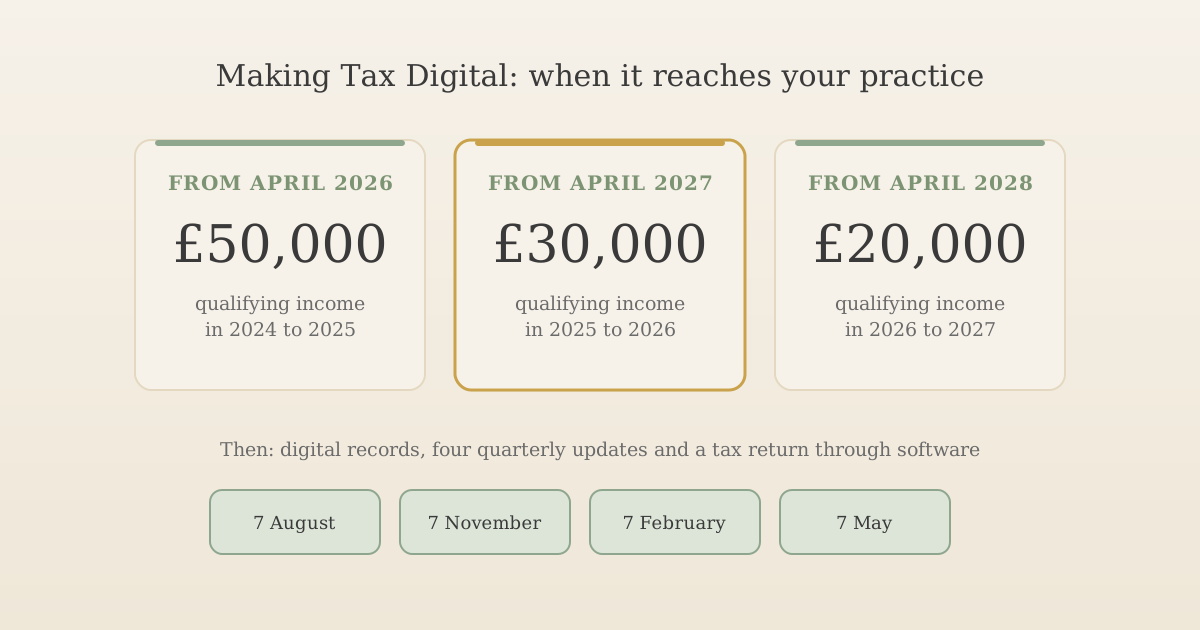
- Making Tax Digital for Income Tax already applies to sole traders with qualifying income over £50,000. The threshold drops to £30,000 from April 2027 and £20,000 from April 2028.
- Qualifying income is turnover, not profit: your fees before room hire, supervision, insurance and other costs come off.
- A salary from an NHS, agency or EAP employment contract taxed through PAYE doesn't count, and nor do dividends from your own limited company.
- You'll keep digital records, send four quarterly updates a year through compatible software, and submit your tax return through that software by 31 January.
- HMRC won't give penalty points for late quarterly updates in 2026 to 2027, the first year. After that, four points means a £200 penalty.
Important: This is a practical overview, not tax, accountancy or legal advice. Your position depends on your own income and circumstances. Check HMRC's current guidance on GOV.UK, or speak to an accountant, before deciding how to keep your records or whether you're affected.
Making Tax Digital for therapists: who's in and when
HMRC's page on checking if you're eligible for Making Tax Digital for Income Tax says it applies to sole traders and landlords registered for Self Assessment whose qualifying income is over a threshold. Each threshold looks back at an earlier tax year:
| You'll need to use it from | If your qualifying income was over | In the tax year |
|---|---|---|
| 6 April 2026 (already in force) | £50,000 | 2024 to 2025 |
| 6 April 2027 | £30,000 | 2025 to 2026 |
| 6 April 2028 | £20,000 | 2026 to 2027 |
The 2025 to 2026 tax year ended on 5 April 2026, so if you're near £30,000, the figure that decides April 2027 is already fixed. It's the turnover on the Self Assessment return you're filing by 31 January 2027. HMRC says it reviews your return and checks your qualifying income each tax year.
If you're already over £50,000 and haven't signed up, HMRC's sign-up guidance says it started signing people up itself from September 2026. It's better to sign up yourself and choose your software than to wait for that letter.
Making Tax Digital for Income Tax is separate from Making Tax Digital for VAT. That one applies to VAT-registered businesses, so if you're not registered for VAT it doesn't affect you, and this guide doesn't cover it.
Qualifying income is turnover, not profit
This is the part most likely to catch a counsellor out. HMRC's guidance on working out your qualifying income defines it as "your total income from self‑employment and property", and adds: "This is the amount before expenses (also known as turnover)."
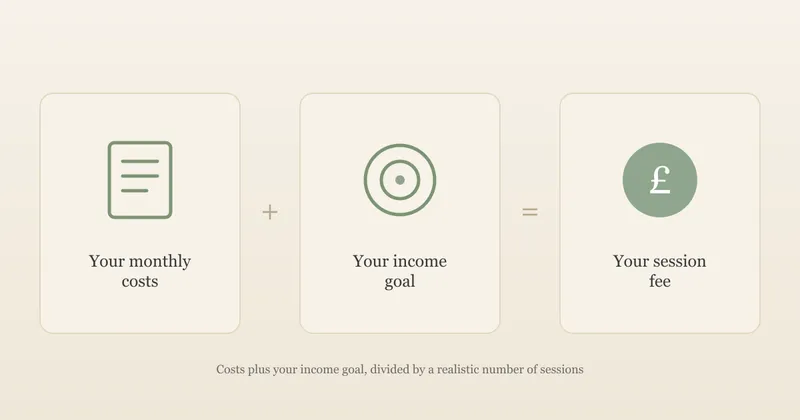
So the question isn't "did I make £30,000?" but "did clients pay me £30,000?" For a therapy practice, where room hire, supervision, insurance, membership fees, CPD and software can take a big share of what comes in, those two figures can be thousands of pounds apart. Our guide to how much counsellors should charge goes through those costs in detail.
What counts, and what doesn't:
| Counts towards qualifying income | Doesn't count |
|---|---|
| Fees from your private practice as a sole trader, before expenses | Salary from employment taxed through PAYE (NHS, agency, EAP or school contracts where you're an employee) |
| Rental income from property, such as letting a flat (your share, if jointly owned) | Your share of profit as a partner in a partnership |
| Dividends, including from your own limited company | |
| State Pension and private pensions |
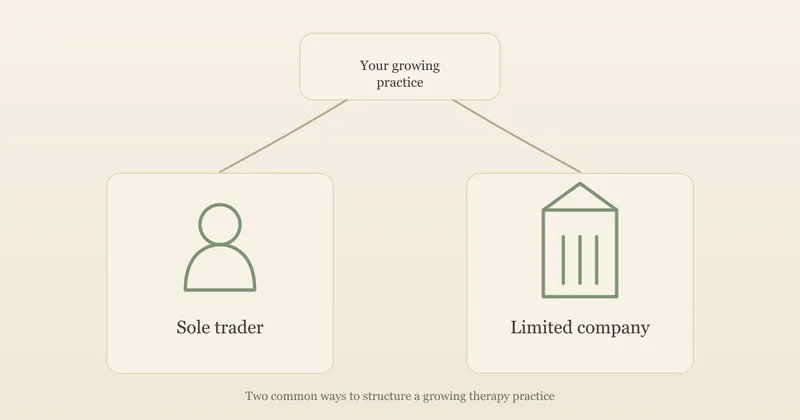
That last column matters for two common therapy set-ups. If you work part-time as an employee and see private clients on the side, only the private fees count. And if your practice runs as a limited company, the salary and dividends you take from it don't count either. Our comparison of sole trader and limited company structures for therapists explains the difference between the two.
Three practices, worked through
These are invented examples, using 44 working weeks a year to allow for holidays and breaks. The question for each one is the same: what was the qualifying income in 2025 to 2026?
Jo, full-time sole trader. Jo sees 13 clients a week at £55: 13 × £55 × 44 weeks = £31,460 in fees. Room hire, supervision, insurance, BACP membership, CPD and software come to around £7,500, so Jo's profit is about £23,960. On profit, Jo would be well under £30,000. On turnover, Jo is over it, so Jo needs Making Tax Digital from 6 April 2027.
Sam, NHS job plus a small private practice. Sam works part-time in an NHS service, paid through PAYE, and sees 8 private clients a week at £55: 8 × £55 × 44 = £19,360. Only the £19,360 counts, so Sam isn't affected in April 2027. If Sam's private fees in 2026 to 2027 go over £20,000, Making Tax Digital would apply from April 2028.
Alex, limited company. Alex's practice is a limited company, and Alex takes a small salary plus dividends from it. Neither counts as qualifying income, so Alex isn't affected by Making Tax Digital for Income Tax unless Alex also has self-employment or rental income over the threshold. The company still has its own Corporation Tax and Companies House filings.
What actually changes day to day
HMRC's main guide, Use Making Tax Digital for Income Tax, breaks it into three jobs.
1. Keep digital records
For each item of income or expense you record the amount, the date and a category, "as close to the date of the transaction as possible". The good news for most therapists is in HMRC's guidance on creating digital records: if your turnover is under £90,000, you can use simpler categorisation, and "If you're a sole trader, you only need to record whether a transaction is income or an expense."
None of those required fields is a client's name. That's worth knowing, because a bookkeeping spreadsheet full of client names is confidential client information sitting in a file that isn't built for it. Using a client code or initials in your income records keeps the record useful without spreading names into another system. Your invoices and receipts still need keeping (HMRC asks you to keep the original records or copies for at least five years after the 31 January deadline), so store them as securely as your other client information. Our guide to GDPR and client records for therapists covers how to do that.
2. Send quarterly updates
Four times a year, your software sends HMRC the totals for each category. Each update runs from the start of the tax year, not just the last three months, so you can correct an earlier mistake without resending anything. The standard periods and deadlines from HMRC's quarterly updates guidance are:
| Update covers | Deadline |
|---|---|
| 6 April to 5 July | 7 August |
| 6 April to 5 October | 7 November |
| 6 April to 5 January | 7 February |
| 6 April to 5 April | 7 May |
If your accounts run 1 April to 31 March, HMRC suggests calendar update periods instead (1 April to 30 June, and so on), with the same deadlines.
Quarterly updates are, in HMRC's words, "summaries, not tax returns". You don't pay tax with them. They also don't give you a final figure for the year.
3. Submit your tax return through software
You still submit a tax return by 31 January after the tax year ends, but through Making Tax Digital software rather than the old Self Assessment online return. This is where you make year-end adjustments. HMRC says the scheme "will not change the way you pay tax or the dates that payments are due", so you pay on the same dates as now.
Penalties, and the first-year easing
According to HMRC's quarterly updates guidance, it "will not apply penalty points for late quarterly updates during the 2026 to 2027 tax year". That easing covers the first year for the £50,000 group. As HMRC's guidance stands, no equivalent easing has been announced for 2027 to 2028, the year the £30,000 group joins, so plan to send every update on time from the start. Penalty points still apply to late tax returns.
From 2027 to 2028, each missed quarterly update or tax return deadline earns a point. At four points you get a £200 penalty, and points below that threshold drop off 24 months after the missed deadline, according to HMRC's penalties guidance for Making Tax Digital for Income Tax. Late payment penalties and interest are separate, and still apply if you pay your tax late.
Spreadsheet or software?
You can't send quarterly updates from a spreadsheet alone, but you don't have to give up a spreadsheet you like. HMRC's software finder lists two kinds of compatible product:
- Full software that keeps your records and sends updates. HMRC notes that "free products are available for those with simple tax affairs but there may be limits on how the product can be used."
- Bridging software that connects to your existing spreadsheet and sends the figures from it.
HMRC doesn't recommend any product, and neither do we. A few things are worth checking for a therapy practice:
- Does it handle "income or expense" simply? With turnover under £90,000 you don't need detailed categories, so a simple tool may be enough.
- Can it take your income from wherever you record it? If you invoice through practice-management software, a card reader or a booking system, check whether it can export to your chosen MTD tool rather than relying on retyping.
- Can your accountant use it? If you use an accountant, ask which products they work with before you choose.
What to do now, depending on where you are
- Over £50,000 in 2024 to 2025: you should already be using it for 2026 to 2027. If you aren't signed up, do it now or speak to an accountant. Your first quarterly update was due on 7 August 2026, and the next is due on 7 November.
- Between £30,000 and £50,000 in 2025 to 2026: you're in from 6 April 2027. Choose your software this winter, and consider signing up voluntarily for the rest of 2026 to 2027 to practise. Volunteers don't get penalties for late quarterly updates, so it's a low-risk trial run.
- Between £20,000 and £30,000: you're probably in from April 2028 if your fees stay at that level through 2026 to 2027. Start keeping records digitally now so the switch is small.
- Under £20,000, or salaried with a small practice: nothing changes yet. Keep an eye on your private turnover each year.
- Can't realistically use digital tools? HMRC lets you apply for an exemption if you're digitally excluded, explaining your reasons.
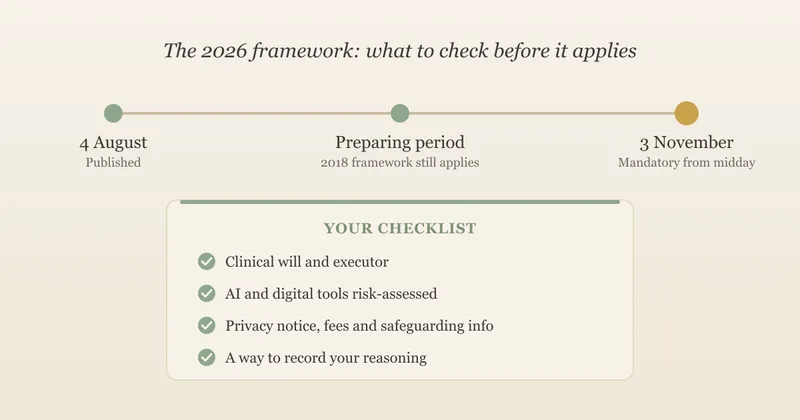
The 2026 BACP Ethical Framework also asks members to know and meet their tax obligations. Our BACP Ethical Framework 2026 checklist covers that duty, and the other new ones, in more detail.
Where your website fits in
Making Tax Digital doesn't change what your website needs to say, and nothing about it needs to appear there. It does reward running costs that are easy to record. A practice with a dozen small subscriptions, one-off domain renewals and an annual hosting bill has more entries to log than one with a single monthly fee and an invoice for each payment. Our guide to what a therapist website costs breaks down those costs, and all of them are allowable business expenses that come off your profit, even though they don't reduce your turnover for the threshold.
If you're setting up a new practice, our guide to setting up a private therapy practice in the UK covers registering for Self Assessment and the other first steps. Making Tax Digital simply changes how you report once you're up and running.
Frequently asked questions
Does Making Tax Digital apply to self-employed counsellors?
Yes, if you're a sole trader registered for Self Assessment and your qualifying income is over the threshold. It has applied since 6 April 2026 if your self-employment and property income was over £50,000 in 2024 to 2025. From 6 April 2027 the threshold is £30,000, based on 2025 to 2026, and from 6 April 2028 it's £20,000, based on 2026 to 2027.
Is the Making Tax Digital threshold based on profit or turnover?
Turnover. HMRC defines qualifying income as your total income from self-employment and property before expenses. A counsellor who takes £31,000 in fees but has £7,000 of room hire, supervision and other costs is over the £30,000 threshold, even though their profit is about £24,000.
If I have an NHS or agency job as well as a private practice, does my salary count?
No. Employment income taxed through PAYE doesn't count towards qualifying income, and nor do pensions, dividends or a share of partnership profit. Only your self-employment and property income before expenses is added up, so a part-time private practice alongside a salaried job can stay under the threshold.
Do I have to pay tax every quarter under Making Tax Digital?
No. Quarterly updates are summaries of your income and expenses, not tax returns or payments. HMRC says Making Tax Digital for Income Tax doesn't change how you pay tax or when payments are due. You still submit a final tax return by 31 January after the end of the tax year, but through compatible software instead of the old online return.
Start with the number you already have
The fees on the Self Assessment return you file by 31 January 2027 decide whether you join in April 2027. Work out that figure, compare it with £30,000 rather than your profit, and if you're over, pick your software before spring. Once the records are flowing into it, a quarterly update takes a few minutes.
One website, one simple monthly fee
UpTopWeb builds calm, professional websites for counsellors and therapists, with hosting, updates and support included in one monthly fee, so your website is one simple line in your records.
Get a free websiteFurther reading
Related articles
Starting a practice10 minute read
Sole Trader or Limited Company for Therapists? A UK Comparison
Starting a practice8 minute read
How Much Should Counsellors Charge? Pricing a Private Practice
Starting a practice14 minute read
BACP Ethical Framework 2026: A Private Practice Checklist