Starting a practice
Allowable Expenses for Counsellors: A UK Self Assessment Guide
Which costs can a self-employed counsellor claim on a Self Assessment return? Supervision, room hire, CPD, personal therapy and more, checked against HMRC.
On this page13 sections
Every pound of allowable expenses you record comes off the profit you pay tax on, and in a therapy practice those costs add up fast: room hire, supervision, insurance, membership and CPD can take a quarter or more of what clients pay you. This guide covers allowable expenses for counsellors and therapists working as sole traders in the UK, for the Self Assessment return due on 31 January 2027. It explains HMRC's test, goes through the costs counsellors actually have one by one, and covers the two that cause the most confusion: training and personal therapy. It reflects HMRC's guidance on GOV.UK as checked on 27 October 2026.
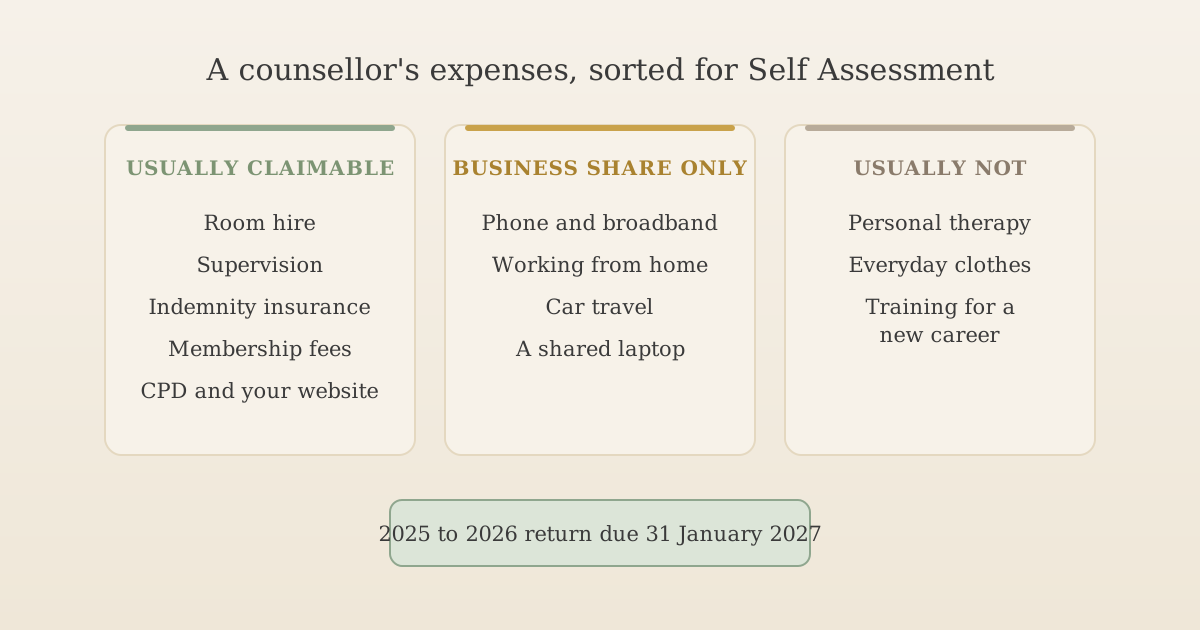
The short answer: if a cost is only for your practice, you can usually claim it. If it's partly personal, you can claim the business share where that share can be separated out, and nothing where it can't. Personal therapy almost always falls into that last group.
Key takeaways:
- Supervision, room hire, professional indemnity insurance, professional body membership, most CPD, practice software and your website are usually allowable.
- Phone, broadband, working from home and car travel are claimable for the business share only. For working from home there's an optional flat rate of £10, £18 or £26 a month.
- Personal therapy is usually not allowable, because HMRC treats spending on your own health as having a personal purpose.
- Training that first qualifies you, or retrains you for a different career, isn't an expense of your existing practice.
- For a basic-rate taxpayer, each £100 of allowable expenses you forget to claim costs about £26 in Income Tax and National Insurance.
Important: This is a practical overview, not tax, accountancy or legal advice. Whether a cost is allowable depends on the facts of your practice. Check HMRC's current guidance on GOV.UK, or speak to an accountant, before you claim anything you're unsure about.
Allowable expenses for counsellors: the one test that decides
HMRC's guide to expenses if you're self-employed says you can only claim costs related to your business, and you can't claim them at all if you use the £1,000 trading allowance instead (more on that below). Underneath that sits the legal test, which HMRC's Business Income Manual sets out in its overview of "wholly and exclusively": if one of the reasons for spending the money isn't a business reason, the expense fails, "even if there is also one or more business reasons".
That gives three practical outcomes:
- Only for the practice: claim it in full. Room hire for client sessions is the clearest example.
- Used for both, but the business part can be measured: claim that part. GOV.UK's own example is a £200 phone bill with £70 of business calls, where you claim £70.
- Bought for a mixed purpose that can't be split: claim nothing. HMRC calls this "dual purpose", and it's where personal therapy and everyday clothes end up.
Remember that you pay Income Tax and National Insurance on your profit, which is your fees minus allowable expenses. Our comparison of sole trader and limited company structures for therapists explains how that profit is taxed, and this guide assumes you're a sole trader.
Cost by cost: what a counsellor can usually claim
These are the costs that come up in almost every private practice. "Usually" is doing real work in this table: it's how HMRC's guidance normally applies, not a ruling on your circumstances.
| Cost | Usually claimable? | Notes |
|---|---|---|
| Therapy room hire | Yes | Hourly, sessional or monthly. Our guide to renting a therapy room covers typical costs and terms |
| Clinical supervision | Yes | A cost of practising. Our guide to clinical supervision for counsellors covers how much you need |
| Professional indemnity and public liability insurance | Yes | See our professional indemnity insurance guide |
| BACP, UKCP, NCPS or other professional body membership | Yes | GOV.UK lists "professional organisation membership if related to your business" on its subscriptions page |
| Journals and professional books | Yes | Trade or professional journals are listed on the same page |
| CPD courses and workshops | Usually | If they update or add to skills you use in your practice. See the training section below |
| DBS check or Update Service | Usually | If you need it for the work you do. Our DBS guide covers when you do |
| ICO data protection fee | Yes | Sole traders who hold client information usually have to pay it, unless exempt |
| Website, domain and hosting | Yes | All of it, if the website is only for your practice |
| Directory listings and advertising | Yes | Counselling directory profiles, ads and printed leaflets |
| Practice management, video and notes software | Yes | Subscriptions you use for the practice |
| Accountant's or bookkeeper's fees | Yes | For your business accounts and tax return |
| Card and payment fees | Yes | Fees taken by your card reader or payment provider |
| Laptop, phone handset, furniture for a dedicated room | Business share | Under the cash basis these are ordinary expenses (see below) |
| Phone and broadband bills | Business share | Work out the business proportion from your actual bills |
| Working from home | Business share | Actual costs split fairly, or HMRC's flat rate |
| Car travel to your room, supervision or home visits | Business share | Business miles only, not your usual commute if your home isn't your base |
| Personal therapy | Usually not | See the personal therapy section below |
| Clothes you see clients in | No | GOV.UK says you can't claim everyday clothing "even if you wear them for work" |
| Training that first qualifies you or retrains you | Usually not | It isn't a cost of the practice you're running |
Two items are easy to forget because they're small: the tissues, water and cups in your room, and the bank or card fees deducted before your fees reach you. They're allowable too, and over a year they add up.
Training and CPD: where HMRC draws the line
GOV.UK's page on claiming training courses says you can claim for training that helps you "improve skills and knowledge you currently use for your business", keep up with technology, or adapt to changes in your industry, including admin skills. You can't claim for courses that help you "start a new business" or move into areas "not directly related to your industry".
HMRC's internal guidance on proprietors' own training courses, updated in August 2026, puts it more precisely. Training is normally allowable "if it updates or provides expertise or knowledge in the individual's existing business area", and it has to be for the trade you carry on "at the time the training is undertaken". It's unlikely to be allowable if you're acquiring "a completely new specialisation or qualification unrelated" to your existing business.
For a counsellor, that tends to work out like this:
- Usually allowable: a trauma-informed practice workshop, an online therapy course, a bereavement or couples CPD day, a bookkeeping course for running the practice. Our guide to how many CPD hours counsellors need covers what your professional body expects.
- Ask an accountant first: a longer qualification, such as a Level 5 diploma or a specialist certificate, taken while you're already practising. HMRC's guidance doesn't say a qualification is disallowed just because it's a qualification. The question is whether it builds on your existing area of work. Our guide to counselling qualifications after Level 4 describes the main routes.
- Usually not allowable: your core counselling training before you started trading, or a course to retrain for a different profession. Neither is a cost of the counselling practice you're running.
Personal therapy: the expense most counsellors get wrong
Many counsellors have personal therapy, and some training courses and accreditation routes ask for it. It feels like a professional cost, so it's tempting to claim it. HMRC's guidance points the other way.
HMRC's Business Income Manual page on health and duality of purpose says "Medical expenditure on ensuring or restoring good health is not generally allowable", because "There will almost always be a personal purpose in wishing to enjoy better health." Spending with a personal purpose fails the wholly and exclusively test, and there's no business-share option for a dual-purpose cost like this.
HMRC's manual doesn't mention therapy or counselling by name, so this isn't a ruling on every case. But personal therapy benefits you as a person as well as a practitioner, which is the duality the manual describes. The safe default is not to claim it. If you think yours is different (for example, therapy required by a course you take as allowable CPD), get an accountant's view in writing before you put it on a return.
If you're still in training, the question usually doesn't arise: therapy taken to complete a qualification before you started practising isn't an expense of a practice that didn't yet exist.
Working from home and travel
Many counsellors do online sessions or admin from home. GOV.UK gives two ways to claim:
- Actual costs: a fair share of heating, electricity, and rent or mortgage interest, split by something reasonable like the rooms you use for work and the hours you use them.
- The flat rate: simplified expenses for working from home let you claim £10 a month for 25 to 50 hours of work at home, £18 for 51 to 100 hours and £26 for 101 hours or more. You need at least 25 hours a month to use it.
The flat rate doesn't include your phone or internet. You still claim the business share of those from your actual bills.
If you see clients in a room you've set aside at home, a business share of household costs is fair. Talk to an accountant before claiming a share of your mortgage interest or rent, because a room used only for business can have knock-on effects, such as Capital Gains Tax when you sell or business rates.
For car travel, you can claim actual running costs or HMRC's mileage rate for business journeys, such as to a hired room, supervision or a CPD event. The simplified expenses vehicle rates were 45p a mile for the first 10,000 business miles in tax years before 6 April 2026, and 25p after that. From 2026 to 2027 the first-10,000 rate is 55p. So the return you file by January 2027 uses 45p, and next year's uses 55p.
Equipment under the cash basis
Since 6 April 2024, the cash basis has been the standard way for sole traders to work out their profit. Under it, you record money when it comes in and goes out, and equipment you buy to keep and use in your practice (a laptop, a chair for your room, a white-noise machine) is claimed as a normal expense in the year you pay for it, rather than through capital allowances. Cars are the main exception, with their own rules.
If you use something partly for personal reasons, such as a laptop that's also the family computer, claim only the business share. You can choose traditional accounting instead, but most solo practices have no reason to.
The £1,000 trading allowance: when it beats your receipts
If you're just starting out, or you see a few private clients alongside a salaried job, the trading allowance lets you deduct a flat £1,000 from your self-employment income instead of claiming your actual expenses. GOV.UK is clear that you can't do both: "You cannot claim expenses if you use your £1,000 tax-free 'trading allowance'."
For most counsellors it isn't worth it. Supervision and insurance alone often cost more than £1,000 a year, before room hire. It only helps if your real costs are under £1,000, for example a counsellor seeing two or three online clients a week whose supervision is paid for by an employer.
A worked example
This is an invented example for the 2025 to 2026 tax year. Priya is a sole trader who sees 12 clients a week at £60 for 44 weeks, so her fees are £31,680. She sees 8 clients a week in a hired room and 4 online from home.
| Expense | Amount |
|---|---|
| Room hire: 8 sessions × £15 × 44 weeks | £5,280 |
| Supervision: £90 a month | £1,080 |
| Car travel to her room: 1,200 business miles × 45p | £540 |
| ICO fee, practice software and video subscription | £420 |
| CPD workshops | £350 |
| Website | £240 |
| Working from home flat rate: £18 × 12 months | £216 |
| Professional body membership | £200 |
| Business share of phone and broadband | £180 |
| Professional indemnity insurance | £85 |
| Total allowable expenses | £8,591 |
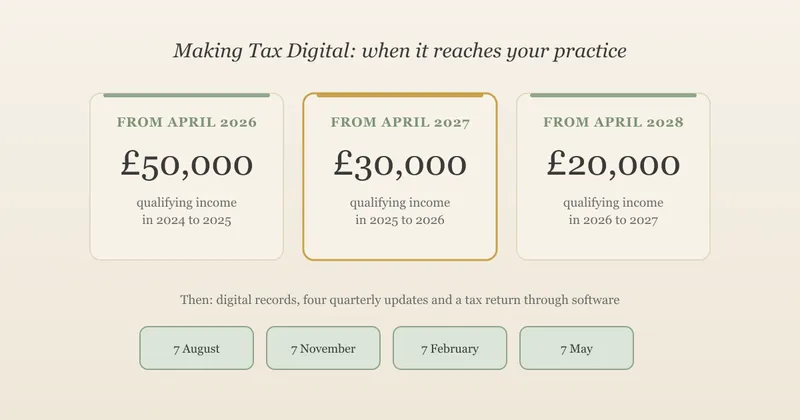
Priya's taxable profit is £31,680 − £8,591 = £23,089. Her personal therapy, about £1,500 a year, isn't in the table. She'd also want to know that her £31,680 of fees, not her profit, is over the £30,000 threshold, so Making Tax Digital applies to her practice from April 2027.
Above the £12,570 Personal Allowance and up to £50,270, a sole trader pays 20% Income Tax and 6% Class 4 National Insurance on profit (see GOV.UK's Income Tax rates and self-employed National Insurance rates). So if Priya forgot to claim her supervision, she'd pay about £281 more (26% of £1,080). Forgetting the small items, like the working-from-home flat rate and the phone share, would cost about another £100. Our guide to how much counsellors should charge uses the same costs to work back from the profit you need to a session fee.
Deadlines between now and 31 January 2027
From HMRC's Self Assessment deadlines for the 2025 to 2026 tax year, as checked on 27 October 2026:
| Date | What's due |
|---|---|
| 31 October 2026 | Paper tax returns |
| 30 December 2026 | Online return, if you want to pay your bill through your PAYE tax code (possible only if you also have PAYE income, and GOV.UK sets other conditions) |
| 31 January 2027 | Online tax return and any tax you owe for 2025 to 2026, plus your first payment on account for 2026 to 2027 if one applies |
| 31 July 2027 | Second payment on account for 2026 to 2027 |
The January surprise. HMRC's payments on account are advance payments towards next year's bill, each half of last year's tax. They apply unless last year's bill was under £1,000 or more than 80% of your tax was already taken at source, for example through PAYE. In your first full year of private practice, that can mean paying a year's tax plus half of the next year's on 31 January. Set money aside every month so it isn't a shock.
Missed the 5 October deadline to register? If 2025 to 2026 was your first year of self-employment and you haven't registered yet, do it now. GOV.UK says HMRC will then give you a deadline three months from the date of its letter or email.
If you file late, HMRC's penalties start at £100, with £10 a day added after three months (up to £900), and more after six and twelve months. Late payment adds 5% of the unpaid tax at 30 days, six months and twelve months, plus interest.
Keeping records without spreading client information
HMRC asks you to keep your records and receipts for at least five years after the 31 January deadline. For a therapy practice, that creates a confidentiality problem: invoices and payment records often contain client names, and a bookkeeping spreadsheet isn't built to protect them.
Using a client code or initials in your income records keeps them useful for tax without copying names into another system. Store invoices as securely as your session notes. Our guide to GDPR and client records for therapists covers how. If you use practice software for invoicing, check whether it can export income totals without client details. Our guide to practice management software for therapists has questions to ask before choosing one.
Where your website fits in
Your website is an allowable expense in full if it's only for your practice: the build, hosting, domain, email address and any changes you pay for. Our breakdown of what a therapist website costs lists what to expect. A single monthly fee, rather than a scatter of renewals and one-off invoices, also makes this part of your records quick to keep.
Frequently asked questions
Can counsellors claim supervision as a business expense?
Usually, yes. Clinical supervision is a cost of practising as a counsellor, and professional bodies expect it, so for a self-employed counsellor it's normally an allowable expense. If one supervisor also gives you training, keep the invoices so you can show what each payment was for.
Is personal therapy tax deductible for a self-employed counsellor in the UK?
Usually not. HMRC's Business Income Manual says spending on ensuring or restoring good health is not generally allowable because there is almost always a personal purpose, and an expense with a personal purpose fails the wholly and exclusively test. HMRC's manual doesn't mention therapy by name, so if you think your situation is different, ask an accountant before claiming it.
Can I claim my counselling training as an expense?
It depends on whether you're already trading and what the course does. HMRC treats training as allowable when it updates or adds to your expertise in your existing business area, such as most CPD. A course that qualifies you for a new, unrelated profession usually isn't allowable, and the training that first qualifies you as a counsellor isn't an expense of a practice that didn't yet exist.
When is the Self Assessment deadline for counsellors?
For the 2025 to 2026 tax year, the online return and any tax you owe are due by 11:59pm on 31 January 2027. Paper returns were due by 31 October 2026. If you have a bill of £1,000 or more, you may also owe your first payment on account for 2026 to 2027 on the same day, with the second due by 31 July 2027.
Before you file: a ten-minute check
Go through last year's bank statement and card statement once, with the table above beside you, and tag every practice cost. Then check the three most often missed: supervision paid by bank transfer, the working-from-home flat rate, and business mileage. Leave personal therapy out unless an accountant has told you otherwise in writing. Most counsellors who do this find at least one cost they'd forgotten, and the return is due on 31 January 2027.
A website that's one line in your accounts
UpTopWeb builds calm, professional websites for counsellors and therapists, with hosting, updates and support in one monthly fee: a single allowable expense, invoiced the same way every month.
Further reading
Related articles
Starting a practice11 minute read
Making Tax Digital for Therapists: What Changes and When
Starting a practice10 minute read
Sole Trader or Limited Company for Therapists? A UK Comparison
Starting a practice8 minute read
How Much Should Counsellors Charge? Pricing a Private Practice