Training & CPD
Counselling Qualifications After Level 4: Your UK Options
Finished your Level 4 counselling diploma? The UK routes after it compared: Level 5, accreditation, supervision, CBT, EMDR, couples work, degrees and UKCP.
On this page13 sections
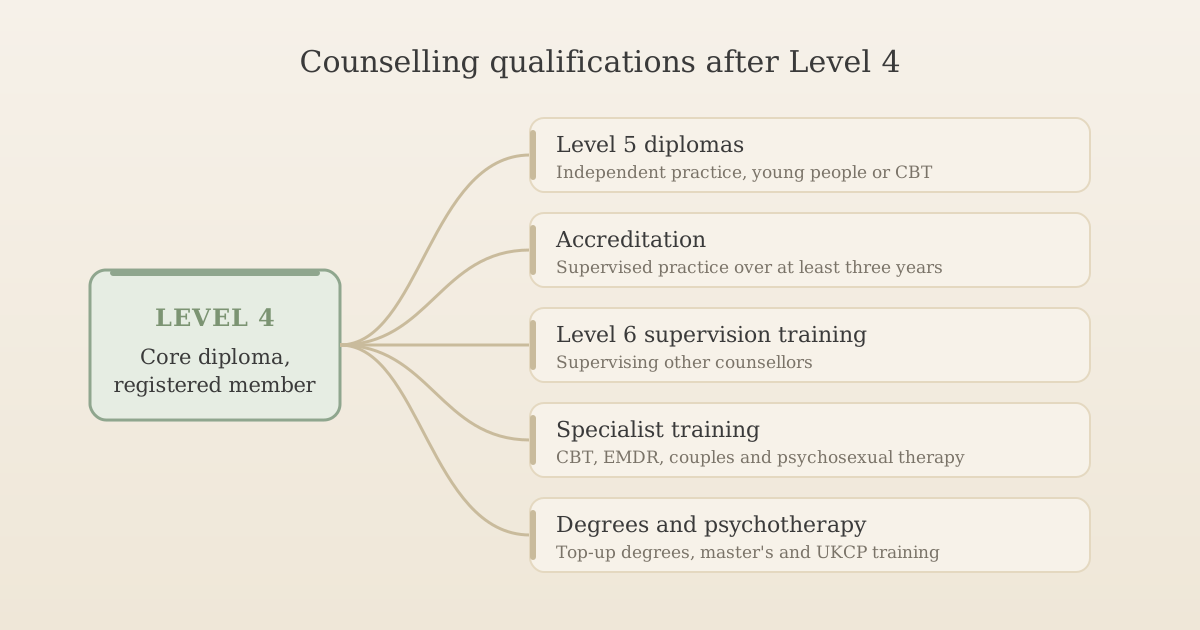
Once your Level 4 diploma is done, the next question is usually what to train in next, and the options are confusing: Level 5 diplomas, Level 6 and 7 courses, accreditation, supervision training, specialist approaches and degrees. This guide maps the counselling qualifications after Level 4 that are open to counsellors in the UK, what each one needs first and what it leads to. The short answer is that there's no single next qualification, and you don't need any of them to see private clients. Pick the route that matches what you want your practice to do, and expect several of the most useful routes, including EMDR (eye movement desensitisation and reprocessing) and supervision, to ask for experience or accreditation before they ask for another certificate.
Important: This is a practical overview, not careers, regulatory or financial advice. Entry criteria, professional-body routes and student finance rules change, and some differ between England, Scotland, Wales and Northern Ireland. Check the current requirements with the training provider, awarding body or professional body before you apply. Details below were checked on 26 October 2026.
Key takeaways:
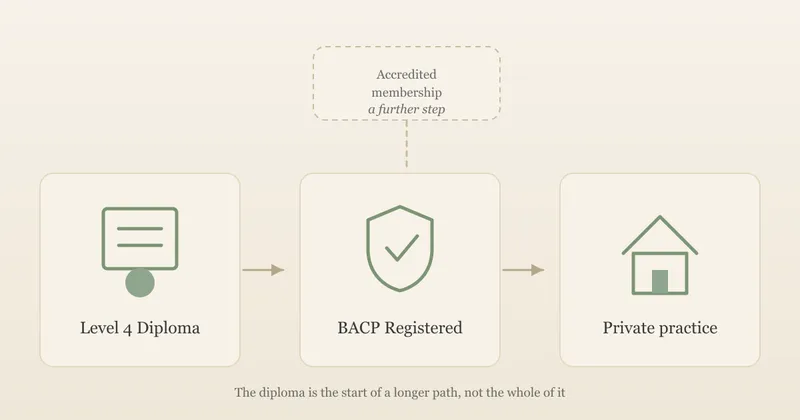
- You don't need a further qualification to work in private practice after Level 4. Further training adds depth or opens specific kinds of work.
- A Level 5 diploma is a common next qualification, but it's one of several routes, not a required stage.
- Accreditation isn't a qualification, but it's often what unlocks the next step: EMDR training, for example, requires counsellors to be fully accredited first.
- Clinical supervision training sits at Level 6 and expects substantial client experience. Couples and psychosexual training is mostly at Level 7.
- Becoming a psychotherapist is a separate, longer route through UKCP (UK Council for Psychotherapy) training, usually three to six years part time.
What Level 5, 6 and 7 mean
In England, Wales and Northern Ireland, qualification levels follow a single national scale. GOV.UK's list of qualification levels puts a Level 4 diploma alongside a certificate of higher education, Level 5 alongside a foundation degree, Level 6 alongside a bachelor's degree with honours, and Level 7 alongside a master's degree or postgraduate diploma. Scotland uses its own framework, so the numbers there are different.
The level tells you how demanding a qualification is. It doesn't tell you what it lets you do. A Level 6 supervision certificate and a Level 6 degree are at the same level but lead to very different places, and some of the most useful steps after Level 4, such as accredited membership, aren't qualifications at all.
Counselling qualifications after Level 4 at a glance
| If you want to... | Route | What you need first | Typical length |
|---|---|---|---|
| Work at greater depth in private practice | Level 5 Diploma in Psychotherapeutic Counselling | A Level 4 diploma | One year part time |
| Work with 11 to 18 year olds | Level 5 Diploma in Counselling Children and Young People | A Level 4 diploma | One year part time |
| Add CBT skills to your work | Level 5 Diploma in CBT Skills and Theory | A Level 4 diploma | One year part time |
| Be recognised as an experienced practitioner | Accredited membership, for example with BACP | Registration and supervised practice over at least three years | At least three years |
| Supervise other counsellors | Level 6 Certificate in Therapeutic Counselling Supervision | Level 4 or 5 plus substantial experience | 328 hours of study in total |
| Use EMDR for trauma work | EMDR Europe accredited training | Full accreditation with a listed body | A standard training course, then further practice for EMDR accreditation |
| Work with couples or sexual difficulties | COSRT accredited course | Varies by course | Often two years |
| Hold a degree | Foundation or top-up degree | Depends on the university | Varies |
| Train as a psychotherapist | UKCP accredited training | Usually a degree for psychotherapy | Three to six years part time |
Each route is covered in more detail below.
Level 5 diplomas: going deeper
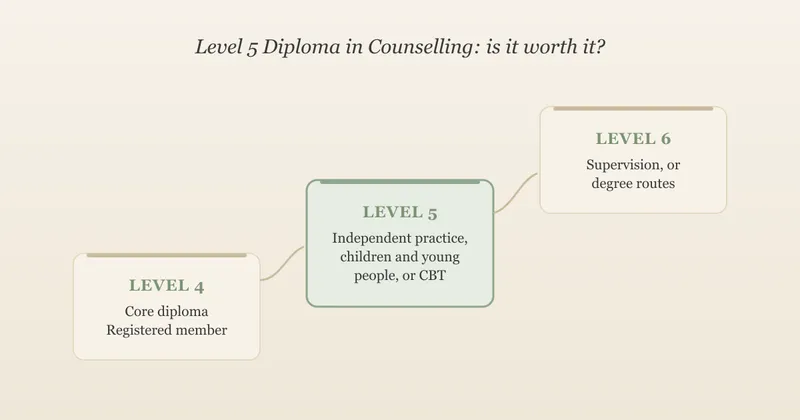
A Level 5 diploma is often the first further qualification counsellors look at. CPCAB (the Counselling & Psychotherapy Central Awarding Body), the awarding body behind most of them, offers three: Psychotherapeutic Counselling, which is designed for independent practice; Counselling Children and Young People, for work with 11 to 18 year olds; and CBT Skills and Theory. Each asks for a Level 4 diploma first and includes supervised client hours.
A Level 5 diploma doesn't change what you're allowed to do in private practice. It gives you more depth in the parts you carry alone, such as assessment, risk and boundaries, and it's a common stepping stone to supervision training and some accreditation routes. Our guide to whether a Level 5 diploma in counselling is worth it compares the three diplomas, their costs, funding and how to check a course is regulated.
Accreditation: often the step that opens the others
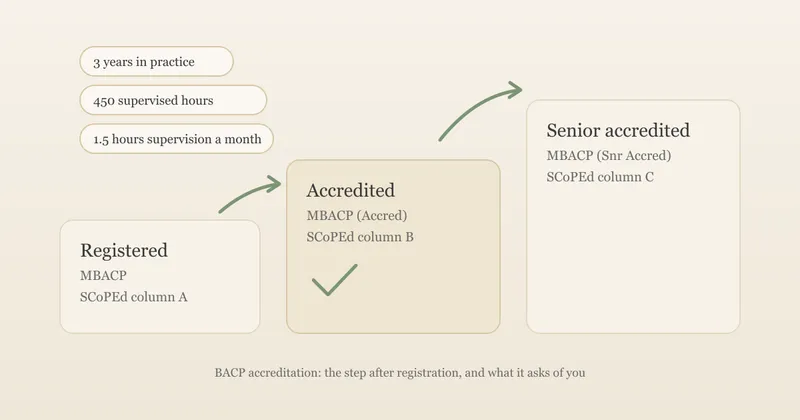
Accredited membership is a higher level of membership with your professional body, based on supervised experience over time rather than a course. With BACP it maps to column B of SCoPEd (the Scope of Practice and Education framework), above the Registered membership that a Level 4 diploma leads to. Our guide to BACP accreditation covers the routes, fees and the 450 hours of supervised practice in detail.
It belongs in a guide to qualifications because other routes depend on it:
- EMDR training is only open to counsellors and psychotherapists who hold full accreditation, as set out below.
- Supervision training isn't closed to registered members, but CPCAB recommends at least 450 supervised client hours first, "in line with BACP individual accreditation requirements".
- Some insurer networks and employed roles ask for accredited status rather than a further certificate.
So if you're a year or two out of your Level 4, building supervised hours towards accreditation may move you further than another course. Our guide to clinical supervision for counsellors explains how supervision hours are counted.
Level 6: training as a clinical supervisor
Supervising other counsellors is a common goal a few years into practice, and it's one of the few routes with a dedicated Level 6 qualification. CPCAB's Level 6 Certificate in Therapeutic Counselling Supervision prepares you to supervise counsellors in an agency or in private practice.
From CPCAB's 2026 to 2027 specification:
- Entry: its Level 4 diploma or one of its Level 5 diplomas, or an equivalent, plus "substantial practitioner experience". CPCAB recommends at least 450 supervised client hours. Its qualifications page summarises the entry point as a Level 5 diploma plus a year of post-qualifying experience, so ask the training centre how it applies this.
- Study: at least 90 guided learning hours, and 328 hours in total including your own study.
- Practice: at least 15 hours supervising supervisees during the course, and at least 5 hours of supervision of your supervision work.
- Cost and funding: the CPCAB registration fee is £398, on top of the centre's tuition. The specification says it isn't currently eligible for funding.
Once you're qualified, supervision becomes a service you can offer, but to a different audience: other counsellors, not clients. When we checked in October 2026, BACP's separate accreditation scheme for specialist supervisors was paused, so check its current position before you plan around it.
Specialist training routes
Some approaches have their own training and their own professional bodies. These routes usually need more than a counselling diploma before you start, so check the entry criteria before you look at course dates. For shorter add-on trainings in a named model, see our comparison of IFS, compassion focused therapy and DIT training for counsellors.
CBT
CPCAB's Level 5 CBT diploma adds CBT skills and theory to your existing work. Becoming an accredited CBT therapist is a different process. BABCP (the British Association for Behavioural and Cognitive Psychotherapies), the lead body for CBT, says its accredited members have completed "both core professional mental health training or recognised equivalent, as well as specific CBT training". Check BABCP's criteria to see how your counselling training is assessed before you choose a CBT course.
EMDR
EMDR is used in trauma work, and the EMDR Association UK's training criteria are strict about who can train. Counsellors and psychotherapists must hold full accreditation with one of the listed bodies, including BACP, UKCP, BABCP, COSRT, COSCA (Counselling & Psychotherapy in Scotland), the British Psychoanalytic Council and the National Counselling & Psychotherapy Society (NCPS) at Accredited Professional grade. All applicants also need:
- one-to-one therapy as a significant part of their current role
- their clinical supervisor's full support to attend
- access to training cases for the length of the course.
The association also warns that if you train without meeting these criteria you won't be eligible for accreditation, and if you train with a trainer who isn't accredited with EMDR Europe you can't join the association or apply for accreditation at all. For a Level 4 counsellor, EMDR is a goal for after accreditation, not straight after the diploma.
Couples and psychosexual therapy
COSRT, the College of Sexual and Relationship Therapists, accredits specialised practice courses in two disciplines: psychosexual and relationship therapy, and relationship therapy. The courses on its list when we checked are at Level 7, including two-year diplomas and MSc programmes, and graduating from one gives entry to COSRT's registers. COSRT introduced updated course accreditation standards on 1 January 2026, so check that a course's accreditation is current.
Children and young people
Working with under-18s is a specialism in its own right, not just an extension of adult work. CPCAB's Level 5 Children and Young People diploma is the usual qualification route after Level 4. You'll also need the right checks; our guide to DBS checks for therapists covers what applies when you work with children.
Degrees: foundation, top-up and master's
A degree doesn't change what you can do in private practice, but it can matter for some employed roles, for psychotherapy training and if you want to study further.
- Foundation degree. CPCAB and the Open University run a Foundation Degree in Counselling worth 240 credits. It combines CPCAB's Level 4 diploma, a mandatory Open University module and either a CPCAB Level 5 diploma or further Open University modules. Only CPCAB qualifications count towards it.
- Top-up degree. Some universities let you use earlier study to enter a degree part-way through. Ask the university how much credit your diplomas carry before you enrol, since policies vary.
- Master's degree. BACP's guide to training as a therapist notes that core counselling training can be a diploma, a bachelor's degree, a master's or a doctorate. After a diploma, a master's is mainly for academic study, research, or roles and training routes that ask for postgraduate study.
Becoming a psychotherapist: the UKCP routes
If you want to register as a psychotherapist, the main route is UKCP training. UKCP's page on training as a psychotherapist describes two levels:
- Psychotherapy training usually starts at postgraduate Level 7. It takes four to six years to accreditation: generally four years of taught training, plus time to complete the client practice requirements.
- Psychotherapeutic counselling training doesn't need a degree first and starts at Level 5. It typically involves three years of taught training plus time to build up client hours.
Both involve around 450 hours of supervised clinical practice and your own therapy throughout. If you already hold counselling qualifications, UKCP says you apply through one of its accrediting organisations, which assess your prior learning. UKCP also says no more than half of any training course can be achieved through prior learning, so expect to study rather than simply transfer.
Paying for further training
In England, two government schemes can help with tuition:
- Advanced Learner Loan. For people aged 19 or over on Level 3 to 6 courses at colleges and training providers in England.
- Lifelong Learning Entitlement. For Level 4 to 6 courses, and some Level 7 courses, starting on or after 1 January 2027, GOV.UK's page on student finance from 1 January 2027 says you'll apply through the new Lifelong Learning Entitlement, with applications from the end of October 2026. It covers tuition fee loans of up to £39,160 in total, and repayments start once you earn over £25,000 a year.
Not every course or provider takes part. CPCAB's supervision certificate, for example, isn't currently eligible for funding, and some providers of Level 5 diplomas don't offer loans. UKCP offers an annual bursary to its student and trainee members. Funding rules in Scotland, Wales and Northern Ireland are different, so check with your own student finance body.
How to choose your next step
Three questions usually narrow it down:
- What do you want your practice to look like in three years? More depth with the same clients points to a Level 5 diploma. Supervising others points to accreditation, then supervision training. A specific client group or approach points to the specialist route for it.
- What does that route need first? If it needs accreditation or a set number of client hours, those are your next step, not the course.
- Can you afford the whole route? Count tuition, registration fees, supervision and personal therapy, and the client hours you'll need to fit around your practice.
Two things to avoid. First, collecting certificates mainly to look more qualified: clients and employers care more about registration, experience and fit than about the number of courses. Second, short online courses that call themselves diplomas but have no placement and aren't regulated qualifications. Check the awarding body and the government register before you pay. CPD is different: short courses can count towards your annual CPD, and our guide to how many CPD hours counsellors need covers what counts.
If you're still unsure, talk it through with your supervisor, who knows your work and where you want to take it. Our guide to whether a Level 4 diploma is enough for private practice covers the basics to get right before any further training.
How further training changes your website
Further training is worth showing clients, but only once it's real:
- Name what you hold in full, with the awarding body, and keep in-progress training clearly labelled, for example "currently training in EMDR (completing 2027)". Don't offer a service until you're qualified and competent to provide it.
- Let new training change what you offer. A specialism you've trained in may earn its own page; our guide to therapist service pages covers when it does. Further training is also a natural point to revisit how you find your niche.
- Give supervision its own page if you start supervising, written for counsellors rather than clients: your training, approach, fees and how you work online or in person.
- Update your directory profiles at the same time, so your qualifications match wherever people find you. Our guide to writing a counselling directory profile covers what to include.
Frequently asked questions
What qualification comes after a Level 4 diploma in counselling?
There isn't one fixed next step. A common next qualification is a Level 5 diploma, such as CPCAB's Psychotherapeutic Counselling, Children and Young People or CBT diplomas. Other routes include accredited membership of a professional body, a Level 6 certificate in clinical supervision, specialist training such as EMDR, CBT or couples and psychosexual therapy, a foundation or top-up degree, and UKCP psychotherapy or psychotherapeutic counselling training. Which one fits depends on what you want your practice to do next.
Do I need another qualification to work in private practice after Level 4?
No. A Level 4 diploma from a recognised course, registration with a professional body, supervision, insurance and the other practical basics are enough to see private clients in the UK. Further qualifications add depth or open specific kinds of work, such as supervision, work with young people or specialist approaches, but they aren't a legal or registration requirement for private practice.
Can I train as a clinical supervisor with only a Level 4 diploma?
Possibly, but not straight away. CPCAB's 2026 to 2027 specification for its Level 6 Certificate in Therapeutic Counselling Supervision accepts its Level 4 diploma or one of its Level 5 diplomas, plus substantial practitioner experience, and recommends at least 450 supervised client hours. Its qualifications page describes the usual entry point as a Level 5 diploma plus a year of post-qualifying experience, so ask the training centre how it applies the criteria.
Can counsellors train in EMDR?
Yes, but only once they're fully accredited. The EMDR Association UK's eligibility criteria say counsellors and psychotherapists must hold full accreditation with a listed body, such as BACP, UKCP, BABCP, COSRT or NCPS at Accredited Professional grade. One-to-one therapy must also be a significant part of your current role, with your supervisor's support and access to training cases.
The short version
There's no single qualification that comes after Level 4, and none of them is required for private practice. A Level 5 diploma is a common next step, especially the Psychotherapeutic Counselling diploma if you want more depth for independent work. Supervision training sits at Level 6, couples and psychosexual training mostly at Level 7, and psychotherapy is a longer UKCP route. Several of the most valuable routes, including EMDR and supervision, ask for experience or accreditation first, so supervised hours towards accreditation are often the most useful next step. Choose the route that matches the practice you want, check its entry criteria and funding before you apply, and describe each new qualification accurately once you hold it.
Show clients what your training means
UpTopWeb builds websites for counsellors and therapists that present qualifications accurately and give your specialisms and supervision work pages of their own.
Further reading
Related articles
Training & CPD12 minute read
Level 5 Diploma in Counselling: Is It Worth It?
Training & CPD12 minute read
BACP Accreditation: Is It Worth It for Private Practice? (UK Guide)
Training & CPD13 minute read
Level 4 Diploma in Counselling: Is It Enough for Private Practice?