Marketing
How to Find Your Niche as a Therapist (UK Guide)
A practical way for UK counsellors to choose a therapist niche you can back up: what clients search for, a 20-minute local test, and how to use it on your website.
On this page11 sections
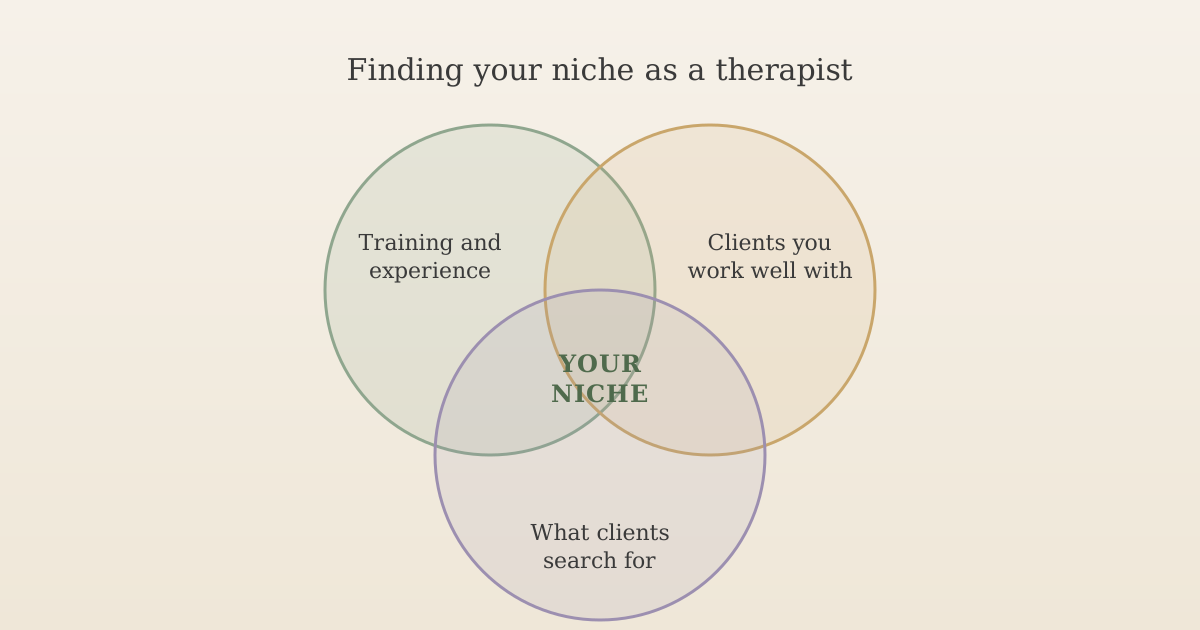
If you're wondering how to find your niche as a therapist, you've probably been told to "niche down" without anyone explaining what that means for a UK counsellor in private practice, or whether you need to at all. This guide is for UK counsellors, psychotherapists and other talking therapists who want to choose a focus they can stand behind, and use it on their website and directory profiles. The short answer: a good niche sits where your training and experience, the clients you work well with, and what people actually search for overlap. Most therapists don't need a tiny niche; a clear focus you can back up does most of the work. Below is what UK search data shows about niche demand, a three-question test, a 20-minute local check you can run yourself, and how to put the result on your website.
Important: This is a practical overview, not professional, regulatory or legal advice. What you can say about the issues you work with is covered by your professional body's code and by advertising rules. Check your own body's current guidance and the ASA's guidance before publishing.
Key takeaways:
- A niche is a focus you can back up with training and experience, not a label you pick because a list says it's "in demand".
- You don't have to choose one. Many UK counsellors do well as generalists with a clear lead area or two.
- Broad areas like couples and bereavement counselling are searched for steadily across the UK. Narrow ones often barely register in search, so those clients tend to arrive through referrals, specialist directories and searches for the problem in their own words.
- Before committing, search for your niche plus your town and see who comes up. It takes about 20 minutes and tells you more than any list.
- Once you've chosen, lead with it in your homepage headline, give it a focused service page and say it in your directory profile, without claiming to cure anything.
What a therapist niche is, and what it isn't
A niche is the area of work you lead with: the clients or issues you want a stranger to associate with you first. It can be built around:
- A client group: students, new parents, men, older adults, LGBTQ+ clients, people in a particular profession.
- An issue or life event: bereavement, relationship breakdown, burnout, infertility, a health diagnosis.
- A life stage: young adults leaving home, midlife, retirement.
- A way of working: EMDR, couples work, walk-and-talk sessions, evening appointments online.
It isn't the same as a specialism in the formal sense. A specialism usually means specific training and substantial experience in an area. A niche can be narrower or broader than that, and plenty of therapists choose a niche that combines two things they're already competent in ("bereavement and loss for adults, in person in York and online").
It also isn't a promise to turn everyone else away. Most therapists who lead with a niche still see clients outside it. What changes is what your homepage and main pages say first, so the right people recognise themselves quickly.
Do you need a niche at all?
Not necessarily. If you see clients in person in one town, many of them will find you through Google Maps, directory listings and word of mouth, and a clear, warm "I see adults for a wide range of difficulties, in person in Leamington Spa and online" can work well. Our guide to marketing yourself as a therapist covers that side.
A niche starts to matter more when:
- You work mostly online. You're no longer one of a handful of counsellors in your town; you're one of thousands offering online sessions. A focus is often what makes a profile or website stand out.
- Your directory profile reads like everyone else's. If your profile could belong to any of the twenty counsellors listed beside you, a focus gives a reader a reason to stop.
- You want referrals. GPs, other therapists, employers and charities refer to people they can describe in one line. "She's good with bereavement" travels further than "she's a lovely integrative counsellor". Our guide to building a referral network covers how those referrals work.
- You'd like more of a certain kind of work. If the clients you find most rewarding are a small part of your caseload, naming them is how you get more of them.
What UK search data shows about niche demand
It's tempting to look for a list of niches that are "in demand". Search data gives a more useful, and more honest, picture. We compared UK search interest in five areas of counselling in Google Trends over the 12 months to 21 October 2026. Trends doesn't show the number of searches; it scores each term from 0 to 100 against the busiest week of the busiest term in the comparison, so it's good for comparing terms, not for sizing a market. Terms with too few searches show as 0.
| Search term (UK, 12 months to 21 Oct 2026) | Weeks with measurable interest | Average weekly score |
|---|---|---|
| bereavement counselling | 53 of 53 | 65 |
| couples counselling | 53 of 53 | 64 |
| autism counselling | 18 of 53 | 7 |
| menopause counselling | 2 of 53 | under 1 |
| perinatal counselling | 1 of 53 | under 1 |
Three things stand out:
- Broad, familiar areas are searched for all year. Bereavement and couples counselling had similar, steady interest every week. Couples counselling was slightly higher in the most recent three months than a year earlier; bereavement was slightly lower. The demand is real, and so is the competition: these are also the searches where free services, directories and established practices are strongest.
- Narrower areas are much smaller in search. Autism counselling was searched for roughly a tenth as often, and only in about a third of weeks.
- Some valuable niches barely register. Perinatal and menopause counselling hardly showed at all. That doesn't mean there's no need. It means people rarely search for the professional label. A new parent struggling after a birth is more likely to search for what they're feeling, ask their health visitor, or look in a specialist directory than type "perinatal counselling".
The practical point: for a broad niche, your website and Google Business Profile can do a lot of the work, but you'll need to stand out. For a narrow one, plan on referrals, specialist directories and pages written in the words clients use for the problem, and don't expect searches for the label alone to fill your diary.
Three questions for finding your niche as a therapist
Run each area you're considering through these three questions. A niche worth leading with gets a clear yes to all three.
1. Can you back it up with training and experience?
This comes first, because everything you publish about a niche is a claim about your competence. BACP's Ethical Framework 2026, which becomes mandatory on 3 November 2026, asks members to give "clear, accurate information" about their services, qualifications, experience and competence (1.2), and to "set out clearly the services we have competence to offer" (4.4). Other professional bodies' codes have similar duties.
A weekend workshop doesn't make a niche (our guide to IFS, CFT and DIT training shows how far apart an introduction and a full training can be). Ask yourself:
- Have you had training specific to this area, beyond your core qualification?
- Have you worked with a meaningful number of clients in it, under supervision?
- Would you be comfortable explaining to your supervisor why you're advertising it?
If the honest answer is "not yet", it can still be a direction. Build experience, take focused CPD (our guide to CPD hours for counsellors covers what counts), and add it to your website when the answer changes.
2. Is it work you do well and want more of?
Look back at your caseload for the last year or two. Which clients did you work best with? Which sessions left you feeling the work mattered, rather than drained? Which enquiries did you get most often without trying?
Your niche will shape your marketing for years, so it's worth choosing work you'd be glad to have more of. A niche picked purely because it looks popular tends to be dropped within a year, which means rewriting your website and profiles again.
3. Do clients look for it, and in what words?
Check that people actually seek help for this area, and notice the words they use. Clients rarely search for a modality or a professional label unless they've already heard of it. They search for "counselling after a miscarriage", "couples therapy online" or "counsellor for anxiety Leeds".
Good places to look:
- Your own enquiries. The exact phrases people use in emails and calls are the best guide you have.
- Directory filters. The issues and client groups listed in directories such as Counselling Directory show the categories clients browse by. Our guide to writing a counselling directory profile explains how those filters work.
- Google's own suggestions. Start typing your niche into Google and note the completions and the "related searches" at the bottom of the results.
Test your niche in 20 minutes
Before you rewrite anything, search Google for your niche plus the town you work in, and compare it with a general search for counselling in the same town. Do it signed out, or in a private window, so your own history doesn't skew the results.
As an example, we searched Google UK for "counselling bristol" and "neurodivergent counselling bristol" on 21 October 2026 through a search data tool:
- The general search was led by a mix: a few individual practices' websites, a low-cost counselling service, NHS Talking Therapies pages, the university's student counselling service, and directory listings.
- The niche search looked quite different. It was mostly specialist directories for neurodivergent clients and practitioners, individual therapists' profiles on those directories, a local autism support charity, a child and family therapy charity, and general directories' neurodiversity and autism pages. Only a couple of individual practitioners ranked with their own websites.
That tells a Bristol counsellor with genuine experience in this area two useful things. There's room for a well-written page of their own, because few practitioners have one. And the specialist directories are where clients are already looking, so a strong listing there matters as much as the website.
When you run your own search, note:
- Who ranks: individual practices, directories, free services, or national charities?
- How specific their pages are: a dedicated page about the area, or a passing mention in a long list?
- What a client would still be missing: fees, availability, how you work with this, whether you see people online.
Where free services dominate, say clearly what's different about seeing you: availability, no waiting list, session length or a particular approach. Results vary by person, device and day, so treat this as a snapshot, not a ranking report. Our service pages guide walks through the same kind of check for Harrogate.
A worked example: from "I see everyone" to a clear focus
Here's an invented but typical case. An integrative counsellor in Derby, five years qualified, sees adults in person and online. Their website headline says "A safe space to explore whatever you're facing", and the services page lists 24 issues.
Looking back over two years, about half their clients came with grief or loss of some kind: bereavement, but also divorce, redundancy and estrangement. They did a bereavement training course three years ago, volunteered with a bereavement charity before qualifying, and find this the work they're best at.
Running the three questions:
| Question | Answer |
|---|---|
| Training and experience? | Yes: specific training, charity work and two years of bereavement clients under supervision |
| Work they want more of? | Yes, clearly |
| Do clients search for it? | Yes: bereavement counselling is searched for every week across the UK |
The practice is invented, but the search isn't. When we searched Google UK for "bereavement counselling derby" on 21 October 2026, the top nine results were two councils' bereavement pages, a hospice, local bereavement charities, Cruse, a GP surgery's wellbeing page, a therapist directory and a funeral director. Not one individual practice ranked with its own page. Free services leading is normal for bereavement searches, and it means a private practice has to say clearly why someone might choose it instead. So the new homepage headline became "Counselling for grief and loss in Derby and online", with a line underneath: "Bereavement, divorce, redundancy and other losses. I also see adults for anxiety and low mood." They wrote one focused bereavement page that explains how their sessions differ from the free services (no waiting list, evening appointments, open-ended work), kept a short "other things I help with" section, and rewrote the opening of their directory profile to match.
They didn't stop seeing other clients. They changed what a stranger reads first.
Putting your niche on your website and profiles
Once you've chosen, make it visible in the places clients actually look:
- Your homepage headline. Name who you help and where, in plain words. Our guide to writing therapist website copy has before-and-after examples.
- A focused service page. One strong page about your niche, saying who it's for, how you work with it and what's different about the practicalities. Our guide to therapist service pages covers when an area earns its own page.
- Your directory profiles. Lead with the niche in the first two lines, which is often all that shows in search listings, and tick the matching filters honestly.
- Specialist directories. If your niche has its own directories or networks, as the Bristol test showed for neurodivergent clients, a listing there may matter as much as your website.
- Your Google Business Profile description, if you see clients in person. Our local SEO checklist for therapists covers setting it up.
- Your referrers. Tell the GPs, therapists and organisations you're in touch with what you now focus on, in one sentence they can repeat.
One line to hold everywhere: describe who you work with, not what you'll fix. The ASA's guidance on mental health treatment claims says claims to treat or cure conditions need robust evidence. "I work with new parents finding the first year hard" is fine; "I'll help you beat postnatal depression" is a claim.
Mistakes that make a niche backfire
- Advertising areas you're not trained in. A list of twenty "specialisms" sits awkwardly with your professional body's competence duties, and clients notice when every counsellor claims everything.
- A niche in name only. "I work with everyone, but especially..." followed by six groups isn't a niche. Pick one or two you can describe specifically.
- Choosing from an "in demand" list. Demand in general doesn't mean demand for you. The search data above shows how differently areas behave, and your own training and local results matter more.
- Going so narrow nobody finds you. If neither searches nor referrers lead to it, a very narrow niche can leave your diary emptier, not fuller. Keep a broader second line on your website while you test it.
- Changing it every few months. Search engines and referrers take time to associate you with something. Give a niche at least six months to a year before judging it, unless it's clearly not working.
When to widen or change your niche
Review your focus once a year, perhaps alongside your fees. Look at where your enquiries came from, which pages people landed on, and which clients you saw most. Widen it if enquiries have dried up and the searches and referrals aren't there; narrow it if one part of it has clearly become your strongest work. If you complete significant new training, that's a natural time to add it.
When you change your niche, update everything at once: homepage, service pages, directory profiles, Google Business Profile and what you tell referrers. A website that says one thing and a directory profile that says another is confusing for clients.
Frequently asked questions
Do I need a niche to succeed in private practice?
No. Plenty of UK counsellors run full practices as generalists, especially in one town where clients find them through Google Maps, directories and word of mouth. A niche helps most when you work online across the UK, where you're competing with far more therapists, or when you want referrers to think of you for something specific. Many therapists settle on a focus: one or two areas they lead with, while still seeing a wider range of clients.
Can I choose a niche I don't have specific training in yet?
You can work towards one, but don't advertise it until your training and experience support it. BACP's Ethical Framework 2026 asks members to give clear, accurate information about their competence and to set out clearly the services they're competent to offer, and other professional bodies have similar duties. A sensible route is to build experience under supervision and add focused CPD, then describe the area on your website once you'd be comfortable explaining it to your supervisor.
Will a niche mean fewer clients?
It can, if it's so narrow that hardly anyone searches for it or refers to it. That's why it's worth testing a niche before committing. In practice most therapists who lead with a focus still see clients outside it: the niche shapes what your homepage and main service pages say, not who you're allowed to work with.
How do I describe my niche without putting other clients off?
Say who you work with most, in the client's own words, and say plainly what else you see. For example: 'I work mainly with adults dealing with loss, including bereavement, divorce and redundancy, and I also see people for anxiety and low mood.' Keep the focus in your headline and main service page, and list your other work in a short section rather than hiding it.
The short version
A therapist niche is a focus you can back up, not a label you pick from a list. Choose where your training and experience, the clients you work well with and what clients search for overlap, and test it with a 20-minute search for your niche and town. Broad areas like bereavement and couples counselling have steady search demand and stiff competition; narrow ones often depend on referrals and specialist directories more than search. You don't have to narrow down to one thing: leading with one or two areas, while saying plainly what else you see, works for most UK counsellors. Then put it in your homepage headline, a focused service page and your directory profiles, describing who you help rather than what you'll cure.
A website that leads with the work you do best
UpTopWeb builds websites for counsellors and therapists with a clear headline, a focused page for your niche and plain-English copy that matches your directory profiles.
Further reading
Related articles
Marketing18 minute read
Google Ads for Therapists (UK): A Step-by-Step Set-Up Guide
Marketing18 minute read
Paid Advertising for Therapists: Google, Meta and What's Worth It (UK)
Marketing15 minute read
Referrals for Therapists: How to Build a Network That Sends You Clients (UK)