Marketing
Referrals for Therapists: How to Build a Network That Sends You Clients (UK)
Where counselling referrals really come from in the UK: GPs, colleagues, link workers, insurers and EAPs, plus the rules on fees, consent and confidentiality.
On this page9 sections
Referrals for therapists are the client source that most practices rely on and few plan for. A GP mentions your name, a colleague with a full diary passes someone on, a supervisor knows you work with teenagers: none of it shows up in your website analytics, and most of it depends on people who aren't paid to market you remembering who you are and trusting that you're the right fit.
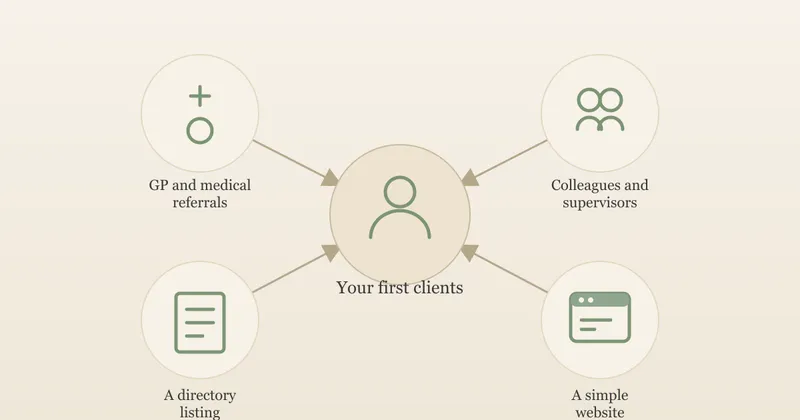
This guide is for UK counsellors and psychotherapists in private practice who want more of those referrals to happen on purpose. It covers who actually refers private clients, what a GP referral looks like in practice, how a colleague network works in both directions, the consent and confidentiality rules around referring and thanking, what professional bodies say about referral fees, and what insurer and EAP networks ask for. If you're still building your first caseload, start with our guide to getting your first counselling clients, which covers referrals alongside directories and a website. Rules and criteria are as checked on 14 October 2026.
Important: This is a practical overview, not legal, regulatory or professional advice. Professional-body rules differ and change, BACP's 2026 Ethical Framework becomes mandatory on 3 November 2026, and insurer and EAP criteria are set by each organisation. Check your own body's current guidance, and take advice if you're unsure about a specific arrangement.
Referrals for therapists: who actually sends private clients
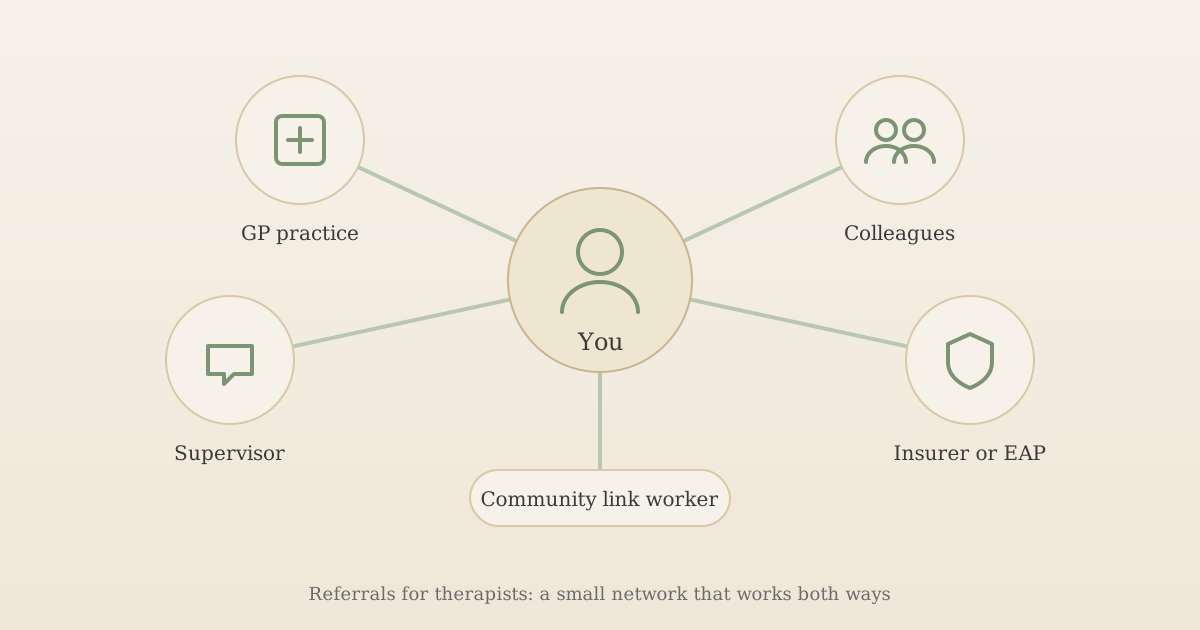
"Get more referrals" is too vague to act on, because each referral source wants something different from you. The table below is the map this guide follows.
| Referral source | Why they refer | What they need to know about you | Watch out for |
|---|---|---|---|
| GP practices and practice staff | Patients ask them for private options, often while waiting for NHS help | Who you help, fees, how quickly you can see someone, how to contact you | Never offer an incentive; GPs are bound by GMC rules on this |
| Social prescribing link workers (England) | They connect people with community services and support | Any low-cost or concession places, and what you don't offer | Their focus is community support, not full-fee private therapy |
| Other therapists | Their diary is full, the issue is outside their competence, or the fit isn't right | Your specialisms, modality, availability, fees and location | It only works if you refer back when it's right for the client |
| Your supervisor and peer groups | They hear about capacity and gaps across many practitioners | What you're looking for and where your competence sits | Keep it a by-product of supervision, not its purpose |
| Health insurers and EAPs | Their customers or employees need a therapist on their approved list | That you meet their criteria and will follow their process | Fees, session numbers and paperwork are set by them, not you |
| Former clients and word of mouth | People recommend someone who helped them | Nothing extra, if your website answers the basics | Never ask clients to recruit others, and never confirm who referred whom |
Two things run through every row. First, referrers are passing on someone they care about, so they need to be confident you're competent and that you'll be honest if you're not the right fit. Second, they're busy: the easier it is to find your fees, availability and specialisms, the more likely your name is the one they remember.
What a GP referral to a private counsellor really looks like
Many new therapists picture GP referrals as a formal letter landing in their inbox. For private practice, that's rarely how it works. In England, the main NHS route for common problems like anxiety and depression is NHS Talking Therapies, and the NHS website tells people they can refer themselves or ask their GP to refer them. A GP referral to private counselling usually means something less formal: a GP, nurse, practice manager or receptionist mentioning your name to a patient who asks about private options, wants something the NHS service doesn't offer, or doesn't want to wait.
That changes what you're actually trying to do. You're not trying to get onto a referral pathway; you're trying to be the name a practice team remembers and trusts. In practice that means:
- Contacting the practice manager, not individual GPs. A short email offering a one-page information sheet for the practice to keep on file is easier to say yes to than a request for a meeting.
- Being specific. An invented example: "Counsellor for adults with anxiety, low mood and bereavement, in-person in [town] and online, £55 for 50 minutes, usually able to offer a first session within two weeks" is far more useful to a busy practice than "I offer a safe, non-judgemental space".
- Keeping it current. If you stop taking new clients, tell the practices you've contacted. Being recommended and then turning people away damages trust quickly.
Never offer a GP or practice anything in return for referrals. The General Medical Council's guidance on identifying and managing conflicts of interest says doctors "must not ask for – or accept – any fee, gift, hospitality or any other incentive" that may affect the way they refer (paragraph 11). Offering one puts the GP in an impossible position and is likely to end the relationship before it starts.
Social prescribing link workers
In England, many GP practices also work with social prescribing link workers. NHS England describes social prescribing as connecting people "to activities, groups, and services in their community", with link workers based in primary care networks so that people can access the service through their GP practice. Their focus is community support rather than private therapy, so they're most likely to be interested if you offer low-cost or concession places, run a group, or can tell them clearly what you don't offer, which helps them signpost people elsewhere.
Writing to a client's GP
The other side of GP contact is writing to a client's GP yourself, for example when a client asks you to, or when you have a concern about risk. BACP's 2026 Ethical Framework sets confidentiality as a core principle: maintain the privacy of information shared in your work, "only disclosing it with the service user's consent, or when required or permitted by law". So the default is that you agree with the client what's being shared, why and with whom, before anything is sent, and you keep it to what the GP actually needs. Safeguarding and legal duties are the exception, and those are worth taking to supervision. Our guide to GDPR for therapists covers why therapy information counts as special category data and needs that extra care.
Other therapists: a referral network that works both ways
The most reliable referral source for many private practitioners is other therapists. A colleague whose diary is full, who doesn't work with couples, or who has a client better suited to a different approach will pass that person to someone they know and trust. That trust is built in both directions: the therapists who receive the most referrals from colleagues tend to be the ones who also refer out readily.
Referring out isn't only good networking, it's part of your professional obligations. BACP's 2026 framework says members must "set out clearly the services we have competence to offer" (4.4a) and must have the qualifications, training and experience to deliver the services they offer (4.1a). UKCP's Code of Ethics and Professional Practice is more direct: members should understand the limits of their competence, "referring clients to another professional when appropriate" (clause 24). A therapist with a ready list of trusted colleagues can do that quickly and well, rather than sending someone back to a search engine.
Building that list doesn't need to be formal:
- Keep a short list of colleagues by specialism: couples, children and young people, eating disorders, trauma, specific languages, low-cost options. Note how each prefers to be contacted and whether they're taking new clients.
- Use the groups you're already in. Peer supervision groups, CPD events and local practitioner networks are where most colleague referrals start. Your clinical supervisor will often know who's taking new clients, too, but keep that a side benefit rather than a use of supervision time.
- Introduce yourself with something useful. A short email to a local colleague saying who you work with, who you don't, and that you'd be happy to pass on enquiries outside your area is a better start than asking them for clients.
Here's an example of that kind of email (invented, adapt it to your own practice):
Hi Priya, I'm a BACP-registered counsellor working with adults in [town], mainly anxiety, low mood and bereavement. I don't work with couples, and I get a few couples enquiries a month. I'd like to be able to pass those on to someone I trust. Would you be open to that? Equally, if you're ever full and someone comes to you with individual anxiety work, I currently have space on Tuesday and Thursday daytimes. Happy to have a quick call if useful.
Referring a client on: consent and what to share
When you refer a client or enquirer to a colleague, the safest default is to give them the colleague's details rather than passing their details to the colleague. If a client wants you to make contact on their behalf, agree with them what you'll share, and keep it to what the colleague needs to decide whether they can help. That follows the same consent principle as writing to a GP, and it means the client stays in control of their own story.
Referral fees, commissions and gifts
This is where good intentions go wrong. A colleague offers a percentage of the first few sessions for every client you send them; a room-hire centre offers a discount for introducing new tenants; a grateful client's relative wants to send a gift. None of these is automatically wrong, but each needs thought.
- BACP: neither the 2018 nor the 2026 Ethical Framework (both checked on 14 October 2026) has a specific clause on referral fees. The relevant commitments are broader: not abusing your position "by taking unfair advantage of people" (1.1c), the principles of transparency and integrity ("Be transparent and ethical in our dealings with others"), and acting in the client's best interest.
- UKCP: the Code says members must not exploit clients "for any purpose including your emotional, sexual or financial gain" (clause 5) and should decline "any gifts, favours, money or hospitality that might be interpreted as exploitative" (clause 7).
- Doctors: as above, GMC guidance rules out fees and incentives for referrals, and says doctors "must not offer such incentives to colleagues" (paragraph 11).
The practical test that falls out of all three is simple: would you be comfortable telling the client about the arrangement, and would it change where you'd refer them? If a referral fee would make you more likely to send someone to a particular colleague, or you'd rather the client didn't know about it, that's your answer. If money does change hands between professionals, tell the client, and take the arrangement to supervision first.
Insurer and EAP networks: referrals with conditions
Health insurers and employee assistance programmes (EAPs) are a different kind of referral source: they send you clients from their own customers or staff, but only if you're on their approved list, and on their terms.
Bupa is a useful example because its criteria are published. Its Mental Health and Wellbeing network page (checked 14 October 2026) asks counsellors and psychotherapists to:
- hold "accreditation" with BACP, UKCP or NCPS. The page doesn't define the word, but Bupa's network terms (updated February 2020, checked 16 October 2026) define a counsellor as "an accredited member" of one of these bodies, so for BACP members that means accredited membership, not registration alone (our guide to BACP accreditation covers what that involves);
- have at least three years' post-qualification experience in full-time practice, or five years part time (at least two working days a week), and provide a reference from their supervisor;
- hold current indemnity insurance and attach the certificate;
- hold an enhanced DBS certificate (or the Scottish or Northern Irish equivalent) completed within the three years before applying; and
- invoice Bupa online rather than the customer.
Bupa says its Finder directory receives 100,000 visits a week and is used by customers and GPs, which shows why insurer networks matter: they're a referral source and a directory at once. Other insurers and EAPs set their own criteria, fees and session limits, and many ask for the same building blocks. Our guides to professional indemnity insurance for therapists and DBS checks for therapists cover the two that most often hold applications up.
Before joining any network, work out what it means for your diary. The fee per session, the number of sessions authorised, the paperwork, and how long payment takes are all set by the network, not by you. For some practices that trade-off is worth it for a steady flow of clients; for others, a few full-fee private clients would do more. Neither answer is wrong, but it's worth deciding on purpose rather than finding out after you've filled your weekday afternoons.
The same sums apply to online therapy platforms that match clients to therapists. In a September 2026 r/UKTherapists thread about private enquiries drying up, one practitioner said platforms now pay therapists around "£18 for a session", while another, working close to full time since 2019, said most of their work now comes through health insurers rather than private clients. These are individual reports, not typical rates, but they show how differently referral networks can pay, and why it's worth comparing any network's fee with your own before you commit diary space to it.
What referrers check before they pass your name on
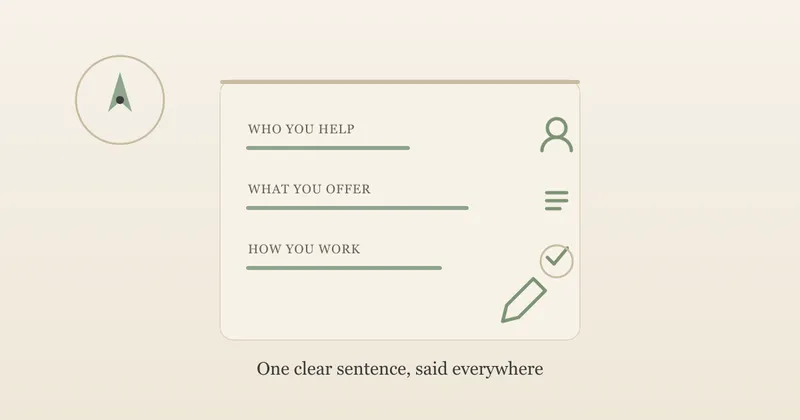
Whoever is referring, there's a moment where they decide whether to mention you. Usually that involves a quick look at your website or directory profile, often while the person in front of them is waiting. In that moment they need to answer four questions: do you help with this, can you see someone soon, what does it cost, and how does the person get in touch.
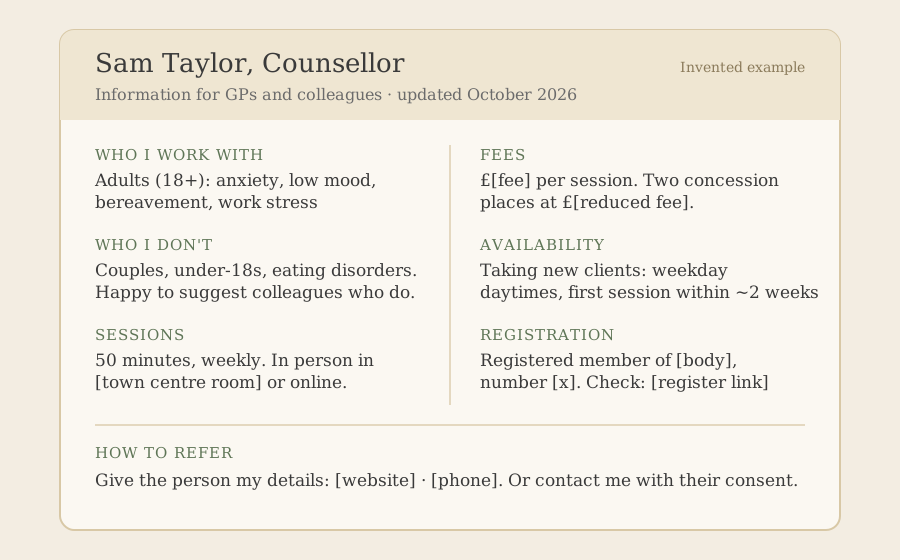
A one-page sheet like the one above is worth having as a PDF to email to practices and colleagues. The same details should be easy to find on your website, because that's where most people will actually look:
- Who you work with, and who you don't. Our guide to therapist service pages covers how to describe specialisms without overclaiming.
- Fees, session length and any concessions, in plain view.
- Current availability or waiting time, updated when it changes. "Currently taking new clients for weekday daytimes" is enough.
- Your registration, with a link to check it on your professional body's register.
- How to refer. A short line for professionals ("If you're a GP or colleague, the simplest way to refer is to give the person my details, or contact me with their consent") saves everyone an email.
These are the same essentials that our guide to what a therapist website should include puts first, and the same details that help a directory listing work; see our guide to writing a counselling directory profile.
A worked example: a twelve-week referral plan
Here's an invented example of how a counsellor might build referral relationships alongside a full working week, at about an hour a week. Sam is a BACP-registered counsellor working with adults, in a rented room in a market town and online.
| Weeks | What Sam does | Why |
|---|---|---|
| 1 to 2 | Updates the website with fees, current availability and a line for professionals; makes a one-page PDF version | Every later step points people here |
| 3 to 4 | Emails the practice managers at three local GP practices, attaching the PDF and offering nothing in return | Easy to say yes to, and compliant with how GPs must work |
| 5 to 6 | Emails four local colleagues with different specialisms (couples, young people, trauma, a low-cost service) offering to refer out | Starts the two-way network with something useful |
| 7 to 8 | Asks the local primary care network how to share details of two concession places with its link workers | Matches what link workers actually do |
| 9 to 10 | Checks one insurer's network criteria against current experience and DBS date; notes the gaps | Decides on purpose whether a network is worth it yet |
| 11 to 12 | Reviews the enquiry log: where did each enquiry come from, and which became clients? | Shows which relationships to keep investing in |
Nothing on that list is a guaranteed source of clients, and some practices won't reply. The point is that each step is small, honest and repeatable, and by week twelve Sam knows which ones are worth doing again.
Thank referrers without breaking confidentiality
Tracking where enquiries come from is the habit that makes all of this work: ask everyone how they found you and note it down, as our guide to getting your first counselling clients explains. But it creates a trap. When a GP or colleague refers someone and that person becomes your client, the natural instinct is to say thank you. Telling the referrer "Jo booked in with me last week" confirms that Jo is in therapy, which is exactly the kind of information you've committed to keep confidential.
The fix is to thank people in general terms, or only with the client's agreement:
Thanks for passing on my details recently. I can't say who gets in touch, but I really appreciate it, and I'm still taking new clients on weekday daytimes.
The same applies to word of mouth from former clients: don't confirm to anyone who recommended whom, and don't ask clients to recruit others. If a referral source sends you people who aren't a good fit, it's fine to tell them that, in general terms, and to say more clearly who you do and don't work with. For the bigger picture of promoting your practice within professional rules, see our guide to how to market yourself as a therapist.
Frequently asked questions
Can a GP refer a patient to a private counsellor?
A GP can suggest a private counsellor, but in England the usual NHS route for common problems like anxiety and depression is NHS Talking Therapies, which people can refer themselves to. In practice, a GP 'referral' to private therapy usually means a GP or practice team member passing on your name, so what matters is that they know who you help, what you charge and how quickly you can see someone.
Can I pay or thank someone for referring clients to me?
Be very careful. Neither BACP's 2018 nor its 2026 Ethical Framework has a specific clause on referral fees, but both expect honesty in all your professional dealings, and UKCP's Code tells members not to exploit clients for financial gain. For doctors it's explicit: GMC guidance says they must not accept any fee, gift or incentive that may affect how they refer, so never offer one to a GP. If any money changes hands between professionals, tell the client.
Can I tell a GP or colleague that the person they referred has booked with me?
Not without the client's consent. Confirming that someone has become your client is itself confidential information. Thank referrers in general terms instead, for example 'thanks for passing on my details, I can't say who gets in touch, but I appreciate it', unless the client has agreed you can contact the referrer.
Do I need to be accredited to get insurance referrals?
It depends on the insurer. Bupa's Mental Health and Wellbeing network, for example, asks counsellors and psychotherapists for accreditation with BACP, UKCP or NCPS (its network terms define a counsellor as an accredited member, so BACP registration alone isn't enough), at least three years' post-qualification experience full time (or five part time), a supervisor reference, indemnity insurance and an enhanced DBS check from the last three years. Check each insurer's current criteria directly, as they differ and change.
Make it easy for referrers to say your name
UpTopWeb designs and builds therapist websites that put your specialisms, fees, availability and registration where GPs, colleagues and clients can find them in seconds. No upfront cost.
Further reading
Related articles
Starting a practice8 minute read
How to Get Your First Counselling Clients
Marketing12 minute read
How to Market Yourself as a Therapist
Therapist websites9 minute read
What Should a Therapist Website Include?