Starting a practice
Associate Counsellor Work in the UK: What to Check Before You Sign
Thinking of working as a self-employed associate for a practice or platform? What to check first: your real share of the fee, status, notes, insurance, supervision and leaving.
On this page12 sections
Associate work is one of the most common ways UK counsellors start seeing private clients: a practice or online platform finds the clients, and you see them as a self-employed practitioner. It can be a steady way to build hours and experience without running your own marketing. It can also leave you with less money, less freedom and less control over your notes than you expected, if the agreement isn't what it seems.
This guide is for counsellors and psychotherapists in the UK who've been offered associate or self-employed work, or are looking for it, and want to know what to check before they sign. It covers how the money really works out, what makes the arrangement genuinely self-employed, client notes, insurance, supervision, leaving, and where associate roles are advertised. If you're on the other side, taking associates on, our guide to starting a group practice covers the same ground from the practice owner's point of view. GOV.UK, HMRC and ICO guidance is as checked on 17 November 2026.
Key takeaways:
- An associate is usually a self-employed practitioner seeing clients a practice or platform has found. "Associate" isn't a legal status: the agreement and how it works day to day decide what you are.
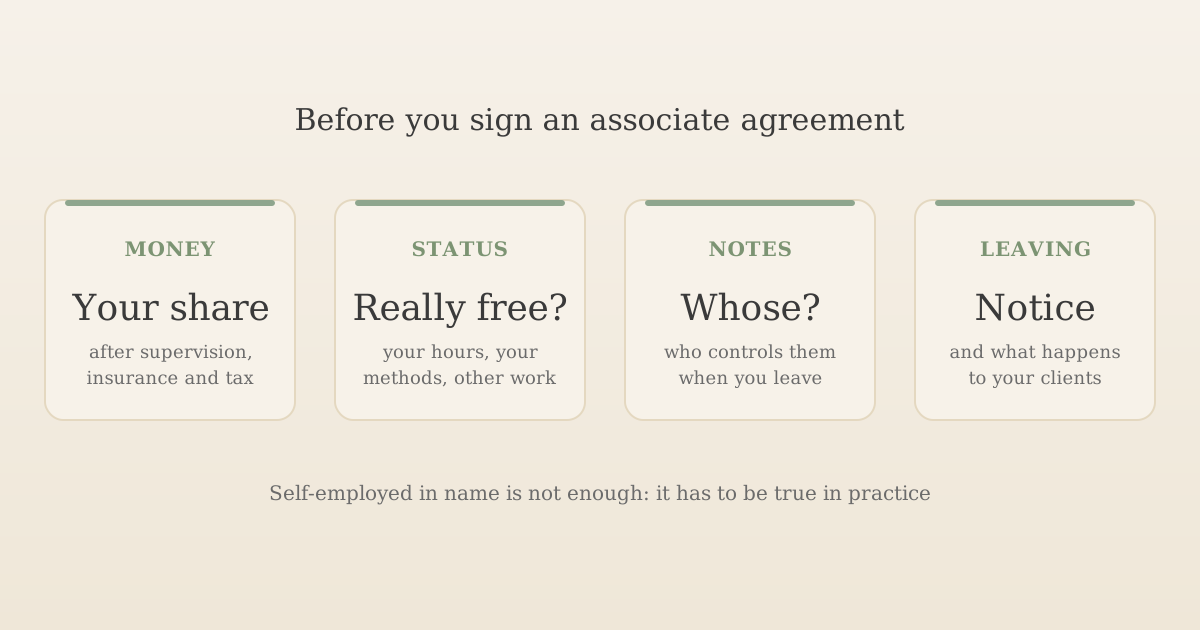
- Work out your share of each fee after supervision, insurance, membership, CPD, travel and tax, and compare it with what you'd keep in your own practice.
- If the practice sets your hours, tells you how to work and won't let you work elsewhere, you may not be self-employed at all. HMRC's Check Employment Status for Tax tool gives HMRC's view.
- Find out who controls the client notes, where they're kept and what happens to them, and to your clients, when you leave.
- Keep your own professional indemnity insurance and supervision, and register with HMRC for Self Assessment.
Important: This is a practical overview, not legal, tax or employment advice. Every associate agreement is different. If anything in yours is unclear, or restricts what you can do after you leave, ask a solicitor to look at it before you sign, and check your professional body's current guidance.
What associate work is, and how it compares
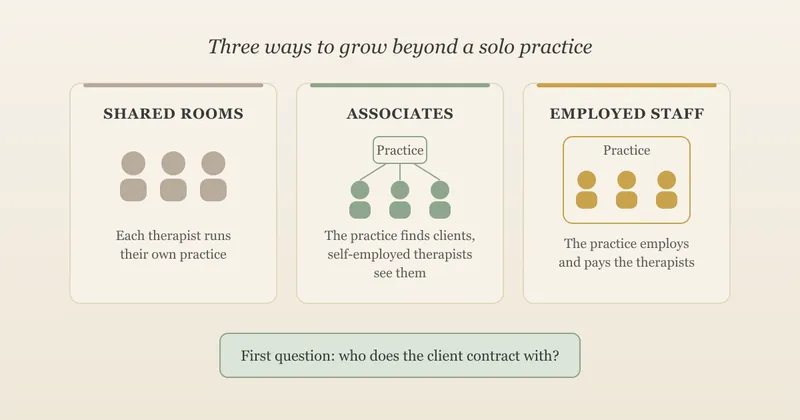
"Associate" is used loosely. Most of the time it means a self-employed counsellor who sees clients allocated by a private practice, a clinic or an online therapy platform. The practice handles marketing, enquiries and often booking and payment; you do the clinical work.
| Associate | Employed | Your own practice | |
|---|---|---|---|
| Who finds clients | The practice or platform | Your employer | You |
| Who sets your fee | Usually the practice | Your employer (a salary) | You |
| Paid when a client doesn't turn up? | Depends on the agreement | Yes | Only if your cancellation policy says so |
| Holiday and sick pay | No | Yes | No |
| Your insurance, supervision and tax | You arrange and pay | Often arranged or paid for by the employer | You arrange and pay |
| Control over hours and methods | Should be yours | Mostly your employer's | Yours |
| Can you work elsewhere? | Should be yes | Depends on your contract | Yes |
Many counsellors mix these: a few associate hours alongside an agency or NHS role, or associate work while they build their own practice. Our guide to therapist salaries in the UK compares what different set-ups can earn.
How the money works out
Associate pay usually takes one of two forms:
- A share of each fee. The client pays the practice, and you receive an agreed percentage or fixed amount per session.
- A fee to the practice. You're paid the client's fee (or collect it yourself) and pay the practice for rooms, referrals or admin, per session or per month.
Neither is better in itself. What matters is who carries the risk. With a share of the fee, you're usually only paid for sessions that happen, so ask what happens when a client cancels late or doesn't turn up. With a flat fee to the practice, you may be paying for referrals or rooms even in a quiet month.
Then work out what you actually keep. The figures below are made up for illustration; use your own.
| Illustrative year as an associate | Amount |
|---|---|
| Client fee | £65 a session |
| Your share (60%) | £39 a session |
| Sessions (12 a week, 44 working weeks) | 528 |
| Income from associate work | £20,592 |
| Supervision (£60 a month) | −£720 |
| Professional indemnity insurance | −£100 |
| Professional body membership | −£200 |
| CPD and training | −£300 |
| Travel to the practice | −£400 |
| Profit before tax | £18,872 |
On that profit, Income Tax at 20% above the £12,570 Personal Allowance and Class 4 National Insurance at 6% on the same slice would come to about £1,639, leaving roughly £17,230 for the year, with no paid holiday, sick pay or pension contributions. Our therapist salary guide explains those rates and how they change at higher profits.
Run the same sum for the arrangement you're offered, then ask two questions. Is it enough for the hours you'd give it? And how does it compare with charging your own fee? Our guide to how much counsellors should charge explains how private fees are set, and our guide to how many clients a counsellor should see helps you decide how many sessions a week is sustainable.
Are you really self-employed?
Most associate roles are offered as self-employed, and for many they genuinely are. But the label in the agreement doesn't settle it. What happens day to day does.
GOV.UK's page on self-employed contractors says someone is probably self-employed if they're self-employed for tax purposes and most of a list of things are true, including that "they're not under direct supervision when working", that "they submit invoices for the work they've done" and that "they do not get holiday or sick pay when they're not working". HMRC's Check Employment Status for Tax tool gives HMRC's view for a particular arrangement.
Things in an offer that point towards employment rather than self-employment:
- Fixed hours set by the practice, rather than you offering the slots you choose.
- Being told how to work beyond normal professional standards, such as a required model of therapy, session structure or note template.
- No right to turn down a referral.
- A ban on working anywhere else, or a requirement to work only under the practice's name.
- Paid holiday or a guaranteed weekly amount whether or not clients come.
If several of these apply, ask the practice how it has assessed your status. Being treated as self-employed when you're really an employee can mean you miss out on employment rights, so it's worth raising before you start, not after.
Clinical supervision is a professional requirement, not "direct supervision" in GOV.UK's sense. Arranging your own supervisor is normal for self-employed counsellors.
Client notes and data
This is the question associates most often forget to ask, and the one that matters most when you leave.
Under UK GDPR, a controller decides why and how personal information is used. In associate work there are three common patterns:
- You keep your own notes, on your own system, and decide how they're used. You're likely to be a controller for those records.
- The practice holds notes on its own system and decides how they're used. The practice is likely to be the controller.
- You decide together, for example notes on a shared system that both of you use for your own purposes. You may be joint controllers, which the ICO's guidance on joint controllers says needs a transparent arrangement setting out each one's responsibilities.
If you're a controller, the ICO says that organisations "(including sole traders) that use personal information need to pay a data protection fee, unless they are exempt". Check the ICO's data protection fee page to see whether that applies to you.
Ask the practice, and get the answer in the agreement:
- Where are notes kept, and who can read them?
- Who is the controller, and does the practice's privacy notice say so?
- What happens to notes when you leave, and for how long are they kept?
- If a client asks for their records, who answers?
- What happens to your clients and notes if you die or can't work? Our guide to a clinical will for counsellors explains how to set one up.
Our guide to GDPR and client records for therapists covers record keeping and retention in more detail.
Insurance, supervision and registration
As a self-employed associate, you'll usually arrange and pay for these yourself:
- Professional indemnity insurance. Most practices ask associates to hold their own, because a claim about the work is made against the practitioner who saw the client. Check your policy covers the work the practice will give you, such as online sessions, couples, or children and young people. Our guide to professional indemnity insurance for therapists explains what to look for.
- Supervision. Your supervision has to meet your professional body's requirements for all your client work, associate work included. If the practice offers in-house supervision, ask whether you can choose an independent supervisor instead, and who pays. Our guide to clinical supervision for counsellors sets out what BACP expects.
- Professional body membership or registration. Practices commonly ask for it, along with a DBS check for some work. Our guide to DBS checks for therapists explains which level applies.
Tax: what being self-employed means
If you haven't been self-employed before, you'll need to register with HMRC for Self Assessment. GOV.UK's page on registering if you're self-employed says you must tell HMRC by 5 October if you need to complete a tax return for the previous tax year, and that telling them later could mean a penalty.
Two other things to be aware of:
- Making Tax Digital for Income Tax. GOV.UK's eligibility guidance says self-employed people with qualifying income over £30,000 in the 2025 to 2026 tax year will need to use it from 6 April 2027, and over £20,000 in 2026 to 2027 from 6 April 2028. Qualifying income is your total income from self-employment and property, before costs, so associate fees and your own practice count together.
- Working through your own limited company. GOV.UK says the off-payroll working rules (IR35) apply "if a worker provides their services through their own intermediary (usually a limited company...)". If you're thinking of becoming a company, our comparison of sole trader and limited company structures for therapists covers the basics; talk to an accountant first.
Keep a note of every session and payment from the start. It makes your tax return, and any question about your status, much easier.
Leaving: notice, clients and restrictions
Read the ending clauses as carefully as the fee. They decide what happens to the clients you've been seeing, sometimes for years.
- Notice period. How much notice you give and receive, and whether the practice can stop sending you referrals without notice.
- Current clients. Whether clients can choose to continue with you privately, move to another associate at the practice, or end. Plan for an ending the client chooses, not one forced by a business arrangement.
- Restrictions after you leave. Some agreements say you can't see clients who came through the practice, or can't practise within a certain distance, for a period after you leave. Whether a restriction like that can be enforced depends on whether it's reasonable, which is a question for a solicitor, not this guide. Ask before you sign, not when you want to leave.
- Your name and profile. When your profile comes down from the practice's website, and whether the practice can keep using your name, photo or reviews.
Questions to ask before you sign
Bring this list to your conversation with the practice:
- How are clients allocated, and can I turn a referral down?
- What do clients pay, what do I receive, and when am I paid?
- What happens to my pay when a client cancels late or doesn't turn up?
- Do I choose my own hours and days?
- Can I work elsewhere, including in my own private practice?
- Who is the controller for client notes, where are they kept, and what happens to them when I leave?
- What insurance, supervision and registration do you need from me, and do you pay for any of it?
- Who handles complaints and safeguarding concerns about my clients?
- How much notice is there on either side, and what happens to my clients when I leave?
- Are there any restrictions on what I can do after I leave?
If the answers are vague, or different from what's in the written agreement, ask for the agreement to be changed before you sign. The written version is the one that counts.
Where associate roles are advertised
- Professional body job boards. BACP's member-only jobs board lists paid roles and placements, and other professional bodies run their own.
- Practices' own websites. Many group practices have a "work with us" or "join our team" page. If there's a practice you'd like to work with, it's worth asking even if nothing is advertised.
- General job sites, where you'll find associate and self-employed roles alongside employed ones. Read the terms carefully: "remote" or "flexible" roles can still come with fixed hours.
- Online therapy platforms, which recruit self-employed therapists. The same checks apply, especially on fees, notes and status.
- EAP providers, which recruit self-employed affiliate counsellors to deliver short-term counselling for employers. Our guide to EAP counselling work covers what they ask for and pay.
- Colleagues. Supervisors, peer groups and your training cohort often hear about openings first. Our guide to peer support and networking for counsellors covers where to find them.
Associate work alongside your own practice
Plenty of counsellors use associate work as a base while they build a practice of their own, or keep a few associate hours for steady referrals. If that's your plan, check the agreement lets you advertise your own practice and see your own clients, and keep the two separate: separate records, separate client contracts, and a clear answer to who each client is contracting with.
Your own website is what makes the second part possible. It's where clients who find you directly, rather than through the practice, can see who you are, what you charge and how to get in touch. Our guide to setting up a private therapy practice in the UK walks through the rest.
Frequently asked questions
What is an associate counsellor?
In UK private practice, an associate is usually a self-employed counsellor or psychotherapist who sees clients found by a practice or online platform. The practice markets the service, takes enquiries and allocates clients; the associate sees them and is paid a share of each fee, or pays the practice a fee for rooms and referrals. The word isn't a legal status, so what matters is how the arrangement works and what the agreement says.
Are associate counsellors employed or self-employed?
Most are offered work as self-employed, but the label doesn't decide it. GOV.UK says someone is probably self-employed if most of a list of things are true, including that they're not under direct supervision when working, submit invoices, pay their own tax and National Insurance, and don't get holiday or sick pay. HMRC's Check Employment Status for Tax tool gives HMRC's view for a particular arrangement.
Do associate counsellors need their own insurance?
Usually, yes. Most practices ask self-employed associates to hold their own professional indemnity insurance, and claims about the work are made against the practitioner who saw the client. Check that your policy covers the kind of work the practice will give you, such as online sessions, couples or young people, and ask whether the practice expects a minimum level of cover.
Can I keep my own private practice while working as an associate?
Often, yes, and being free to work elsewhere is one of the signs of genuine self-employment. Check the agreement for clauses that stop you working in the same area, advertising similar services or seeing clients who first came to you through the practice, and ask a solicitor whether any restriction is reasonable before you sign.
Who owns the client notes when I work as an associate?
It depends on who decides why and how the information is used. If you keep your own notes and decide how to use them, you're likely to be a controller for those records and may need to pay the ICO's data protection fee. If the practice holds notes on its own system and decides how they're used, it may be the controller, or you may be joint controllers. The agreement should say which, and what happens to the notes when you leave.
The short version
Associate work can be a good way to see more clients without doing your own marketing, but only if the agreement is fair and the arrangement is what it says it is. Before you sign, work out what you'll really keep, check you'd genuinely be self-employed, get a clear answer on who controls the notes, and read the leaving clauses as carefully as the fee.
Building your own practice alongside associate work?
UpTopWeb builds calm, professional websites for UK counsellors and therapists, so clients who find you directly can see who you are, what you charge and how to get in touch. Hosting and updates included in one monthly fee.
Further reading
Related articles
Starting a practice14 minute read
Starting a Group Practice in the UK: A Guide for Counsellors
Starting a practice16 minute read
Therapist Salary UK: What Private Practice Really Pays
Starting a practice10 minute read
Sole Trader or Limited Company for Therapists? A UK Comparison