Starting a practice
Peer Support, Networking and Communities for UK Counsellors
Where UK counsellors and therapists find peer support: professional body networks, local groups, peer supervision, online and identity-based communities.
On this page11 sections
Peer support for counsellors is easy to lose once you leave training. On a course there's a cohort, a tutor and a placement team. In private practice there can be days when the only professionals you speak to are your clients. Supervision helps, but it's an hour or two a month with one person, and it isn't the place for every question about fees, rooms, software or a hard week.
This guide is for UK counsellors and psychotherapists in private practice, or heading there, who want colleagues to talk to. It covers the main places to find them: your professional body's own networks, local groups and events, peer supervision groups, online communities, and networks built around a specialism or identity. It ends with how to choose a community and the confidentiality line to hold in all of them. Groups and pages were checked on 12 November 2026.
Key takeaways:
- Peer support complements supervision but doesn't replace it. You still need supervision that meets your professional body's requirements.
- Your professional body is the best place to start: BACP has divisions, including one for private practice, and UKCP has faculties, special interest groups and member-run psychotherapy clubs.
- Local networks usually grow by word of mouth, so ask your supervisor and your old training cohort before searching online.
- A peer supervision group can count towards BACP accreditation for accredited members, as long as it's structured and recorded.
- Treat every online group as public. BACP's guidance says even closed groups are, so never post anything that could identify a client.
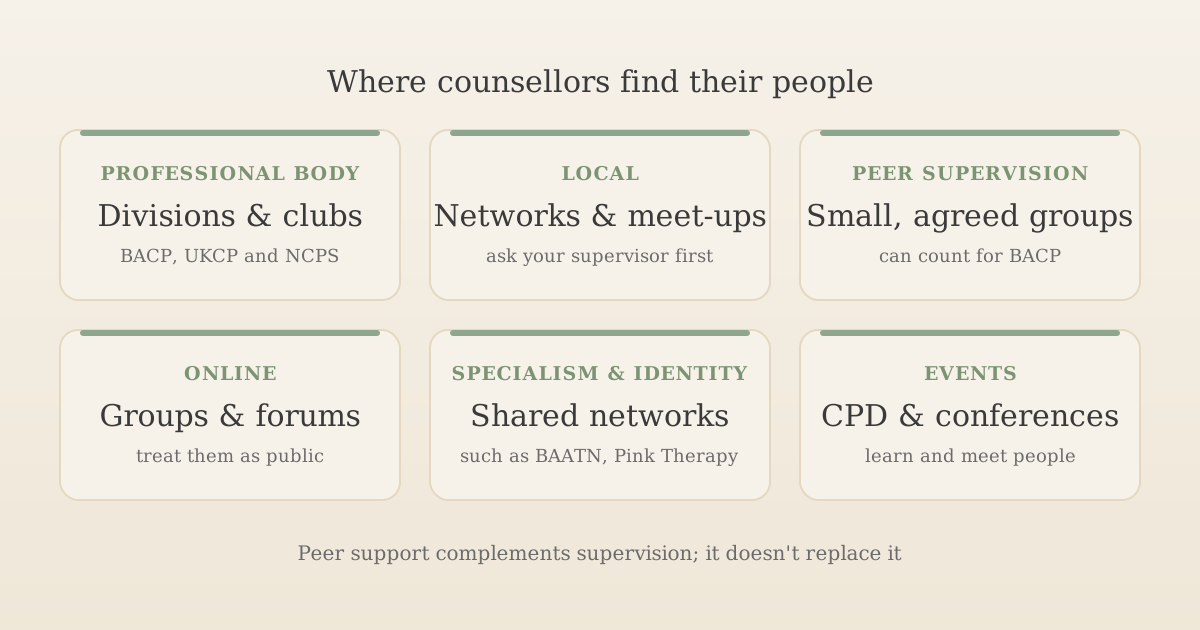
Peer support for counsellors: six places to find it
Each kind of community does a different job, and you don't need all six.
| Where | Good for | Cost | How to find it |
|---|---|---|---|
| Your professional body's networks | Specialist resources, events and colleagues in your setting | Some are included in membership; check each one | Your body's website and member area |
| Local networks and networking events | Meeting colleagues face to face, local referrals, room and supervisor tips | Usually free or low cost | Supervisor, training cohort, events listings |
| Peer supervision groups | Structured case discussion with colleagues you trust | Usually free | You set one up, or join one through colleagues |
| Online groups and forums | Quick practical questions and company between sessions | Free | Facebook, Reddit, LinkedIn |
| Specialism and identity networks | Colleagues who share your client group, approach or background | Varies | The network's own website |
| CPD events and conferences | Learning plus meeting people outside your area | Varies | Professional bodies and CPD providers |
Why peer support matters in private practice
Private practice takes away the colleagues down the corridor. There's no team meeting, no one to ask how they'd handle a late cancellation, and no one to notice you've had a heavy week. Our guide to how many clients a counsellor should see covers what BACP's Ethical Framework asks about looking after your own health. Colleagues are one of the ways you notice when your caseload is getting too much.
Peer support also covers the parts of the job supervision usually doesn't: setting fees, choosing software, finding a room, getting your first clients and dealing with a quiet month. Supervision is for the clinical work. Keep it that way, and take the rest to your peers.
Start with your professional body
Professional bodies run networks for members, and they're the easiest way to find colleagues who share your setting.
BACP divisions. BACP describes its divisions as "networks of occupational groups or special areas of interests". There are seven: Children, Young People and Families; Coaching; Healthcare; Private Practice; Spirituality; Universities and Colleges; and Workplace. BACP Private Practice "supports members who work in, or are about to embark upon" private practice. Each division publishes a quarterly journal and offers member-only resources and events. Check the division's own page for what joining involves.
UKCP faculties, groups and clubs. UKCP's faculties and groups page describes three kinds. Faculties are groups of members who share a mission or interest, and any UKCP member can join any of them. Special interest groups are informal groups set up by members. Psychotherapy clubs are informal gatherings, held anywhere from a meeting room to a pub, where members can connect and share ideas. If there isn't a club near you, UKCP says it will help promote one you set up.
NCPS. NCPS has regional representatives, and in 2026 it ran in-person Regional Connections events for members, including one in Manchester in October, alongside an annual conference. Check with NCPS for upcoming dates.
If you belong to a modality association too, such as for CBT or EMDR, check its member groups as well. Our guide to EMDR training covers one example of how those bodies work.
Local networks and networking events
Local counsellor networks are often small, informal and run by volunteers: a monthly breakfast, an evening meet-up or a Zoom group for practitioners in one town. They're good for referrals, room recommendations and knowing who to call when you're full.
Many of them grow by word of mouth, so ask in this order:
- Your supervisor and your old training cohort. They're the quickest route to a group that already exists.
- Your professional body's events listings. BACP's site lists events by location, including network meetings.
- Counselling Directory's local events. Some local networking and CPD groups advertise there.
- Facebook. Search for your town or region plus "counsellors" or "therapists". Our guide to Facebook for therapists names three established UK groups.
Go to your first meeting to listen, not to pitch. Most groups welcome new members but dislike being used as an advertising board. If you're full, say so: colleagues remember who passes on clients.
If there isn't a group near you, start one. Pick a regular time, keep it small, and agree from the start that it's for support and practice questions, not case discussion. Case material belongs in supervision or a properly contracted peer supervision group.
Peer supervision groups
A peer supervision group is a small group of practitioners who meet regularly to discuss their client work, without a designated supervisor leading it. Done well, it's one of the most useful things a private practitioner can have.
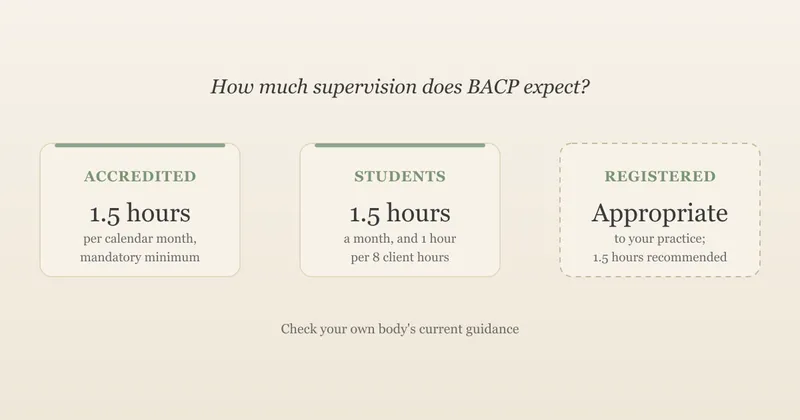
It can also count towards your supervision. BACP's supervision page says accredited members' supervision "can be a mix of one to one, peer, telephone and online, as all these count for accreditation". There are rules on how group time is counted, which our guide to clinical supervision for counsellors explains. BACP recommends peer supervision in addition to contracted one to one supervision, and other bodies count it differently. If you're a registered member who isn't accredited, talk to your supervisor about whether a peer group covers what your practice needs. Our guide to setting up a peer supervision group covers what each body counts, the written agreement and a meeting structure.
A peer supervision group needs more structure than a support group:
- A written agreement covering confidentiality, how clients are anonymised, how often you meet and what happens if someone has a concern about a colleague's practice.
- A small, stable membership, small enough that everyone gets time to bring their work.
- A record of each meeting: the date, who attended and how long, plus a brief note of anything you'll act on, without client names.
- Members with comparable experience, or a clear agreement about how you'll handle differences.
Online communities
Online groups are where most counsellors go for quick answers between sessions: which insurer, which notes app, what to charge for a missed session.
- Facebook groups are where many UK practitioner groups meet. Our Facebook guide covers how to use them well.
- Reddit has r/UKTherapists for UK-specific discussion and the larger, mostly American r/therapists. Both are anonymous, which makes them good for honest questions but means you can't check who you're talking to.
- LinkedIn is quieter but useful for connecting with colleagues, EAPs and other professionals.
The confidentiality line is the same everywhere. BACP's guidance on social media says social networking sites, "even closed groups, are public". Posts can be screenshotted, shared and searched long after you delete them. Ask practical questions freely, but never post anything that could identify a client, however well hidden you think the details are. Our guide to whether therapists can write about clients explains why disguising details often isn't enough.
Specialism and identity networks
Some of the most valuable communities are built around who you work with or who you are.
- The Black, African and Asian Therapy Network (BAATN) runs a UK-wide directory and network for counsellors and psychotherapists of Black, African, Asian and Caribbean heritage, with professional development resources and job listings.
- Pink Therapy runs a directory of LGBTQ+ affirmative therapists along with a hub and CPD training for therapists working with gender, sex and relationship diversity.
- Professional body divisions and faculties, covered above, bring together people working in the same setting, such as schools, workplaces or healthcare.
Networks like these can be a source of referrals as well as support, because they connect clients with therapists who share or understand their background. Check each network's joining criteria and fees on its own website.
How to choose a community
Before you invest your time, check a few things:
| Question | Why it matters |
|---|---|
| Who runs it, and how is it moderated? | A group with clear rules and active moderators stays useful; an unmoderated one can fill up with adverts |
| Who can join? | A group that checks members are practitioners is safer for practice questions than one open to anyone |
| What are its confidentiality rules? | Good groups say clearly that client details aren't allowed |
| Is it UK-focused? | Advice on fees, insurance, tax and regulation from other countries can mislead |
| What does it cost? | Many groups are free; professional body divisions and some networks charge |
| Is it active? | A group with no posts in months won't help you on a Tuesday afternoon |
You don't have to stay in a community that doesn't suit you. Leaving a busy online group, or a local meet-up that has become a sales pitch, is a reasonable choice.
Referrals: the etiquette
Communities are one of the best sources of referrals, in both directions. A few lines keep them working:
- Pass on clients when you're full, with a short note of who you'd suggest and why, rather than handing over the client's details. Our guide to referrals for therapists covers consent and what to share.
- Never pay or accept a referral fee. The same guide explains why.
- Don't advertise in peer groups unless the group's rules allow it. Being helpful is what makes colleagues think of you.
Frequently asked questions
Is peer support the same as supervision?
No. Peer support is informal: colleagues you talk to about the work, the business and the isolation of private practice. Supervision is a formal, contracted arrangement that your professional body requires. A structured peer supervision group can count towards BACP accreditation hours, but a friendly chat with colleagues doesn't replace supervision.
Does peer supervision count for BACP?
For accredited members, BACP says supervision can be a mix of one to one, peer, telephone and online, and all of these count for accreditation. There are rules on how group time is counted, which our clinical supervision guide explains. Registered members who aren't accredited need supervision appropriate to their practice, so check with your supervisor that a peer group covers what you need.
Are online therapist groups confidential?
Treat them as public. BACP's social media guidance says social networking sites, even closed groups, are public, and that posts can be recorded, shared and searched even after you delete them. Never post anything that could identify a client, and take case discussion to supervision or a properly contracted peer supervision group instead.
How do I find a local counsellors' network?
Ask your supervisor and your old training cohort first, since many local groups grow by word of mouth. Then check your professional body's events listings, search Facebook for your town plus 'counsellors' or 'therapists', and look at the local events listed on Counselling Directory. If there isn't one, starting a small monthly meet-up is often easier than people expect.
The short version
Peer support won't replace supervision, but it makes private practice far less isolating. Start with your professional body's networks (BACP divisions, UKCP faculties and clubs, NCPS regional events), ask your supervisor and old training cohort about local groups, and consider a small, properly agreed peer supervision group. Use online groups for practical questions, and treat every one of them as public: never post anything that could identify a client.
Make it easy for colleagues to refer to you
When a peer passes on your name, your website is where a client checks you out. UpTopWeb builds clear websites for counsellors and therapists, with who you work with, your fees and your availability set out plainly.
Further reading
Related articles
Social media15 minute read
Facebook for Therapists: Groups, Pages and Messenger
Starting a practice12 minute read
Clinical Supervision for Counsellors: BACP Requirements (UK)
Marketing15 minute read
Referrals for Therapists: How to Build a Network That Sends You Clients (UK)