Starting a practice
How to Set Up a Peer Supervision Group (UK Guide)
How UK counsellors set up a peer supervision group: where to find one, who to invite, what BACP and NCPS count, and a free group agreement template.
On this page11 sections
A peer supervision group is a small group of counsellors or psychotherapists who meet regularly to discuss their client work with each other, without a paid supervisor leading. For a private practitioner it can be one of the most useful hours in the month: several experienced colleagues looking at your work from different angles, for free. It works best with a bit of structure, and it doesn't replace one-to-one supervision for most UK counsellors.
This guide is for UK counsellors and psychotherapists who want to start or join a peer supervision group. It covers what each professional body counts, who to invite, what to put in the written agreement, a simple structure for each meeting, meeting online, keeping records and what to do when a group stops working. Rules are as checked on BACP's, NCPS's, BABCP's and COSCA's websites on 13 November 2026.
Key takeaways:
- A peer supervision group adds to your one-to-one supervision rather than replacing it. BACP recommends it "in addition to contracted one to one supervision".
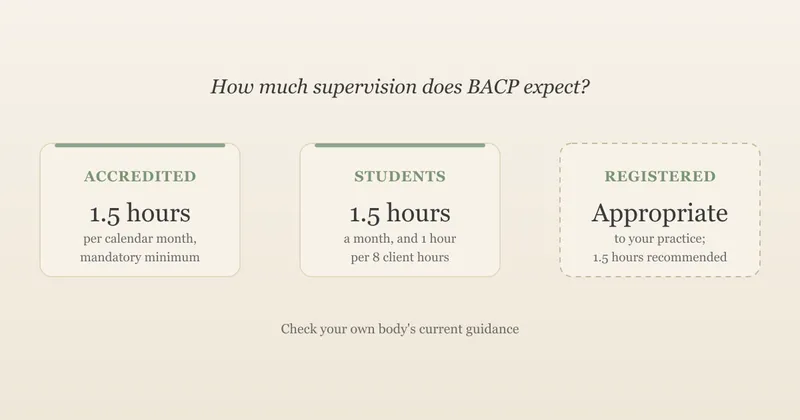
- What counts differs by body. BACP and BABCP count peer time for accreditation, NCPS requires at least one hour of formal one-to-one a month, and COSCA doesn't accept peer-led group hours.
- Three to five members, meeting monthly for about two hours, gives everyone real time. Under BACP's rules a group of up to four can each claim half the meeting time.
- Put the agreement in writing: confidentiality, how clients are anonymised, attendance, and what happens if someone is concerned about a colleague's practice. Our free agreement template covers all of it.
- Keep a short record of each meeting, without client names, so you can show the hours if you need to.
What a peer supervision group is, and isn't
Peer supervision groups are easy to confuse with two other things:
| Peer supervision group | Group supervision | Peer support group | |
|---|---|---|---|
| Who leads it | Members take turns, or share it | A paid, experienced supervisor | No one in particular |
| Typical size | Three to five practitioners (our suggestion) | One supervisor with a small group of supervisees; COSCA says small enough to give each 20 to 30 minutes | Anything from a handful locally to thousands online |
| What you discuss | Client work, anonymised | Client work, anonymised | Practice life, business, wellbeing |
| Contract | A written agreement between members | A contract with the supervisor | Usually informal |
| Counts as supervision? | Depends on your body (see below) | Usually, within your body's rules | No |
If what you want is company and practical help with the business side, a peer support group or network is the better fit. Our guide to peer support and networking for counsellors covers where to find one. This guide is about the clinical kind.
Does peer supervision count? What each body says
Before you set one up, check what your professional body will accept. The bodies differ more than most people expect:
| Body | Does peer supervision count? | What it says |
|---|---|---|
| BACP | Yes, for accreditation | Accredited members' supervision "can be a mix of one to one, peer, telephone and online". A group of up to four can claim 50% of the time together; in groups of five or more, the time is divided equally. BACP recommends peer supervision "in addition to contracted one to one supervision" |
| NCPS | Partly | Your 1.5 hours a month can be a mix of one-to-one, group and peer supervision, but group or peer supervision alone isn't acceptable, and at least one hour must be formal one-to-one |
| BABCP | Yes, with limits | Only the time you spend receiving supervision counts, and peer supervision can't be used for the training cases in an accreditation application |
| COSCA | No | Hours in "peer-led" groups aren't accepted as evidence of counselling supervision |
| UKCP | Check with your college | We couldn't find a published UKCP rule on peer supervision. Each UKCP college holds its own standards, so ask yours |
The sources are BACP's supervision page, NCPS's membership criteria, BABCP's supervision guidance and COSCA's supervision recommendations.
So for most counsellors, a peer group sits alongside one-to-one supervision rather than replacing it. Our guide to clinical supervision for counsellors explains BACP's requirements for each membership level. If you're a registered BACP member who isn't accredited, talk to your supervisor about how a peer group fits with the supervision your practice needs.
Where to find a group
Not everyone wants to start a group from scratch. Here's where to look for each kind:
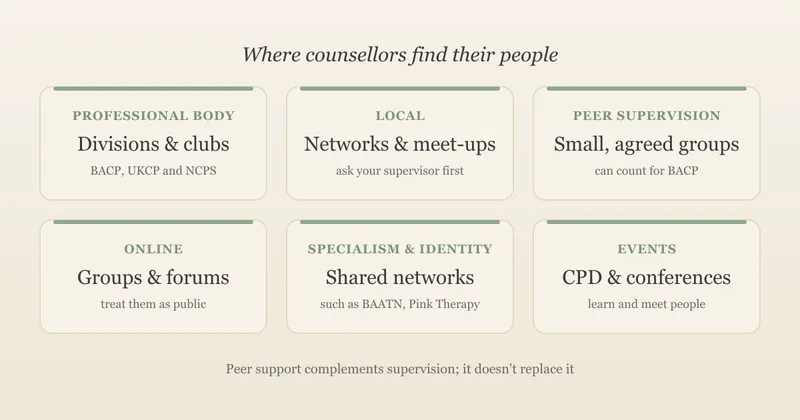
Peer supervision groups. Most are found through people you already know:
- your old training cohort and course tutors;
- your supervisor, who may know practitioners looking for a group;
- local counsellor networks and professional body meet-ups;
- Facebook groups for UK counsellors, where practitioners post that they're looking for, or starting, a peer supervision group. Our guide to Facebook for therapists names three established UK groups.
Before you join an existing group, ask to see its written agreement and how it keeps records. If it hasn't got one, that's worth raising early.
Group supervision, led by a supervisor. This is paid supervision in a small group. BACP's website has a "Trainers & supervisors" search, UKCP's members area includes a supervisor directory, and some supervisors advertise groups on their own websites. Check the supervisor's training and experience as you would for one-to-one supervision, and check how the group's time will count under your body's rules.
Peer support groups. For company and practical help rather than case discussion, our guide to peer support and networking for counsellors covers professional body networks, local groups, online communities and specialist networks.
If you can't find a peer supervision group near you, starting one with two or three colleagues is often quicker than waiting for one to appear. The rest of this guide shows how, starting with who to invite.
Who to invite
The people matter more than anything else. A few things help:
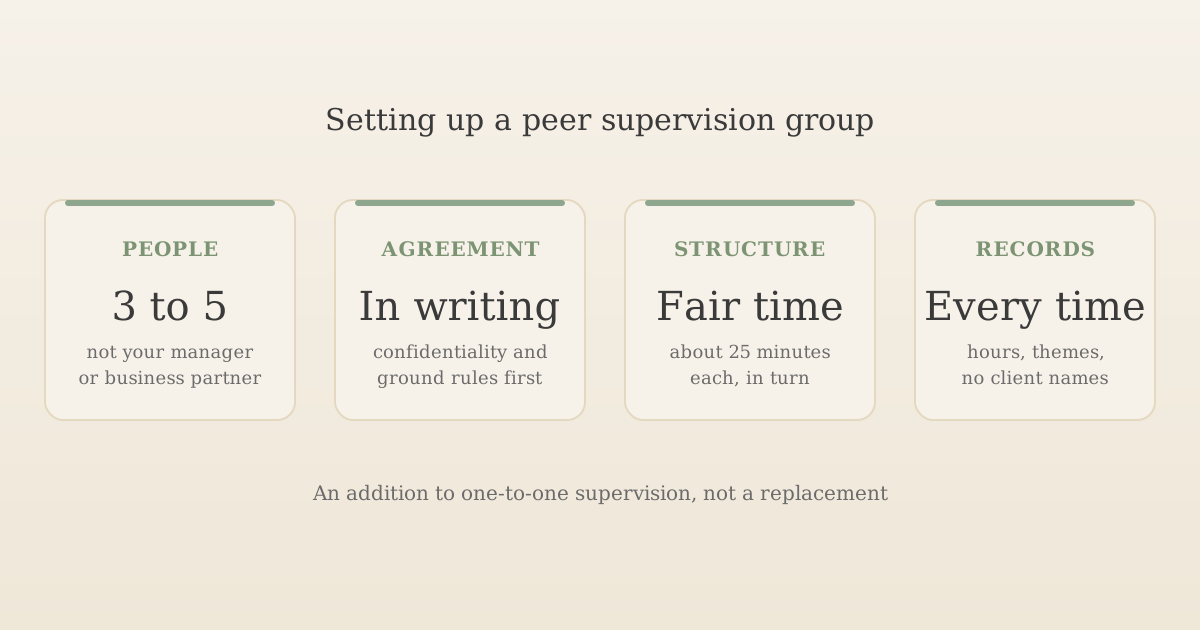
- Three to five members. Enough for different perspectives, few enough that everyone brings work each time. With six or more, it's hard for everyone to bring work each time.
- Comparable experience, or an open agreement about how you'll handle differences. A group where one person is always the expert tends to turn into informal supervision by that person.
- People who aren't your line manager or business partner. BACP's 2026 Ethical Framework says supervision must be "independent of line and case management" (4.3). It's also harder to be honest about a struggling case with someone who decides your work or shares your income.
- A shared commitment to attend. Trust builds slowly, and a group where people drop in and out never gets there.
- Some variety. Different trainings, settings or client groups make the discussion richer, as long as everyone can follow each other's language.
Good places to find members include your old training cohort, your professional body's local networks and the peer groups covered in our peer support guide.
The written agreement
Agree the ground rules in writing before your first case discussion. It needn't be long. A page covering these points is enough:
- Confidentiality. What's discussed stays in the group, with the same limits as your client work. Members don't discuss each other's cases outside the meeting.
- Anonymising clients. No names, and no details that could identify a client to someone who knows them. If two members might share a client or know them socially, the presenter stops and says so.
- Frequency, length and attendance. For example, the second Tuesday of each month, 10am to midday, with notice if you can't come.
- Structure and roles. How time is shared, and who keeps time and notes (see below).
- Concerns about practice. What the group does if a member is worried about another's practice: raising it with them first, encouraging them to take it to their own supervisor, and following professional body and safeguarding guidance if a client may be at risk.
- Records. What the group records, who keeps it and where.
- Joining and leaving. How new members join, and how someone leaves well rather than just stopping.
- Review. When you'll look at whether the group is working, for example every six months.
Store the agreement with your supervision records, and give every member a copy.
Free peer supervision group agreement template
We've made a two-page agreement you can fill in and sign at your first meeting. It covers all eight points above, with spaces for members' names and professional bodies, your meeting arrangements, who keeps the records, and a signature for each member.
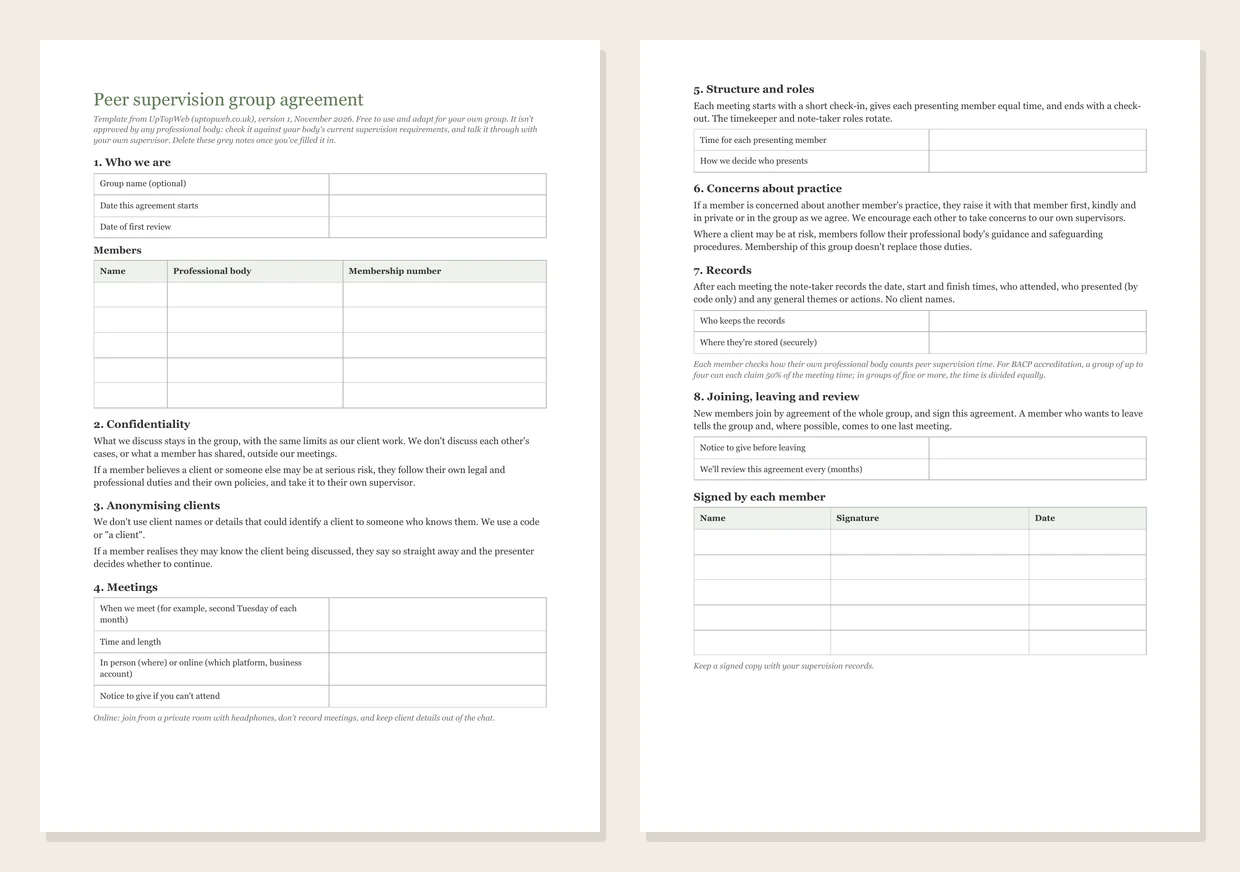
- Download the peer supervision group agreement (PDF, 2 pages, 115 KB)
- Download the editable version (Word, 38 KB)
You can use and adapt it freely. It isn't approved by any professional body, so check it against your own body's supervision requirements and talk it through with your supervisor.
A simple structure for each meeting
Without structure, a peer group drifts into general conversation. Here's one way to run a two-hour meeting for four members:
| Time | What happens |
|---|---|
| 10 minutes | Check-in, and agree who's presenting and in what order |
| 25 minutes each | Each member brings one client or issue: a short presentation, a clear question for the group, discussion, then the presenter says what they're taking away |
| 10 minutes | Check-out: anything to follow up, and the note-taker confirms the record |
Some groups rotate the presenter so only two or three people bring work each time, with longer slots. Others use a recognised supervision framework, such as Hawkins and Shohet's seven-eyed model, to keep discussion focused. Whatever you choose, rotate the timekeeper and note-taker so no one ends up running the group by default.
The 25-minute slot sits within COSCA's guidance for led group supervision, which allows 20 to 30 minutes per member. COSCA doesn't count peer-led groups, but the timing is a useful guide.
A useful habit for the presenter: start with the question you want help with, not the whole history. "I'm not sure whether to suggest ending" gives the group something to work on. Twenty minutes of background doesn't.
Meeting online
Many peer groups meet online, which makes it easier to find colleagues beyond your town. The same care applies as for client sessions:
- Use a business account with the provider's data processing terms, as our guide to GDPR for therapists explains for Zoom, Teams and Google Meet.
- Join from a private room, with headphones, where no one can overhear.
- Don't record the meeting, and agree that in writing.
- Keep chat messages clinical-free. Use the chat only for practical things like timings.
Our guide to online counselling in private practice has more on setting up a confidential space at home.
Keeping records
A short record after each meeting helps the group and helps you show the hours if your body asks. Keep it simple:
- the date, start and finish times, and who attended;
- the hours each member can claim under their body's rules (for BACP, a two-hour group of four counts as one hour each);
- who presented, using client codes or "a client", never names;
- any themes, learning or actions, in general terms.
Keep your copy with your other supervision records, stored as securely as your client notes. If you count the time towards accreditation, check what your body expects to see in your supervision log.
When the group isn't working
Peer groups often hit a rough patch. Common signs and fixes:
- It's become a chat. Go back to the structure, and ask each presenter to bring a clear question.
- One person dominates. Rotate the roles, and use the timekeeper firmly.
- People keep missing meetings. Revisit the agreement at your next review, and be willing to change the day or time.
- No one challenges anyone. Groups of friends can become too comfortable. Agree that challenge is part of the job, and practise giving it kindly.
- A serious concern comes up. Follow your written agreement, and take it to your own supervisor.
If a group has run its course, end it well: agree a last meeting, close the records, and thank each other for the work.
Frequently asked questions
Can peer supervision replace one-to-one supervision?
Not on its own, for most UK counsellors. BACP recommends peer supervision in addition to contracted one to one supervision. NCPS says group or peer supervision alone isn't acceptable and at least one hour a month must be formal one-to-one supervision. COSCA doesn't accept peer-led group hours as evidence of supervision at all. Treat a peer group as an addition to your supervision, not a replacement.
How many people should be in a peer supervision group?
Small enough that everyone gets real time to bring their work. Three to five members works well for a two-hour meeting. BACP's counting rules also favour small groups: a group of up to four can each claim half the meeting time, while in a group of five or more the time is divided equally.
How often should a peer supervision group meet?
Monthly is a sensible starting point, because it fits around one-to-one supervision and gives members time to bring new work. What matters most is that the group meets regularly and everyone commits to attending, so it builds the trust case discussion needs.
Do I need a written agreement for a peer supervision group?
Yes. A short written agreement covers confidentiality, how clients are anonymised, how often you meet, what happens if someone is concerned about a colleague's practice, and how members join and leave. It protects clients and members, and it gives you something to show if you count the hours towards accreditation.
The short version
A peer supervision group is a small group of practitioners who discuss client work together without a paid supervisor. For most UK counsellors it adds to one-to-one supervision rather than replacing it: BACP counts it for accreditation but recommends it alongside one-to-one, NCPS requires at least an hour of formal one-to-one a month, and COSCA doesn't accept peer-led hours. Invite three to five people who aren't your manager or business partner, agree the ground rules in writing, give everyone fair time in a set structure, and keep a short record of each meeting without client names.
A website that shows your professional standards
Clients and referrers look for signs you practise safely. UpTopWeb builds websites for counsellors and therapists with your registration, supervision and approach set out clearly.
Further reading
Related articles
Starting a practice12 minute read
Clinical Supervision for Counsellors: BACP Requirements (UK)
Starting a practice10 minute read
Peer Support, Networking and Communities for UK Counsellors
Starting a practice11 minute read
How Many Clients Should a Counsellor See? UK Caseload Guide