Starting a practice
Starting a Group Practice in the UK: A Guide for Counsellors
Thinking of bringing other therapists into your practice? How to choose between room-sharing, associates and staff, and what to sort out first: status, data, insurance and fees.
On this page12 sections
Starting a group practice usually begins with a good problem: you have more enquiries than hours, or a waiting list you'd rather not keep growing. This guide is for UK counsellors and therapists in solo private practice who are thinking about bringing other practitioners in. It covers the three ways of doing that, the decisions to make before the first associate starts (employment status, contracts, client data, insurance, supervision and fees) and what your website needs to say once more than one therapist works under your name. It reflects GOV.UK and ICO guidance as checked on 29 October 2026.
The short answer: decide first who the client's contract is with, because almost everything else follows from it. If each therapist contracts with their own clients, you're closer to a shared practice and your job is mostly rooms, referrals and branding. If clients contract with your practice, you're running a business with clinical, data and employment responsibilities, and those need to be set up in writing before you take anyone on.
Key takeaways:
- There are three common models: shared rooms, self-employed associates and employed staff. Most UK group practices start with associates.
- Calling someone an associate doesn't make them self-employed. How the arrangement works in practice decides that, and HMRC's Check Employment Status for Tax tool gives HMRC's view.
- Work out who controls client data before anyone sees a client: the practice, each therapist, or both jointly.
- Each self-employed therapist needs their own professional indemnity insurance, supervision and professional body registration. Employing anyone adds employers' liability insurance and workplace pension duties.
- Your website has to tell clients who they'll be working with, who reads their enquiry and who they're contracting with.
Important: This is a practical overview, not legal, tax, employment or data protection advice. The right arrangement depends on how your practice will actually work. Speak to an accountant, an employment solicitor and your insurer before taking anyone on, and check your professional body's current guidance.
Three ways of starting a group practice
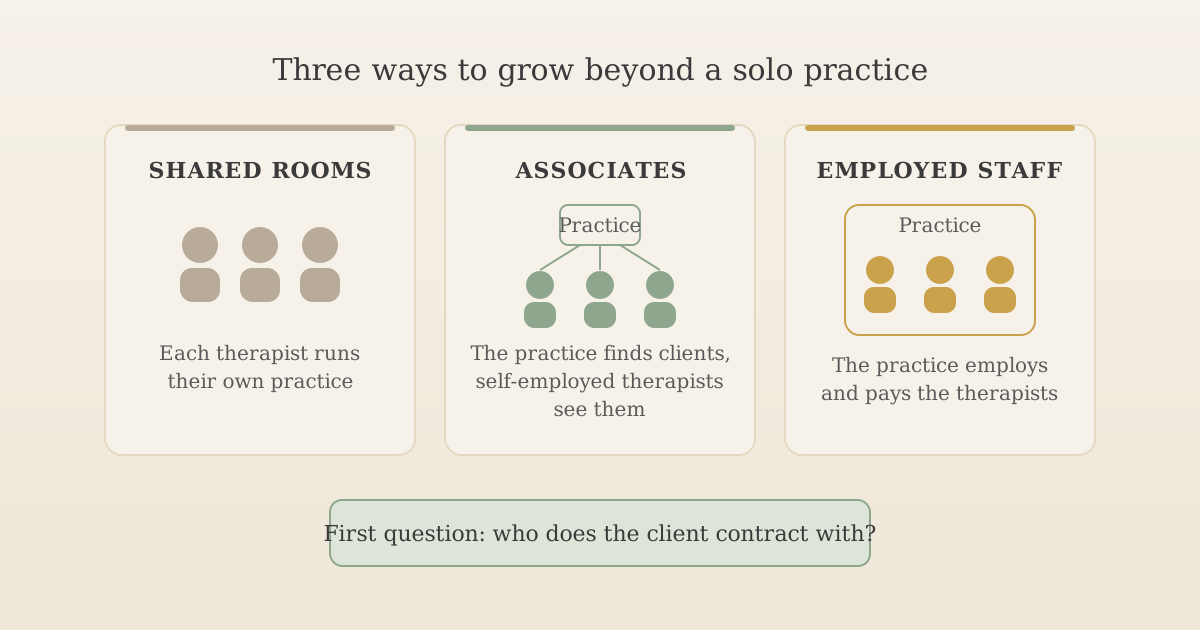
"Group practice" covers quite different arrangements. Before you look at agreements or fee splits, decide which of these you're actually building.
| Shared rooms | Self-employed associates | Employed staff | |
|---|---|---|---|
| Who finds clients | Each therapist | Mostly the practice | The practice |
| Who the client contracts with | The therapist | Usually the practice, sometimes the therapist | The practice |
| Who sets fees | Each therapist | The practice, often agreed with the associate | The practice |
| How the money flows | Therapists pay you rent | Practice keeps a share of each fee, or charges a fee | Practice pays a salary |
| Your main responsibilities | Premises, shared costs | Allocation, contracts, data, quality of the service you advertise | All of that, plus employment law, PAYE and pensions |
| Best suited to | Testing whether working together suits you | Most practices growing from solo | Larger practices wanting consistent hours and control |
Shared rooms is the lightest option. You rent space to other therapists, perhaps share a name or a waiting room, and each person runs their own practice. Our guide to renting a therapy room covers this from the other side: what a tenant will expect from you.
Self-employed associates is where most UK group practices sit. The practice markets itself, takes enquiries and allocates clients to associates, who see them in their own way and invoice the practice or are paid a share of each fee.
Employed staff gives you the most control over hours, methods and consistency, and the most obligations. It's more common in larger clinics and services with contracts that need guaranteed capacity.
There's also a fourth route: two or more therapists going into business together as partners or co-directors of a company. That's a joint venture rather than one person taking on associates, and it needs a partnership or shareholders' agreement drawn up with a solicitor.
Employed or self-employed: what decides it
This is the decision most worth getting right, because getting it wrong can mean back tax, National Insurance and employment claims later. The label in your agreement doesn't settle it. What happens day to day does.
GOV.UK's page on self-employed contractors says someone is probably self-employed if most of a list of things are true, including that "they're not under direct supervision when working", that they submit invoices, that they're responsible for their own tax and National Insurance, and that they don't get holiday or sick pay. For tax, HMRC's Check Employment Status for Tax tool gives HMRC's view based on the answers you give, and HMRC says it will stand by the result "as long as the information you give remains accurate".
In a therapy practice, these are the arrangements that tend to push towards employment:
- You set their hours and expect them to be available on fixed days, rather than them offering the slots they choose.
- You tell them how to work, beyond the professional standards you'd expect of anyone (for example, requiring a specific model of therapy, session structure or note format).
- They can't turn work down or send a suitably qualified substitute.
- You pay them whether or not clients turn up, or give them paid holiday.
- They work only for you and look, to clients, like part of your staff.
Clinical supervision is a professional requirement, not "direct supervision" of the kind GOV.UK means: each associate arranging their own supervisor is normal for self-employed therapists. If you plan to supervise your associates yourself, discuss with your accountant how that affects the picture, and see the section on supervision below.
Run the tool for the arrangement you actually intend, keep the result, and rerun it if the arrangement changes. If the result says employed, either change the arrangement or treat the person as an employee.
Sole trader or limited company?
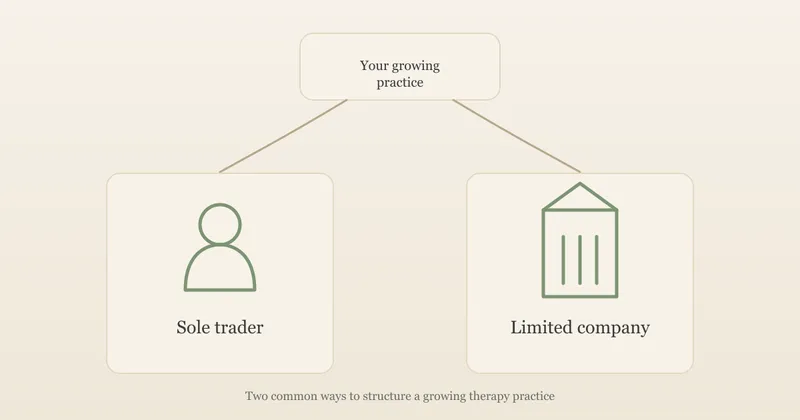
You don't need a limited company to start a group practice. A sole trader can take on associates or employ staff. But this is the point where many practice owners make the switch: a company separates the business from your personal finances, can look more established to associates and contracting organisations, and gives a clearer answer to "who does the client contract with?"
Our comparison of sole trader and limited company structures for therapists covers the tax side. If you do incorporate, the company becomes the business that holds the contracts, insurance and data protection fee, so set it up before associates start rather than moving everything across later.
The associate agreement: what to cover
An associate agreement is the written arrangement between your practice and each self-employed therapist. Have a solicitor draft or check it; this list is what to make sure it answers, not a template.
- Status. That the associate is self-employed, responsible for their own tax and National Insurance, and free to work elsewhere, which should also be true in practice.
- Allocation. How enquiries are matched to associates, and whether an associate can decline a referral.
- Fees and payment. What clients pay, what share the associate receives or what they pay the practice, when, and what happens with cancellation fees and unpaid sessions.
- Professional requirements. Registration or accreditation with a professional body, current insurance, supervision, and DBS checks where the work requires them. Our guide to DBS checks for therapists explains which level applies.
- Records and data. Where notes are kept, who controls them, and what happens to them when the associate leaves (see the next section).
- Rooms and equipment. Which rooms, at what cost, and who provides the video platform for online sessions.
- Complaints and safeguarding. How a complaint about an associate is handled, and who is told about a safeguarding concern.
- Ending the arrangement. Notice periods, what happens to current clients, and any restriction on taking clients with them. Ethically, the client's wellbeing comes first: plan for an ending the client can choose, not a handover forced by a business dispute.
The client also needs their own contract that says who they're contracting with. Our guide to therapy contracts for counsellors covers what that contract should include, including the cooling-off rules for therapy agreed online.
Client data: who is the controller?
Under UK GDPR, a controller decides why and how personal information is used. In a solo practice that's simply you. In a group practice there may be several controllers, and the answer changes what each person must do.
A common pattern in associate practices looks like this:
- The practice is a controller for enquiries, booking and payment records, and allocation decisions, because it decides how those are used.
- Each associate is often a controller for their own clinical notes, because they decide what to record and how to use it.
- Where both decide together, for example a shared practice management system with notes the practice can also access and use, they may be joint controllers.
If you're joint controllers, the ICO's guidance on what it means to be joint controllers says you don't need a contract, but you "must have a transparent arrangement" setting out your roles, the main points of it should be available to clients, and clients must be able to exercise their rights against each controller. The ICO notes that this guidance is under review following the Data (Use and Access) Act, so check the current version.
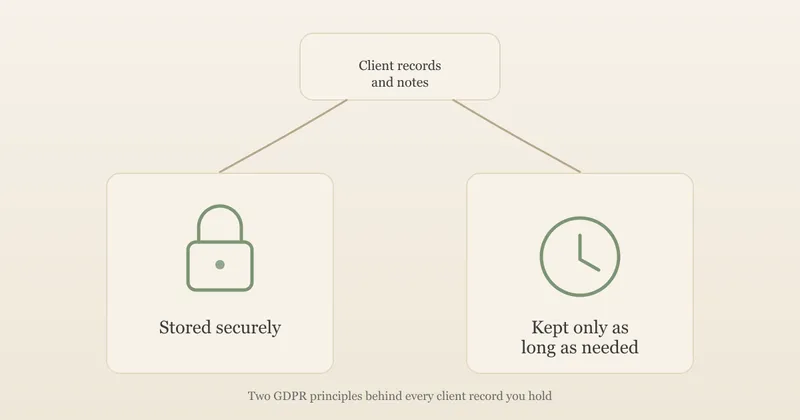
Write the answer down, put it in your privacy notice and associate agreement, and check that each controller has paid the ICO's data protection fee, which the ICO says applies to organisations "including sole traders" that use personal information, unless they're exempt. Our guide to GDPR and client records for therapists covers the record-keeping side, and our guide to practice management software for therapists lists questions to ask about multi-practitioner accounts and access controls.
Insurance for a group practice
Insurance follows the same split as the contracts:
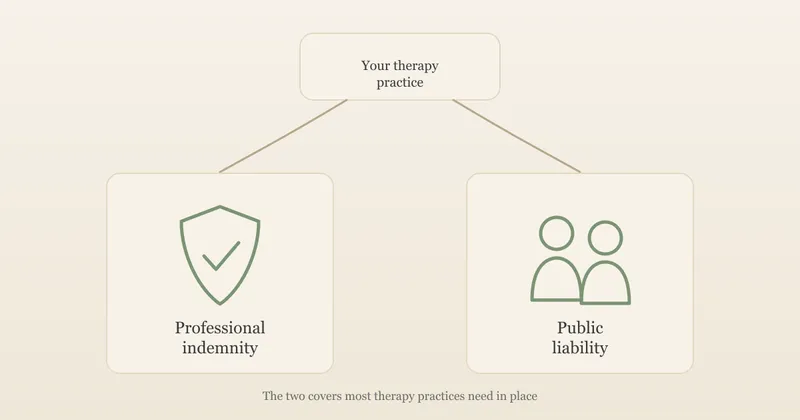
- Each self-employed associate needs their own professional indemnity insurance, because a claim about the work is made against the practitioner who did it.
- The practice should ask its own insurer whether its policy covers the practice's activities, such as triaging enquiries, allocating clients and advertising the service. Don't assume your solo policy does.
- Public liability matters if clients come to premises you run.
- If you employ anyone, GOV.UK's page on employers' liability insurance says you need it "as soon as you become an employer", with cover of at least £5 million, and you can be fined £2,500 for every day you're not properly insured.
Our guide to professional indemnity insurance for therapists explains the different types of cover in more detail.
If you employ therapists or staff
Employing a therapist, receptionist or practice manager brings duties that associates don't. In outline:
- Register as an employer with HMRC. GOV.UK's page on registering as an employer says to do this before the first payday, and that a company director must register even if they only employ themselves.
- Run payroll and pay at least the National Minimum Wage.
- Enrol eligible staff in a workplace pension. GOV.UK's guidance for workplace pension employers says you must enrol staff aged between 22 and State Pension age who earn at least £10,000 a year and normally work in the UK.
- Hold employers' liability insurance, as above.
- Give written terms of employment and follow employment law on holiday, sick pay and dismissal. ACAS publishes free guidance for small employers.
Many practices employ a part-time administrator before they employ any therapists, which is a gentler way to learn these duties.
Supervision and clinical responsibility
Each therapist in the practice needs supervision that meets their professional body's requirements. Our guide to clinical supervision for counsellors sets out what BACP expects, which differs for registered and accredited members.
The harder question is what the practice is responsible for. If your website promises a particular kind of therapy, the practice should be confident that every associate it allocates clients to can provide it. That usually means checking qualifications and registration before an associate starts, matching referrals to each associate's actual competence, and having a clear route for raising concerns.
Supervising your own associates is possible if you're trained and experienced as a supervisor, but it creates a dual relationship: you'd be both their business partner and the person they bring difficulties to. Discuss it with your own supervisor first, and make sure associates can choose an independent supervisor if they prefer.
A worked example: does the fee split cover your costs?
Fee arrangements in associate practices vary a lot, and there's no standard split. Rather than copy someone else's percentage, work out what the practice spends to fill one session. The figures below are made up for illustration; use your own.
| Monthly practice cost (illustrative) | Amount |
|---|---|
| Rooms used by associates | £600 |
| Website, enquiry handling and booking system | £150 |
| Directory listings and advertising | £150 |
| Admin time (taking enquiries, allocating, chasing payments) | £400 |
| Insurance, data protection and accountancy share | £100 |
| Total | £1,400 |
If associates see 80 sessions a month between them, the practice spends £17.50 to support each session. At a £65 fee, keeping 30% (£19.50) leaves the practice £2 a session for your own time and risk; keeping 40% (£26) leaves £8.50. Your associate would receive £45.50 or £39 respectively, before their own supervision, insurance and tax.
Two things come out of a sum like this. First, the split needs to cover your real costs, including your time, or you're subsidising the practice from your own clinical work. Second, it needs to leave associates enough to be worth their while compared with running their own practice. Our guide to how much counsellors should charge explains how to set the client fee itself.
What your website needs to say
A group practice website does more work than a solo one. It has to help clients choose a therapist and be clear about who they're dealing with. Before your first associate goes live, check that your site has:
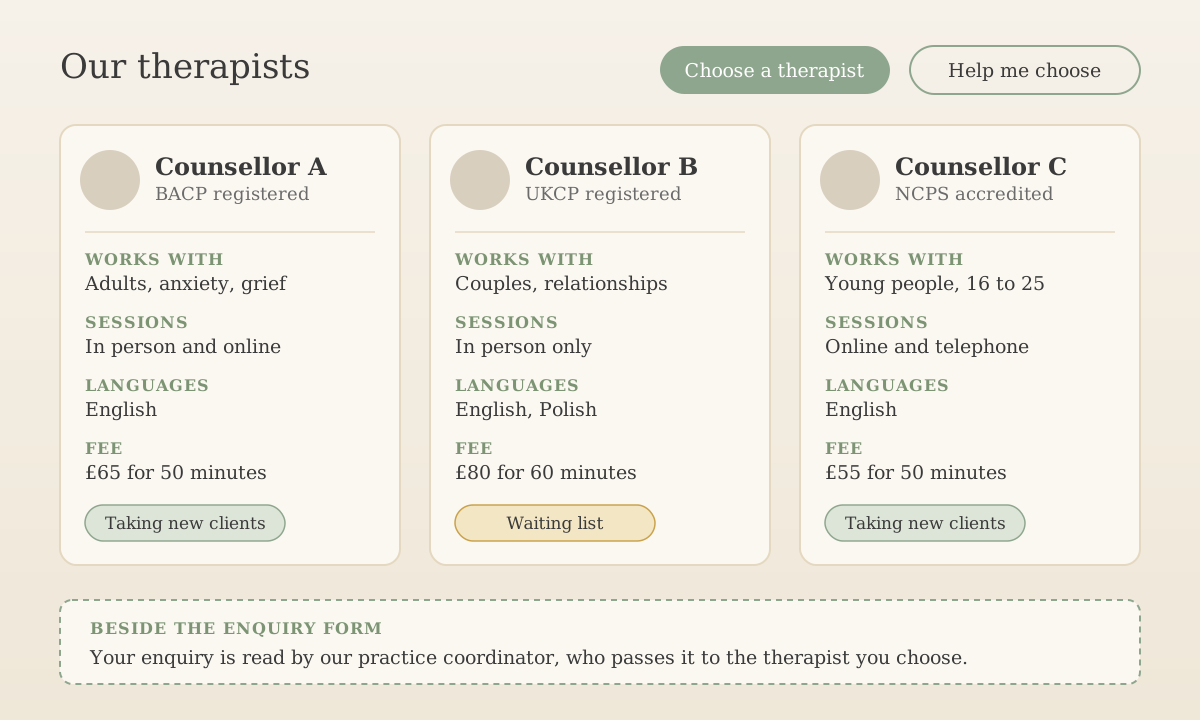
- A profile for each therapist with the same structure: who they work with, how they work, qualifications and registration, languages, fees and whether they're taking new clients.
- Two routes in: "choose a therapist" for clients who know what they want, and "help me choose" for those who don't.
- Clear enquiry routing. Say who reads an enquiry (the practice, or the therapist directly) beside the form, and keep the form short.
- Who the client contracts with and who controls their information, in your privacy notice and terms.
- Fees in one place, so a client can compare without contacting several people.
- Profiles that are kept current. A therapist who has left, or one shown as available when they're full, is the quickest way to lose trust.
Our guide to what a therapist website should include covers the basics that still apply, and our therapy centre and group practice websites page shows how we build sites for practices with several therapists.
Frequently asked questions
Do I need a limited company to start a group practice?
No. A sole trader can take on self-employed associates or employ staff. Many practice owners move to a limited company as they grow, because it separates the business from their personal finances and can look more established to associates and contracting organisations, but it isn't a legal requirement. Talk to an accountant about the tax effect before you switch.
Are associate therapists employed or self-employed?
It depends on how the arrangement works in practice, not on what the agreement calls it. HMRC's Check Employment Status for Tax tool gives HMRC's view for tax purposes, and HMRC says it will stand by the result as long as the information you give remains accurate. The more you control an associate's hours, methods and pay, and the more they look like part of your staff, the more likely they are to be treated as employees.
Who is the data controller in a group practice?
It depends on who decides why and how client information is used. An associate who keeps their own notes and decides how to use them is usually a controller for those records; a practice that takes enquiries and allocates clients is a controller for that information; and where the two decide things together, they may be joint controllers. The ICO says joint controllers need a transparent arrangement setting out their roles, with the main points made available to clients.
Do associates need their own insurance?
Usually, yes: each self-employed therapist should hold their own professional indemnity insurance, because claims are made against the practitioner who saw the client. The practice owner should also ask their own insurer whether their policy covers the practice's activities, such as triaging and allocating clients. If you employ anyone, employers' liability insurance of at least £5 million is a legal requirement.
Before your first associate starts
Get five things written down: which model you're using, the result of HMRC's status tool for that arrangement, a signed associate agreement, a clear answer on who controls client data, and confirmation from your insurer that the practice's activities are covered. Then update your website so clients can see who they'll be working with. None of it is quick, but all of it is easier to get right before the first client is allocated than to untangle afterwards.
A website for a practice with more than one therapist
UpTopWeb builds calm, professional websites for UK counsellors and group practices, with consistent therapist profiles, clear enquiry routing and fees in one place, plus hosting and updates in one monthly fee.
Further reading
Related articles
Starting a practice10 minute read
Sole Trader or Limited Company for Therapists? A UK Comparison
Starting a practice13 minute read
GDPR for Therapists: A Guide to Client Records and Data Protection
Starting a practice13 minute read
Professional Indemnity Insurance for Therapists: A UK Guide