Training & CPD
How to Find a Counselling Placement (UK): Where to Look and What Counts
Placements are scarce, so start early. Where UK trainee counsellors find placements, which hours BACP and NCPS accept, and what to ask before saying yes.
On this page11 sections
Knowing how to find a counselling placement matters as much as passing your assignments, because without the client hours you can't finish a practitioner diploma. It's also harder than most trainees expect. BACP's own training guide says that "the demand for placements is usually far greater than the number available". The best ways to improve your chances are to start looking early, apply to several services at once, and check before you apply that the hours will count.
This guide is for UK trainee counsellors on a Level 4 diploma or equivalent course. It covers which hours count (and which don't), where placements are advertised, what placement providers usually ask for, the questions to ask before you say yes, and how long 100 hours really takes. It reflects BACP, NCPS and CPCAB guidance as checked on 10 November 2026. Your course handbook has the final word on your own course.
Key takeaways:
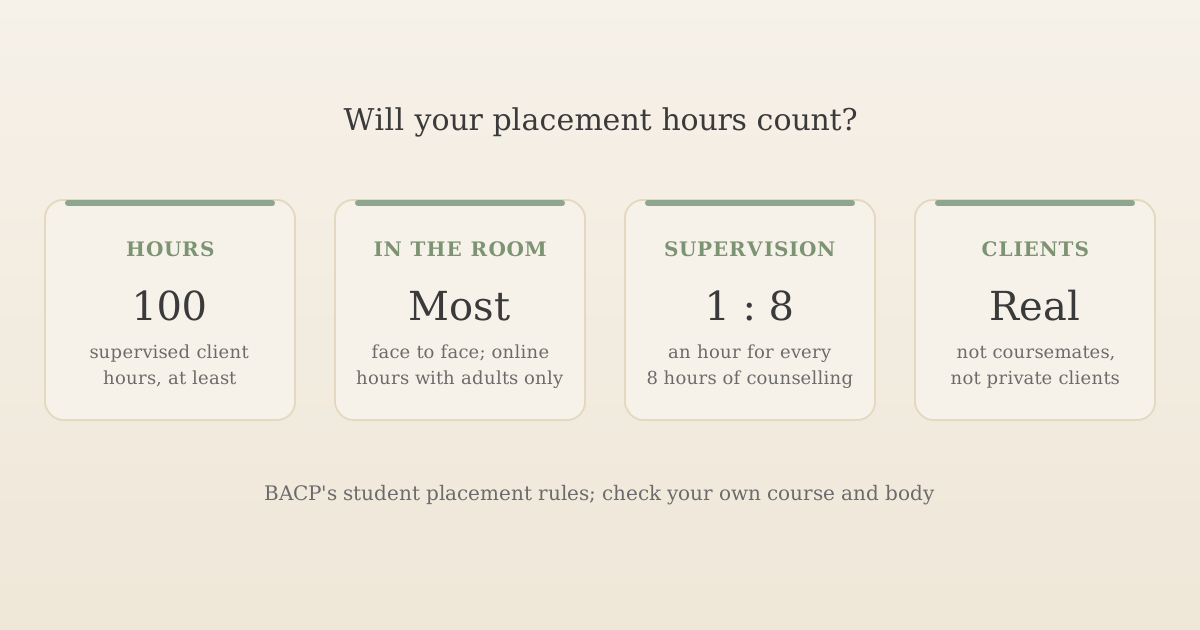
- Check the rules first. BACP asks for at least 100 supervised client hours, mostly face to face, with genuine clients in a setting your course has approved.
- Private clients don't count towards BACP placement hours, and neither do coursemates or online hours with anyone under 18.
- Start with your course's list of past placement providers, then BACP's jobs board (for student members) and local counselling services.
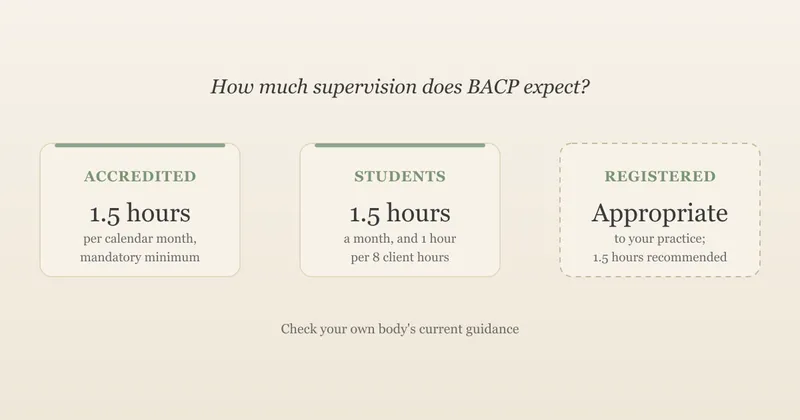
- Ask who provides and pays for supervision. BACP recommends one hour of supervision for every eight hours of counselling.
- Allow most of a year for 100 hours. Cancellations, breaks and waiting for referrals all slow the count.
Important: This is a practical overview, not professional or regulatory advice. Placement rules differ between courses, awarding bodies and professional bodies, and they change. Check your course handbook and your professional body's current guidance before relying on any figure here.
Before you search: which placement hours count
The most painful placement mistake is spending months on client work that your course or professional body won't accept. So start with the rules, not the adverts.
BACP's guide to training to become a therapist sets out what a placement needs for student membership and, later, for joining its Register. NCPS publishes its own requirements on its becoming a counsellor page. Here's how the main points compare:
| Question | BACP | NCPS |
|---|---|---|
| How many hours? | A supervised placement of at least 100 client hours | A minimum of 100 supervised clinical hours with clients in a relevant organisation or agency |
| Who approves it? | Your training provider, before you start | Not stated on its public page; your course decides |
| Online and phone? | Allowed for a minority of hours, with adults only | Not covered on its public page; ask your course |
| Private clients? | Not accepted, except possibly after you've passed core training | Hours are expected in an organisation or agency |
| Supervision | Recommends 1 hour for every 8 hours of counselling, seeing your supervisor fortnightly | At least 1.5 hours a month, face to face, no less than fortnightly, and 1 hour for every 8 hours of client work |
| How many clients a week? | No figure published | Guidance of up to four clients a week at first, rising to six after 75 hours |
A few details trip people up:
- Most hours must be face to face. BACP's guidance on remote placements gives the example that on a 100-hour placement, "at least 51 hours must be conducted face-to-face". Online sessions should be with UK-based clients, and text-based work that isn't live can't be counted at all.
- Children and young people have their own limits. BACP says you shouldn't be required to work with client groups that haven't been assessed as suitable for trainees, such as children and young people. If your course is adult-focused, its page on student placements with children and young people caps that work at 30% of your 100 hours, in person only, after the right pre-placement training. CPCAB, which awards many Level 4 diplomas, recommends that at least 70% of your client hours are with adults.
- Clients have to be genuine. Practice with coursemates is skills work, not placement hours.
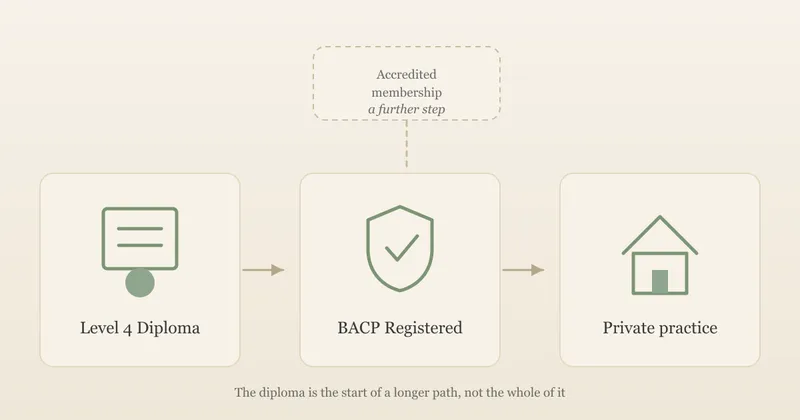
If you're not sure your course leads to registration in the first place, our guide to whether a Level 4 diploma is enough for private practice explains how courses, awarding bodies and the BACP Register fit together.
How to find a counselling placement: where to look
Work through these roughly in order, since the first two are the most likely to lead somewhere.
- Your course. BACP suggests asking your course provider first, as it may have a list of organisations that have offered placements before. Ask your tutors and the year above you too. Services that took last year's trainees often want more.
- BACP's jobs board. Student members can search BACP's member-only jobs board, which includes student placements. If you're deciding which body to join as a student, our comparison of BACP, NCPS and UKCP includes student fees.
- Local counselling services. BACP also suggests contacting local agencies that offer counselling to see whether they'll take you. Think about charities, bereavement and relationship services, low-cost community counselling, student counselling services, and services for particular groups such as carers or people affected by addiction. Many put a "placements" or "volunteer counsellor" page on their website, so searching for "counselling placement" plus your town or county is a quick way to find them.
- Your own network. Tutors, supervisors and qualified counsellors you know often hear about new services before they advertise.
Apply to several at once. With demand higher than supply, waiting to hear from one service before contacting the next can cost you months.
When to start looking
Earlier than you think. Some services only recruit trainees at certain points in the year, and many run an induction and then need time to allocate clients, so a placement agreed today may not give you a first client for weeks.
Start researching in your first year, even if your course won't let you see clients yet. Your course decides when you're ready: BACP's remote placement guidance says students "should be assessed individually for their readiness" before starting client work, and your course will tell you how it does that. Knowing which services you want, and what they ask for, means you can apply the week you're cleared.
What placement providers usually ask for
Every service sets its own requirements, so read each placement page carefully. Common ones include:
- Your stage of training. Most want you to be on a practitioner course, usually Level 4 or above, and some ask for a minimum number of training hours completed first.
- Professional body membership. Student membership of BACP, NCPS or another body is a frequent requirement.
- Insurance. BACP says that if you're seeing clients, "you should be covered by personal indemnity insurance". Some placements cover trainees under their own policy, but always check. Our guide to professional indemnity insurance for therapists has a section on trainee cover.
- A DBS check. Whether you need one, and at what level, depends on the work and the client group. Ask the service whether it arranges the check. Our guide to DBS checks for therapists explains the levels.
- A commitment. Services invest in inducting and supervising you, so many ask for a minimum period or a set number of client hours per week.
Questions to ask before you say yes
A placement is a two-way arrangement. These questions help you avoid surprises halfway through:
- Supervision: Is it provided, and is it individual or group? If not, can I use my own supervisor, and who pays? (At BACP's recommended ratio, 100 hours of counselling means at least 12 or 13 hours of supervision.)
- Fees and expenses: Is there a fee for trainees, and are travel costs covered?
- Client assessment: Are clients assessed before they're allocated to trainees? Which presenting issues does the service not give to trainees?
- Hours: How many clients a week can I expect, and how quickly will I get my first one?
- Mode: Will sessions be in person, online or by phone, and how many of each?
- Agreement: Is there a written agreement between me, the service and my course? BACP's remote placement guidance expects one to set out responsibilities, including who is responsible for data protection.
- Notes and records: Where are client notes kept, and who has access?
- Endings: What happens to my clients when my placement or course ends?
Supervision deserves extra thought, because it's where most of your learning happens. Our guide to clinical supervision for counsellors covers what BACP expects of students and how to find a supervisor if the placement doesn't provide one.
Counselling placement interview questions to prepare for
Most services interview trainees. The questions vary, but they usually test whether you'll be safe and reliable with their clients rather than how much theory you know. These are the areas we'd prepare for:
- Why this service? Show you've read about its clients and how it works.
- Your approach. Describe your course's model in plain words, and how it might suit this service's clients.
- Confidentiality and its limits. Explain when you would need to share information, such as a safeguarding concern, and that you would take it to your supervisor and follow the service's policy.
- Boundaries. For example, what you'd do if a client asked to contact you between sessions or sent you a friend request.
- Using supervision. Give an example of bringing something difficult to supervision or a tutor.
- Self-awareness and self-care. Show you understand how client work affects you, and what you do about it, including your own therapy if your course requires it.
- Practicalities. Your availability, how many clients a week you can manage, and how long you can commit for.
Have one or two questions of your own ready from the list above. Asking about supervision and client assessment shows that you're thinking about client safety.
How long 100 placement hours really takes: a worked example
Here's an invented example. A trainee starts their placement in October with two clients a week and builds to four, the upper limit in NCPS's guidance for new trainees.
- October to December: induction, then two clients a week once referrals arrive. With a two-week Christmas closure, they log about 15 hours.
- January to March: three clients a week, with some cancellations and one client ending early. About 30 hours.
- April to July: four clients a week, with a two-week break at Easter. About 50 hours.
- August: a few sessions around holidays, taking the total past 100.
That's ten months for 100 hours at a caseload that most trainees would find full. Every cancellation, no-show, gap between clients and service closure pushes the date back, which is why starting your search early matters so much.
If you can't find a placement
If the first round of applications doesn't work out:
- Tell your course straight away. It may know of new services, extend deadlines or let you change your study plan.
- Widen your search. Look further afield, or at settings you hadn't considered, as long as your course approves them.
- Ask for feedback from services that turned you down, and use it for the next application.
- Don't take shortcuts. Seeing private clients, or working with client groups your course hasn't approved, can leave you with hours that don't count, as well as putting clients at risk.
From placement to private practice
Your placement is also your first experience of the practical side of counselling: contracts, notes, supervision, endings and managing a caseload. If you're planning private practice later, notice how your service handles them. You'll need your own versions later.
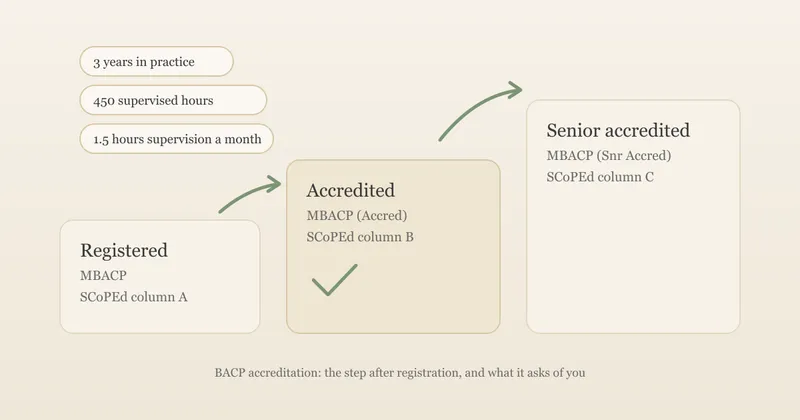
The hours can matter after you qualify too. If you aim for BACP accreditation later, BACP's guidance lets you count the three-year practice period from your first client, which may include your placement. Our guide to BACP accreditation has a worked timeline. When you're ready to set up on your own, our guide to setting up a private therapy practice in the UK walks through the steps.
Frequently asked questions
How many placement hours do I need for a counselling diploma?
For BACP student membership, your course must include a supervised placement of at least 100 client hours, and NCPS also asks for a minimum of 100 supervised clinical hours with clients in an organisation or agency. Your course may ask for more, so check your course handbook as well as your professional body.
Can I do my counselling placement online?
Partly. BACP says the majority of your placement hours need to be face to face. The rest can be online or a mix of online and phone, but only with adults and in an environment suitable for remote work. On a 100-hour placement that means at least 51 hours in the same room as the client, and text-based work that isn't live can't be counted.
Can I count private clients towards my placement hours?
Not for BACP membership. BACP says it can't accept private work towards your supervised placement hours, with possible exceptions if you've already completed and passed core training. Placement hours should be with genuine clients in a setting your course has approved, not with coursemates, friends or private clients.
Do counselling placements pay?
Placements are usually unpaid, as they're part of your training. Ask before you accept whether the placement charges trainees a fee, whether supervision is provided free or you need to pay for your own, and whether travel expenses are covered, because these costs vary from one provider to the next.
The short version
Placements are scarce, so start looking in your first year and apply to several at once. Before you apply, check the hours will count: at least 100 supervised client hours with genuine clients, mostly face to face, in a setting your course has approved, and never with private clients. Look through your course first, then BACP's jobs board and local counselling services. Before you say yes, ask about supervision, fees, client assessment and the written agreement. Then allow most of a year to reach 100 hours.
Planning for practice after your placement?
When you're ready to see clients privately, UpTopWeb builds clear, professional websites for counsellors and therapists, with your qualifications, fees and approach set out plainly.
Further reading
Related articles
Training & CPD14 minute read
Level 4 Diploma in Counselling: Is It Enough for Private Practice?
Starting a practice12 minute read
Clinical Supervision for Counsellors: BACP Requirements (UK)
Training & CPD12 minute read
BACP Accreditation: Is It Worth It for Private Practice? (UK Guide)