Starting a practice
Can I Call Myself a Psychotherapist? UK Job Titles Explained
Can a counsellor call themselves a psychotherapist in the UK? Which titles are protected by law, what BACP, NCPS and UKCP allow, and what to put on your site.
On this page10 sections
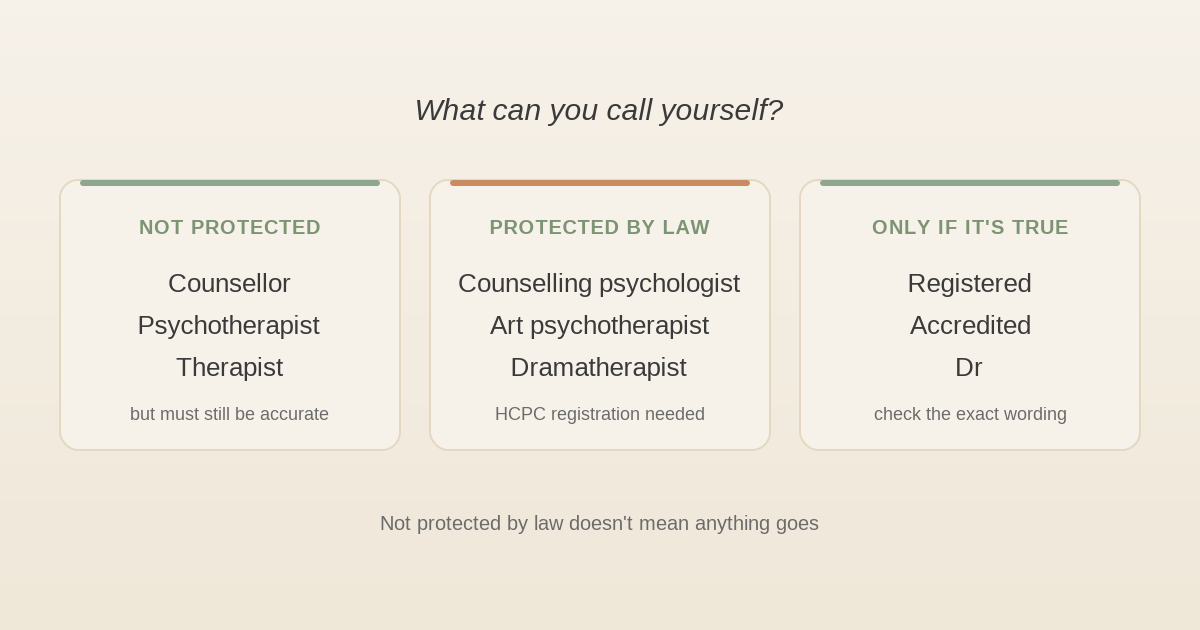
Can I call myself a psychotherapist? It's one of the first questions counsellors ask when they set up in private practice and write their website. The legal answer is short: "counsellor", "psychotherapist" and "therapist" aren't protected titles in the UK, so using them isn't an offence. The practical answer takes longer, because your professional body, the advertising rules and your clients all expect the title to match your training.
This guide is for UK counsellors and psychotherapists in private practice, or about to start. It covers which titles are protected by law, what BACP, NCPS and UKCP let you call yourself, the titles most likely to get you into trouble, and how to describe yourself on your website and directory profiles. Rules are as checked on 25 November 2026.
Key takeaways:
- "Counsellor", "psychotherapist" and "therapist" aren't protected by law, so anyone can legally use them.
- Some nearby titles are protected, including counselling psychologist, clinical psychologist, art psychotherapist and dramatherapist. Using one without HCPC registration, intending to deceive, is a criminal offence.
- Your professional body expects your title to describe your training accurately, and each body has its own wording for registered and accredited members.
- "Psychologist" and "Dr" cause the most problems: they aren't always protected, but they're easy to use in a way that misleads.
- On 2 November 2026 an independent commission recommended that government explore statutory regulation, which could protect these titles in future.
Can I call myself a psychotherapist? The short answer
Yes, legally you can. UKCP's register page says it plainly: therapists don't have to register with anyone, so "anyone can call themselves a psychotherapist". The same is true of "counsellor" and "therapist".
But legal isn't the whole test. Three other things decide what you should write:
- Your professional body's rules. BACP's Ethical Framework 2026 asks you to give clear, accurate information about your services, qualifications, experience and competence (1.2a). UKCP's Code of Ethics and Professional Practice says members must not make claims they can't show to be true (clause 13).
- What clients will assume. Many people read "psychotherapist" as meaning longer, deeper training than "counsellor", even though the law draws no line between them.
- Advertising rules. Your website and directory profile are advertising, and a title that gives a misleading impression of your qualifications can fall foul of the CAP Code, which the Advertising Standards Authority (ASA) enforces.
So the honest answer for most people is: use the title your training and your register entry support.
Which titles are protected by law in the UK?
The Health and Care Professions Council (HCPC) regulates 15 professions, and each has titles that are protected by law. To use one, you must be on the HCPC register. These are the ones closest to counselling:
| Title | Protected by law? | Who can use it |
|---|---|---|
| Counsellor | No | Anyone, but registration is how clients check you |
| Psychotherapist | No | Anyone, as above |
| Therapist (on its own) | No | Anyone, as above |
| Psychologist (on its own) | No | Anyone in law, but see the section below |
| Counselling, clinical, health, forensic, educational, occupational or sport and exercise psychologist | Yes | HCPC-registered practitioner psychologists only |
| Practitioner psychologist, registered psychologist | Yes | HCPC-registered practitioner psychologists only |
| Art psychotherapist, art therapist, dramatherapist, music therapist | Yes | HCPC-registered arts therapists only |
| Occupational therapist, physiotherapist, speech and language therapist | Yes | HCPC-registered members of those professions only |
Two of these catch counsellors out. "Art psychotherapist" is protected even though "psychotherapist" isn't, so a counsellor who uses art in sessions can't call themselves one without HCPC registration. And "counselling psychologist" is a protected title, not a description of a counsellor who studied psychology.
Using a protected title you aren't entitled to, with intent to deceive, is an offence under article 39 of the Health Professions Order 2001, punishable by a fine. If you're registered with HCPC as well as a counselling body, the title on your HCPC entry is the one to use for that work.
What your professional body lets you call yourself
Being on a register accredited by the Professional Standards Authority (PSA) is what gives a title meaning for clients. Each body sets its own wording, and getting it exactly right matters more than which body you're with.
| Body | Registered level | What you can say |
|---|---|---|
| BACP | Registered Member MBACP | "Registered Member of BACP", "Registered counsellor (or psychotherapist or counselling professional)", plus your registration number |
| BACP | Accredited | "Accredited Member of BACP", letters Registered Member MBACP (Accred) |
| NCPS | Accredited Registrant | MNCPS (Acc.), and higher grades as you reach them |
| UKCP | Full clinical member | The title on your register entry: psychotherapist or psychotherapeutic counsellor |
BACP's promoting your membership guidelines add some detail that's easy to miss:
- Student and Individual members can't use designatory letters, logos or certificates. They should describe themselves as a "Student Member of BACP" or an "Individual Member of BACP".
- Registered members should show their registration number on promotional materials, so clients can check the register.
- SCoPEd columns: registered members can say their competences are aligned to column A, and accredited members to column B. Student and Individual members shouldn't claim alignment to the framework.
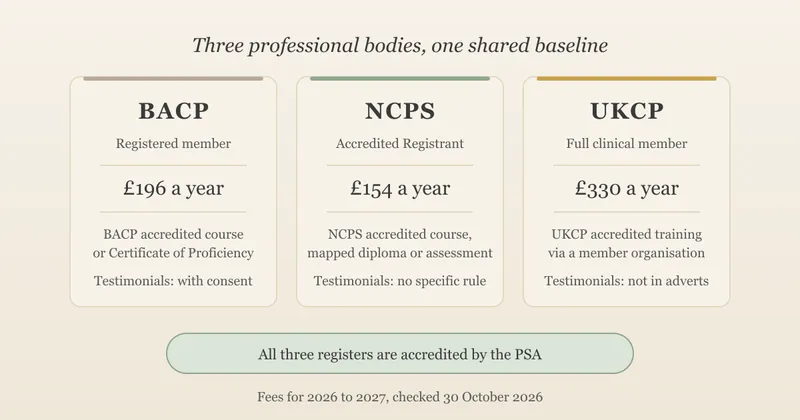
BACP's wording lets a registered member describe themselves as a registered psychotherapist. That doesn't settle whether it's the right word for you. If your training was a counselling diploma, "counsellor" is usually the more accurate description, and the framework's 1.2a point about accuracy still applies. For the full comparison of the three bodies, see our guide to BACP vs NCPS vs UKCP.
Counsellor or psychotherapist: which should you use?
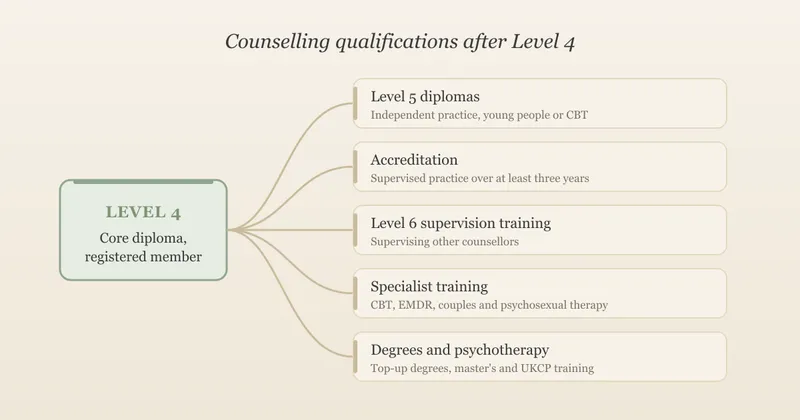
There's no legal difference, but there is a difference in training. UKCP's psychotherapy training is a separate route that usually starts at postgraduate level and takes four to six years to accreditation, as our guide to counselling qualifications after Level 4 explains. Many counsellors in private practice trained through a counselling diploma instead.
A simple test:
- Trained on a counselling diploma, registered with BACP or NCPS: "counsellor" is the clearest and most accurate choice. "Therapist" works as a plain-English alternative.
- Trained on a UKCP accredited psychotherapy course: "psychotherapist", matching your UKCP register entry.
- Trained on a UKCP psychotherapeutic counselling course: "psychotherapeutic counsellor", again matching your entry.
- Both trainings, or further training since: "counsellor and psychotherapist" is fine if both are true. Say what each one is based on.
You don't need "psychotherapist" in your title to be found. A page that says clearly what you offer, who for and where does more for search than an extra job title, and adding a title only to catch another search phrase is the kind of thing that can mislead. Our guide to writing therapist website copy covers how to use the words clients search for without overclaiming.
"Psychologist" and "Dr": the two titles that cause the most trouble
"Psychologist" on its own isn't protected by law. Parliament's research briefing on the regulation of psychological professionals (October 2025) says the term itself has no statutory protection. But it sits right next to nine titles that are, from counselling psychologist to registered psychologist. Clients are unlikely to know the difference. If you have a psychology degree but aren't HCPC-registered, describing yourself as a psychologist on a therapy website will give most readers the wrong idea. Say what you have instead: "BSc Psychology" in your qualifications reads honestly.
"Dr" isn't a protected title in itself, and people with a doctorate can use it, but the advertising rules are strict. The CAP Executive's guidance on using "Dr" with a PhD says it's likely to be acceptable with a relevant doctorate if you add "PhD", and that in health-related ads you should make clear straight away that you don't hold a general medical qualification. Its safest advice is not to use "Dr" at all in health marketing unless you're medically qualified.
If you do use it, write something like "Dr Sam Patel PhD, counsellor (not a medical doctor)" the first time it appears, not just in your About page small print.
When an accurate title can still mislead
The independent Commission for the Future of Counselling and Psychotherapy found that almost half the public (48%) believe "counsellor", "therapist" and "psychotherapist" are protected titles. So your title already carries more weight with clients than the law gives it. The words around it matter as much as the title itself.
These are the wordings we see most often that need changing:
| Instead of | Write | Why |
|---|---|---|
| "Psychotherapist" (Level 4 counselling diploma) | "BACP registered counsellor" | Matches your training and register entry |
| "Counselling psychologist" (not HCPC registered) | "Counsellor", with your degree listed under qualifications | A protected title |
| "Art psychotherapist" (not HCPC registered) | "Counsellor who uses creative and art-based approaches" | A protected title |
| "BACP accredited" (registered, not accredited) | "Registered Member of BACP (MBACP)" | Accreditation is a separate, later grade |
| "Fully qualified psychotherapist" | Your actual qualification and register entry | "Fully qualified" has no fixed meaning |
| "Dr Sam Patel" in a heading | "Dr Sam Patel PhD, counsellor (not a medical doctor)" | The ASA expects the doctorate to be clear immediately |
Our guide to BACP accreditation has more on showing your membership grade correctly.
What to write on your website and directory profiles
Pick one title and use it the same way everywhere: your website, your directory profiles, your Google Business Profile and your email signature. A client who sees "psychotherapist" on Google and "counsellor" on your directory profile may wonder which is true.
A clear pattern for your website's header or About page:
Sam Patel, BACP registered counsellor (MBACP, registration number 123456). Counselling for adults in Leeds and online.
Then, in your qualifications section:
- Your main qualification, named as the certificate names it.
- Your professional body and grade, using the body's exact wording.
- A link to your register entry, so a client can check it in one click.
- Any HCPC registration, with its own title, if you have one.
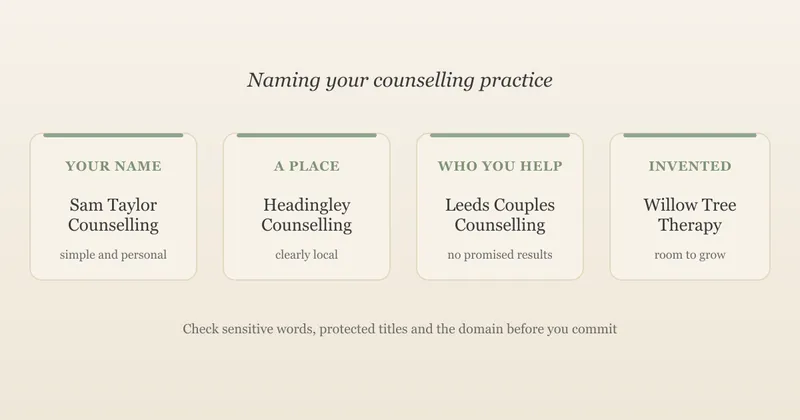
If you choose a category on Google Business Profile or a directory, pick the one that matches your title. Don't choose "psychologist" because it appears in more searches. Our guides to practice names and what a therapist website should include cover the rest of what goes on those pages.
Is statutory regulation coming?
Possibly, but not soon. UKCP's statutory regulation page says only the UK government can introduce it and there is "currently no formal timetable".
What changed this month is the pressure for it. On 2 November 2026 the independent Commission, set up by the Partnership of Counselling and Psychotherapy Bodies, of which BACP is a partner, published its report. One of its six priorities is to strengthen public protection by introducing statutory regulation, and it recommends that government work with the professional bodies to identify options. BACP's news report on the Commission says it will be shared with ministers and policymakers.
If regulation does come, titles such as "counsellor" and "psychotherapist" could become protected, as many respondents to the Commission hoped. Nobody knows yet what the entry requirements would be. The sensible position now is the same either way: be on a PSA-accredited register, use the title it gives you, and keep your website matching your register entry.
Frequently asked questions
Can a counsellor call themselves a psychotherapist?
Legally, yes. 'Psychotherapist' isn't a protected title in the UK, so it isn't an offence to use it. But your professional body expects you to describe your training accurately, and many clients read 'psychotherapist' as meaning longer training than a counselling diploma. BACP lets registered members describe themselves as a registered counsellor or psychotherapist, while UKCP registers people as psychotherapists or psychotherapeutic counsellors according to their training. Use the title that matches your training and your register entry.
Is psychotherapist a protected title in the UK?
No. Counselling and psychotherapy aren't regulated by law in the UK, and UKCP's own register page says that anyone can call themselves a psychotherapist. A few related titles are protected, including art psychotherapist, counselling psychologist and clinical psychologist. You can only use those if you're registered with the Health and Care Professions Council (HCPC).
Can anyone call themselves a counsellor?
Yes. 'Counsellor' isn't protected by law, so there's no legal bar on someone untrained using it. That's why registration matters: being on a register accredited by the Professional Standards Authority, such as BACP's, NCPS's or UKCP's, is how a client can check your training, your ethics and that there's a complaints process.
Can a counsellor call themselves a therapist?
Yes. 'Therapist' on its own isn't protected, and it's a common, plain word for what counsellors do. Some titles ending in 'therapist' are protected, including art therapist, music therapist, dramatherapist, occupational therapist, physiotherapist and speech and language therapist, so don't combine 'therapist' with one of those unless you're registered with the HCPC.
Can a counsellor diagnose?
No law stops a counsellor forming a view in assessment, but formal diagnosis of conditions such as PTSD, ADHD, OCD or depression is usually made by a doctor or an HCPC-registered psychologist. Advertising is stricter: the CAP Code says marketers must not offer diagnosis of, or treatment for, conditions that need medical supervision unless it's done under the supervision of a suitably qualified health professional. Describe what you work with, not what you diagnose.
Do I have to be on a register to practise as a counsellor?
Not by law. But most insurers, referral networks, employers and directories expect registration with a body whose register is accredited by the Professional Standards Authority, and the 2026 Commission report recommends that government explores statutory regulation. Joining a register now is the safest position either way.
The short version
You can legally call yourself a counsellor, psychotherapist or therapist in the UK. Stay away from the HCPC's protected titles unless you're registered, be careful with "psychologist" and "Dr", and use your professional body's exact wording for your grade. Then pick the title that describes your training honestly and use it everywhere a client might find you.
Your title, your register, your website, all saying the same thing
UpTopWeb designs and builds your therapist website for free, with one simple monthly fee covering hosting, support and unlimited edits.
Further reading
Related articles
Starting a practice19 minute read
BACP vs NCPS vs UKCP: Which Professional Body to Join?
Training & CPD13 minute read
Counselling Qualifications After Level 4: Your UK Options
Starting a practice16 minute read
Counselling Practice Names: Ideas and UK Rules