Starting a practice
When Can a Counsellor Break Confidentiality? (UK Guide)
What UK counsellors must report by law, when breaking confidentiality is your judgement, the new child sexual abuse reporting duty, and how to explain the limits.
On this page9 sections
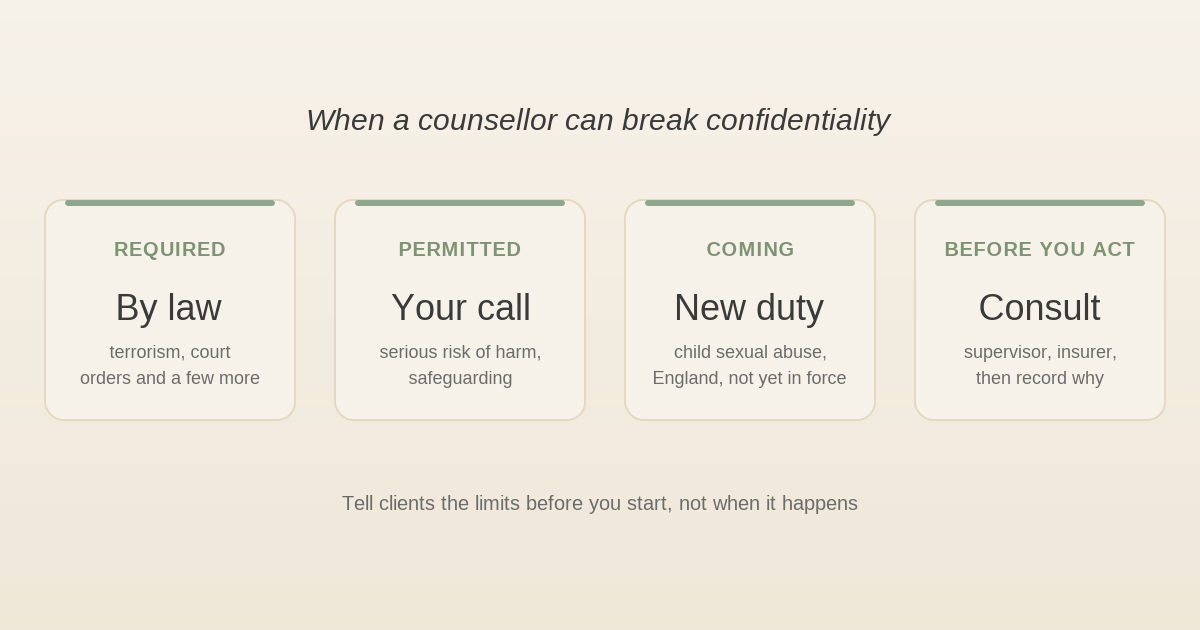
When can a counsellor break confidentiality? In the UK, much less often than many clients assume, and in a few situations more often than some counsellors realise. A small number of disclosures are required by law, such as information about terrorism or a court order. Most others, including serious risk of harm and safeguarding concerns, are your professional judgement. A new legal duty to report child sexual abuse is on its way in England, too.
This guide is for counsellors and psychotherapists in UK private practice. It covers what the law requires you to report, when you may choose to share information, what the new mandatory reporting duty means for you, and how to make and record the decision. It's written for practice in England, with differences for the rest of the UK noted where they matter. Laws and guidance are as checked on 23 November 2026.
Key takeaways:
- There's no general legal duty on counsellors to report crimes. The clear legal duties are narrow: terrorism, court orders, some police requests about drivers and, for HCPC-registered practitioners, female genital mutilation.
- Breaking confidentiality for serious risk of harm, suicide risk or safeguarding is usually a judgement, not a legal requirement. Data protection law doesn't stop you sharing information to protect someone.
- The Crime and Policing Act 2026 will require people in regulated activity with children in England to report child sexual abuse. It isn't in force yet, and isn't expected before 29 April 2027.
- Talk to the client first where it's safe, take it to supervision, use your insurer's legal helpline, and record your reasons.
- Tell clients the limits of confidentiality before you start. BACP says complaints mostly arise when clients assumed confidentiality was absolute.
Important: This is a practical overview, not legal advice. Every situation is different. If you're facing a real decision, speak to your supervisor and your insurer's legal helpline, and check your professional body's current guidance.
Must, may and must not: three kinds of disclosure
BACP's page on what confidentiality complaints tell us says the first thing to get right is the difference between being required by law to break confidentiality and being permitted to. It helps to add a third group:
| Kind | What it means | Examples |
|---|---|---|
| Required | The law says you must disclose, and not doing so can be an offence or contempt | Terrorism information, a court order, the new child sexual abuse duty once it's in force |
| Permitted | You may disclose if you judge it necessary, usually because someone is at serious risk | Risk to life, safeguarding a child or an adult at risk, a client asking you to share |
| Not allowed | Sharing without a good reason or the client's consent | Telling a client's GP, partner or employer because you're worried in a general way, or answering informal questions about a client |
Most of the hard decisions sit in the middle row. That's why consultation and good records matter more than memorising a list.
When the law requires you to break confidentiality
NCPS's safeguarding and confidentiality policy puts the starting point plainly: "there is no general duty to report crime except in specific circumstances." These are the circumstances most likely to reach a counsellor in private practice.
Terrorism
The Terrorism Act 2000 has two duties that can apply to you:
- Information about acts of terrorism. Under section 38B, anyone who has information they know or believe might be of material assistance in preventing an act of terrorism, or in catching and prosecuting someone for one, commits an offence if they don't tell the police as soon as reasonably practicable. The maximum penalty is ten years in prison. There's a defence of "reasonable excuse".
- Terrorist funding. Under section 19, if information that comes to you in the course of your profession makes you believe or suspect that someone has committed one of the terrorist property or funding offences, you must tell the police. The maximum penalty is five years.
Both apply across the UK.
Court orders
A court can order you to produce records or give evidence. NCPS notes that refusing to answer a court's questions may be contempt of court. You can ask the court to limit what's disclosed, but don't decide that on your own: call your insurer's legal helpline as soon as you receive a witness summons or order.
Police requests
The police asking isn't the same as a legal requirement. NCPS says "there is no general obligation to answer police questions about a client." Records about someone's mental health that you hold in confidence count as "excluded material" under sections 11 and 12 of the Police and Criminal Evidence Act 1984, and the police generally need an order from a judge to get them.
One narrow exception: under section 172 of the Road Traffic Act 1988, anyone must give information that could identify a driver when formally required to by the police, where the driver is accused of certain motoring offences.
Female genital mutilation, if you're HCPC-registered
The Female Genital Mutilation Act 2003, section 5B, requires healthcare professionals, teachers and (in Wales) social care workers to tell the police within one month if, in their work, a girl under 18 tells them she has had FGM or they see physical signs of it. "Healthcare professional" here means someone on a statutory register, such as HCPC's. So it applies to practitioner psychologists and arts therapists in England and Wales. Counsellors and psychotherapists on accredited voluntary registers (BACP, UKCP, NCPS) aren't named, although FGM is child abuse and would be a safeguarding concern anyway.
What about money laundering and drug trafficking?
Some lists, including BACP's complaints page, name drug trafficking and money laundering among the situations where you're legally obliged to disclose. The failure-to-disclose offence in the Proceeds of Crime Act 2002 (section 330) applies to information that comes to you in the course of business in the "regulated sector", which is banks, accountants, lawyers and similar businesses, and counselling isn't on that list. Treat this as one to check with your insurer's legal helpline if it ever comes up, rather than assuming either way.
The new duty to report child sexual abuse
The Crime and Policing Act 2026 received Royal Assent on 29 April 2026. Part 5, Chapter 2 creates a duty to report child sexual abuse, following the Independent Inquiry into Child Sexual Abuse. The government's factsheet explains the policy.
Who it applies to
The duty applies to people aged 18 or over who, in the course of a "relevant activity" in England, are given reason to suspect a child sex offence. Relevant activity includes regulated activity relating to children under the Safeguarding Vulnerable Groups Act 2006. That's the same test that decides whether you need a children's barred list check, which our guide to DBS checks for therapists covers. For counsellors, it depends on your actual work with under-18s, not your job title.
If you only see adults, the duty as written is tied to activity with children, so it's unlikely to cover your client work. The government has said it will publish guidance; check it when it appears.
The duty applies to activity in England only. Scotland, Wales and Northern Ireland aren't covered by this part of the Act.
What triggers it
Section 87 lists the situations, and says there are no others:
- you see something that is a child sex offence;
- a child tells you something that would make a reasonable person in your role suspect an offence;
- someone tells you something that would make a reasonable person suspect they may have committed one;
- you see an image or hear a recording that would make a reasonable person suspect an offence.
An adult telling you about abuse they experienced as a child isn't one of these. The British Psychoanalytic Council reads it the same way in its summary of the Act. An adult client saying they may have abused a child is different, if you're engaged in a relevant activity when they tell you.
What you have to do
Report to the police or the local authority as soon as practicable, naming the people you believe were involved and explaining why you're reporting. It can be in writing or by phone. The Act says a report doesn't breach any duty of confidence.
There are limited breathing spaces. You can delay for up to seven days if you reasonably believe reporting would put the child's life or safety at risk, or that someone else is about to report. If someone tells you they've already reported and you reasonably believe them, you don't have to.
What happens if you don't
The government says it hasn't made failing to report a criminal offence. Instead, failing to report can lead to a referral to the Disclosure and Barring Service and to your professional regulator. Preventing or deterring someone else from reporting is an offence, with up to seven years in prison.
When it starts
Not yet. The Act says this part comes into force on a date set by regulations, and we couldn't find any when we checked. Local safeguarding partnerships, including Hampshire's, say it isn't expected before 29 April 2027. If you work with under-18s, use the time to update your safeguarding policy and contract, and look out for the statutory guidance.
When you may break confidentiality
Outside those duties, breaking confidentiality is a judgement you make, not one the law makes for you. BACP lists child protection and safeguarding, protecting vulnerable adults, and risk of suicide, serious self-harm or harm to others as discretionary. The BACP Ethical Framework 2026 also asks you to have safeguarding training, policies and procedures, and to let clients see your safeguarding policy details and who to contact (2.4). Our summary of the 2026 framework covers what else changed.
Serious risk to life
If you believe a client or someone else is at serious and imminent risk, you can share what's needed to protect them. The ICO's guidance on data sharing in an emergency says data protection law doesn't stop you sharing personal data where it's appropriate, and that in an emergency you should share what's necessary and proportionate. Share the minimum, with the right people: usually emergency services or the client's GP.
Children
A child at risk of significant harm is a safeguarding concern whoever tells you about it. If you can't get consent, or asking for it would increase the risk, NCPS says you'll have to decide whether to refer anyway. The ICO's guide to sharing information to safeguard children is clear that data protection law doesn't prevent it. Your local authority's children's services team is the usual first contact. Keep their number in your safeguarding policy, not just in your head.
Adults at risk
Local authorities have a duty under section 42 of the Care Act 2014 to look into concerns about adults with care and support needs who are at risk of abuse or neglect. There's no matching duty on you to report. For an adult who has capacity, the starting point is to work with them and respect their choices, unless others, including children, are at risk too.
Self-harm, domestic abuse and past crimes
These are the questions counsellors search for most, and each works slightly differently.
- Self-harm and suicidal thoughts. There's no general legal duty to report an adult's self-harm or suicidal thoughts. NCPS says "there is no general duty to rescue" in British law, and advises being explicit in your contract if you reserve the right to act when a client's life is at risk. For under-18s, it's also a safeguarding question.
- Domestic abuse. An adult client experiencing domestic abuse can decide what to do, and your role is usually to support that decision. If children live in the home, or someone faces serious and imminent risk, it becomes a safeguarding judgement.
- Past crimes. A client telling you about a crime they committed in the past doesn't usually create a duty to report. The exceptions are the ones above, terrorism and, once it's in force, the child sexual abuse duty where it applies to your work.
How to decide, and how to record it
When something comes up, slow down where you can. BACP advises against acting "impulsively without consultation". A sequence that works for most situations:
- Check whether it's required or permitted. Use the sections above. If it's required, the question is how and when, not whether.
- Talk to the client where it's safe. BACP says it's generally advisable and ethical to discuss a disclosure with the client first. Consent makes everything simpler. Don't do this if telling them could increase the risk, for example to a child.
- Take it to supervision. This is exactly what supervision is for. Our guide to clinical supervision for counsellors covers arranging extra sessions when you need them.
- Get legal advice. Both BACP and NCPS point you to your insurer for legal advice, and most professional indemnity insurance policies include a legal helpline. Use it before you act if there's time.
- Share the minimum. Give only what the person receiving it needs, and only to someone who can act on it.
- Record your reasoning. Note what you heard, who you consulted, what you decided and why, including if you decided not to share. The BACP Ethical Framework 2026 asks you to be able to give a rationale for your decisions and to record your reasons where you can't work collaboratively with a client. Our guide to writing counselling notes shows how to write a risk entry.
Explaining the limits of confidentiality to clients
BACP says complaints about confidentiality mostly arise because clients assumed it was absolute, and its advice is direct: don't promise total confidentiality. Clients should know the limits before the first session, not when you're about to act.
Put them in three places:
- Your contract. A plain list of the exceptions, agreed at the start. Our guide to what to include in a therapy contract covers the confidentiality clause and how to word it.
- Your privacy notice. The limits of confidentiality, and who you might share information with. Our GDPR guide for therapists covers what a privacy notice needs.
- Your website. A short answer in your FAQs, so a prospective client knows what to expect before they contact you.
For example, this illustrative website FAQ answer is short enough for most practices:
Is what I say confidential? Yes, with a few exceptions. I may need to share information if I believe you or someone else is at serious risk of harm, if I'm concerned a child is at risk, or if the law requires it, for example a court order. Wherever possible I'll talk to you first. I discuss my work in supervision without using your name.
If you work with under-18s, update this wording when the new reporting duty comes into force.
Frequently asked questions
Do counsellors have to report crimes in the UK?
Not as a general rule. There is no general legal duty on counsellors to report crimes a client tells them about. The main exceptions are terrorism, where the Terrorism Act 2000 makes it an offence not to tell the police certain information, court orders, and a few narrower duties. HCPC-registered practitioners also have the female genital mutilation reporting duty. Other disclosures, such as serious risk of harm or safeguarding concerns, are a matter of professional judgement.
Do counsellors have to report self-harm?
There's no general legal duty to report an adult client's self-harm or suicidal thoughts. Whether to share information is a professional judgement, usually made with the client where possible and with your supervisor. Many counsellors say in their contract that they may contact a GP or emergency services if they believe a client's life is at serious risk, so the client knows before it happens. Under-18s are a safeguarding question as well.
Does the new mandatory reporting duty apply to counsellors?
It can. The Crime and Policing Act 2026 creates a duty to report child sexual abuse for people aged 18 or over engaged in certain activities with children in England, including regulated activity relating to children. If your work with under-18s counts as regulated activity, the duty is likely to apply to you once it comes into force. It isn't in force yet, and local safeguarding partnerships say it isn't expected before 29 April 2027.
Can the police make me hand over a client's notes?
Not just by asking. Records about a client's mental health that you hold in confidence count as 'excluded material' under the Police and Criminal Evidence Act 1984, and the police generally need a judge's order to see them. A court can order you to produce records or give evidence, and refusing may be contempt of court. If you're asked, don't hand anything over on the spot: get advice from your insurer's legal helpline first.
Should I tell a client before I break confidentiality?
Usually, yes. BACP says it's generally advisable and ethical to discuss a disclosure with the client first, and ideally to get their consent. The exception is where telling them could increase the risk of harm, for example to a child. Talk it through with your supervisor, get legal advice if you need it, and record what you decided and why.
When can a counsellor break confidentiality: the short version
A counsellor can break confidentiality in the UK where the law requires it, or where they judge it necessary to protect someone. The legal duties are narrow: terrorism, court orders, some police requests about drivers, FGM for HCPC-registered practitioners and, from a date not yet set, child sexual abuse for those in regulated activity with children in England. Most other disclosures are a judgement. Make it with the client where it's safe, with your supervisor and insurer, and write down why. Then tell clients the limits clearly before you start, in your contract, privacy notice and website.
Want your confidentiality and FAQs set out clearly?
UpTopWeb builds calm, professional websites for UK counsellors and therapists, with clear FAQ, fees and privacy pages so clients know what to expect before they get in touch. Hosting and updates included in one monthly fee.
Further reading
Related articles
Starting a practice13 minute read
Therapy Contracts for UK Counsellors: What to Include and What's Fair
Starting a practice17 minute read
How to Write Counselling Notes: Examples and What to Include
Starting a practice10 minute read
DBS Checks for Therapists: A UK Guide