Starting a practice
How to End Therapy With a Client: A UK Guide for Counsellors
How to end therapy with a client well: planned endings, clients who stop coming, ending the work yourself, notice and referral, plus free ending letter templates.
On this page11 sections
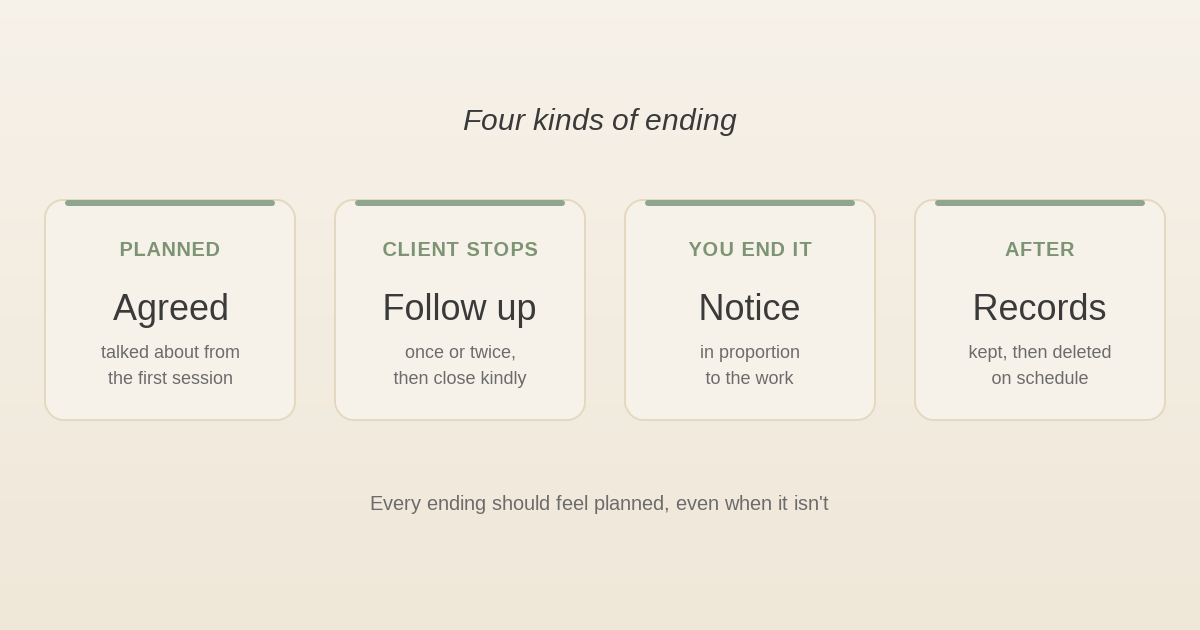
How to end therapy with a client is a question that comes up in complaints more than you might expect. UKCP's guidance on endings says it's an area that "frequently leads to complaints", and BACP lists abrupt endings, and endings by text or email, among the complaints it sees. The short answer: talk about the ending from the first session, give notice in proportion to the work, offer a final session, help the client find other support if they need it, and record what happened.
This guide is for counsellors and psychotherapists in UK private practice. It covers planned endings, clients who stop coming, ending the work yourself, breaks and pauses, referral, and what to do with records and future contact afterwards. It uses BACP's Ethical Framework 2026 and UKCP's Code of Ethics and Professional Practice, as checked on 24 November 2026.
Key takeaways:
- BACP's Ethical Framework 2026 (4.5) asks you to tell clients about any session limits, give reasonable notice of breaks and endings where it's safe, manage unplanned endings to minimise harm, and have a clinical will.
- Agree in your contract whether the work is open-ended or time-limited, how either of you can end it, and whether clients can return.
- A client can stop whenever they choose. Follow up kindly, offer a final session, then close the work.
- If you end the work, give notice in proportion to how long you've worked together, explain why, offer a final session and help with referral. Don't end by text or email.
- After the ending, keep records for the period your privacy notice states, and be clear about future contact.
Important: This is a practical overview, not clinical, legal or professional advice. Follow your professional body's current guidance, and take any ending you're unsure about to supervision.
How to end therapy with a client: what good endings have in common
BACP, UKCP and NCPS all set out what they expect.
| Source | What it asks of you |
|---|---|
| BACP Ethical Framework 2026, 4.5 | Tell clients about any limit on sessions; give reasonable, advance notice of planned breaks and, where safe, of an ending; manage unplanned breaks and endings to minimise harm and disruption; have a clinical will and an appointed executor |
| UKCP Code of Ethics and Professional Practice, clauses 14, 24, 27 and 28 | Explain arrangements for referral and ending at the outset (14); refer on when work is beyond your competence (24); make "considered and timely arrangements" to end, with clients informed and other practitioners identified where possible (27); have arrangements for your illness or death (28) |
| NCPS Code of Ethics, Offering and Delivering a Service | Respect a client's choice whether to continue (Offering 5); never protract therapy unnecessarily, and end it at the earliest point consistent with the client's welfare and wishes (Delivering 6); be prepared to refer on when you reach your limits (Delivering 7); tell former clients who resume about the Code (Offering 12) |
BACP's learning from complaints about endings adds the practical detail. It says a mutually agreed ending is better than one that's forced, premature or unilateral. The complaints it describes are about therapy ended abruptly, without notice or preparation, or by text or email without a final session.
Put together, a good ending is expected, explained, given time, and leaves the client knowing where to go next.
Planning the ending from the first session
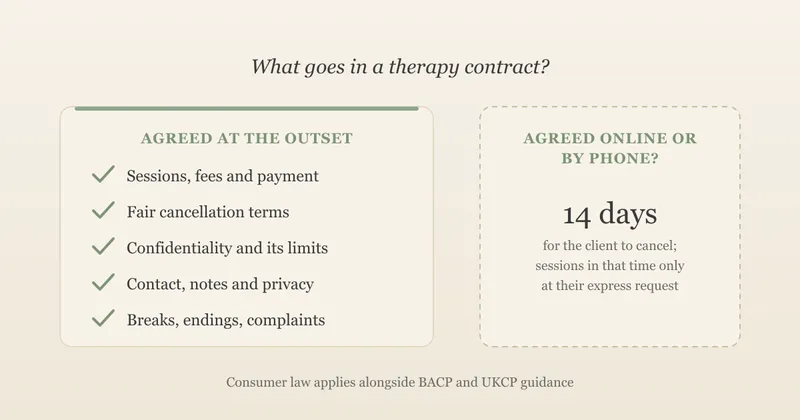
The easiest endings are the ones the client knew about from the start. BACP advises making it clear in your initial contracting whether therapy is open-ended or time-limited. Your contract is the natural place for this, and our guide to what to include in a therapy contract covers the breaks and endings clause alongside the rest.
During the work:
- Review regularly. BACP's client leaflet on ending therapy suggests regular reviews of progress, which make it natural to talk about when to end.
- Raise the ending before the last session. The same leaflet says most therapists talk about the end several sessions before it's due, so it shouldn't come as a surprise. In time-limited work, keep the client aware of how many sessions are left.
- Match the ending to the length of the work. The leaflet says there are no rules, but someone in long-term therapy will generally need more ending sessions than someone in short-term work.
- Say what happens next. Be clear whether this is a final ending or the door stays open, and whether there will be any future contact.
When a client stops coming
Sometimes there's no ending to plan, because the client simply stops coming. BACP's leaflet reminds clients that it's their choice to stop and that they don't have to give a reason. Your job is to make it easy for them to end well if they want to, without pressure.
This is the approach we'd suggest, rather than a rule from any professional body:
- After a missed session, send one short, kind message. Check they're OK, and say when their next session is or ask whether they'd like to rebook.
- If you don't hear back, send one more. Offer a final session to close the work, and say you won't contact them again after this unless they get in touch.
- Then close the work. Note the dates of your messages and that the client didn't reply. If a session is unpaid, follow your contract, but think carefully before chasing a small fee from someone who may be struggling.
An illustrative second message:
Hi Sam, I haven't heard from you since our last session and wanted to check in. If you'd like to come back, I'd be glad to see you. If you'd prefer to stop, that's completely fine. I'm happy to offer one final session to close our work together if that would help. I won't contact you again after this, but you're welcome to get in touch at any time.
If there's still no reply, our free ending letter templates include a short letter for closing the work.
If you have reason to think the client may be at risk, this becomes a different question. Our guide to when a counsellor can break confidentiality covers when you may share information to protect someone.
When you need to end the work
BACP's leaflet says therapists don't have a duty to see clients indefinitely and don't need a client's permission to end. It lists common reasons: retirement, illness or accident, fitness to practise, a change in work patterns, funding, feeling outside your competence, and a conflict of interest.
Whatever the reason, the same steps apply:
- Take it to supervision first. BACP's leaflet calls this good ethical practice if you're stopping because you feel you can't help the client further. UKCP's guidance ends with the same advice: think of the client, and ask your supervisor. Our guide to clinical supervision for counsellors covers arranging extra sessions.
- Give notice in proportion to the work. BACP suggests notice in proportion to the length of the therapy. UKCP calls it a rule of thumb: the longer the therapy, the longer the notice.
- Tell the client in a session, not by message. BACP's complaints guidance specifically warns against ending by text or email.
- Explain the reason as openly as you can, without making the client feel they've done something wrong. BACP mentions both.
- Offer a final session to review the work.
- Help them find other support, and refer on where it's appropriate.
- Confirm it in writing afterwards, if that helps the client. One of our free ending letter templates is for this.
When the work is outside your competence
UKCP's code (clause 24) asks you to refer clients on when their needs are beyond your competence, and BACP's framework asks you to be clear about the services you're competent to offer. This is one of the better reasons to end, but the client may hear it as rejection. Say what you've noticed, why you think someone else could help more, and that you'll help them find that person.
When you need to end straight away
UKCP says there may be an immediate need to end where the therapist's or client's safety is at risk. Even then, it suggests offering an alternative therapist or service where that's appropriate. Talk to your supervisor and your insurer's legal helpline, and record your reasons.
Unpaid fees
Your contract should say what happens if fees aren't paid. If it comes to ending the work over fees, follow the same steps: raise it in a session, give notice, and offer a final session. Ending abruptly over money is the kind of ending complaints are made about.
If you're ill, or you die
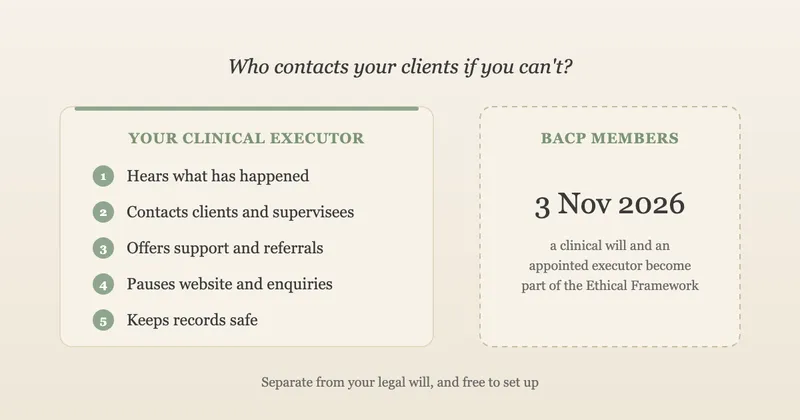
BACP's framework requires a clinical will with an appointed executor who can contact your clients (4.5e), and UKCP's code asks for arrangements to inform and support clients (28). Our guide to writing a clinical will explains what to include, and it comes with a free template.
Breaks and pauses, compared with a final ending
Not every gap is an ending. BACP's framework asks for reasonable, advance notice of planned breaks (4.5b), and BACP's complaints guidance says clients should understand whether an ending is interim or final. Our Christmas break plan for therapists shows how to give notice of a holiday and what to tell clients about support while you're away.
If a client pauses the work, for money, a move or a life event, agree what the pause means. Will you hold their slot, and for how long? Do they need to get in touch to restart? Write down what you agreed, so a pause doesn't quietly turn into an unplanned ending.
Referring a client on
Referral is part of a good ending when the client needs more, or different, help. BACP's complaints guidance asks you to make sure the client knows about other sources of support, referring them on where appropriate. UKCP's code asks you to identify alternative practitioners where possible.
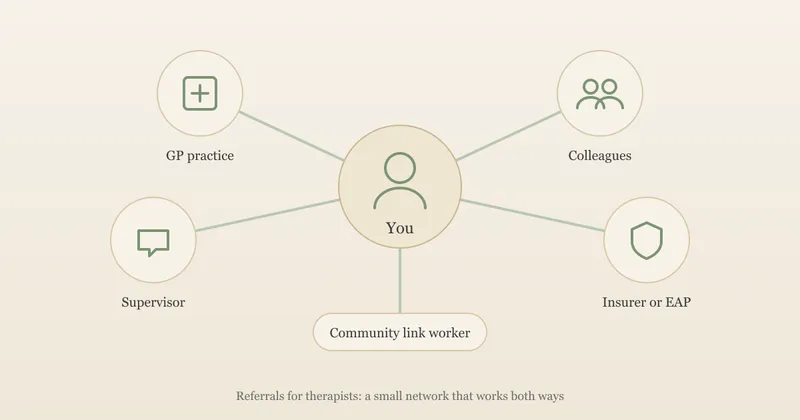
Get the client's consent before you share anything with the person you're referring to, and share only what they need. Our guide to referrals for therapists covers referring a client on, including consent and what to share, and building a network of colleagues you trust to refer to.
After the ending: records, returning clients and contact
Records. Ending the work doesn't end your record-keeping. Write a short closing note: when and how the work ended, any referral, and what you agreed about future contact. Our guide to writing counselling notes covers what a useful note includes. Then keep the records for the period set out in your privacy notice and delete them securely afterwards. There's no single legal retention period; our GDPR guide for therapists explains how to decide yours.
Returning clients. Decide in advance whether former clients can come back, and say so in your contract. If they can, think about how you'll handle it when your caseload is full. Our guide to how many clients a counsellor should see covers planning capacity and waiting lists.
Contact afterwards. Be clear in the last session about whether there will be any future contact, as BACP's leaflet suggests. The same boundaries apply online: our guide to social media for therapists covers what to do when a client, current or former, tries to connect.
Endings in your contract and on your website
Prospective clients often want to know how long therapy will last before they get in touch. A short answer on your website, and a clear clause in your contract, cover most of what BACP and UKCP expect you to explain at the outset.
An illustrative contract clause:
Ending our work. We'll review how things are going every few sessions. Either of us can decide to end the work. If you decide to stop, I'd encourage you to come to a final session so we can end well, but that's your choice. If I need to end our work, I'll tell you in a session and give you as much notice as I can, and I'll help you find other support if you need it. You're welcome to get in touch again in future, and I'll let you know whether I have space.
An illustrative website FAQ answer:
How long will counselling last? It depends on what you'd like to work on. Some people come for six to twelve sessions, others for longer. We'll review how things are going regularly, and you can decide to stop at any time. We'll plan the ending together.
Free therapy ending letter templates
We've made three short letter templates you can adapt, as a Word document and a PDF:
- Confirming a planned ending: the date of the last session, what happens afterwards, and how long you'll keep notes.
- When you need to end the work: confirming, after you've told the client in a session, the reason, the sessions left and help with referral.
- Closing the work when a client has stopped coming: a short, warm letter with the offer of a final session.
Each has a grey note on when to use it, and there's a short check to run before you send any of them.
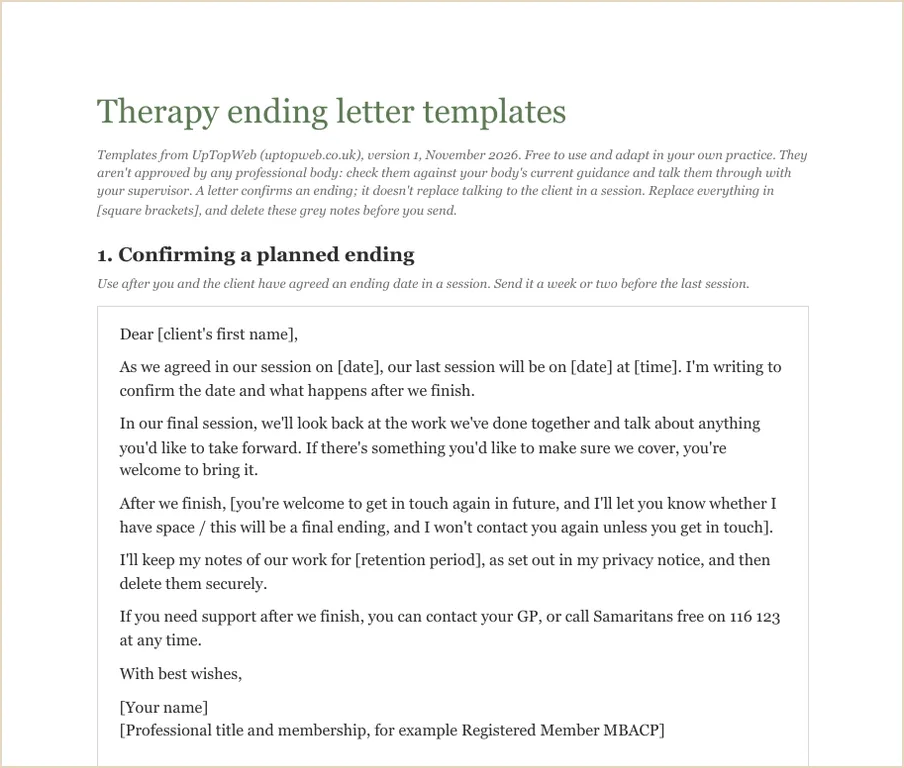
- Download the ending letter templates (PDF, 3 pages, 71 KB)
- Download the editable version (Word, 38 KB)
You can use and adapt them freely in your own practice. They aren't approved by any professional body, so check them against your body's guidance and talk them through with your supervisor. A letter confirms an ending; it doesn't replace talking about it in a session. These are practical letters, not the therapeutic "goodbye letters" used in some approaches, such as cognitive analytic therapy.
Frequently asked questions
How much notice should a therapist give before ending therapy?
There's no fixed number of weeks. BACP's Ethical Framework 2026 asks for reasonable, advance notice of an ending where it's safe to give it, and both BACP and UKCP suggest notice in proportion to how long the work has gone on: the longer the therapy, the longer the notice. Offer at least one final session to review the work, rather than ending by text or email.
Can a therapist end therapy without the client's agreement?
Yes. BACP's client leaflet on endings says therapists don't have a duty to see clients indefinitely and don't need a client's permission to end. But BACP and UKCP both expect you to give notice, explain the reasons as openly as you can, offer a final session and help the client find other support. Take the decision to supervision first.
What should I do if a client stops coming to therapy?
It's the client's right to stop. A kind message after a missed session, and one more offering a final session if you don't hear back, gives them a chance to end well without pressure. If they don't reply, close the work, note what happened in your records and leave the door open if your contract allows it.
Can a client come back after ending therapy?
It depends on what you agreed. BACP says clients should understand whether they can return later and whether an ending is interim or final. Decide your approach, say it in your contract, and confirm it in the last session so the client isn't left guessing.
Should I refund prepaid sessions if a client ends early?
Follow your contract, and make sure the contract is fair. BACP's client leaflet tells clients to check whether unused prepaid sessions will be refunded, and says clients should be able to refuse block booking. Under consumer law, a blanket 'non-refundable' term may not be binding, so refunding unused sessions is the safer default.
How to end therapy with a client: the short version
Plan the ending from the first session, so it never comes as a surprise. If a client stops coming, follow up kindly, offer a final session, then close the work. If you need to end it, take it to supervision, give notice in proportion to the work, tell the client in a session, explain why, and help them find other support. Afterwards, keep a closing note, hold records for the period you've stated, and be clear about future contact. Then make sure your contract and website explain all of this before a client starts.
Want your website to answer “how long will therapy last?”
UpTopWeb builds calm, professional websites for UK counsellors and therapists, with clear FAQs, fees and contact pages so clients know what to expect before they get in touch. Hosting and updates included in one monthly fee.
Further reading
Related articles
Starting a practice15 minute read
Therapy Contracts for UK Counsellors: What to Include and What's Fair
Marketing15 minute read
Referrals for Therapists: How to Build a Network That Sends You Clients (UK)
Starting a practice14 minute read
Clinical Will for Therapists: Free UK Template and Guide